
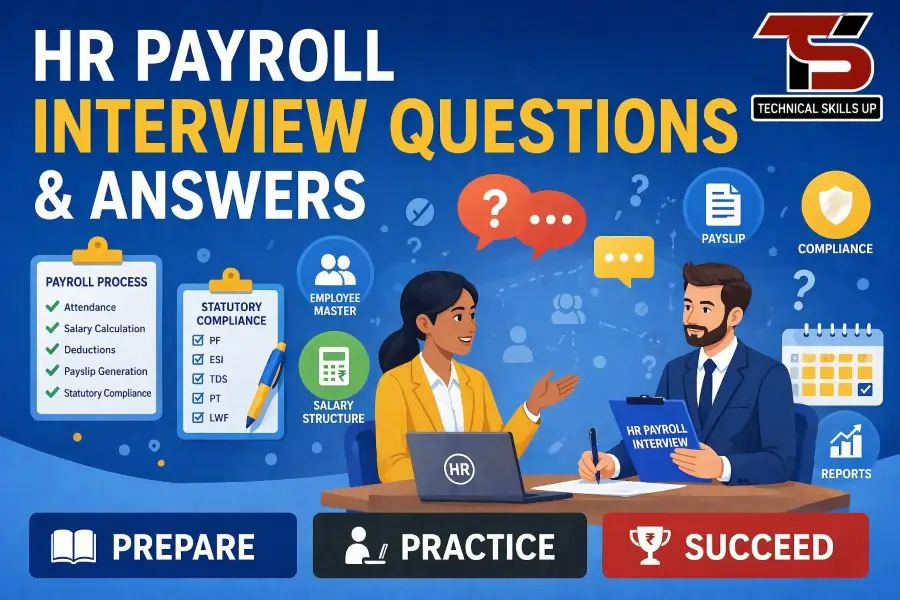
HR Payroll is a field where accuracy, confidentiality, and a thorough understanding of regulations are paramount. Technical Skills Up presents this collection of Top HR Payroll Interview Questions and Answers to help you make your interview preparation both easy and effective. The information provided here is grounded in industry experience, practical knowledge, and the latest HR trends—elements that serve to strengthen your preparation and boost your confidence. Explained in simple language, these questions and answers are beneficial for candidates at every level.
In today’s landscape, companies prioritize professionals who possess a strong command of payroll processes, compliance, and HR operations. This guide will assist you in covering everything from basic fundamentals to advanced topics, enabling you to perform exceptionally well in your interviews. Technical Skills Up aims to provide you with the right direction and reliable information, empowering you to advance further in your career.
Q1. What is HR Payroll?
Ans: HR Payroll is a process involving the management of employee salaries, taxes, PF (Provident Fund), ESI (Employee State Insurance), and other deductions. It involves coordination between both the HR and Accounts departments of a company.
Q2. What are the main steps in the Payroll Process?
Ans: The Payroll Process includes collecting employee data, verifying attendance, calculating salaries, applying deductions, and disbursing salaries.
Q3. What is Gross Salary?
Ans: Gross Salary is the total salary amount that includes the basic salary, HRA (House Rent Allowance), various allowances, and bonuses. Deductions are not yet subtracted from this amount.
Q4. What is Net Salary?
Ans: Net Salary is the actual amount credited to an employee’s bank account after all deductions—such as PF, ESI, taxes, etc.—have been subtracted.
Q5. What does CTC stand for?
Ans: CTC, or “Cost to Company,” represents the total annual expenditure incurred by a company on an employee, encompassing their salary, benefits, and allowances.
Q6. What is Basic Salary?
Ans: Basic Salary is the core component of an employee’s remuneration, serving as the base upon which PF, HRA, and other allowances are calculated.
Q7. What is HRA?
Ans: House Rent Allowance (HRA) is an allowance provided to employees to cover their rental expenses; it is eligible for tax exemptions subject to certain conditions.
Q8. What is PF?
Ans: The Provident Fund (PF) is a retirement savings scheme to which both the employee and the employer contribute.
Q9. What is ESI?
Ans: Employee State Insurance (ESI) is a social security scheme designed to provide medical benefits to employees.
Q10. What is TDS?
Ans: TDS stands for “Tax Deducted at Source,” a mechanism wherein tax is deducted directly from an employee’s salary before disbursement and subsequently deposited with the government.
Q11. What is Payroll Software?
Ans: Payroll Software is a digital tool that automates various payroll-related tasks, such as salary calculation, tax deduction, and reporting.
Q12. What is the role of Attendance in Payroll?
Ans: Salary calculations are based on an employee’s attendance records. Absences or late arrivals may result in salary deductions.
Q13. What is Leave Management?
Ans: Leave Management involves maintaining records of an employee’s leave (vacation/absences) and adjusting their salary accordingly.
Q14. What is a Bonus?
Ans: A bonus is an extra payment provided based on performance or during festive occasions.
Q15. What is Overtime?
Ans: Overtime is additional compensation received for working extra hours beyond regular working hours.
Q16. What is a Payroll Cycle?
Ans: A payroll cycle is the specific time period during which salaries are processed—for instance, on a monthly or weekly basis.
Q17. What is a Payslip?
Ans: A payslip is a document that contains comprehensive details regarding an employee’s salary breakdown, deductions, and net pay.
Q18. What is Statutory Compliance?
Ans: Statutory compliance involves adhering to government-mandated regulations, such as those concerning Provident Fund (PF), Employee State Insurance (ESI), and taxation.
Q19. What is Form 16?
Ans: Form 16 is a tax certificate issued by an employer, which is utilized by an employee for filing their income tax returns.
Q20. What is a Payroll Audit?
Ans: A payroll audit involves a systematic examination of the salary processing workflow to identify and rectify any errors or compliance-related issues.
Q21. What is Payroll Reconciliation?
Ans: Payroll reconciliation involves verifying payroll data to ensure the accuracy and correctness of all payments made.
Q22. How is a Salary Structure Formulated?
Ans: A salary structure is formulated by appropriately balancing components such as Basic Pay, HRA (House Rent Allowance), various allowances, and deductions, with the aim of minimizing tax liability while maximizing employee benefits.
Q23. What is Professional Tax?
Ans: Professional Tax is a levy imposed by the State Government, which is deducted directly from an employee’s salary.
Q24. What is Gratuity?
Ans: Gratuity is a monetary benefit awarded to an employee in recognition of their long-term service and tenure with a company.
Q25. What is a Full and Final Settlement?
Ans: Upon an employee’s resignation, a “Full and Final Settlement” involves clearing all pending dues, including their outstanding salary, leave encashment, and any other financial entitlements.
Q26. Why is an HR Payroll Online Course essential?
Ans: Pursuing an HR Payroll Online Course provides practical knowledge and enhances software skills, thereby increasing job opportunities.
Q27. What are the benefits of an HR Payroll Course in Noida?
Ans: Taking an HR Payroll Course in Noida offers industry exposure, hands-on experience with live projects, and placement support, all of which aid in career growth.
Q28. Why should one pursue an HR Payroll Course in Delhi?
Ans: An HR Payroll Course in Delhi features experienced trainers and provides corporate-level training, which boosts confidence during job interviews.
Q29. How can payroll errors be avoided?
Ans: Payroll errors can be minimized through regular audits, the use of specialized software, and thorough data verification.
Q30. Why is confidentiality important in payroll?
Ans: Employee salaries and personal data are sensitive; therefore, maintaining strict confidentiality is essential.
Q31. What is the role of an HR Payroll Executive?
Ans: An HR Payroll Executive handles salary processing, ensures regulatory compliance, and addresses employee queries.
Q32. How do you read a salary slip?
Ans: It is crucial to understand the components of a salary slip—including earnings, deductions, and net salary—in order to identify any potential errors.
Q33. How is Excel used in payroll?
Ans: Excel is utilized for salary calculations, data analysis, and the generation of various reports.
Q34. Why is payroll compliance important?
Ans: Failure to comply with regulations can expose a company to penalties and significant legal issues.
Q35. What is Payroll Outsourcing?
Ans: Payroll Outsourcing involves a company delegating its entire payroll processing function to an external agency.
Q36. Why is automation necessary in a payroll system?
Ans: Automation reduces errors and accelerates processing speeds, thereby saving valuable time.
Q37. What is the difference between HR and Payroll?
Ans: HR focuses on overall employee management, whereas Payroll specifically handles salaries and financial aspects.
Q38. What are the challenges in Payroll Management?
Ans: Maintaining accuracy, ensuring regulatory compliance, and safeguarding data security are among the major challenges in payroll management.
Q39. What are Payroll Reports?
Ans: Payroll Reports provide a summary of salaries, taxes, and deductions, serving as a valuable resource for management.
Q40. What are the career opportunities in HR Payroll?
Ans: Career opportunities in HR Payroll range from roles such as Executive and Analyst to Managerial positions; furthermore, both salary and career growth tend to increase with experience.
Conclusion:
Preparing for an HR Payroll interview in the right direction significantly boosts your chances of securing a job. Possessing the right knowledge, practical understanding, and confidence strengthens your career foundation. Learning on platforms like ‘Technical Skills Up’ equips you with industry-relevant skills, which prove invaluable during interviews. If you wish to build a strong foundation, an HR Payroll Online Course can prove to be an excellent option for you.
Proper training is essential for acquiring new skills. Through an HR Payroll Course in Noida, you can gain hands-on experience with real-time projects. This further enhances your understanding, enabling you to answer interview questions with confidence.
The right guidance and up-to-date knowledge play a pivotal role in career growth. An HR Payroll Course in Delhi prepares you in accordance with industry standards, allowing you to easily secure job opportunities and take your career to new heights.