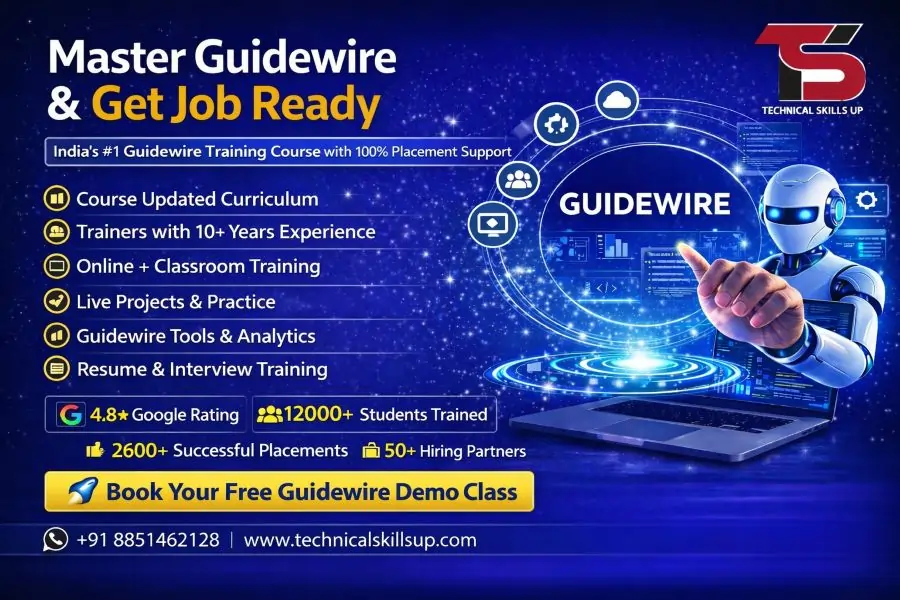
Guidewire Online Course with Placement

The Guidewire Online Course offered by Technical Skills Up is specifically designed for students and professionals who want to build a successful career in Guidewire. This course covers all important topics in detail, from basic concepts to advanced levels. During the training, you are given in-depth knowledge of Guidewire’s core architecture, its tools, and modern technologies used in the industry. You also get the opportunity to work on live projects, strengthening your practical experience. This course is designed by industry experts to help you understand the real requirements of the job market and gain better career opportunities.

Guidewire Online Course with Placement – Become a Certified Guidewire Developer

Are you looking to build a high-paying career in the insurance IT sector? Our Guidewire Online Course with Placement is designed to help you master Guidewire technology and secure a rewarding job in top MNCs. With industry-expert trainers, real-time projects, and 100% placement assistance, this Guidewire Training with Placement program prepares you to become a job-ready Guidewire developer.

Guidewire is one of the most in-demand platforms in the insurance domain. Companies across the globe use Guidewire Software solutions like PolicyCenter, ClaimCenter, and BillingCenter to manage their insurance operations efficiently. By enrolling in our Guidewire Certification Course, you gain practical exposure and hands-on experience that employers are actively seeking.

What is Guidewire?

Guidewire is a leading software platform used by property and casualty (P&C) insurance companies to manage policy administration, claims processing, and billing systems. It provides a robust and scalable architecture that helps insurers streamline operations and improve customer service.

The three core products of Guidewire include:

  • Guidewire PolicyCenter
  • Guidewire ClaimCenter
  • Guidewire BillingCenter

Our Guidewire Developer Course covers all these modules in detail, ensuring you understand both technical and functional aspects of the platform.

Why Choose Our Guidewire Online Course with Placement?

Choosing the right training institute is crucial for your career growth. Our Guidewire Online Course with Placement stands out because of:

1. Industry-Expert Trainers

Learn from professionals who have real-time experience working on Guidewire implementation projects.

2. Live Instructor-Led Training

Interactive online sessions where you can ask questions and clarify doubts instantly.

3. 100% Practical Training

We focus on hands-on learning through real-time case studies and live projects.

4. Placement Assistance

Our Guidewire Training with Placement program includes resume preparation, mock interviews, and job referrals.

5. Flexible Timings

Weekend and weekday batches available for students and working professionals.

Skills You Will Gain

After completing our Guidewire Online Course, you will be able to:

  • Configure Guidewire applications
  • Customize UI using PCF
  • Work with Gosu programming language
  • Integrate Guidewire with third-party systems
  • Handle real-time insurance projects

These skills make you a strong candidate for Guidewire developer roles.

Career Opportunities After Guidewire Training with Placement

The demand for Guidewire professionals is rapidly increasing in India and abroad. After completing the Guidewire Developer Course, you can apply for roles such as:

  • Guidewire Developer
  • Guidewire Consultant
  • PolicyCenter Developer
  • ClaimCenter Developer
  • BillingCenter Consultant
  • Guidewire Support Engineer

Top IT companies and insurance firms hire trained Guidewire professionals for implementation and support projects.

Salary of a Guidewire Developer in India

One of the biggest reasons students enroll in our Guidewire Online Course with Placement is the attractive salary package.

  • Freshers: ₹4–7 LPA
  • 2–5 Years Experience: ₹8–15 LPA
  • Senior Professionals: ₹18+ LPA

With proper certification and project experience, you can secure a high-paying job quickly.

Who Should Enroll in Guidewire Certification Course?

This Guidewire Training with Placement is ideal for:

  • B.Tech / BCA / MCA Graduates
  • Java Developers
  • Software Engineers
  • Insurance Domain Professionals
  • Freshers Looking for IT Jobs

Even if you are new to Guidewire, our structured training approach makes learning easy.

100% Placement Assistance

Our placement team works closely with students to ensure job readiness. The placement support includes:

  • Resume Building
  • LinkedIn Profile Optimization
  • Mock Interviews
  • HR Interview Preparation
  • Job Referrals
  • Internship Opportunities

We prepare you technically and professionally to crack interviews confidently.

Why Guidewire is a Great Career Option?

Guidewire is a niche technology with less competition compared to Java or Python. Since it is specialized in the insurance domain, companies prefer certified professionals.

Benefits of learning Guidewire:

  • High Demand in Insurance IT
  • Limited Skilled Professionals
  • Excellent Salary Packages
  • Long-Term Career Growth
  • Global Opportunities

By enrolling in our Guidewire Online Course with Placement, you enter a specialized and growing field.

Real-Time Project Experience

We believe in learning by doing. During the Guidewire Developer Course, students work on live projects covering:

  • Policy creation
  • Claims processing
  • Billing setup
  • Integration scenarios

This practical exposure helps you gain confidence and stand out during interviews.

Online Training Benefits

Our Guidewire Training with Placement is delivered online, allowing you to learn from anywhere.

Advantages:

  • Live Interactive Sessions
  • Recorded Videos for Revision
  • Study Materials & Assignments
  • Doubt-Clearing Sessions
  • Flexible Batch Timings

Working professionals can easily upgrade their skills without leaving their jobs.

Certification & Project Experience Letter

After completing the Guidewire Certification Course, you will receive:

  • Course Completion Certificate
  • Project Experience Certificate

These certifications strengthen your resume and improve your job prospects.

Enroll in Guidewire Online Course with Placement Today

If you are serious about building a career in the insurance IT sector, this is the right time to enroll in our Guidewire Online Course with Placement. With expert trainers, practical exposure, and dedicated placement support, you can transform your career and secure a high-paying job.

Frequently Asked Questions (FAQ)

Q1. What is Guidewire?

Ans: Guidewire is an insurance software platform used for policy, claim, and billing management.

Q2. What is taught in the Guidewire Online Course?

Ans: This course covers Guidewire PolicyCenter, ClaimCenter, BillingCenter, Configuration, and Integration.

Q3. Is this course for beginners?

Ans: Yes, this course is suitable for both freshers and IT professionals.

Q4. What is the duration of the course?

Ans: The course typically lasts 2 to 3 months, including practical training.

Q5. Does the course offer live projects?

Ans: Yes, students get the opportunity to work on real-time projects and case studies.

Q6. Is placement support available?

Ans: Yes, 100% placement assistance, interview preparation, and resume building support are provided.

Q7. What job roles can be found after learning Guidewire?

Ans: Job profiles such as Guidewire Developer, Configuration Specialist, and Business Analyst are available.

Q8. What are the Guidewire course fees?

Ans: The fees depend on the institute and the training mode (online/offline).

Q9. Is programming knowledge required for this course?

Ans: Knowledge of basic Java and SQL is beneficial.

Q10. What is the career scope at Guidewire?

Ans: Guidewire is in high demand in the insurance domain, so it offers career opportunities with good packages.
Leave a Reply

Your email address will not be published. Required fields are marked *

Related Post

Databricks Course

Databricks Online Course in India with Placement

Modern businesses generate massive amounts of data every day. Organizations need professionals who can manage, process, analyze, and transform this data into meaningful insights. Strong data platforms have become essential for companies that want to improve decision-making, automate operations, and drive innovation. Learning a Databricks Course helps learners gain practical knowledge of one of the most powerful unified analytics platforms used across industries today. Technical Skills Up offers industry-focused learning designed for students, graduates, software professionals, data analysts, and IT enthusiasts who want to build expertise in cloud-based data engineering and analytics. The program combines practical projects, expert guidance, hands-on exercises, and real-world use cases to help learners understand how modern data platforms work in enterprise environments. Growing adoption of cloud technologies has created a strong demand for professionals who can work with large-scale data processing systems. Employers seek candidates who understand modern data architectures, big data frameworks, machine learning workflows, and cloud analytics solutions. This training program provides a structured learning path that helps learners develop these valuable skills while preparing for industry-recognized certifications and career opportunities. Databricks Training Designed for Real Industry Needs Organizations across finance, healthcare, retail, manufacturing, telecommunications, and e-commerce rely on modern data platforms to process large datasets efficiently. Businesses require professionals who understand how to build data pipelines, manage analytics workloads, and support machine learning projects. Databricks Training at Technical Skills Up focuses on practical implementation rather than theoretical concepts alone. Learners gain exposure to industry-standard practices that are commonly used in enterprise environments. Key highlights of the program include: Instructor-led live sessions Hands-on practical exercises Real-world projects Cloud-based learning environment Career-oriented curriculum Interview preparation support Certification guidance Placement assistance Every module is designed to help learners develop confidence while working on real data engineering and analytics scenarios. Course Overview A strong foundation is essential for success in modern data engineering roles. The curriculum begins with fundamental concepts and gradually progresses toward advanced topics used in enterprise projects. Learning modules cover: Introduction to Modern Data Platforms Understanding the evolution of data management systems helps learners appreciate why organizations are moving toward cloud-based architectures. Topics include: Data ecosystem overview Traditional data warehouses Big data concepts Cloud computing fundamentals Data lake architecture Analytics workflows Understanding Databricks Architecture Comprehensive knowledge of platform architecture helps learners understand how different components work together. Key concepts include: Workspace management Clusters and compute resources Notebooks Job scheduling Security models Workspace administration Data Processing Fundamentals Modern organizations process huge volumes of structured and unstructured data. Learning efficient processing techniques is essential for successful project delivery. Coverage includes: Batch processing Stream processing Data ingestion Data transformation Data quality management Data validation techniques Why Databricks Has Become Important in Industry Businesses want faster access to insights and more efficient ways to handle growing data volumes. Traditional systems often struggle with scalability, performance, and operational complexity. Modern cloud-based platforms solve these challenges by offering: Faster data processing Improved collaboration Unified analytics environment Better scalability Simplified infrastructure management Advanced machine learning capabilities Many global organizations use Databricks to support their digital transformation initiatives. Data engineers, analysts, and machine learning professionals increasingly rely on this platform to build and manage complex analytics workflows. Growing industry adoption has created significant demand for professionals who possess practical expertise in cloud-based analytics platforms. Skills Covered in the Program Practical skill development remains a major focus of this training program. Every module helps learners gain hands-on experience that can be applied directly in workplace environments. Data Engineering Skills Learners develop expertise in: Data ingestion techniques ETL pipeline development Data transformation Data orchestration Data quality management Workflow automation Analytics Skills Practical analytics knowledge includes: Data exploration Business intelligence concepts Dashboard preparation Reporting workflows Data visualization fundamentals Insight generation Cloud Computing Skills Cloud technologies continue to dominate modern enterprise environments. Important cloud-related concepts include: Cloud architecture Resource management Cost optimization Security implementation Performance monitoring Infrastructure scaling Machine Learning Foundations Understanding machine learning workflows provides additional career opportunities. Topics covered include: Machine learning lifecycle Feature engineering Model training Model evaluation Experiment tracking Model deployment basics Databricks Classes with Practical Learning Experience Practical implementation plays a critical role in mastering any technical skill. Reading concepts alone cannot prepare learners for real-world challenges. Databricks Classes at Technical Skills Up focus heavily on hands-on learning through guided exercises and project-based assignments. Practical activities include: Creating clusters Working with notebooks Building data pipelines Processing large datasets Managing cloud resources Implementing analytics workflows Every session is structured to help learners gain confidence through continuous practice and instructor support. Tools and Technologies Covered Modern data engineering projects involve multiple technologies working together. Industry professionals are expected to understand how these tools integrate within enterprise ecosystems. The curriculum includes exposure to several important technologies. Apache Spark Apache Spark serves as a powerful distributed processing engine used for large-scale data processing. Topics include: Spark architecture Spark transformations Spark actions Performance optimization Distributed computing concepts Python Programming Python remains one of the most popular languages in data engineering and analytics. Coverage includes: Python fundamentals Data manipulation Functions and modules Data processing workflows Automation techniques SQL Strong SQL skills remain essential for data professionals. Learners practice: Query writing Joins and aggregations Data filtering Data transformations Performance optimization Delta Lake Reliable data storage and management are critical for analytics success. Key learning areas include: Delta architecture Data versioning Data reliability Transaction management Performance improvements Cloud Platforms Industry projects often involve cloud infrastructure. Exposure includes: Cloud storage concepts Resource provisioning Security best practices Analytics environments Data integration workflows Databricks Certification Course for Career Growth Professional certifications help validate technical skills and improve credibility in competitive job markets. Employers often prefer candidates who demonstrate structured learning and practical expertise. A Databricks Certification Course provides preparation guidance that helps learners understand certification objectives and exam expectations. Benefits of certification preparation include: Stronger professional profile Better interview opportunities Increased employer confidence Improved technical validation Enhanced career prospects Training modules align with industry requirements to help learners prepare effectively for certification pathways. Career Opportunities After Completing the Program Data-driven

Manual Testing Course

Manual Testing Course in Noida with Placement

Manual testing remains one of the most important skills in the software industry. Every application, website, or mobile app needs to be tested before it reaches users. A strong foundation in manual testing helps you enter the IT field without requiring deep coding knowledge. Technical Skills Up offers a practical and industry-focused Manual Testing Course in Noida designed for beginners as well as working professionals. Why Choose Manual Testing as a Career? Software testing plays a key role in delivering quality products. Companies look for skilled testers who can identify bugs and improve user experience. Manual testing stands as the first step in the testing domain and builds the base for automation and advanced testing tools. A career in manual testing offers: Entry into the IT industry without programming expertise Strong demand across startups and MNCs Opportunities to grow into automation testing, QA lead, or test manager roles Stable and long-term career growth Technical Skills Up focuses on building real skills so that students can confidently face interviews and perform well in real projects. Manual Testing Training in Noida – Course Overview Technical Skills Up provides structured and practical Manual Testing Training in Noida that covers all essential concepts from basic to advanced level. Training follows a step-by-step approach so that every student can understand and apply the concepts easily. Key Highlights of the Course Beginner-friendly modules Real-time project practice Industry-standard tools and techniques Resume and interview preparation Placement support Every topic includes practical examples to help students understand real-world testing scenarios. What You Will Learn in Manual Testing Classes in Noida Training at Technical Skills Up focuses on practical knowledge rather than just theory. Students gain hands-on experience in testing applications and writing test cases. Core Concepts Covered 1. Introduction to Software Testing Understanding the basics of software testing helps you build a strong foundation. Training includes software development life cycle (SDLC) and software testing life cycle (STLC). 2. Types of Testing Manual testing includes various types such as: Functional Testing Non-Functional Testing Regression Testing Smoke Testing Sanity Testing User Acceptance Testing Clear explanations and real examples help students understand when and how to use each testing type. 3. Test Case Writing Test cases form the backbone of manual testing. Students learn how to write effective test cases, test scenarios, and test data. 4. Bug Reporting Bug reporting skills play a major role in testing jobs. Training includes how to identify, document, and track defects using proper formats. 5. SDLC & STLC Models Understanding different models like Waterfall, Agile, and V-Model helps students work in real projects confidently. 6. Agile Methodology Modern companies follow Agile practices. Training includes Scrum concepts, sprint planning, and daily stand-up meetings. 7. Test Management Tools Students get exposure to tools used in the industry to manage test cases and bugs. Manual Testing Training Institute in Noida – Why Technical Skills Up? Choosing the right institute plays a major role in your career. Technical Skills Up stands out as a reliable Manual Testing Training Institute in Noida because of its practical approach and industry-oriented training. 1. Experienced Trainers Training is delivered by professionals who have real industry experience. Trainers share practical knowledge and real project scenarios. 2. Practical Learning Approach Focus remains on hands-on practice instead of only theory. Students work on live projects to gain real experience. 3. Updated Course Content Course syllabus is designed based on current industry requirements. Students learn skills that companies actually need. 4. Small Batch Size Small batches ensure personal attention for every student. Trainers solve doubts individually. 5. Flexible Timings Classes are available for students, job seekers, and working professionals. Flexible schedules help manage time easily. 6. Placement Assistance Technical Skills Up provides support in resume building, interview preparation, and job referrals. Real-Time Project Training Real-time projects help students understand how testing works in actual companies. Technical Skills Up includes project-based training where students perform: Requirement analysis Test case creation Test execution Bug reporting Test summary reports This practical exposure builds confidence and improves job readiness. Who Can Join This Course? Manual testing course suits a wide range of learners. No coding background is required to start. Ideal Candidates Fresh graduates (B.Tech, BCA, B.Sc, etc.) Non-IT students who want to enter IT Working professionals looking for a career switch Anyone interested in software testing Simple teaching methods make learning easy for beginners. Career Opportunities After Manual Testing Course Completing the Manual Testing Course in Noida opens multiple career paths in the IT industry. Job Roles You Can Apply For Software Tester QA Tester Manual Test Engineer Quality Analyst Test Engineer Experience and skills help you move into advanced roles like Automation Tester or QA Lead. Salary Expectations in Manual Testing Salary depends on skills, knowledge, and experience. Freshers can start with a decent package, and growth becomes faster with experience. Average Salary Range Freshers: ₹2.5 LPA to ₹4 LPA Experienced: ₹5 LPA to ₹10 LPA+ Strong practical knowledge increases chances of better salary offers. Tools Covered in Manual Testing Classes in Noida Manual testing does not require heavy coding, but tools play an important role in improving efficiency. Common Tools Included Bug Tracking Tools Test Case Management Tools Agile Tools Students learn how to use these tools in real project environments. Importance of Manual Testing in Industry Automation testing continues to grow, but manual testing remains essential. Every project starts with manual testing to ensure basic functionality. Manual testing helps in: Understanding application behavior Identifying usability issues Performing exploratory testing Validating user experience Companies still rely on manual testers for quality assurance. Step-by-Step Learning Approach Technical Skills Up follows a simple and effective learning process: Basics of software testing Understanding testing types Writing test cases Practicing on real applications Learning bug tracking Working on live projects Preparing for interviews Each step builds confidence and improves skills gradually. Placement Support at Technical Skills Up Getting a job after training remains a major goal for students. Technical Skills Up provides complete placement support. Placement Assistance Includes Resume creation Interview

SAS Course

SAS Course in Delhi | SAS Training in Delhi

Data-driven decision-making has become a key part of modern business operations. Organizations across healthcare, banking, insurance, retail, pharmaceuticals, IT, and government sectors rely on analytics to understand trends, improve performance, and make informed decisions. Strong analytical skills combined with industry-recognized tools can help professionals secure rewarding career opportunities in this growing field. Technical Skills Up offers a comprehensive SAS Course in Delhi designed for students, graduates, working professionals, and career changers who want to develop practical analytics skills and gain confidence in handling real-world data. Learning analytics today goes beyond understanding theory. Employers prefer candidates who can work with data, create reports, perform statistical analysis, and generate business insights. This program focuses on practical learning, hands-on projects, and industry-oriented training that helps learners develop job-ready skills. Every module is structured to make complex concepts easy to understand while providing valuable exposure to real business scenarios. SAS Course Overview SAS is one of the most trusted analytics platforms used by organizations around the world. It helps professionals manage, analyze, and visualize large volumes of data efficiently. Companies use SAS for predictive analytics, reporting, business intelligence, risk management, forecasting, and statistical modeling. Technical Skills Up has designed this course to provide a strong foundation in SAS programming and data analytics. Training covers fundamental concepts as well as advanced techniques that employers actively seek. Learners gain practical experience through assignments, case studies, projects, and guided exercises. The curriculum is suitable for: Fresh graduates College students Working professionals Data analysts Business analysts IT professionals Healthcare professionals Finance professionals Researchers Career switchers Course content is regularly updated to align with industry requirements and emerging market trends. SAS Training in Delhi for Practical Learning Practical exposure plays a major role in building technical confidence. Classroom theory alone cannot prepare learners for real-world challenges. Technical Skills Up emphasizes hands-on training through industry-focused exercises and project-based learning. Every learner receives opportunities to: Work with real datasets Create analytical reports Perform data cleaning Build statistical models Generate business insights Develop programming skills Understand data visualization concepts Practice problem-solving techniques Guidance from experienced trainers helps students understand how SAS is used in actual business environments. Practical sessions ensure learners can apply concepts effectively after completing the course. Importance of SAS in Modern Industries Data continues to grow at an unprecedented rate. Organizations collect information from customers, operations, marketing campaigns, financial transactions, and digital platforms. Managing and analyzing this information requires powerful tools and skilled professionals. SAS remains highly valued because it offers: Advanced analytics capabilities Reliable data management Strong reporting features Statistical analysis tools Business intelligence functions Predictive modeling capabilities Enterprise-level scalability Industries that heavily depend on SAS include: Healthcare and Pharmaceuticals Healthcare organizations use SAS to analyze patient data, clinical trials, treatment effectiveness, and healthcare trends. Pharmaceutical companies depend on SAS for research and regulatory reporting. Banking and Financial Services Financial institutions utilize SAS for fraud detection, risk assessment, customer segmentation, and financial forecasting. Insurance Sector Insurance companies analyze customer behavior, claim patterns, and risk factors using SAS analytics solutions. Retail and E-commerce Retail businesses leverage data analytics to understand customer preferences, optimize inventory, and improve sales strategies. Government Organizations Public sector departments use analytics for planning, policy development, resource allocation, and performance measurement. Growing adoption across industries continues to create opportunities for trained SAS professionals. SAS Programming Course in Delhi with Industry-Focused Curriculum Programming skills form the foundation of successful analytics careers. Strong knowledge of SAS programming helps professionals manipulate data, automate tasks, and generate meaningful insights. Training modules include: Introduction to SAS Learners begin by understanding the SAS environment, architecture, and workflow. Foundational concepts help students develop confidence before moving to advanced topics. Key topics include: SAS basics Interface navigation Data processing concepts SAS libraries Data structures Project organization Data Management Concepts Organizations often work with large datasets from multiple sources. Data management skills help professionals organize and prepare information for analysis. Topics covered include: Importing data Exporting data Data cleaning Data transformation Data validation Data integration Data formatting SAS Programming Fundamentals Programming concepts help learners automate processes and perform complex data operations efficiently. Training includes: Variables and datasets Conditional statements Loops and iterations Functions and procedures Data step programming Error handling Code optimization Statistical Analysis Analytical professionals must understand statistical methods to generate accurate business insights. Coverage includes: Descriptive statistics Probability concepts Hypothesis testing Regression analysis Correlation analysis Statistical reporting Reporting and Visualization Decision-makers require clear reports and visual presentations. Reporting skills help professionals communicate findings effectively. Topics include: Report generation Summary reports Dashboard concepts Data visualization Charts and graphs Presentation techniques Skills Covered During the Program Technical knowledge alone does not guarantee career success. Employers look for professionals who combine technical expertise with analytical thinking and business understanding. Learners develop the following skills: Technical Skills SAS programming Data management Data transformation Data analysis Statistical modeling Report generation Data visualization Database concepts Analytical Skills Problem-solving Data interpretation Pattern recognition Trend analysis Business intelligence Decision support Professional Skills Communication Project execution Documentation Presentation skills Team collaboration Business understanding Balanced skill development prepares learners for diverse industry roles. Tools and Technologies Covered Modern analytics projects often require interaction with multiple technologies. Technical Skills Up introduces learners to tools commonly used alongside SAS. SAS Platform Components Students learn important SAS modules such as: Base SAS SAS Programming SAS Procedures SAS Macros SAS Reporting Tools SAS Analytics Features Database Concepts Exposure to database fundamentals helps learners work efficiently with enterprise data systems. Areas covered include: SQL basics Data extraction Query writing Data filtering Data joins Excel Integration Business environments frequently use Excel alongside analytics platforms. Training includes: Data import techniques Report exports Spreadsheet integration Data preparation workflows Business Analytics Concepts Understanding business objectives improves analytical decision-making. Topics include: Business metrics KPI analysis Data-driven strategies Performance measurement SAS Certification Course in Delhi for Career Growth Professional certification demonstrates technical competence and commitment to continuous learning. Employers often prefer candidates who have completed structured training programs from reputable institutions. Technical Skills Up provides comprehensive support to help learners prepare for certification-related