Best SAP SD Course in Noida with Placement

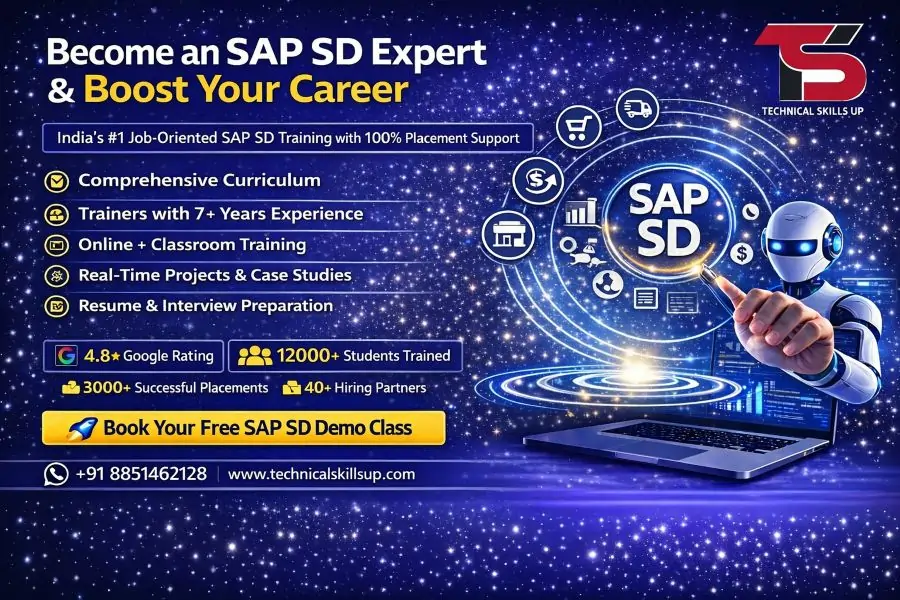
If you are looking to build a strong career in SAP Sales and Distribution, enrolling in a professional SAP SD Course in Noida can help you gain the skills required to work in top MNCs and IT companies. SAP SD is one of the most in-demand functional modules in SAP, widely used by organizations for managing sales, customer distribution, billing, and order processing.

This comprehensive SAP SD training program is designed for beginners, working professionals, and graduates who want to start or switch their career into SAP. The course focuses on real-time project-based learning, practical SAP server access, and industry-oriented training to ensure learners gain hands-on experience.

With expert trainers, structured modules, and placement support, this SAP SD course helps you understand business processes and implement them using SAP S/4HANA environment.

Table of Contents

What is SAP SD?

SAP SD (Sales and Distribution) is a core functional module in SAP ERP that manages sales processes including quotation, sales order, delivery, billing, and customer management. It integrates with other SAP modules such as MM, FICO, and PP to provide a complete business solution.

SAP SD is widely used in industries such as:

  • Manufacturing
  • Retail
  • E-commerce
  • Logistics
  • Pharmaceuticals
  • Automobile
  • FMCG
  • IT Services

Because every company needs a strong sales and distribution system, SAP SD professionals are always in high demand.

Why Choose SAP SD Training?

SAP SD is ideal for candidates who want to enter functional consulting without programming. This module focuses on business logic and process implementation rather than coding.

Key benefits of learning SAP SD:

  • High demand in IT and MNC companies
  • No coding required
  • Good salary packages
  • Multiple job roles available
  • Fast career growth
  • Global opportunities
  • Easy to learn for freshers

This course is structured to help learners understand both theoretical and practical aspects of SAP SD.

SAP SD Course Highlights

This training program includes everything needed to become a SAP SD consultant:

  • Live Instructor-Led Training
  • Real-Time Project Exposure
  • SAP Server Access
  • End-to-End SAP SD Configuration
  • Case Study Based Learning
  • Resume Building Support
  • Mock Interview Preparation
  • Placement Assistance
  • Recorded Sessions
  • Certification Guidance

The course is designed according to current industry standards and SAP S/4HANA environment.

SAP SD Course Modules

Introduction to SAP & ERP

  • What is ERP
  • Introduction to SAP
  • SAP Architecture
  • SAP Modules Overview
  • SAP GUI Navigation
  • SAP Project Landscape

Enterprise Structure in SAP SD

  • Company Code
  • Sales Organization
  • Distribution Channel
  • Division
  • Sales Area
  • Plant Assignment

Master Data in SAP SD

  • Customer Master Data
  • Material Master
  • Customer Material Info Record
  • Output Master Data
  • Business Partner Concept

Sales Document Configuration

  • Inquiry
  • Quotation
  • Sales Order
  • Sales Document Types
  • Item Categories
  • Schedule Line Categories

Pricing and Condition Technique

  • Pricing Procedure
  • Condition Tables
  • Access Sequence
  • Condition Types
  • Pricing Determination
  • Discounts & Surcharges

Availability Check

  • ATP Check
  • Transfer of Requirements
  • Availability Control
  • Backorder Processing

Delivery Processing

  • Outbound Delivery
  • Picking
  • Packing
  • Post Goods Issue
  • Delivery Document Configuration

Billing Process

  • Billing Document
  • Invoice
  • Credit Memo
  • Debit Memo
  • Proforma Invoice
  • Billing Types Configuration

Credit Management

  • Credit Control Area
  • Credit Limit
  • Risk Category
  • Credit Check

Text Determination

  • Header Text
  • Item Text
  • Text Procedure

Output Determination

  • Output Types
  • Print Configuration
  • Email Output

Partner Determination

  • Partner Functions
  • Partner Procedure

Account Determination

  • Revenue Account Determination
  • FI Integration

Integration with Other Modules

  • SD with MM
  • SD with FICO
  • SD with PP

SAP SD End-to-End Cycle

  • Inquiry to Cash Process
  • Order to Cash Scenario
  • Real-Time Project

Who Can Join SAP SD Course?

This course is suitable for:

  • B.Com Students
  • BBA / MBA Students
  • Commerce Graduates
  • Marketing Professionals
  • Sales Executives
  • Supply Chain Professionals
  • Freshers
  • Working Professionals
  • ERP Users
  • Career Switchers

Even candidates without technical background can easily learn SAP SD.

SAP SD Training Methodology

The training methodology focuses on practical learning. The course includes:

Instructor-Led Live Sessions

Classes are conducted by experienced SAP consultants who explain concepts with real-time scenarios.

Practical Server Access

Students get SAP server access to practice configurations and transactions.

Real-Time Case Studies

Industry-based examples help students understand business flow.

Assignments and Practice

Daily assignments improve learning and confidence.

Interview Preparation

Students get commonly asked SAP SD interview questions.

Resume Building

Professional resume creation for SAP jobs.

Placement Assistance

Job support and interview scheduling.

SAP SD Training Features

  • Small Batch Size
  • Flexible Batch Timings
  • Weekday & Weekend Batches
  • Online & Classroom Training
  • Recorded Sessions
  • Lifetime Access to Material
  • Hands-on Practice
  • Certification Support
  • Job Assistance

SAP SD Course Duration

The course duration typically depends on batch type:

  • Fast Track: 4 Weeks
  • Regular Batch: 6 Weeks
  • Weekend Batch: 8 Weeks

Each session includes theory + practical implementation.

SAP SD Career Opportunities

After completing SAP SD training, you can apply for roles such as:

  • SAP SD Consultant
  • SAP SD End User
  • SAP SD Support Consultant
  • SAP Functional Consultant
  • Order Management Executive
  • Sales Operations Analyst
  • SAP Business Analyst
  • SAP Implementation Consultant

Top SAP SD consultants are required in almost every industry.

SAP SD Salary in India

SAP SD salary depends on experience:

Freshers:
3 LPA – 5 LPA

1–3 Years Experience:
5 LPA – 9 LPA

3–5 Years Experience:
8 LPA – 15 LPA

Experienced Consultants:
15 LPA – 25 LPA

With real-time experience, salary increases rapidly.

Why Choose SAP SD Training in Noida?

Noida has become a major IT hub with many MNC companies and SAP implementation partners. Learning SAP SD here provides better job exposure and networking opportunities.

Advantages include:

  • IT Company Exposure
  • Better Placement Opportunities
  • Industry Trainers
  • Corporate Training Environment
  • Networking Opportunities
  • Job Openings in Nearby Cities

This makes SAP SD Training in Noida a smart choice for career growth.

Practical Learning Approach

Students learn complete end-to-end business process:

Customer Inquiry → Quotation → Sales Order → Delivery → Billing → Payment

This complete order-to-cash cycle helps learners understand real SAP project scenarios.

SAP SD Certification

After completing the training, students receive:

  • Course Completion Certificate
  • Project Experience Certificate
  • Interview Preparation Material

Students can also prepare for SAP global certification.

SAP SD Placement Support

Placement assistance includes:

  • Resume Preparation
  • Interview Questions
  • Mock Interviews
  • Job Referrals
  • LinkedIn Profile Optimization
  • HR Interview Preparation

This helps students get job-ready.

Learning Outcomes

After completing the course, you will be able to:

  • Understand SAP SD business process
  • Configure enterprise structure
  • Create customer and material master
  • Configure pricing procedure
  • Process sales orders
  • Create deliveries and billing
  • Configure account determination
  • Implement end-to-end SAP SD cycle
  • Work on real-time SAP projects

Industry Demand for SAP SD

SAP SD professionals are required in:

  • IT Companies
  • Manufacturing Companies
  • Retail Organizations
  • Logistics Companies
  • Pharma Companies
  • Automobile Sector
  • E-commerce Companies

Because sales and distribution is core to every business, SAP SD demand remains high.

Training Mode Available

Students can choose:

  • Online Training
  • Classroom Training
  • Weekend Batches
  • Corporate Training
  • Fast Track Training

Flexible learning options available.

Best SAP SD Learning Path

Step 1: Learn SAP Basics
Step 2: Understand SD Configuration
Step 3: Practice on SAP Server
Step 4: Work on Real-Time Project
Step 5: Prepare Resume
Step 6: Attend Mock Interviews
Step 7: Apply for Jobs

This structured approach helps learners become job-ready.

SAP SD Classes in Noida – Practical Based Training

The training program focuses on practical implementation rather than just theory. Students work on real SAP scenarios and understand actual business processes used in companies.

Hands-on topics include:

  • Sales Order Creation
  • Delivery Processing
  • Billing Configuration
  • Pricing Procedure Setup
  • Credit Management
  • Output Determination
  • Partner Determination

This makes SAP SD Classes in Noida ideal for beginners and professionals.

SAP SD Training Institute in Noida – Key Benefits

Choosing a professional training institute provides:

  • Experienced SAP Trainers
  • Real-Time Project Training
  • Job-Oriented Curriculum
  • Placement Support
  • Practical Sessions
  • Industry Exposure
  • Interview Preparation

A structured learning environment helps students gain confidence and skills.

SAP SD Real-Time Project

Students work on a real-time project covering:

  • Company Setup
  • Sales Area Configuration
  • Customer Creation
  • Pricing Configuration
  • Order Processing
  • Delivery Setup
  • Billing Configuration
  • End-to-End Testing

This project experience helps in interviews.

Tools Covered in SAP SD Course

  • SAP GUI
  • SAP S/4HANA
  • SAP SD Module
  • Pricing Configuration
  • Delivery Processing
  • Billing Process
  • Master Data Configuration

Start Your SAP SD Career Today

SAP SD is one of the best career options for freshers and working professionals. With proper training, practical knowledge, and placement support, you can easily enter the SAP domain.

This job-oriented training program helps you gain:

  • Real SAP knowledge
  • Practical experience
  • Interview preparation
  • Certification guidance
  • Placement support

Enroll now and become a certified SAP SD professional with industry-ready skills.

1. SAP Related Courses in Noida

2. SAP Related Courses in Delhi

3. SAP Related Courses in India

FAQs:

Q1. What is SAP SD?

Ans: SAP SD (Sales and Distribution) is an ERP module used to manage sales, billing, order processing, and distribution.

Q2. Who is the SAP SD course best suited for?

Ans: This course is ideal for the following individuals:

  • MBA / BBA Students
  • Those with a Commerce background
  • Sales / Marketing Professionals
  • Freshers
  • Individuals aspiring to build a career in ERP
Q3. What is the duration of the SAP SD course?

Ans: The SAP SD course is typically completed within 6 to 8 weeks, including practical training.

Q4. Is coding required for the SAP SD course?

Ans: No, coding is not required to learn SAP SD. It is a functional module.

Q5. What topics are covered in the SAP SD course?

Ans: Key Topics coverd:

  • SAP Introduction
  • Enterprise Structure
  • Master Data
  • Sales Order Process
  • Pricing Procedure
  • Delivery & Billing
  • Credit Management
  • Real-Time Project
Q6. What are the job opportunities after completing the SAP SD course?

Ans: After completing the course, you can apply for the following roles:

  • SAP SD Consultant
  • SAP Functional Consultant
  • SAP End User
  • SAP Support Consultant
Q7. What is the fee for the SAP SD course?

Ans: The fee for the SAP SD course varies depending on the institute and the mode of training. Technical Skills Up offers an affordable fee structure.

Q8. Does the SAP SD course include placement support?

Ans: Yes, upon completion of the course, assistance is provided for resume building, interview preparation, and job placement.

Q9. Is the SAP SD course available online or offline?

Ans: Yes, this course is available in both online and offline modes.

Q10. What are the eligibility criteria for the SAP SD course?

Ans: Graduates or final-year students are eligible to pursue the SAP SD course. There is no requirement for a specific academic stream.

Q11. How long does it take to learn SAP SD?

Ans: It takes approximately 1.5 to 2 months to learn from a basic to an advanced level.

Q12. Does the SAP SD course include live projects?

Ans: Yes, during the training, students work on real-time projects and practical scenarios.

Q13. What is the expected salary after completing the SAP SD course?

Ans: Freshers can initially expect a salary ranging from ₹3 LPA to ₹6 LPA, which increases with experience.

Q14. What is the difference between SAP SD and SAP MM?

Ans: SAP SD handles Sales and Distribution, whereas SAP MM relates to Purchasing and Inventory Management.

Q15. What are the benefits of joining an SAP SD course?

Ans: Key Benefits:

  • High-demand skill
  • Non-coding career path
  • Attractive salary packages
  • Job opportunities in MNCs
  • Growth within the ERP domain

Leave a Reply

Your email address will not be published. Required fields are marked *

Related Post

SQL Server Course

SQL Server Course in Noida with Placement

Technology continues to transform the way businesses manage and store information. Organizations rely on secure and efficient database systems to handle customer records, financial data, inventory details, and operational processes. Strong database management skills have become highly valuable for both fresh graduates and working professionals. Technical Skills Up offers a comprehensive SQL Server Course in Noida designed to help learners understand database concepts, query writing, database administration, reporting, and real-world implementation. Practical learning, expert guidance, and industry-focused training make this program suitable for anyone looking to build a successful career in database management and development. Build a Strong Foundation in Database Management Modern businesses generate huge volumes of data every day. Proper management of this data helps organizations improve decision-making, enhance customer experience, and maintain operational efficiency. Database professionals play an important role in ensuring that information remains secure, organized, and easily accessible. Technical Skills Up has designed this training program to bridge the gap between academic knowledge and industry requirements. Learners gain practical exposure to database development techniques, query optimization, data security practices, and advanced SQL concepts that are widely used in professional environments. SQL Server Training in Noida for Career-Oriented Learning Database technology remains one of the most important components of enterprise applications. Organizations across industries use Microsoft SQL Server to manage critical business data and support daily operations. This training program focuses on developing practical skills that employers look for when hiring database professionals. Learners work on real-world scenarios, assignments, and projects that help them understand how SQL Server functions in business environments. Key Objectives of the Program Understand database architecture and concepts Learn SQL query writing from basic to advanced levels Develop skills in database design and normalization Manage database security and permissions Perform backup and recovery operations Learn performance tuning techniques Understand reporting and business intelligence concepts Gain hands-on experience through practical projects Course Overview Comprehensive learning plays a major role in professional growth. This program covers every important aspect of SQL Server technology from beginner to advanced level. Students receive structured training that gradually builds their understanding of databases and SQL programming. Every module includes practical exercises that reinforce theoretical concepts. Who Should Join This Program? This course is suitable for: Fresh graduates seeking IT careers Computer science students Software developers Database administrators Data analysts IT support professionals Working professionals looking for career growth Career changers entering the technology field Learning Approach Technical Skills Up follows a practical learning methodology that focuses on real implementation rather than memorization. Training includes: Instructor-led sessions Hands-on practical exercises Live projects Case studies Industry examples Interview preparation Career guidance Importance of SQL Server in Today’s Industry Data serves as the backbone of modern organizations. Every business process generates valuable information that must be stored, processed, and analyzed efficiently. Microsoft SQL Server has become a preferred database platform because of its reliability, scalability, and security features. Organizations use it for: Enterprise applications Customer relationship management systems Financial management software Healthcare databases E-commerce platforms Government applications Educational management systems Manufacturing solutions Professionals who understand SQL Server technology remain highly valuable in the job market because businesses continuously need skilled experts to manage and optimize databases. Skills Covered in the Program Successful database professionals require both technical and analytical skills. This course focuses on developing practical abilities that can be applied directly in the workplace. Database Fundamentals Learners begin with core database concepts that create a strong foundation for advanced topics. Topics include: Database concepts Data storage structures Relational databases Tables and relationships Keys and constraints Data integrity principles SQL Query Writing Effective query writing forms the heart of database management. Students learn: SELECT statements WHERE clauses Sorting and filtering Aggregate functions Grouping techniques Subqueries Joins and relationships Advanced query optimization Database Design Proper database design improves performance and scalability. Key concepts covered: Data modeling Entity relationships Normalization Schema design Database planning Performance considerations Advanced SQL Concepts Advanced topics help learners handle complex business requirements. Modules include: Views Stored procedures Functions Triggers Transactions Error handling Dynamic SQL SQL Server Developer Course in Noida for Application Development Application development often requires strong database integration skills. Developers need to write efficient queries, create procedures, and manage data operations effectively. This specialized learning path helps participants understand how SQL Server works with software applications. Practical exercises focus on real development scenarios that prepare learners for professional roles. Important development topics include: Stored procedure development Trigger creation Database programming Query optimization Data manipulation techniques Application integration methods Transaction management Error handling strategies Real-world projects allow learners to apply these concepts in practical business environments. Tools and Technologies Covered Industry-ready training requires exposure to professional tools and technologies. Technical Skills Up introduces learners to the platforms commonly used in organizations. Microsoft SQL Server Participants learn: Database creation Database management Security configuration Performance monitoring Administrative tasks SQL Server Management Studio (SSMS) Practical sessions cover: Query execution Database administration Object management Reporting tools Performance analysis SQL Server Integration Services Students gain an understanding of: Data migration Data transformation ETL processes Workflow automation SQL Server Reporting Services Reporting plays a crucial role in business intelligence. Topics include: Report creation Data visualization Report deployment Business reporting solutions SQL Server Analysis Services Advanced modules introduce: Data analytics Data warehousing concepts Multidimensional models Business intelligence techniques Practical Projects for Real-World Experience Employers value practical experience as much as technical knowledge. Hands-on projects help learners gain confidence and understand industry requirements. Project-based learning may include: Employee management systems Hospital database solutions Banking database applications Inventory management systems E-commerce databases Student information systems Sales reporting platforms Project work strengthens problem-solving abilities and improves technical confidence. SQL Server Certification Course in Noida for Professional Recognition Professional certifications help validate technical skills and increase credibility in the job market. Organizations often prefer candidates who can demonstrate verified expertise in database technologies. Technical Skills Up prepares learners with the knowledge required to pursue industry-recognized certifications. Structured learning and practical assignments help participants build confidence before appearing for certification exams. Certification benefits include: Improved professional credibility Better

AWS DevOps Course

AWS DevOps Online Course in India with Placement

Cloud computing has become the backbone of modern IT systems, and organizations are rapidly moving toward automation-driven infrastructure. A strong career path in this field can be built through the AWS DevOps Course offered by Technical Skills Up, which is designed for beginners as well as working professionals. This program focuses on real-world skills, hands-on practice, and industry-based learning that helps learners understand how development and operations work together in cloud environments. The training is structured to build confidence, improve technical knowledge, and prepare learners for global job opportunities in DevOps and cloud engineering roles. AWS DevOps Training Course Overview at Technical Skills Up The AWS DevOps Training program is designed to provide complete knowledge of cloud infrastructure, continuous integration, continuous delivery, and automation tools. Learners get a step-by-step learning path that starts from basic cloud concepts and gradually moves to advanced DevOps practices. This course focuses on practical implementation rather than only theory. Students learn how real-world systems are deployed, monitored, and maintained in cloud environments like AWS. The training includes live projects, assignments, and scenario-based learning to ensure better understanding. Key highlights of the training include: Structured learning from basics to advanced DevOps concepts Real-time project implementation using AWS services Continuous guidance from experienced trainers Industry-focused curriculum designed for job readiness Practical labs for hands-on experience The AWS DevOps Online Training model allows learners to study from anywhere while still getting live instructor-led sessions and interactive support. Importance of AWS DevOps Course in Today’s Industry Modern IT companies rely heavily on speed, automation, and scalability. Traditional software development methods are no longer enough to meet fast-changing business demands. This is where DevOps plays a major role by combining development and operations into a single workflow. The AWS DevOps Course helps learners understand how companies automate software delivery, manage infrastructure, and improve deployment speed. Businesses today expect faster updates, zero downtime, and high reliability, which makes DevOps professionals highly valuable. Cloud platforms like AWS provide tools that simplify automation and infrastructure management. Learning these tools gives candidates a strong advantage in the job market. Important industry needs covered in this program: Faster software deployment cycles Continuous integration and delivery pipelines Scalable cloud infrastructure management Automated testing and monitoring systems Reduced downtime and improved performance Because of these industry demands, AWS DevOps skills are becoming essential for IT professionals. Skills Developed in AWS DevOps Classes The AWS DevOps Classes at Technical Skills Up focus on building strong technical and practical skills. The learning approach ensures that students can confidently handle real-time projects. Core skills developed during training include: Cloud infrastructure management using AWS CI/CD pipeline creation and automation Version control using Git and GitHub Configuration management and infrastructure as code Containerization using Docker Orchestration with Kubernetes Monitoring and logging of applications Security best practices in cloud environments Along with technical skills, learners also develop problem-solving abilities and system thinking. These skills are essential for handling complex IT environments in real companies. The AWS DevOps Online Course in India also helps learners gain exposure to global industry practices, making them job-ready for both domestic and international opportunities. Tools and Technologies Covered in AWS DevOps Online Course A strong DevOps engineer must be familiar with multiple tools used in real-world environments. This program includes hands-on training on widely used tools in the industry. Tools covered in the course include: AWS Services like EC2, S3, Lambda, RDS, IAM Git and GitHub for version control Jenkins for automation and CI/CD pipelines Docker for containerization Kubernetes for container orchestration Terraform for infrastructure as code Ansible for configuration management Linux for server management CloudWatch for monitoring and logging Each tool is taught with practical exercises and live demonstrations. Students also work on projects that combine multiple tools together, similar to real company environments. This practical exposure helps learners build confidence and improves their understanding of DevOps workflows. Career Opportunities After AWS DevOps Certification Course Completing an AWS DevOps Certification Course opens doors to multiple career paths in IT and cloud computing. Companies across industries are hiring professionals who can manage cloud infrastructure and automate deployment processes. Popular job roles include: DevOps Engineer Cloud Engineer AWS Solutions Architect (Junior Level) Site Reliability Engineer (SRE) Build and Release Engineer Infrastructure Engineer These roles are highly in demand across IT companies, startups, banking, e-commerce, and telecom sectors. Freshers and experienced professionals both benefit from this training. Beginners can start a new career, while working professionals can upgrade their skills for better job roles and higher salaries. Career benefits include: High-paying job opportunities Global career scope Faster career growth in IT industry Strong demand across multiple sectors Opportunity to work on advanced cloud systems Industry Demand and Future Scope of AWS DevOps Skills The demand for DevOps professionals is increasing rapidly due to digital transformation across industries. Companies are shifting their infrastructure to cloud platforms like AWS to improve performance and reduce costs. The future of DevOps is closely linked with automation, artificial intelligence, and cloud-native technologies. Professionals who understand AWS DevOps tools will continue to stay relevant in the coming years. Key industry trends include: Increased adoption of cloud computing Rise of automation in software development Growth of microservices architecture Expansion of container-based applications Integration of AI in DevOps processes The AWS DevOps Online Training helps learners stay updated with these trends and prepares them for future-ready roles. Why Choose Technical Skills Up for AWS DevOps Training Technical Skills Up is focused on delivering high-quality IT training with practical exposure. The institute follows a structured learning approach that supports both beginners and professionals. Reasons to choose this training platform: Experienced trainers with industry knowledge Practical-oriented learning approach Real-time project-based training sessions Updated curriculum based on industry requirements Flexible learning options including online classes Career guidance and support for learners The AWS DevOps Classes are designed to make learning simple and effective. Every topic is explained in a clear and understandable way so that learners can easily apply it in real-world situations. Students also receive mentorship support, which helps

Kubernetes Course

Kubernetes Online Course in India with Placement

Modern companies depend on fast, secure, and scalable applications. Cloud technology has changed the way businesses manage software, and container platforms now play a major role in IT infrastructure. A professional Kubernetes Course helps students and working professionals learn how to deploy, manage, and scale containerized applications in real business environments. Technical Skills Up provides industry-focused training with practical projects, expert mentorship, and placement support to help learners build strong DevOps and cloud computing skills. Training sessions focus on real-world implementation instead of only theoretical concepts. Students gain practical experience with clusters, containers, networking, scaling, monitoring, and deployment automation. Every module follows current industry standards so learners can confidently work on live projects after course completion. Simple explanations, hands-on labs, and guided assignments make learning easier for beginners as well as experienced IT professionals. Build a Strong Career in Cloud and DevOps Cloud computing and automation technologies continue to create high demand for skilled professionals. Companies across healthcare, banking, e-commerce, education, and software development use Kubernetes to manage applications efficiently. Technical Skills Up prepares students for these growing opportunities through job-oriented learning and real-time practice. Career options after completing the course include: Kubernetes Administrator DevOps Engineer Cloud Engineer Site Reliability Engineer Platform Engineer Docker and Container Specialist Automation Engineer Infrastructure Engineer Growing adoption of cloud-native technologies increases the need for professionals who can manage scalable infrastructure. Practical learning at Technical Skills Up helps students become job-ready in a competitive market. Why Choose Technical Skills Up Many students look for training that provides practical exposure, expert guidance, and career support. Technical Skills Up focuses on skill development through structured modules and industry-based learning methods. Key Benefits of Learning Here Live instructor-led sessions Hands-on practical training Real-time projects and assignments Interview preparation support Resume building assistance Flexible class timings Access to recorded sessions Industry-standard curriculum Certification preparation guidance Placement assistance support Experienced trainers explain complex topics in simple language so learners can understand concepts easily. Personalized attention during sessions helps students clear doubts quickly and improve technical confidence. Practical Learning with Real Projects Learning becomes more effective when students work on practical tasks. Real projects help learners understand how organizations use Kubernetes in production environments. Technical Skills Up includes multiple practical activities to improve implementation skills. Practical Topics Covered Container deployment Pod management Cluster setup Service discovery Load balancing Auto scaling Namespace management Rolling updates Monitoring and logging CI/CD pipeline integration Project-based learning improves troubleshooting ability and gives students confidence to handle enterprise-level environments. Kubernetes Training for Beginners and Professionals Many learners hesitate to start cloud technologies because they think the concepts are difficult. Technical Skills Up simplifies the learning process with step-by-step explanations and guided practical sessions. Freshers, system administrators, developers, and IT professionals can all benefit from this program. Beginner-Friendly Learning Structure Training modules start with basic concepts before moving to advanced implementation. Students learn container fundamentals, Docker basics, Kubernetes architecture, and cluster management gradually. Topics for beginners include: Introduction to containers Basics of Docker Understanding Kubernetes architecture Installing Kubernetes Working with pods and services YAML configuration basics Application deployment methods Advanced Skills for Professionals Experienced professionals can improve their cloud and automation expertise through advanced modules. Advanced concepts include: Kubernetes networking Stateful applications Security and RBAC Helm charts Persistent storage Monitoring tools Troubleshooting clusters Production deployment strategies Hands-on experience with advanced tools prepares learners for real-world DevOps responsibilities. Industry-Oriented Curriculum Technology changes rapidly, so training programs must follow current market requirements. Technical Skills Up regularly updates the curriculum according to industry trends and employer expectations. Modules Included in the Course Introduction to Cloud Computing Students learn cloud fundamentals, deployment models, and service models. Docker Fundamentals Training covers image creation, container management, Docker networking, and Docker Compose. Kubernetes Architecture Learners understand nodes, master components, scheduler, API server, and cluster communication. Pods and Services Sessions explain pod lifecycle, replica sets, deployments, and service exposure methods. Configuration and Secrets Students learn how to manage environment variables, configuration files, and sensitive information securely. Storage Management Training includes persistent volumes, storage classes, and stateful applications. Monitoring and Logging Practical implementation of monitoring tools helps learners track application performance. CI/CD Integration Students understand automation workflows using Jenkins, GitHub, and container pipelines. Security and Access Control Security-focused modules cover RBAC, authentication, authorization, and cluster protection techniques. Learn from Experienced Trainers Professional guidance plays an important role in technical education. Technical Skills Up provides experienced trainers with strong industry knowledge and practical exposure. Trainer Support Includes Live demonstrations One-on-one doubt sessions Project guidance Career mentoring Interview preparation Real-world case studies Industry experts share practical experiences that help students understand workplace challenges and best practices. Kubernetes Online Course for Flexible Learning Busy schedules often make classroom learning difficult for working professionals and college students. Technical Skills Up offers a flexible Kubernetes Online Course that allows learners to study from home without compromising training quality. Online sessions include live interaction, practical labs, recorded videos, and assignments. Students can revise concepts anytime through recorded classes and practice materials. Advantages of Online Learning Learn from any location Flexible class schedules Access to recorded sessions Interactive live classes Real-time practical demonstrations Continuous trainer support Structured online learning helps students balance education, work, and personal commitments effectively. Interactive Online Learning Environment Online training at Technical Skills Up focuses on engagement and practical understanding. Trainers use live demonstrations and screen-sharing sessions to explain every concept clearly. Online Training Features Live project implementation Interactive discussions Assignment-based learning Cloud lab access Practice exercises Mock interviews Continuous practice during sessions improves technical understanding and implementation skills. Kubernetes Online Training with Real-Time Practice Practical implementation remains one of the most important parts of technical learning. Technical Skills Up delivers Kubernetes Online Training with hands-on exercises designed according to industry use cases. Students perform real deployment tasks and cluster operations during live sessions. Trainers guide learners step by step through installation, configuration, troubleshooting, and scaling processes. Skills Developed During Training Application deployment Cluster administration Container orchestration Infrastructure automation Troubleshooting techniques Monitoring and scaling Strong practical exposure helps learners