
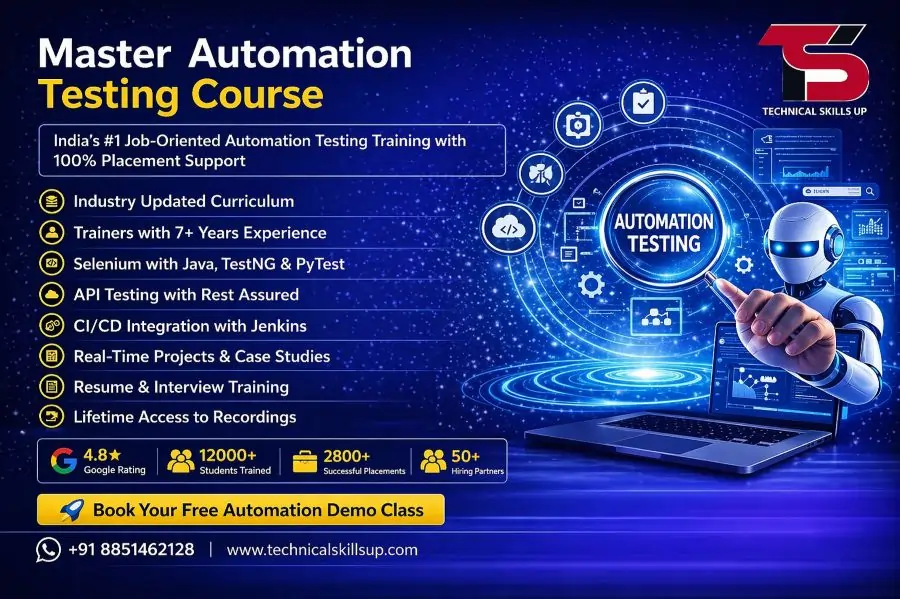
Automation testing has become a must-have skill in today’s fast-growing IT industry. Companies now prefer faster, more accurate, and efficient testing methods to deliver high-quality software. Manual testing alone cannot handle the speed of modern development cycles, which is why automation testing plays a key role.
Technical Skills Up offers a practical and career-focused Automation Testing Course in Delhi designed for beginners as well as working professionals. This course helps you learn real-world skills, tools, and techniques that companies actually use. Every topic is explained in simple language so learners can easily understand and apply concepts in real projects.
Why Choose Automation Testing as a Career
Growing demand for automation testers makes this field highly rewarding. Organizations want faster product delivery, and automation helps achieve that by reducing manual effort and errors.
High salary packages attract many students and professionals toward this field. Skilled automation testers often get better opportunities compared to manual testers.
Career growth remains strong because automation testing connects with DevOps, Agile, and continuous integration processes. Professionals can move into roles like Test Engineer, Automation Engineer, QA Lead, or even DevOps Engineer.
Job security increases due to continuous demand across industries such as banking, healthcare, e-commerce, and IT services.
About Automation Testing Training in Delhi
Technical Skills Up provides industry-oriented Automation Testing Training in Delhi with a strong focus on practical learning. Trainers use real-time examples to help students understand how automation works in actual projects.
Course structure covers all important tools and technologies needed to become a skilled automation tester. Learning starts from basic concepts and gradually moves toward advanced frameworks and real-time scenarios.
Hands-on practice plays a major role in this training. Students get access to live projects, assignments, and case studies to build confidence and experience.
Key Highlights of the Course
Comprehensive curriculum ensures that learners cover all essential topics related to automation testing. Every module is designed according to current industry requirements.
Experienced trainers guide students with step-by-step explanations and real project insights. Trainers share practical knowledge instead of only theoretical concepts.
Live project work helps learners gain real-world experience. Students learn how to automate test cases for web applications and APIs.
Flexible batch timings support both students and working professionals. Weekend and weekday batches are available.
Placement support helps students prepare for interviews and secure jobs. Resume building and mock interviews improve confidence.
Automation Testing Classes in Delhi – What You Will Learn
Basics of Software Testing
Understanding software testing fundamentals builds a strong foundation. Topics include SDLC, STLC, testing types, and defect lifecycle.
Concept clarity helps learners understand why automation is needed and where it should be used.
Introduction to Automation Testing
Automation testing concepts explain how tools help execute test cases automatically. Students learn advantages, limitations, and real-world usage.
Knowledge of automation benefits helps in deciding when to use automation instead of manual testing.
Selenium WebDriver
Selenium WebDriver is one of the most popular tools used in automation testing. Students learn how to automate web applications using Selenium.
Practical sessions include handling web elements, forms, alerts, dropdowns, and dynamic elements.
Framework development using Selenium helps students understand how large projects are managed.
Programming Basics (Java/Python)
Basic programming knowledge helps in writing automation scripts. Students learn core concepts like variables, loops, conditions, and functions.
Simple coding approach ensures that even non-technical learners can understand programming easily.
TestNG Framework
TestNG helps manage and execute test cases efficiently. Students learn annotations, test execution, reporting, and grouping.
Understanding TestNG improves automation script organization and execution.
Maven and Jenkins
Maven helps in project management and dependency handling. Jenkins supports continuous integration and automation execution.
Integration of tools provides real industry exposure and prepares students for DevOps environments.
API Testing
API testing plays a major role in backend validation. Students learn tools like Postman and automation of APIs.
Practical knowledge of API testing increases job opportunities.
Git and Version Control
Version control tools like Git help manage code changes and collaboration.
Understanding Git helps students work in team environments and manage automation scripts effectively.
Practical Learning Approach
Hands-on training makes learning more effective. Students work on real-time projects to understand how automation testing works in companies.
Assignments and exercises help in improving problem-solving skills. Regular practice ensures better understanding of tools and concepts.
Real project exposure builds confidence and prepares students for job roles.
Who Can Join This Course
Fresh graduates looking to start a career in software testing can benefit from this course.
Manual testers who want to upgrade their skills to automation testing can join.
Working professionals from non-technical backgrounds can also learn automation with proper guidance.
Students from BCA, MCA, B.Tech, or any IT-related field find this course highly useful.
Automation Testing Training Institute in Delhi – Why Technical Skills Up
Technical Skills Up stands out as a trusted Automation Testing Training Institute in Delhi due to its practical approach and industry-focused training.
Quality training ensures that students learn skills that companies actually require.
Affordable course fees make training accessible for everyone.
Small batch sizes allow trainers to give personal attention to each student.
Updated syllabus keeps learners aligned with current industry trends.
Strong placement support increases chances of getting hired.
Tools Covered in the Course
Learning multiple tools helps students become versatile automation testers.
Selenium WebDriver remains the primary tool for web automation.
TestNG helps manage test execution and reporting.
Maven supports project structure and dependency management.
Jenkins enables continuous integration and automation runs.
Postman helps in API testing and validation.
Git supports version control and team collaboration.
Real-Time Project Experience
Working on live projects gives students a clear understanding of industry workflows. Students learn how to create automation frameworks from scratch.
Exposure to real-world scenarios helps in handling complex testing situations.
Project experience improves resume value and increases chances of selection in interviews.
Placement Assistance
Technical Skills Up provides strong placement support to help students start their careers.
Resume building sessions help create professional resumes.
Mock interviews prepare students for real interview situations.
Interview questions and answers help in understanding what companies expect.
Job assistance connects students with hiring companies.
Career Opportunities After Course
Automation testing opens doors to multiple job roles.
Automation Test Engineer role focuses on creating and executing automated test scripts.
QA Engineer role includes both manual and automation testing responsibilities.
SDET (Software Development Engineer in Test) role combines development and testing skills.
Performance Tester role focuses on testing application speed and stability.
DevOps Engineer role becomes possible with additional skills and experience.
Benefits of Learning Automation Testing
Faster testing process improves efficiency and productivity.
Reduced manual effort saves time and resources.
Better accuracy reduces chances of human error.
Improved test coverage ensures higher software quality.
Continuous testing support helps in Agile and DevOps environments.
Course Duration and Structure
Course duration usually ranges from 2 to 3 months depending on the batch type.
Each module is designed to cover theory and practical sessions.
Regular assessments help track progress and understanding.
Flexible schedule supports working professionals and students.
Learning Outcome
Students gain strong knowledge of automation testing concepts and tools.
Ability to write automation scripts independently improves confidence.
Understanding of real-world testing scenarios prepares students for jobs.
Practical experience helps in cracking interviews easily.
Why Automation Testing is Future-Proof
Technology keeps evolving, and automation testing continues to grow with it. Companies adopt Agile and DevOps practices, increasing the need for automation testers.
Cloud-based testing, AI in testing, and continuous integration make automation skills even more valuable.
Future opportunities remain strong for professionals who upgrade their skills regularly.
Conclusion
Automation testing offers excellent career opportunities for anyone interested in software testing and development. Technical Skills Up provides a well-structured and practical Automation Testing Course in Delhi that helps learners build strong skills and confidence.
Simple teaching methods, real-time projects, and placement support make this course a great choice for beginners and professionals. Learning automation testing today can open doors to a successful and stable career in the IT industry.
Taking the right step at the right time can shape your future. Joining a professional Automation Testing Training in Delhi can be the beginning of a rewarding journey in the world of software testing.
Online Courses
- Software Testing Online Course
- Manual Testing Online Course
- Automation Testing Online Course
- Selenium Testing Online Course
- Playwright Automation Online Course
Related Courses in Noida
- Software Testing Course in Noida
- Manual Testing Course in Noida
- Automation Testing Course in Noida
- Selenium Testing Course in Noida
- Playwright Automation Course in Noida
Related Courses in Delhi
FAQs:
Q1. What is Automation Testing?
Ans: Automation Testing is a process in which software testing is performed using tools and scripts, rather than through manual methods. It involves automating repetitive test cases, thereby saving time and enhancing accuracy. In today’s landscape, companies increasingly prefer Automation Testing to ensure rapid delivery and high quality.
Q2. Why should one pursue an Automation Testing Course in Delhi?
Ans: Delhi serves as a prominent IT and training hub, offering access to reputable institutes and abundant placement opportunities. Pursuing an Automation Testing course equips you with practical skills, significantly boosting your chances of securing a job in the IT sector. This course is highly beneficial for fostering career growth.
Q3. What are the key highlights of the Automation Testing Course at Technical Skills Up?
Ans: Technical Skills Up offers an industry-aligned curriculum, hands-on live projects, instruction from experienced trainers, and dedicated placement support. Here, students receive training in a real-time environment, ensuring they become job-ready upon completion.
Q4. Which tools are taught in this course?
Ans: This course covers tools such as Selenium, TestNG, JUnit, Maven, Jenkins, and introduces basic Java or Python. All these tools are widely utilized across the industry.
Q5. What are the eligibility criteria for learning Automation Testing?
Ans: Basic computer literacy is a prerequisite for this course. While having some prior knowledge of programming is advantageous, beginners can also easily master this course.
Q6. What is the duration of the Automation Testing Course?
Ans: Typically, this course spans a duration of 2 to 4 months. Some institutes also offer fast-track or weekend batches, making it convenient for working professionals to acquire these skills.
Q7. Does this course guarantee a job placement?
Ans: If you undergo proper training and engage in consistent practice, your chances of securing a job increase significantly. Technical Skills Up also provides placement assistance to help students navigate the interview process effectively.
Q8. What is the difference between Automation Testing and Manual Testing?
Ans: In Manual Testing, a tester manually executes test cases, whereas in Automation Testing, the testing process is performed automatically with the aid of scripts and tools. Automation Testing is generally faster and more accurate than Manual Testing.
Q9. How much does an Automation Testing Course cost?
Ans: The fees may vary depending on the institute and the course content. Generally, the fee for an Automation Testing Course in Delhi ranges from ₹20,000 to ₹50,000.
Q10. Can non-technical students also take this course?
Ans: Yes, non-technical students can certainly take this course. Programming basics are taught at the beginning, enabling any student to learn with ease.
Q11. What is the career scope in Automation Testing?
Ans: The career scope in Automation Testing is excellent. IT companies are in high demand for automation testers. As your experience grows, both your salary and opportunities increase.
Q12. Does this course include work on live projects?
Ans: Yes, at Technical Skills Up, students get the opportunity to work on live projects. This enhances practical knowledge and strengthens their resume.
Q13. How long does it take to learn Automation Testing?
Ans: It takes 2–3 months to learn the basics, but regular practice is essential to become an expert. The more you practice, the faster your skills will improve.
Q14. Are both online and offline options available?
Ans: Yes, both online and offline training modes are available at Technical Skills Up. Students can choose whichever mode suits their convenience.
Q15. What is the starting salary after completing an Automation Testing Course?
Ans: As a fresher, the starting salary for an Automation Tester can range from approximately ₹3 lakhs to ₹6 lakhs per annum. Salary increases rapidly based on experience and skills.