
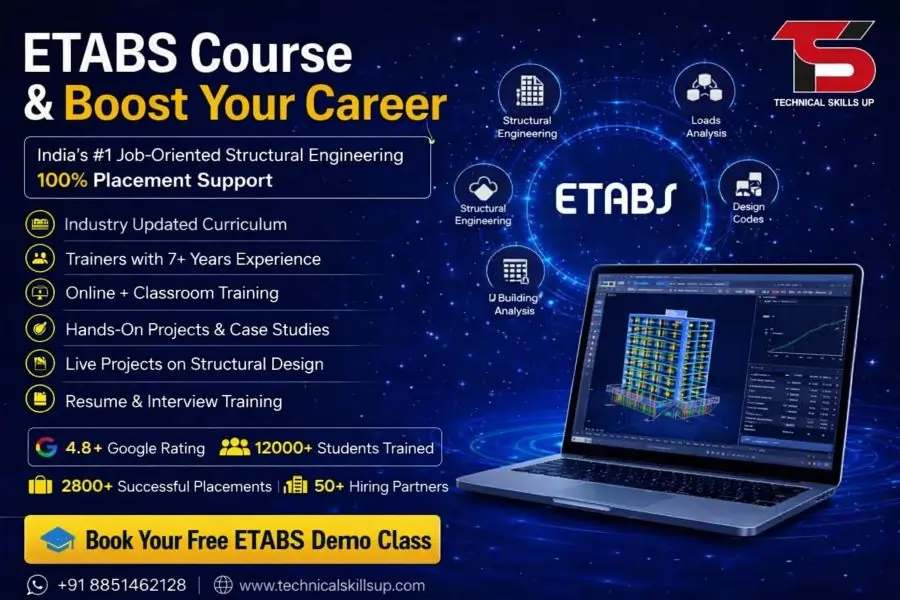
ETABS Course in Delhi with Placement

Modern construction projects require safe, strong, and cost-effective structures. Structural engineers need advanced software skills to design and analyze buildings accurately. ETABS has become one of the most trusted tools for structural analysis and building design across the construction industry. Technical Skills Up offers a professional ETABS Course in Delhi designed to help students, civil engineers, architects, and working professionals gain practical expertise in structural design.

Training is delivered by experienced industry experts who focus on real-world applications, live projects, and hands-on practice. Every module is designed to help learners understand structural concepts and software operations step by step. The course combines theoretical knowledge with practical implementation so that learners can confidently work on residential, commercial, and industrial projects.

Table of Contents

Why Learn ETABS?

Building design has become more complex due to modern construction techniques and safety requirements. Companies prefer professionals who can perform structural analysis efficiently and accurately.

Benefits of learning ETABS include:

  • Strong understanding of structural behavior
  • Better job opportunities in the construction sector
  • Ability to design multi-storey buildings
  • Improved project planning and analysis skills
  • Enhanced career growth in civil engineering
  • Industry-recognized software expertise
  • Higher chances of securing engineering roles

About Technical Skills Up

Technical Skills Up is committed to providing practical and career-oriented training programs. The institute focuses on developing job-ready skills through industry-based learning methods. Students receive guidance from trainers who possess real project experience in structural engineering and construction.

Key highlights include:

  • Experienced trainers
  • Practical learning approach
  • Industry-oriented curriculum
  • Live project exposure
  • Flexible learning schedules
  • Certification support
  • Placement assistance
  • Interview preparation sessions

ETABS Training Program Overview

The training program covers all major concepts required for structural analysis and design. Learners begin with the fundamentals and gradually move toward advanced topics.

Course modules are designed to help participants understand:

  • Structural modeling
  • Load calculations
  • Seismic analysis
  • Wind load analysis
  • Reinforced concrete design
  • Steel structure design
  • Building performance evaluation
  • Project documentation

Practical exercises help students gain confidence while working on real engineering scenarios.

Who Should Join This Course?

The program is suitable for individuals looking to improve their structural engineering skills and career prospects.

Ideal candidates include:

  • Civil Engineering students
  • Structural Engineering students
  • Diploma holders
  • Site engineers
  • Design engineers
  • Architects
  • Project engineers
  • Working professionals
  • Fresh graduates

Previous ETABS experience is not mandatory because training starts from the basics.

ETABS Classes in Delhi for Practical Learning

Classroom sessions focus on practical implementation rather than only theoretical concepts. Trainers explain every topic with examples taken from real construction projects.

Learning activities include:

  • Software demonstrations
  • Building modeling exercises
  • Structural analysis tasks
  • Design calculations
  • Case studies
  • Project-based assignments
  • Industry discussions

Interactive learning methods make it easier for students to understand complex engineering concepts.

Learning Environment

A productive learning environment helps students gain maximum benefits from training.

Students receive:

  • Individual attention
  • Doubt-clearing sessions
  • Practice assignments
  • Recorded learning support
  • Project guidance
  • Career counseling

Structured learning ensures better knowledge retention and practical understanding.

Course Curriculum

The curriculum has been developed according to current industry requirements.

Module 1: Introduction to Structural Engineering

Topics covered:

  • Basics of structural engineering
  • Building components
  • Structural systems
  • Design standards
  • Engineering principles

Module 2: Introduction to ETABS Interface

Topics covered:

  • Software navigation
  • User interface overview
  • Project setup
  • Grid creation
  • Model initialization

Module 3: Structural Modeling

Topics covered:

  • Beam modeling
  • Column modeling
  • Slab modeling
  • Wall modeling
  • Foundation concepts

Module 4: Material Properties

Topics covered:

  • Concrete properties
  • Steel properties
  • Material definitions
  • Design parameters
  • Material assignments

Module 5: Load Application

Topics covered:

  • Dead loads
  • Live loads
  • Wind loads
  • Earthquake loads
  • Load combinations

Module 6: Structural Analysis

Topics covered:

  • Static analysis
  • Dynamic analysis
  • Response spectrum analysis
  • Structural behavior assessment
  • Result interpretation

Module 7: Design Procedures

Topics covered:

  • Reinforced concrete design
  • Beam design
  • Column design
  • Slab design
  • Structural optimization

Module 8: Project Work

Topics covered:

  • Real project execution
  • Building analysis
  • Design validation
  • Documentation
  • Final presentation

Industry-Relevant Skills You Will Learn

Construction companies seek professionals who can handle design software confidently. The course helps learners develop practical skills required in real engineering projects.

Skills gained include:

  • Structural modeling
  • Building analysis
  • Design optimization
  • Load calculations
  • Seismic design
  • Wind analysis
  • Report generation
  • Project management support

These competencies improve employability and professional growth.

ETABS Certification Course in Delhi

Certification plays an important role in demonstrating technical competency. After successful completion of training, learners receive a certificate that validates their ETABS knowledge and practical skills.

Benefits of certification:

  • Professional recognition
  • Enhanced resume value
  • Better interview opportunities
  • Improved career credibility
  • Stronger industry profile

Employers often prefer candidates who possess verified software skills and practical project experience.

Real Project-Based Training

Practical exposure helps students understand industry workflows more effectively. Training includes project-based learning where participants work on actual building structures.

Project activities include:

  • Building modeling
  • Structural analysis
  • Design validation
  • Load calculations
  • Safety checks
  • Report preparation

Hands-on learning bridges the gap between academic knowledge and professional requirements.

ETABS Training Institute in Delhi with Expert Mentorship

Professional mentorship can significantly improve learning outcomes. Trainers guide students through every stage of the learning process and share valuable industry insights.

Mentorship support includes:

  • Technical guidance
  • Career advice
  • Project reviews
  • Interview preparation
  • Resume assistance
  • Industry best practices

Experienced mentors help learners understand practical engineering challenges and solutions.

Placement Assistance Support

Career support is an important part of the training program. Technical Skills Up provides assistance to help students prepare for employment opportunities.

Placement support includes:

  • Resume building
  • Interview preparation
  • Technical assessments
  • Mock interviews
  • Career guidance
  • Job opportunity updates

Focused preparation helps learners approach interviews with confidence.

Common Job Roles After ETABS Training

Career opportunities may include:

  • Structural Design Engineer
  • Civil Design Engineer
  • Structural Analyst
  • Site Engineer
  • Project Engineer
  • Design Consultant
  • BIM Coordinator
  • Construction Engineer

Growing infrastructure development has increased demand for skilled structural professionals across various sectors.

Advantages of Learning Through Practical Projects

Project-based learning offers several benefits compared to traditional classroom training.

Advantages include:

  • Better understanding of concepts
  • Improved problem-solving ability
  • Real-world exposure
  • Enhanced software proficiency
  • Stronger portfolio development
  • Increased confidence

Practical experience prepares students for workplace challenges more effectively.

Tools and Concepts Covered Alongside ETABS

Structural engineering projects often require knowledge of multiple concepts and workflows.

Additional learning areas may include:

  • Engineering drawing interpretation
  • Structural detailing concepts
  • Design standards
  • Building codes
  • Construction practices
  • Project documentation

Understanding these areas creates a stronger foundation for professional success.

Career Opportunities in Structural Engineering

Rapid urbanization and infrastructure growth continue to create demand for qualified structural professionals. Organizations involved in construction, infrastructure, industrial projects, and real estate development regularly hire engineers with software expertise.

Industries hiring ETABS professionals include:

  • Construction companies
  • Infrastructure firms
  • Real estate developers
  • Engineering consultancies
  • Design firms
  • Government projects
  • Industrial construction companies

Strong software skills combined with engineering knowledge can create long-term career opportunities.

Why Choose Technical Skills Up?

Selecting the right training provider is important for skill development and career growth.

Reasons learners choose Technical Skills Up:

  • Industry-experienced trainers
  • Practical learning methodology
  • Updated curriculum
  • Live project training
  • Flexible batch timings
  • Career-focused approach
  • Certification support
  • Placement assistance

Every aspect of the training program is designed to help students become confident professionals.

Conclusion

A successful structural engineering career requires both theoretical knowledge and practical software expertise. Professional training helps learners understand real-world design processes and industry standards. The ETABS Training in Delhi offered by Technical Skills Up focuses on practical implementation, project-based learning, and career development. Students gain valuable experience in structural modeling, analysis, design, and project execution while learning from industry experts. With comprehensive training, certification support, and placement assistance, learners can build the skills needed to pursue rewarding opportunities in the construction and structural engineering industry.

Online Courses

Related Courses in Noida

Related Courses in Delhi

FAQs: 

Q1. What is the ETABS Course?

The ETABS Course is a professional civil engineering training program that teaches the structural analysis and design of buildings. This course provides practical training in the design, load analysis, and modeling of steel and RCC (Reinforced Cement Concrete) structures.

Q2. Who is eligible for the ETABS Course?

This course is suitable for Civil Engineering students, diploma holders, B.Tech/B.E. graduates, structural engineers, and professionals working in the construction industry.

Q3. What are the benefits of learning ETABS?

Learning ETABS helps develop critical skills such as building design, structural analysis, earthquake analysis, and project design. It enhances job opportunities and facilitates career growth.

Q4. What is the duration of the ETABS Course at Technical Skills Up?

The duration of the ETABS Course may vary depending on the specific batch and training modules. Generally, the course runs for a period ranging from a few weeks to a few months, encompassing both theoretical and practical sessions.

Q5. Does the ETABS Course involve working on live projects?

Yes, at Technical Skills Up, students are given the opportunity to work on industry-based live projects, thereby gaining real-world project experience.

Q6. In which fields is ETABS software used?

ETABS is widely used in structural engineering, building design, construction companies, infrastructure projects, and consultancy firms.

Q7. Is placement assistance provided after completing the ETABS Course?

Yes, Technical Skills Up offers students facilities such as placement assistance, resume building, interview preparation, and job support.

Q8. What subjects are taught in the ETABS Course?

This course covers subjects such as structural modeling, load calculation, RCC design, steel structure design, seismic analysis, wind analysis, and project design.

Q9. Is coding knowledge required for the ETABS Course?

No, prior knowledge of coding is not required to learn the ETABS Course. It is a course primarily focused on structural design and analysis software.

Q10. What job profiles can one pursue after completing the ETABS Course?

Upon completing the course, opportunities may arise in roles such as Structural Engineer, Design Engineer, Site Engineer, Project Engineer, BIM Engineer, and Construction Consultant.

Q11. Is ETABS Certification beneficial for one’s career?

Yes, ETABS Certification validates your technical skills and significantly strengthens your professional profile when applying for jobs.

Q12. Can freshers take the ETABS course?

Yes, freshers in Civil Engineering, as well as final-year students, can enroll in the ETABS course. It can prove to be highly beneficial for kickstarting their careers.

Q13. Does the ETABS course include practical training?

Yes, at Technical Skills Up, special emphasis is placed on hands-on practical training, real-time exercises, and project-based learning.

Q14. What are the salary prospects after learning ETABS?

Salary prospects depend on the candidate’s skills, experience, location, and the specific company. Candidates possessing a strong command of ETABS may find access to superior career opportunities.

Q15. Why choose the ETABS course at Technical Skills Up?

Technical Skills Up offers features such as training by experienced instructors, live projects, practical learning, an industry-oriented curriculum, certification, and placement assistance—all designed to ensure that students become job-ready.
Related Post

Databricks Course

Databricks Online Course in India with Placement

Modern businesses generate massive amounts of data every day. Organizations need professionals who can manage, process, analyze, and transform this data into meaningful insights. Strong data platforms have become essential for companies that want to improve decision-making, automate operations, and drive innovation. Learning a Databricks Course helps learners gain practical knowledge of one of the most powerful unified analytics platforms used across industries today. Technical Skills Up offers industry-focused learning designed for students, graduates, software professionals, data analysts, and IT enthusiasts who want to build expertise in cloud-based data engineering and analytics. The program combines practical projects, expert guidance, hands-on exercises, and real-world use cases to help learners understand how modern data platforms work in enterprise environments. Growing adoption of cloud technologies has created a strong demand for professionals who can work with large-scale data processing systems. Employers seek candidates who understand modern data architectures, big data frameworks, machine learning workflows, and cloud analytics solutions. This training program provides a structured learning path that helps learners develop these valuable skills while preparing for industry-recognized certifications and career opportunities. Databricks Training Designed for Real Industry Needs Organizations across finance, healthcare, retail, manufacturing, telecommunications, and e-commerce rely on modern data platforms to process large datasets efficiently. Businesses require professionals who understand how to build data pipelines, manage analytics workloads, and support machine learning projects. Databricks Training at Technical Skills Up focuses on practical implementation rather than theoretical concepts alone. Learners gain exposure to industry-standard practices that are commonly used in enterprise environments. Key highlights of the program include: Instructor-led live sessions Hands-on practical exercises Real-world projects Cloud-based learning environment Career-oriented curriculum Interview preparation support Certification guidance Placement assistance Every module is designed to help learners develop confidence while working on real data engineering and analytics scenarios. Course Overview A strong foundation is essential for success in modern data engineering roles. The curriculum begins with fundamental concepts and gradually progresses toward advanced topics used in enterprise projects. Learning modules cover: Introduction to Modern Data Platforms Understanding the evolution of data management systems helps learners appreciate why organizations are moving toward cloud-based architectures. Topics include: Data ecosystem overview Traditional data warehouses Big data concepts Cloud computing fundamentals Data lake architecture Analytics workflows Understanding Databricks Architecture Comprehensive knowledge of platform architecture helps learners understand how different components work together. Key concepts include: Workspace management Clusters and compute resources Notebooks Job scheduling Security models Workspace administration Data Processing Fundamentals Modern organizations process huge volumes of structured and unstructured data. Learning efficient processing techniques is essential for successful project delivery. Coverage includes: Batch processing Stream processing Data ingestion Data transformation Data quality management Data validation techniques Why Databricks Has Become Important in Industry Businesses want faster access to insights and more efficient ways to handle growing data volumes. Traditional systems often struggle with scalability, performance, and operational complexity. Modern cloud-based platforms solve these challenges by offering: Faster data processing Improved collaboration Unified analytics environment Better scalability Simplified infrastructure management Advanced machine learning capabilities Many global organizations use Databricks to support their digital transformation initiatives. Data engineers, analysts, and machine learning professionals increasingly rely on this platform to build and manage complex analytics workflows. Growing industry adoption has created significant demand for professionals who possess practical expertise in cloud-based analytics platforms. Skills Covered in the Program Practical skill development remains a major focus of this training program. Every module helps learners gain hands-on experience that can be applied directly in workplace environments. Data Engineering Skills Learners develop expertise in: Data ingestion techniques ETL pipeline development Data transformation Data orchestration Data quality management Workflow automation Analytics Skills Practical analytics knowledge includes: Data exploration Business intelligence concepts Dashboard preparation Reporting workflows Data visualization fundamentals Insight generation Cloud Computing Skills Cloud technologies continue to dominate modern enterprise environments. Important cloud-related concepts include: Cloud architecture Resource management Cost optimization Security implementation Performance monitoring Infrastructure scaling Machine Learning Foundations Understanding machine learning workflows provides additional career opportunities. Topics covered include: Machine learning lifecycle Feature engineering Model training Model evaluation Experiment tracking Model deployment basics Databricks Classes with Practical Learning Experience Practical implementation plays a critical role in mastering any technical skill. Reading concepts alone cannot prepare learners for real-world challenges. Databricks Classes at Technical Skills Up focus heavily on hands-on learning through guided exercises and project-based assignments. Practical activities include: Creating clusters Working with notebooks Building data pipelines Processing large datasets Managing cloud resources Implementing analytics workflows Every session is structured to help learners gain confidence through continuous practice and instructor support. Tools and Technologies Covered Modern data engineering projects involve multiple technologies working together. Industry professionals are expected to understand how these tools integrate within enterprise ecosystems. The curriculum includes exposure to several important technologies. Apache Spark Apache Spark serves as a powerful distributed processing engine used for large-scale data processing. Topics include: Spark architecture Spark transformations Spark actions Performance optimization Distributed computing concepts Python Programming Python remains one of the most popular languages in data engineering and analytics. Coverage includes: Python fundamentals Data manipulation Functions and modules Data processing workflows Automation techniques SQL Strong SQL skills remain essential for data professionals. Learners practice: Query writing Joins and aggregations Data filtering Data transformations Performance optimization Delta Lake Reliable data storage and management are critical for analytics success. Key learning areas include: Delta architecture Data versioning Data reliability Transaction management Performance improvements Cloud Platforms Industry projects often involve cloud infrastructure. Exposure includes: Cloud storage concepts Resource provisioning Security best practices Analytics environments Data integration workflows Databricks Certification Course for Career Growth Professional certifications help validate technical skills and improve credibility in competitive job markets. Employers often prefer candidates who demonstrate structured learning and practical expertise. A Databricks Certification Course provides preparation guidance that helps learners understand certification objectives and exam expectations. Benefits of certification preparation include: Stronger professional profile Better interview opportunities Increased employer confidence Improved technical validation Enhanced career prospects Training modules align with industry requirements to help learners prepare effectively for certification pathways. Career Opportunities After Completing the Program Data-driven

Structural Design Course

Structural Design Online Course in India with Placement

Modern construction and infrastructure development require strong technical knowledge, practical design skills, and a deep understanding of engineering principles. A career-focused Structural Design Course plays a crucial role in shaping skilled professionals who can design safe, durable, and efficient structures for real-world projects. At Technical Skills Up, the learning approach focuses on building strong fundamentals along with advanced practical exposure so that students and working professionals can confidently enter the structural engineering field. Growing demand in construction, real estate, and industrial projects has made structural design one of the most valuable career paths in engineering. Learners gain both theoretical understanding and software-based design experience that helps them work on real-time projects. This program is designed to bridge the gap between academic knowledge and industry expectations, making it highly beneficial for fresh graduates and experienced engineers looking to upgrade their skills. Course Overview – Structural Design Training Program The Structural Design Training program at Technical Skills Up is structured to provide complete knowledge of design principles used in civil and structural engineering. The course covers everything from basic load calculations to advanced structural analysis and modeling techniques. Students begin with core engineering concepts and gradually move toward practical applications using industry-standard software tools. The training focuses on real-life construction scenarios so learners understand how structures behave under different conditions. Key highlights of the program include: Step-by-step learning from fundamentals to advanced design concepts Practical exposure to real-world structural projects Industry-relevant assignments and case studies Hands-on software training for design and analysis Guidance from experienced industry professionals This structured approach helps learners build confidence and become job-ready by the end of the course. Importance of Structural Design in the Industry The construction industry depends heavily on accurate structural planning and execution. Even a small design error can lead to safety risks or financial losses. That is why trained structural designers are always in demand. A professional with knowledge gained from Structural Design Classes can contribute to safe building designs, bridges, industrial structures, and infrastructure projects. Structural design ensures that every construction can withstand environmental forces such as wind, earthquakes, and load pressure. Industry importance includes: Ensuring safety and durability of buildings Reducing construction risks and design failures Improving cost efficiency in projects Supporting sustainable and smart construction methods Meeting global engineering standards Construction companies, architecture firms, and infrastructure developers actively hire skilled structural designers to maintain quality and safety standards in their projects. Skills Covered in Structural Design Certification Course The Structural Design Certification Course at Technical Skills Up focuses on building strong technical and analytical skills required in the industry. Learners develop the ability to understand, analyze, and design different structural systems. Core Engineering Skills Understanding of structural mechanics Load calculation and distribution techniques Analysis of beams, columns, and slabs Design of RCC (Reinforced Cement Concrete) structures Basics of steel structure design Analytical and Problem-Solving Skills Structural load analysis under different conditions Earthquake-resistant design concepts Wind load and environmental impact analysis Interpretation of engineering drawings Practical Design Skills 2D and 3D structural modeling Drafting and detailing of structures Design validation and error checking Real-world project implementation techniques These skills help learners become confident professionals capable of handling real engineering challenges. Tools and Technologies Covered in Structural Design Online Course in India Modern structural engineering relies heavily on software tools for accuracy and efficiency. The Structural Design Online Course in India at Technical Skills Up introduces students to industry-standard applications used by professionals worldwide. Software and Tools Training AutoCAD for structural drafting and design drawings STAAD Pro for structural analysis and design ETABS for building analysis and modeling Revit Structure for BIM-based structural design MS Excel for engineering calculations and data management Technology-Based Learning Approach BIM (Building Information Modeling) concepts Digital construction workflows 3D modeling and simulation techniques Structural optimization methods Hands-on practice with these tools helps learners understand how modern engineering projects are executed in real environments. Career Opportunities After Structural Design Training Completing a Structural Design Training program opens multiple career paths in the construction and engineering sector. Skilled professionals are required in both private and government sectors. Job Roles Available Structural Design Engineer Civil Design Engineer Structural Analyst BIM Structural Modeler Site Engineer Project Engineer Industry Sectors Hiring Professionals Construction and real estate companies Infrastructure development firms Architectural consultancy agencies Government infrastructure departments Industrial design and manufacturing companies With experience, professionals can also move into senior positions such as project managers, design consultants, or independent structural consultants. Industry Demand and Future Scope The future of structural engineering continues to grow with rapid urbanization and infrastructure development. Smart cities, highways, bridges, and high-rise buildings require advanced structural planning and design expertise. Demand for professionals trained in Structural Design Classes is increasing due to: Growth in construction and infrastructure projects Rising focus on earthquake-resistant structures Adoption of modern design technologies like BIM Global demand for skilled civil engineers Expansion of real estate and industrial sectors Future scope includes opportunities in international markets, large-scale infrastructure projects, and advanced research in structural engineering. Professionals with updated technical skills will continue to remain highly valuable in the industry. Why Choose Technical Skills Up for Structural Design Certification Course Technical Skills Up focuses on delivering career-oriented education that combines theoretical knowledge with practical exposure. The Structural Design Certification Course is designed to meet current industry requirements and future expectations. Key Advantages Experienced trainers with industry background Practical project-based learning approach Updated curriculum aligned with industry standards Flexible learning options for students and professionals Real-time project experience for better understanding Learning Environment Students receive continuous support and mentorship throughout the course. The focus remains on building confidence, improving technical skills, and preparing learners for real job roles. Training Methodology – Online + Practical Learning Approach The training methodology at Technical Skills Up combines online learning with practical sessions to ensure complete understanding of structural design concepts. Online Learning Benefits Flexible study schedule for learners Recorded sessions for revision Easy access from any location Step-by-step conceptual learning Practical Training Approach Live project-based assignments Real structural design

SAP Successfactors Course

SAP SuccessFactors Course in Delhi with Placement

If you want to build a strong career in HR technology, SAP SuccessFactors training in Delhi is a great option. This course is designed to help you understand cloud-based HR tools in a simple and practical way. You will gain hands-on experience and develop skills that are highly valued by modern organizations. SAP SuccessFactors is one of the leading HR software platforms used by global companies to manage employee data, payroll, recruitment, and performance. With proper training, you can open doors to exciting job opportunities and build a successful, future-ready career in the growing HR technology domain. SAP SuccessFactors is one of the top HR software platforms in the world. Many global companies use it to manage employees, payroll, hiring, and performance. With the right training, you can start a high-growth career in this field. Why Choose SAP SuccessFactors Course in Delhi Choosing the right course is very important. Our training program is designed to be simple, clear, and practical. Learn from expert trainers Work on real-time projects Get step-by-step guidance Access updated course material Get job-ready skills Delhi is a great place to learn SAP. You get access to top trainers and better job opportunities. What is SAP SuccessFactors SAP SuccessFactors is a cloud-based HR management system. It helps companies manage their workforce in an easy way. It includes tools for: Hiring new employees Managing employee data Tracking performance Handling payroll and compensation Learning and development SAP SuccessFactors Course Details Course Duration The course usually takes 6 to 8 weeks. Fast-track options are also available. Course Fees Fees are affordable. You can choose flexible payment options. Training Mode Classroom training in Delhi Online live classes Recorded sessions for revision SAP SuccessFactors Modules Covered Our course covers all key modules in a simple way. Employee Central Learn how to manage employee data and HR processes. Performance and Goals Understand how to track employee performance and goals. Recruitment Management Learn how companies hire and onboard new employees. Learning Management System Manage training and development programs. Compensation and Payroll Understand salary, bonuses, and payroll systems. Benefits of SAP SuccessFactors Training This course offers many career benefits. High demand in the job market Attractive salary packages Global career opportunities Easy entry for beginners Strong career growth SAP professionals are needed in many industries. This makes it a safe and smart career choice. Who Can Join This Course This course is suitable for many learners. Fresh graduates HR professionals IT professionals MBA students Career switchers You do not need advanced technical skills to start. SAP SuccessFactors Certification Guidance We help you prepare for SAP certification exams. Practice tests and mock exams Real exam questions Expert tips and tricks One-on-one guidance Certification adds value to your resume and improves your job chances. Best SAP SuccessFactors Training Institute in Delhi We aim to be one of the best training institutes in Delhi. Certified and experienced trainers Live project training Small batch size Flexible class timings Updated course content Our focus is on quality training and student success. Placement Support and Career Help We provide strong placement support to help you get a job. Resume building support Mock interview sessions Job referrals Career counseling We guide you until you feel confident and job-ready. SAP SuccessFactors Classes in Delhi – Batch Timings We offer flexible batch options for all learners. Weekday batches Weekend batches Fast-track batches You can choose a schedule that fits your routine. Student Reviews and Testimonials Many students have built successful careers after this training. “The course was simple and easy to follow.” “Trainers explained every concept clearly.” “I got a job within 2 months of completing the course.” Our students trust us for quality learning. Contact Us for SAP SuccessFactors Course in Delhi Start your career in HR technology today. Call us now to know more Book a free demo class Get expert counseling Join the best SAP SuccessFactors training institute in Delhi and take the next step toward a successful career. 1. SAP Related Courses in Delhi SAP Course in Delhi SAP FICO Course in Delhi SAP ABAP Course in Delhi SAP BASIS Course in Delhi SAP HANA Course in Delhi SAP MM Course in Delhi SAP SD Course in Delhi 2. SAP Related Courses in Noida SAP Course in Noida SAP FICO Course in Noida SAP ABAP Course in Noida SAP BASIS Course in Noida SAP HANA Course in Noida SAP MM Course in Noida SAP SD Course in Noida SAP SuccessFactors Course in Noida 3. SAP Related Courses in India SAP Online Course SAP FICO Online Course SAP ABAP Online Course SAP BASIS Online Course SAP HANA Online Course SAP MM Online Course SAP SD Online Course SAP SuccessFactors Online Course Frequently Asked Questions (FAQs) Q1. What is SAP SuccessFactors? Ans: SAP SuccessFactors is a cloud-based HR (Human Resources) software that helps companies streamline processes such as employee management, recruitment, payroll, performance management, and learning. Q2. Why pursue an SAP SuccessFactors course in Delhi? Ans: Delhi is home to several excellent training institutes that offer industry-standard training, practical projects, and placement assistance. Q3. What are the eligibility criteria for this course? Ans: Graduation (in any stream) An HR background is beneficial, though not mandatory Basic computer knowledge Q4. What is the duration of the SAP SuccessFactors course? Ans: Typically, this course lasts between 2 to 4 months, though the duration may vary depending on the institute and the specific batch. Q5. How much does the course cost? Ans: In Delhi, the fee for an SAP SuccessFactors course can range from approximately ₹30,000 to ₹80,000. Q6. What are the job opportunities after learning SAP SuccessFactors? Ans: SAP SuccessFactors Consultant HR Analyst SAP HR Functional Consultant Implementation Specialist Q7. Can freshers take this course? Ans: Yes, freshers are welcome to take this course. However, individuals with a background in HR or IT may have a slight advantage. Q8. Is a certification provided upon completion of this course? Ans: Yes, many institutes issue a certificate upon the successful completion of the course; additionally, you can