
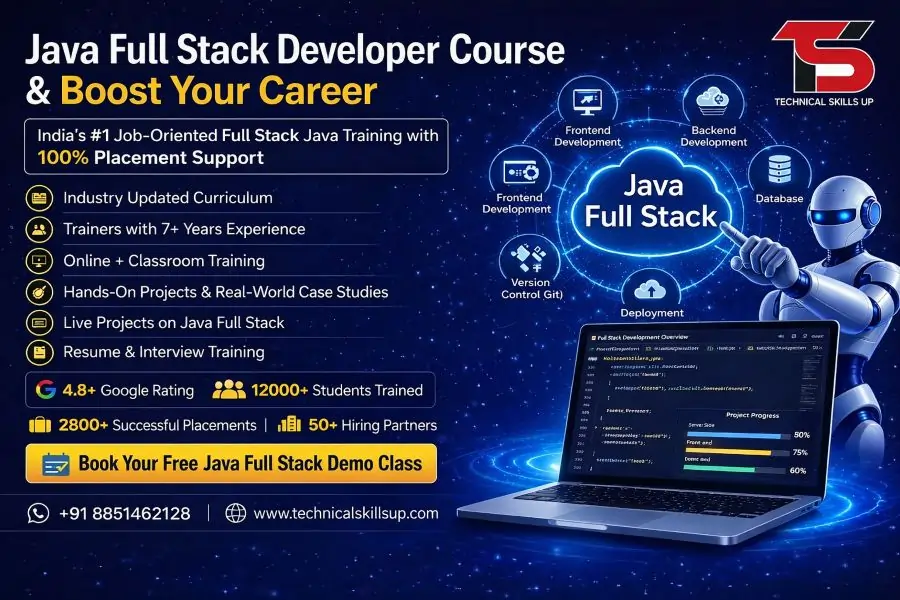
The demand for skilled software developers is increasing rapidly in the IT industry, and companies are looking for professionals who can handle both frontend and backend development with confidence. A well-structured Java Full Stack Developer Course in Delhi helps learners build strong programming skills, understand real-world application development, and prepare for high-paying job roles in software engineering. This training is designed for beginners as well as working professionals who want to upgrade their technical skills. The course focuses on industry-relevant technologies, practical coding experience, and project-based learning that improves problem-solving ability. Learners also gain exposure to real business scenarios, which helps them become job-ready in a competitive market.
Introduction to Full Stack Development
Full stack development refers to the process of building complete web applications, including both the user interface and server-side logic. A full stack developer works on frontend design, backend development, database management, and server configuration. This role is highly valued because it reduces dependency on multiple specialists and improves development efficiency.
Modern applications require seamless performance, responsive design, and secure data handling. Full stack developers ensure that all these components work together smoothly. With growing digital transformation, companies prefer developers who understand the entire software development lifecycle.
Why Java for Full Stack Development
Java is one of the most powerful and widely used programming languages in the software industry. It is known for stability, security, and platform independence. Java is used in enterprise applications, banking systems, e-commerce platforms, and mobile applications.
Key advantages of Java include:
- Strong object-oriented programming structure
- High security and reliability
- Large community support
- Compatibility with modern frameworks
- Excellent performance for large-scale systems
Because of these benefits, Java remains a top choice for full stack development training programs.
Frontend Development Skills
Frontend development focuses on designing the user interface of web applications. It is the part users interact with directly. A well-designed frontend improves user experience and engagement.
Students learn technologies such as:
- HTML for webpage structure
- CSS for styling and layout
- JavaScript for interactivity
- React or Angular for dynamic web applications
Frontend training also includes responsive design techniques to ensure applications work smoothly on mobile, tablet, and desktop devices. Practical assignments help learners understand how real websites are designed and optimized.
Backend Development with Java
Backend development handles server-side operations, database communication, and application logic. Java plays a major role in backend development due to its robustness.
Key backend topics include:
- Core Java programming
- Advanced Java concepts
- Spring Boot framework
- RESTful API development
- Server-side architecture
Students learn how to create secure and scalable applications that handle large amounts of data efficiently. Backend training also focuses on debugging, performance optimization, and error handling techniques.
Database Management Systems
Database knowledge is essential for every full stack developer. It helps in storing, retrieving, and managing application data effectively.
Commonly used databases include:
- MySQL
- PostgreSQL
- MongoDB
Students learn SQL queries, relational database design, normalization, and indexing. NoSQL databases are also introduced for handling unstructured data. Practical exercises help learners understand real-time data operations used in industry projects.
Tools and Development Environment
Modern development requires the use of advanced tools to improve productivity and collaboration.
Important tools include:
- Git and GitHub for version control
- Maven for project management
- Eclipse or IntelliJ IDEA as IDE
- Postman for API testing
- Docker basics for deployment
These tools help developers manage code efficiently and work in team environments. Understanding these tools is essential for professional software development.
Project-Based Learning Approach
Practical experience plays a key role in mastering full stack development. Students work on real-world projects such as:
- E-commerce applications
- Employee management systems
- Blogging platforms
- Online booking systems
These projects help learners apply theoretical knowledge into practical solutions. Project-based learning improves coding skills, logical thinking, and problem-solving ability.
Java Full Stack Training in Delhi – Structured Learning Program
A professional training program focuses on step-by-step learning from basic to advanced levels. The curriculum is designed according to industry standards and current job market requirements.
Training features include:
- Live instructor-led sessions
- Hands-on coding practice
- Real-time project development
- Doubt-solving sessions
- Regular assessments
This structured approach helps students build confidence and technical expertise gradually.
Teaching Methodology and Learning Experience
A good learning environment plays an important role in skill development. The teaching methodology includes interactive sessions, practical labs, and coding exercises.
Key highlights:
- Easy-to-understand explanations
- Real-time examples
- Practical assignments after each topic
- One-on-one mentorship support
- Interview preparation guidance
This approach ensures that students not only learn concepts but also apply them effectively.
Java Full Stack Classes in Delhi – Skill Enhancement Sessions
Classroom-based learning provides direct interaction with trainers and peers. It helps in faster doubt resolution and better understanding of complex topics.
Class features include:
- Small batch sizes for personal attention
- Daily coding practice sessions
- Weekly mock tests
- Group discussion activities
- Career counseling sessions
These classes are designed to improve both technical and communication skills, which are important for job interviews.
Skills Developed During Training
Students gain a wide range of technical and professional skills throughout the course.
Technical skills:
- Programming in Java
- Web development using frontend tools
- API development and integration
- Database design and management
- Problem-solving and debugging
Professional skills:
- Logical thinking
- Team collaboration
- Project management basics
- Communication skills
- Interview readiness
These combined skills prepare learners for real job roles in the IT industry.
Java Full Stack Training Institute in Delhi – Learning Excellence
A professional training institute provides structured education, experienced trainers, and industry-oriented curriculum. The focus remains on delivering quality education that matches current IT standards.
Institute benefits include:
- Experienced industry trainers
- Updated course curriculum
- Practical lab environment
- Career guidance support
- Certification after completion
Such institutes ensure that students receive both theoretical knowledge and practical exposure required for employment.
Industry Exposure and Real-World Experience
Understanding industry workflow is important for becoming a successful developer. Students are exposed to real-time development scenarios that simulate workplace environments.
Exposure includes:
- Agile development practices
- Version control usage in teams
- Software testing basics
- Deployment concepts
- Code optimization techniques
This exposure helps students understand how professional software projects are managed.
Career Opportunities After Training
After completing full stack training, multiple career paths become available in the IT sector.
Job roles include:
- Java Full Stack Developer
- Backend Developer
- Software Engineer
- Web Application Developer
- API Developer
These roles are in high demand across startups, IT companies, and multinational organizations. The salary potential increases with experience and skill level.
Importance of Practical Projects and Portfolio
A strong project portfolio increases job opportunities. Employers prefer candidates who can demonstrate real work experience through projects.
Portfolio benefits:
- Shows technical ability
- Demonstrates problem-solving skills
- Builds confidence during interviews
- Improves chances of selection
Students are encouraged to build multiple projects during training.
Interview Preparation and Placement Support
Career support plays a major role in helping students secure jobs. Training programs include interview preparation sessions and placement assistance.
Support includes:
- Resume building guidance
- Mock interviews
- Technical interview practice
- HR interview preparation
- Job referral support
This structured support system improves placement success rate significantly.
Learning Outcomes and Professional Growth
After completing the program, learners gain confidence in building full stack applications independently. They understand how to design, develop, test, and deploy applications.
Learning outcomes include:
- Strong coding skills in Java and web technologies
- Ability to build complete web applications
- Understanding of software development lifecycle
- Readiness for IT job roles
- Improved logical and analytical thinking
These outcomes help students build a successful career in software development.
Conclusion
A structured full stack development program provides the right foundation for building a successful career in software engineering. With proper training, practical exposure, and guidance, learners can become industry-ready professionals. The combination of frontend, backend, and database knowledge creates a complete skill set that is highly valued in the IT industry. With consistent practice and project experience, students can confidently enter the job market and grow in their careers as skilled developers.
FAQs:
Q1. What is a Java Full Stack Developer Course?
Ans: A Java Full Stack Developer Course is a professional training program that teaches both frontend (HTML, CSS, JavaScript) and backend (Java, Spring Boot, Database) technologies, enabling you to build end-to-end web applications.
Q2. Who is this course suitable for?
Ans: This course is ideal for freshers, engineering students, and anyone aspiring to build a career in the IT sector who is seeking a job in web development.
Q3. Is prior programming experience required for this course?
Ans: No, beginners can also take this course. Everything is taught from a basic to an advanced level.
Q4. What technologies are taught in this course?
Ans: The course covers technologies such as HTML, CSS, JavaScript, React or Angular, Core Java, Advanced Java, Spring Boot, Hibernate, and MySQL.
Q5. Does this course lead to a job?
Ans: Yes, upon completion of the course, students are provided with placement assistance and interview preparation, which significantly increases their chances of securing a job.
Q6. Does the course involve working on live projects?
Ans: Yes, students get the opportunity to work on real-time projects, thereby gaining practical experience.
Q7. What is the duration of the course?
Ans: This course typically lasts between 4 to 6 months, though the duration may vary depending on the training mode and the specific batch.
Q8. Is this course available in both online and offline modes?
Ans: Yes, the course is available in both modes, allowing students to learn according to their convenience.
Q9. What job roles can one pursue after completing this course?
Ans: After completing this course, you can apply for roles such as Java Developer, Full Stack Developer, Software Engineer, and Backend Developer.
Q10. Is a certificate provided upon completion of the course?
Ans: Yes, upon successfully completing the course, you are awarded an industry-recognized certificate.
Q11. Does the course include interview preparation?
Ans: Yes, Technical Skills Up provides mock interviews, resume building assistance, and aptitude training as part of the course.
Q12. Is this course suitable for beginners?
Ans: Yes, this course has been designed specifically with beginners in mind.
Q13. Does this course include any live doubt-solving sessions?
Ans: Yes, regular doubt-clearing sessions and mentor support are available.
Q14. What is the fee for this course?
Ans: The fee may vary depending on the training mode and the specific batch. It is best to contact the institute directly for accurate information.
Q15. Why should I take this course through Technical Skills Up?
Ans: Technical Skills Up is an institute that focuses on practical training, where students are made industry-ready through the guidance of experienced trainers, hands-on live projects, and placement support.