Deep Learning Online Course in India with Placement

Deep Learning Course is one of the most in-demand programs for anyone looking to build a career in Artificial Intelligence and data-driven technologies. Technical Skills Up has designed this course for beginners as well as professionals who want to upgrade their skills with real-world applications. Learning deep learning opens doors to exciting opportunities in automation, computer vision, natural language processing, and intelligent systems. Strong focus on practical training, industry tools, and hands-on projects helps learners understand concepts easily and apply them in real scenarios. Structured modules, expert guidance, and career-oriented training make this program a complete solution for building a successful AI career.

Table of Contents

Why Choose Technical Skills Up for Deep Learning Training

Technical Skills Up focuses on delivering industry-relevant knowledge with a practical approach. Every concept is explained in simple language so learners can easily understand even complex topics.

Key Benefits:

  • Industry-expert trainers with real experience
  • Beginner-friendly teaching approach
  • Real-world projects and case studies
  • Lifetime access to learning materials
  • Placement support and career guidance
  • Flexible learning options

Strong emphasis is placed on skill development instead of just theoretical knowledge.

What is Deep Learning?

Deep Learning is a subset of Artificial Intelligence that uses neural networks to mimic how the human brain works. These models help machines learn from data and make decisions.

Simple Explanation:

  • Works on large datasets
  • Uses neural networks with multiple layers
  • Helps in recognizing patterns
  • Used in AI applications like chatbots, self-driving cars, and image recognition

Growing demand for AI solutions has increased the need for deep learning professionals worldwide.

Deep Learning Training Program Overview

This training program is designed step-by-step so that learners can move from basic to advanced level without confusion.

Course Highlights:

  • Complete practical training
  • Step-by-step learning structure
  • Real-world applications
  • Hands-on coding sessions
  • Industry tools and frameworks

Each module builds a strong foundation for the next level.

Deep Learning Online Course – Learn Anytime, Anywhere

Flexible learning options make it easier for students and working professionals to learn without disturbing their schedule.

Features of Online Learning:

  • Live interactive classes
  • Recorded sessions for revision
  • Access from any location
  • Doubt-solving sessions
  • Assignments and projects

Online training ensures the same quality learning experience as classroom training.

Deep Learning Online Training – Practical Approach

Training is designed to make learners job-ready with hands-on experience.

Practical Learning Includes:

  • Real-world datasets
  • Model building exercises
  • Debugging and optimization
  • Project-based learning
  • Case studies from industry

Focus remains on “learning by doing” instead of just theory.

Deep Learning Online Course in India – Career Opportunities

India is rapidly growing in AI and machine learning fields. Skilled professionals are highly demanded across industries.

Career Roles:

  • Deep Learning Engineer
  • Machine Learning Engineer
  • AI Developer
  • Data Scientist
  • Computer Vision Engineer

Companies are actively hiring candidates with practical deep learning skills.

Deep Learning Online Training in India – Industry Demand

Demand for AI professionals in India has increased due to digital transformation in businesses.

Industries Hiring:

  • IT and Software companies
  • Healthcare and medical research
  • Finance and banking
  • E-commerce platforms
  • Automation and robotics

Learning deep learning helps in securing high-paying jobs.

Course Curriculum – Step-by-Step Learning

Structured curriculum ensures proper understanding of each topic.

1. Introduction to Artificial Intelligence

  • Basics of AI and ML
  • Difference between AI, ML, and DL
  • Applications of AI

2. Python Programming for AI

  • Basics of Python
  • Data structures
  • Libraries for AI

3. Mathematics for Deep Learning

  • Linear algebra basics
  • Probability and statistics
  • Optimization techniques

4. Neural Networks

  • Introduction to neural networks
  • Activation functions
  • Forward and backward propagation

5. Deep Learning Frameworks

  • TensorFlow basics
  • Keras implementation
  • Model building

6. Computer Vision

  • Image processing
  • Object detection
  • CNN models

7. Natural Language Processing (NLP)

  • Text processing
  • Sentiment analysis
  • Language models

8. Advanced Deep Learning

  • RNN and LSTM
  • GANs
  • Transfer learning

9. Real-Time Projects

  • Image classification project
  • Chatbot development
  • Recommendation system

Tools and Technologies Covered

Learning industry tools is important for job readiness.

Tools Included:

  • Python
  • TensorFlow
  • Keras
  • NumPy
  • Pandas
  • OpenCV

Hands-on practice with these tools builds strong technical skills.

Who Can Join This Course?

This course is designed for a wide range of learners.

Suitable For:

  • Students from technical background
  • Working professionals
  • Software developers
  • Data analysts
  • Beginners interested in AI

Basic programming knowledge is helpful but not mandatory.

Learning Methodology

Simple and effective teaching method helps learners understand complex topics easily.

Approach:

  • Concept explanation in simple language
  • Live coding sessions
  • Real-life examples
  • Assignments after each module
  • Continuous assessment

Focus is on clarity and practical understanding.

Real-World Projects

Projects help learners gain confidence and industry experience.

Project Examples:

  • Face recognition system
  • Chatbot development
  • Image classification
  • Sentiment analysis tool

Projects can be added to portfolio for job applications.

Certification

Certification adds value to your resume and increases job opportunities.

Benefits of Certification:

  • Industry-recognized certificate
  • Proof of skills
  • Helps in job interviews
  • Boosts career growth

Certificate is provided after successful completion of training.

Placement Support

Technical Skills Up provides dedicated placement support to help learners get jobs.

Placement Assistance Includes:

  • Resume building
  • Interview preparation
  • Mock interviews
  • Job referrals
  • Career guidance

Support continues until you get placed.

Why Deep Learning is a Future Skill

Technology is evolving rapidly, and AI is becoming a core part of many industries.

Future Scope:

  • Automation in industries
  • Smart applications
  • AI-driven decision making
  • Robotics and innovation

Deep learning skills will remain in demand for years to come.

Advantages of Learning Deep Learning

Learning this skill offers multiple benefits.

Key Advantages:

  • High salary packages
  • Global career opportunities
  • Work on innovative projects
  • Job security
  • Career growth

Professionals with AI skills are highly valued in the market.

Flexible Learning Options

Different learning options are available based on your needs.

Options:

  • Online live classes
  • Recorded sessions
  • Weekend batches
  • Fast-track courses

Learners can choose what suits them best.

Student Support System

Strong support system ensures smooth learning experience.

Support Includes:

  • Doubt clearing sessions
  • One-on-one guidance
  • Community support
  • Trainer assistance

Continuous support helps learners stay motivated.

Duration and Training Structure

Course is designed to be completed within a structured time frame.

Details:

  • Duration: 2 to 4 months
  • Classes: Regular or weekend
  • Projects: Included
  • Assignments: Weekly

Balanced schedule helps in effective learning.

How to Enroll

Enrollment process is simple and quick.

Steps:

  1. Contact Technical Skills Up
  2. Get course details
  3. Choose batch
  4. Complete registration
  5. Start learning

Support team helps you at every step.

Conclusion

Deep learning has become one of the most powerful technologies in today’s digital world. Learning this skill can completely transform your career and open new opportunities in Artificial Intelligence. Technical Skills Up provides a complete learning experience with practical training, expert guidance, and placement support. Step-by-step learning, real-world projects, and flexible training options make this course suitable for everyone. Strong focus on industry requirements ensures that learners are fully prepared for job roles. Joining this program can be the right step toward a successful and future-ready career in AI and deep learning.

Online Courses

Related Courses in Noida

Related Courses in Delhi

FAQs:

Q1. What is a Deep Learning Course?

Ans: A Deep Learning Course is an advanced AI program that teaches how to work with neural networks, process data, and train machine learning models. It imparts practical knowledge through real-world projects.

Q2. Who is a Deep Learning Online Course suitable for?

Ans: This course is suitable for IT students, working professionals, data analysts, and individuals aspiring to build a career in AI. Having basic programming knowledge is beneficial.

Q3. What skills are necessary to learn Deep Learning?

Ans: Proficiency in Python programming, basic mathematics (linear algebra, statistics), and an understanding of machine learning concepts aid significantly in learning Deep Learning.

Q4. Is a Deep Learning Online Course suitable for beginners?

Ans: Yes, many institutes—such as Technical Skills Up—begin with beginner-friendly modules, allowing even new learners to grasp the concepts with ease.

Q5. What topics are covered in a Deep Learning Course?

Ans: This course covers neural networks, CNN (Convolutional Neural Networks), RNN (Recurrent Neural Networks), NLP (Natural Language Processing), and real-time projects.

Q6. What is the duration of a Deep Learning Online Course?

Ans: The duration of the course typically ranges from 3 to 6 months, depending on the institute and the specific syllabus.

Q7. Does this course include live projects?

Ans: Yes, a high-quality Deep Learning Course provides practical training involving real-world projects and case studies, thereby offering valuable industry experience.

Q8. What are the career opportunities after completing a Deep Learning Course?

Ans: After completing this course, you can pursue roles such as Data Scientist, AI Engineer, Machine Learning Engineer, and NLP Engineer.

Q9. Is placement support provided after a Deep Learning Online Course?

Ans: Many reputed institutes offer placement assistance, resume building support, and interview preparation guidance.

Q10. What is the difference between Deep Learning and Machine Learning?

Ans: Machine Learning is a subset of AI, whereas Deep Learning is an advanced branch of Machine Learning that solves complex problems using neural networks.

Q11. What tools are taught in a Deep Learning Course?

Ans: The course covers tools such as Python, TensorFlow, Keras, PyTorch, and Jupyter Notebook.

Q12. Is the Deep Learning Online Course flexible?

Ans: Yes, since it is an online course, you can learn from anywhere and at any time, according to your own convenience.

Q13. What is the salary after learning Deep Learning?

Ans: In India, the salary for entry-level Deep Learning professionals starts at ₹5 LPA and can rise to ₹15 LPA or higher with experience.

Q14. Is certification necessary?

Ans: Certification validates your skills and assists in securing a job; therefore, obtaining a certification from a recognized institute is beneficial.

Q15. Why choose Technical Skills Up’s Deep Learning Course?

Ans: Technical Skills Up provides quality education featuring industry-expert trainers, practical training, live projects, and placement support, thereby equipping learners with real-world skills.

Related Post

Terraform Course

Terraform Course in Noida with Placement

Modern IT companies need professionals who can manage cloud infrastructure quickly and securely. A professional Terraform Course in Noida helps students and working professionals learn Infrastructure as Code (IaC) with real industry projects. Technical Skills Up provides practical training with expert guidance, live projects, and placement support to help learners build strong cloud automation skills. Training sessions focus on real-world implementation instead of only theory. Every module covers important DevOps concepts, cloud deployment methods, automation practices, and configuration management techniques. Simple learning methods, hands-on assignments, and industry-focused projects make the training easy to understand for beginners as well as experienced professionals.

Introduction to Terraform

Terraform is an open-source Infrastructure as Code tool developed by HashiCorp. Developers and DevOps engineers use Terraform to automate cloud infrastructure management. Multiple cloud platforms such as Amazon Web Services, Microsoft Azure, and Google Cloud support Terraform integration.

Companies prefer Terraform because automation reduces manual errors and saves deployment time. Infrastructure provisioning becomes easier with reusable code templates and automated workflows.

Why Learn Terraform in 2026

Cloud computing adoption continues to grow rapidly across industries. Organizations now require automated infrastructure deployment to manage applications efficiently. Skilled Terraform professionals help businesses maintain scalable and secure cloud environments.

Learning Terraform provides several career advantages:

  • High demand in DevOps and Cloud Computing
  • Better salary opportunities
  • Strong career growth in automation roles
  • Easy integration with cloud platforms
  • Useful skill for CI/CD environments
  • Supports multi-cloud infrastructure management

Technical Skills Up focuses on practical learning that matches current industry requirements.

About Technical Skills Up

Technical Skills Up delivers industry-oriented IT training programs for students, job seekers, and working professionals. Experienced trainers conduct live practical sessions with real-time project exposure. Training methodology helps learners understand concepts step by step in simple language.

Students receive:

  • Practical lab sessions
  • Live project experience
  • Interview preparation support
  • Resume building assistance
  • Placement guidance
  • Flexible batch timing
  • Updated course modules

Training quality and practical exposure help learners gain confidence for real job roles.

Key Features of Terraform Training

Practical Learning Approach

Hands-on implementation remains the main focus during training. Students work on real cloud environments and infrastructure deployment tasks.

Industry Expert Trainers

Experienced professionals with real DevOps project exposure conduct training sessions. Trainers explain concepts using practical examples from the IT industry.

Live Projects

Real-time projects help learners understand how Terraform works in production environments. Project-based learning improves technical confidence.

Placement Support

Technical Skills Up provides career guidance and interview preparation sessions for students preparing for DevOps and cloud job roles.

Updated Course Content

Course modules follow the latest industry trends and cloud automation practices.

Terraform Training in Noida for Beginners

Beginners often worry about learning DevOps tools without coding experience. Technical Skills Up uses easy teaching methods that simplify complex concepts. Basic cloud computing and infrastructure concepts receive proper attention before advanced topics begin.

Training includes:

  • Basic DevOps concepts
  • Cloud infrastructure fundamentals
  • Terraform installation and setup
  • Configuration file creation
  • Infrastructure provisioning
  • Resource management
  • Automation practices

Step-by-step guidance helps beginners learn confidently.

Advanced Terraform Concepts Covered

Advanced modules prepare learners for real-world enterprise projects.

Infrastructure as Code

Students learn how to manage infrastructure through reusable configuration files instead of manual deployment.

Terraform Providers

Training covers provider setup and integration with different cloud platforms.

State Management

Proper state file management improves infrastructure tracking and collaboration.

Modules and Reusability

Reusable modules simplify infrastructure deployment across multiple environments.

Variables and Outputs

Dynamic configurations become easier with variables and outputs.

Remote Backend Configuration

Remote state management improves team collaboration and security.

Multi-Cloud Deployment

Students learn deployment methods across multiple cloud platforms.

Terraform Classes in Noida with Live Projects

Live project training improves practical understanding. Real-time implementation helps learners gain industry-level experience.

Projects may include:

  • AWS infrastructure automation
  • Virtual machine deployment
  • Load balancer setup
  • Kubernetes cluster provisioning
  • Network configuration
  • Security group management
  • Cloud resource scaling

Project experience strengthens technical skills and improves interview performance.

Benefits of Learning Terraform

Faster Infrastructure Deployment

Automation reduces manual configuration tasks and speeds up deployment.

Better Resource Management

Terraform helps organize and manage cloud resources efficiently.

Reduced Human Errors

Automated infrastructure creation minimizes configuration mistakes.

Scalability

Cloud environments become easier to scale with Infrastructure as Code practices.

Improved Collaboration

Teams can manage infrastructure using version-controlled configuration files.

Career Opportunities After Terraform Training

Cloud and DevOps professionals remain in high demand worldwide. Terraform skills open opportunities in multiple job roles.

Popular job profiles include:

  • DevOps Engineer
  • Cloud Engineer
  • Site Reliability Engineer
  • Infrastructure Engineer
  • AWS DevOps Engineer
  • Automation Engineer
  • Cloud Consultant

Companies across healthcare, finance, eCommerce, education, and IT services hire Terraform professionals.

Who Can Join This Course

Training programs suit different learners from technical and non-technical backgrounds.

Suitable candidates include:

  • College students
  • IT graduates
  • System administrators
  • Network engineers
  • Cloud professionals
  • Software developers
  • DevOps beginners
  • Working professionals

Basic computer knowledge helps learners understand concepts more easily.

Course Modules Covered

Introduction to DevOps

  • DevOps lifecycle
  • Automation basics
  • CI/CD concepts
  • Infrastructure management

Cloud Computing Fundamentals

  • Public cloud concepts
  • Virtual machines
  • Networking basics
  • Storage services

Terraform Basics

  • Installation process
  • Terraform commands
  • Configuration syntax
  • Resource creation

AWS Integration

  • EC2 deployment
  • VPC setup
  • IAM configuration
  • Security management

Advanced Automation

  • Modules
  • Workspaces
  • Provisioners
  • Remote backend

Project Implementation

  • Real-world deployment
  • Infrastructure automation
  • Cloud monitoring
  • Troubleshooting

Practical Skills Students Learn

Hands-on practice helps students develop job-ready skills.

Learners gain experience in:

  • Cloud automation
  • Infrastructure provisioning
  • Terraform scripting
  • AWS deployment
  • Resource management
  • CI/CD integration
  • Infrastructure monitoring
  • Configuration management

Practical exposure improves confidence during interviews and project implementation.

Why Companies Prefer Terraform Professionals

Modern businesses depend heavily on cloud infrastructure. Automation tools reduce deployment time and improve operational efficiency. Terraform professionals help organizations maintain reliable and scalable cloud environments.

Companies value professionals who can:

  • Automate infrastructure deployment
  • Reduce operational costs
  • Improve cloud security
  • Manage large-scale environments
  • Support DevOps workflows
  • Increase deployment efficiency

Growing demand continues to create strong career opportunities.

Learning Environment at Technical Skills Up

Training quality plays an important role in skill development. Technical Skills Up provides an interactive learning environment with practical implementation sessions.

Students receive:

  • Trainer support
  • Lab access
  • Project practice
  • Career guidance
  • Doubt-clearing sessions
  • Interview preparation

Simple teaching methods make technical concepts easier to understand.

Terraform Training Institute in Noida with Placement Support

Placement preparation remains an important part of career-focused training. Technical Skills Up helps learners prepare for technical interviews and job opportunities.

Placement assistance includes:

  • Resume creation guidance
  • Mock interviews
  • Technical interview preparation
  • Soft skills support
  • Job referrals
  • Career counseling

Industry-oriented preparation improves job selection chances.

Importance of Terraform in DevOps

Terraform plays a major role in modern DevOps practices. Infrastructure automation supports continuous integration and continuous deployment pipelines.

Benefits in DevOps environments include:

  • Faster deployments
  • Consistent infrastructure
  • Automated provisioning
  • Improved collaboration
  • Easier rollback management
  • Better scalability

DevOps teams use Terraform to simplify infrastructure management across multiple environments.

Real-World Applications of Terraform

Many industries use Terraform for cloud infrastructure automation.

IT Companies

Large IT firms automate server deployment and infrastructure scaling.

eCommerce Platforms

Online businesses use Terraform to manage scalable cloud environments.

Banking and Finance

Financial organizations automate secure infrastructure deployment.

Healthcare Sector

Healthcare platforms manage cloud infrastructure with automation tools.

Education Industry

Online learning platforms deploy scalable applications using cloud automation.

Advantages of Joining Offline and Online Batches

Technical Skills Up provides flexible learning options for students and professionals.

Offline Training Benefits

  • Classroom interaction
  • Practical lab access
  • Face-to-face guidance
  • Better networking opportunities

Online Training Benefits

  • Learn from home
  • Flexible schedule
  • Recorded sessions
  • Live trainer interaction

Flexible options help learners continue training according to their schedule.

Skills Required Before Learning Terraform

No advanced coding background is required to start learning Terraform. Basic technical understanding helps students learn more effectively.

Helpful skills include:

  • Basic Linux knowledge
  • Networking fundamentals
  • Cloud computing basics
  • Command-line understanding

Beginners can still learn successfully with proper guidance and practice.

Future Scope of Terraform

Cloud infrastructure automation continues to grow worldwide. Companies increasingly adopt Infrastructure as Code practices for better scalability and management.

Future demand for Terraform professionals is expected to increase because:

  • Cloud adoption continues growing
  • Automation reduces operational costs
  • Multi-cloud environments require better management
  • DevOps practices are expanding rapidly

Strong automation skills can help professionals build long-term IT careers.

Why Choose Technical Skills Up

Technical Skills Up focuses on practical and career-oriented learning. Industry-relevant projects and expert mentorship help students develop real-world skills.

Major reasons to choose the institute include:

  • Experienced trainers
  • Practical learning methods
  • Live project implementation
  • Industry-focused curriculum
  • Flexible learning modes
  • Placement support
  • Interview preparation
  • Updated training modules

Training programs help learners become job-ready for cloud and DevOps careers.

Conclusion

Cloud automation skills have become highly valuable in the IT industry. Professional Terraform training helps learners understand infrastructure automation, cloud deployment, and DevOps workflows effectively. Technical Skills Up provides practical learning, live projects, expert mentorship, and placement support to help students build successful careers in cloud computing and DevOps. Structured learning methods, industry-focused modules, and real-time implementation make the course suitable for beginners and experienced professionals alike. Students looking for career growth in cloud automation can benefit greatly from professional Terraform training in Noida.

FAQs:

Q1. What is Terraform?

Ans: Terraform is a popular Infrastructure as Code (IaC) tool created by HashiCorp. It is used to automate cloud infrastructure. Its adoption is growing rapidly within the fields of DevOps and Cloud Computing.

Q2. Who can benefit from the Terraform Course in Noida?

Ans: This course is beneficial for B.Tech, BCA, MCA, and IT students, as well as System Admins, DevOps Engineers, and Cloud Professionals. Beginners can also easily learn this course.

Q3. Why choose Terraform Training in Noida at Technical Skills Up?

Ans: At Technical Skills Up, we offer live projects, training led by industry experts, hands-on practical training, and placement support. Our training is conducted in strict adherence to industry standards.

Q4. What is taught in the Terraform classes in Noida?

Ans: This course covers Terraform installation, Providers, Modules, State Management, AWS integration, Azure integration, automation, and infrastructure deployment.

Q5. Is coding knowledge required to learn Terraform?

Ans: Basic coding knowledge is helpful, but it is not mandatory. Beginners can easily learn Terraform because it features a simple and intuitive syntax.

Q6. What is the duration of the Terraform course?

Ans: Most Terraform training programs are completed within 1 to 3 months. The exact duration depends on the training mode (online/offline) and the specific batch timings.

Q7. Does the Terraform course include placement support?

Ans: Yes, many training institutes offer placement assistance. Technical Skills Up provides support with resume building, interview preparation, and job placement assistance.

Q8. What job opportunities become available after learning Terraform?

Ans: Completing this course significantly increases opportunities for roles such as DevOps Engineer, Cloud Engineer, Infrastructure Engineer, and Automation Engineer.

Q9. Is Terraform used in conjunction with AWS?

Ans: Yes, Terraform is most widely used for automating AWS infrastructure. Additionally, it is also utilized with Azure and the Google Cloud Platform.

Q10. Why is practical training essential at a Terraform training institute in Noida?

Ans: Practical training allows students to gain experience working on real-time projects. This provides valuable industry exposure and helps strengthen their technical skills.

Q11. Are both online and offline classes available?

Ans: Yes, many institutes offer both online and classroom training options, allowing students to learn according to their own convenience.

Q12. What are the benefits of Terraform certification?

Ans: Certification validates your skills and creates a positive impression during job interviews. It also enhances opportunities for career growth.

Q13. What is the relationship between Terraform and DevOps?

Ans: Terraform is a crucial component of the DevOps process. It simplifies infrastructure automation and accelerates the deployment process.

Q14. How much does a Terraform course cost?

Ans: The fees depend on the institute, the duration of the course, and the specific training features offered. Fee structures may vary across different institutes.

Q15. Can freshers build a career by learning Terraform?

Ans: Yes, Terraform is an excellent skill for freshers. Its demand within the Cloud and DevOps industries is constantly rising, resulting in promising career opportunities.

Workday Integration Course

Workday Integration Course in Delhi with Placement

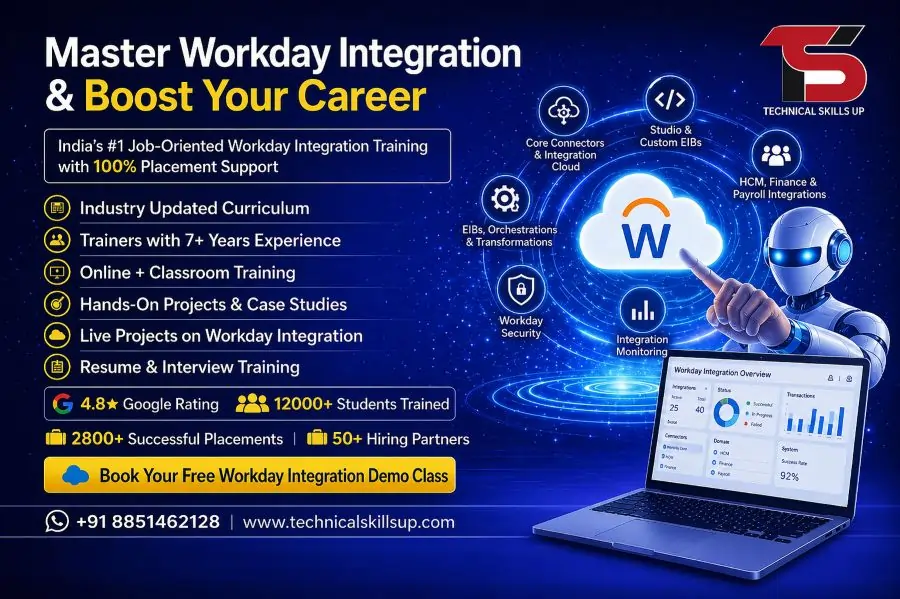
Growing demand for cloud-based HR and finance solutions has created excellent career opportunities for skilled professionals. Workday stands out as one of the most widely used enterprise platforms, and integration expertise has become a high-value skill in the IT industry. A Workday Integration Course in Delhi helps learners understand how different systems connect, exchange data, and automate business processes efficiently. Technical Skills Up focuses on practical learning, real-time scenarios, and industry-relevant tools so that learners gain confidence and job-ready skills. Strong training combined with guided projects supports career growth and prepares candidates for real-world challenges in top organizations.

Why Choose Workday Integration as a Career

High Demand in the Job Market

Companies across industries rely on Workday for HR, payroll, and financial operations. Skilled integration professionals help organizations connect Workday with other systems like SAP, Oracle, and third-party applications.

Attractive Salary Packages

Integration specialists earn competitive salaries due to their technical expertise and problem-solving abilities. Career growth remains strong with experience.

Global Career Opportunities

Workday professionals find opportunities not only in India but also in international markets where Workday adoption is high.

Continuous Learning Scope

Technology keeps evolving, and Workday regularly updates its features. Professionals continue to learn and upgrade their skills over time.

About Technical Skills Up

Industry-Focused Training Approach

Technical Skills Up delivers training that matches current industry requirements. Practical sessions and real-time use cases help learners understand concepts clearly.

Experienced Trainers

Certified trainers with real project experience guide students step by step. Learning becomes easier with proper mentorship and doubt-solving sessions.

Hands-On Practice

Practical exposure remains the core focus of the training. Students work on live projects to gain real-world experience.

Career Support

Placement assistance, resume building, and interview preparation sessions help students secure job opportunities after course completion.

Workday Integration Training in Delhi – Course Overview

Comprehensive Curriculum

The course covers all essential topics required to become a skilled Workday Integration professional. Learning starts from basic concepts and gradually moves to advanced topics.

Beginner to Advanced Level

Structured modules help both freshers and experienced professionals understand Workday integration from scratch.

Real-Time Projects

Project-based learning ensures practical understanding of integration concepts and tools.

Flexible Learning Options

Both online and classroom training options allow learners to choose according to their schedule.

Key Modules Covered in the Course

Introduction to Workday

  • Overview of Workday architecture
  • Understanding Workday modules
  • Basics of cloud computing

Integration Fundamentals

  • Introduction to integrations
  • Types of integrations in Workday
  • Data flow and transformation

Workday Studio

  • Overview of Workday Studio
  • Building integrations using Studio
  • Handling errors and debugging

Core Connectors

  • Pre-built connectors in Workday
  • Configuration and usage
  • Data mapping techniques

EIB (Enterprise Interface Builder)

  • Creating inbound and outbound integrations
  • File-based integrations
  • Data upload and extraction

Web Services and APIs

  • SOAP and REST APIs
  • Consuming web services
  • Security and authentication

XSLT and XML

  • Basics of XML structure
  • Transforming data using XSLT
  • Real-time transformation examples

Integration Security

  • Understanding Workday security model
  • Securing integrations
  • Role-based access control

Testing and Deployment

  • Integration testing strategies
  • Migration to production
  • Monitoring integrations

Workday Integration Classes in Delhi – Learning Benefits

Practical Learning Experience

Hands-on training allows students to work on real integration scenarios and understand workflows.

Live Projects

Real-time projects simulate actual industry challenges and improve problem-solving skills.

Updated Study Material

Latest course content ensures learners stay updated with current Workday trends.

Interactive Sessions

Live classes and doubt-clearing sessions improve understanding and confidence.

Who Can Join This Course

Fresh Graduates

Students from IT, Computer Science, or related fields can start their career in Workday integration.

Working Professionals

Professionals from HR, finance, or IT domains can upgrade their skills and switch to Workday roles.

Career Switchers

Individuals looking to move into cloud-based technologies can benefit from this course.

Developers and Analysts

People with technical backgrounds can easily understand integration concepts and tools.

Skills You Will Gain

Technical Skills

  • Workday integration tools
  • XML and XSLT
  • Web services and APIs
  • Data transformation

Analytical Skills

  • Problem-solving techniques
  • Data mapping and validation
  • Troubleshooting integrations

Professional Skills

  • Project handling
  • Communication
  • Time management

Workday Integration Training Institute in Delhi – Key Features

Structured Learning Path

Step-by-step training ensures proper understanding of each concept before moving ahead.

Expert Guidance

Trainers provide continuous support and mentorship throughout the course.

Project-Based Learning

Real-world projects enhance practical knowledge and build confidence.

Placement Assistance

Dedicated support helps students prepare for interviews and secure jobs.

Career Opportunities After Course Completion

Workday Integration Consultant

Responsible for designing and managing integrations between Workday and other systems.

Workday Developer

Builds custom integrations and enhances system functionality.

Integration Analyst

Analyzes business requirements and designs integration solutions.

Technical Consultant

Provides technical expertise in Workday implementation and integration.

Salary Expectations

Entry-Level Professionals

Freshers can expect a good starting salary with opportunities to grow quickly.

Mid-Level Professionals

Experienced professionals earn higher salaries based on skills and project experience.

Senior-Level Roles

Senior consultants and architects earn premium packages in top companies.

Tools and Technologies Covered

  • Workday Studio
  • Enterprise Interface Builder (EIB)
  • Core Connectors
  • XML & XSLT
  • SOAP & REST APIs

Learning Methodology

Instructor-Led Training

Expert trainers guide students through every module with practical examples.

Hands-On Assignments

Assignments help reinforce concepts learned during training sessions.

Case Studies

Real-world scenarios help students understand industry challenges.

Continuous Evaluation

Regular assessments track progress and improve learning outcomes.

Certification Preparation

Industry-Recognized Knowledge

Course prepares students with skills aligned to industry standards.

Practical Understanding

Hands-on training ensures better performance in certification exams.

Mock Tests

Practice tests help students evaluate their knowledge and improve performance.

Placement Support

Resume Building

Professional resume creation helps highlight skills and projects effectively.

Interview Preparation

Mock interviews and guidance improve confidence and communication skills.

Job Assistance

Support team connects students with job opportunities in top companies.

Why Delhi is a Good Place to Learn Workday

IT Hub Growth

Delhi offers strong career opportunities in IT and cloud technologies.

Access to Companies

Many organizations in Delhi-NCR use Workday, increasing job prospects.

Networking Opportunities

Students can connect with professionals and industry experts.

Advantages of Learning with Technical Skills Up

Quality Education

Focus on delivering practical and industry-relevant knowledge.

Affordable Fees

Cost-effective training options make learning accessible.

Flexible Timings

Weekend and weekday batches available for convenience.

Lifetime Support

Ongoing support helps students even after course completion.

Real-World Project Experience

Integration Development

Students build integrations from scratch to understand workflows.

Data Transformation Projects

Practical assignments on XML and XSLT improve technical skills.

API Integration

Working with APIs helps students understand real-time system communication.

Soft Skills Development

Communication Skills

Training sessions help improve professional communication.

Interview Confidence

Mock interviews prepare students for real job scenarios.

Team Collaboration

Group projects enhance teamwork and coordination skills.

Course Duration and Training Format

Duration

Course duration typically ranges from 2 to 3 months depending on the batch.

Training Mode

  • Classroom training
  • Online live sessions
  • Recorded sessions for revision

How This Course Helps Your Career

Strong Technical Foundation

Learners build a solid base in Workday integration tools and concepts.

Job-Ready Skills

Practical training ensures readiness for real-world job roles.

Career Growth Opportunities

Workday professionals continue to grow with experience and certifications.

Final Thoughts

Choosing the right training institute plays a crucial role in career success. Technical Skills Up provides structured learning, expert guidance, and real-time project experience that helps learners become confident Workday professionals. Strong focus on practical knowledge, combined with placement support, makes this course a valuable step toward a successful IT career. Consistent practice and dedication during training ensure better learning outcomes and long-term professional growth.

Online Courses

Related Courses in Noida

Related Courses in Delhi

FAQs:

Q1. What is a Workday Integration Course?

Ans: A Workday Integration Course is a training program designed to teach how to connect the Workday system with other software or applications. It covers the usage of APIs, Web Services, and various integration tools.

Q2. Why should one pursue a Workday Integration Course in Delhi?

Ans: Delhi has emerged as a major hub for IT and HR technology. Pursuing a Workday Integration Course here offers superior job opportunities, networking prospects, and industry exposure.

Q3. Why choose this course at Technical Skills Up?

Ans: Technical Skills Up provides training delivered by industry experts, along with live projects and practical learning, giving students real-world experience.

Q4. What is the duration of this course?

Ans: The duration of the Workday Integration Course typically ranges from 2 to 4 months, depending on the specific batch and learning mode chosen.

Q5. Is an IT background required for this course?

Ans: While a basic understanding of computers and IT is beneficial, beginners with no prior experience can also successfully learn this course.

Q6. What topics are covered in Workday Integration?

Ans: This course covers key topics such as Workday Studio, EIB, Core Connectors, Web Services, XML, XSLT, and API Integration.

Q7. Does this course include live projects?

Ans: Yes, Technical Skills Up incorporates work on live projects to provide students with hands-on practical experience.

Q8. What job opportunities are available after completing the Workday Integration Course?

Ans: Upon completing this course, one can secure job profiles such as Workday Integration Developer, Consultant, or HR Tech Specialist.

Q9. Does Technical Skills Up provide placement assistance?

Ans: Yes, Technical Skills Up offers comprehensive support including interview preparation, resume building, and job placement assistance.

Q10. What is the salary range for Workday Integration professionals?

Ans: For freshers, the starting salary can range from 4 to 8 lakhs per annum, which increases with experience.

Q11. Is this course available in both online and offline modes?

Ans: Yes, the Workday Integration Course at Technical Skills Up is available in both online and offline learning modes.

Q12. Which tools are taught in this course?

Ans: This course covers tools such as Workday Studio, the EIB Tool, Cloud Integration Tools, and Web Services.

Q13. Is a certificate provided upon completion of the course?

Ans: Yes, upon completing the course, a certificate is issued by Technical Skills Up, which is beneficial for job prospects.

Q14. Does the Workday Integration Course include interview preparation?

Ans: Yes, students receive guidance for interviews, including mock interviews and Q&A sessions.

Q15. What is the fee for the Workday Integration Course in Delhi?

Ans: The fee depends on the institute and the course content. At Technical Skills Up, quality training is provided at an affordable fee.

Java Full Stack Developer Course

Java Full Stack Developer Online Course with Placement

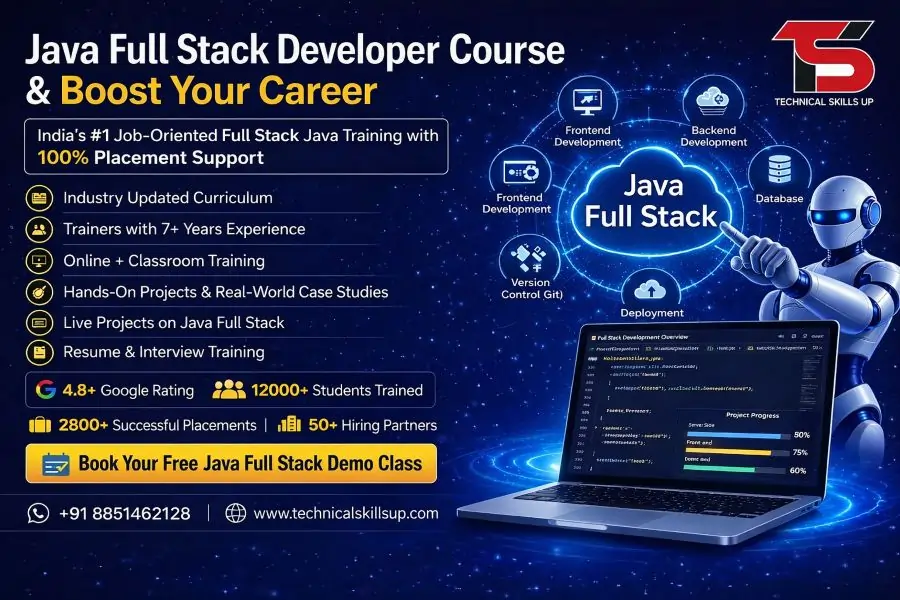
Technology is changing the way businesses operate, and companies need professionals who can build complete web applications from start to finish. The Java Full Stack Developer Course at Technical Skills Up is designed for students, job seekers, working professionals, and career changers who want to build strong software development skills. This training program covers both front-end and back-end development, helping learners understand how modern web applications are created and managed.

Through practical projects, industry-focused training, and expert guidance, learners gain hands-on experience with the tools and technologies used by leading companies. Every module focuses on real-world implementation so students can confidently apply their knowledge in professional environments. A structured learning path, live project exposure, and placement support make this course an excellent choice for building a successful career in software development.

Why Learn Full Stack Development with Java?

Modern organizations prefer developers who can handle multiple parts of an application. Full stack developers understand user interfaces, databases, servers, APIs, and application deployment. Java remains one of the most trusted programming languages because of its reliability, security, and scalability.

Benefits of Learning Java Full Stack Development

  • High demand across industries
  • Strong career growth opportunities
  • Excellent salary packages
  • Opportunities in startups and multinational companies
  • Ability to build complete web applications
  • Strong foundation for software engineering careers
  • Global recognition of Java skills
  • Wide range of job roles available

About Technical Skills Up

Technical Skills Up focuses on practical and career-oriented training. Industry experts deliver sessions designed to bridge the gap between academic learning and real-world requirements.

What Makes Technical Skills Up Different?

  • Experienced trainers from the IT industry
  • Practical learning approach
  • Live projects and case studies
  • Updated curriculum
  • Placement assistance
  • Flexible learning schedules
  • Interview preparation sessions
  • Resume-building support

Course Objectives

This training program aims to help learners develop complete web development skills using Java technologies.

Key Learning Goals

  • Understand programming fundamentals
  • Build responsive user interfaces
  • Develop dynamic web applications
  • Work with databases efficiently
  • Create RESTful APIs
  • Manage application deployment
  • Implement industry best practices
  • Gain project development experience

Skills You Will Learn

Students develop both technical and professional skills during the program.

Technical Skills

  • Core Java Programming
  • Object-Oriented Programming
  • HTML5
  • CSS3
  • JavaScript
  • Bootstrap
  • React JS
  • SQL
  • JDBC
  • Servlets
  • JSP
  • Spring Framework
  • Spring Boot
  • REST API Development
  • Git and GitHub
  • Application Deployment

Professional Skills

  • Problem-solving
  • Team collaboration
  • Communication skills
  • Project management
  • Technical documentation
  • Interview preparation

Course Curriculum

Module 1: Programming Fundamentals

A strong foundation in programming helps learners understand software development concepts effectively.

Topics Covered

  • Introduction to Programming
  • Variables and Data Types
  • Operators
  • Conditional Statements
  • Loops
  • Arrays
  • Functions
  • Basic Problem Solving

Module 2: Core Java

Java forms the backbone of enterprise application development.

Topics Covered

  • Java Introduction
  • Classes and Objects
  • Constructors
  • Inheritance
  • Polymorphism
  • Encapsulation
  • Abstraction
  • Exception Handling
  • Collections Framework
  • Multithreading
  • File Handling

Module 3: Database Management

Applications require secure and organized data storage.

Topics Covered

  • Database Concepts
  • SQL Commands
  • Data Manipulation
  • Joins
  • Views
  • Stored Procedures
  • Database Design
  • MySQL Integration

Module 4: Front-End Development

Modern websites require attractive and responsive interfaces.

Topics Covered

  • HTML5 Fundamentals
  • CSS3 Styling
  • Responsive Design
  • Bootstrap Framework
  • JavaScript Basics
  • DOM Manipulation
  • Form Validation
  • UI Development Techniques

Java Full Stack Course with Practical Learning

A successful developer needs more than theoretical knowledge. Practical implementation helps learners understand how technologies work together in real projects.

Practical Activities Included

  • Coding assignments
  • Mini projects
  • Real-world exercises
  • Application development tasks
  • Code reviews
  • Debugging sessions

Hands-on learning improves confidence and prepares students for workplace challenges.

React JS for Modern User Interfaces

React JS is widely used for building fast and interactive web applications.

Topics Covered

  • React Introduction
  • Components
  • Props and State
  • Event Handling
  • Hooks
  • Routing
  • API Integration
  • Project Development

Practical projects help students understand how modern front-end applications are developed.

Back-End Development with Java Technologies

Backend systems manage application logic, security, and database communication.

Key Concepts

  • Servlets
  • JSP
  • MVC Architecture
  • JDBC Connectivity
  • Session Management
  • Authentication
  • Authorization
  • Error Handling

Students learn how to create secure and scalable applications using industry-standard practices.

Spring Framework and Spring Boot

Modern enterprises rely heavily on Spring technologies for application development.

Topics Covered

  • Spring Core
  • Dependency Injection
  • Spring MVC
  • Spring Boot Fundamentals
  • REST APIs
  • Security Concepts
  • Database Integration
  • Microservices Basics

Practical implementation helps learners understand enterprise-level development processes.

Java Full Stack Training with Live Projects

Project-based learning plays an important role in skill development. Real-world projects help students understand software development workflows and industry standards.

Project Experience Includes

  • Requirement analysis
  • Database design
  • Front-end development
  • Backend integration
  • Testing procedures
  • Application deployment

Sample Projects

  • Online Shopping Portal
  • Employee Management System
  • Student Management System
  • Banking Application
  • Inventory Management System

Project work strengthens technical knowledge and improves problem-solving abilities.

Version Control Using Git and GitHub

Development teams use version control systems to manage code efficiently.

Learning Areas

  • Git Basics
  • Repository Management
  • Branching
  • Merging
  • Pull Requests
  • Collaboration Techniques
  • GitHub Workflows

Knowledge of version control tools is highly valuable for professional developers.

Industry-Focused Learning Approach

Employers look for candidates who can contribute from day one. Training sessions focus on practical implementation and current industry requirements.

Industry-Oriented Features

  • Real-world scenarios
  • Case studies
  • Coding standards
  • Team-based assignments
  • Application deployment exercises
  • Professional development guidance

Java Full Stack Classes for Flexible Learning

Learning flexibility helps students and working professionals manage their schedules effectively.

Available Learning Options

  • Classroom Training
  • Online Live Training
  • Weekend Batches
  • Weekday Batches
  • Fast-Track Programs

Flexible schedules allow learners to continue their education without disrupting existing commitments.

Java Full Stack Certification Course

Certification validates skills and demonstrates technical knowledge to employers.

Certification Benefits

  • Professional credibility
  • Enhanced resume value
  • Better job opportunities
  • Industry recognition
  • Improved confidence during interviews

Course completion certification helps showcase expertise in full stack development technologies.

Java Full Stack Developer Online Course

Online learning provides access to quality education from any location. Interactive sessions ensure that learners receive practical guidance throughout the training journey.

Online Training Features

  • Live instructor-led sessions
  • Interactive classroom environment
  • Practical assignments
  • Recorded session access
  • Project mentoring
  • Technical support

Online learners receive the same curriculum and project exposure as classroom participants.

Career Opportunities After Course Completion

Organizations across various sectors actively hire skilled full stack developers.

Popular Job Roles

  • Java Developer
  • Full Stack Developer
  • Software Engineer
  • Backend Developer
  • Front-End Developer
  • Web Application Developer
  • Application Support Engineer
  • Software Consultant

Industries Hiring Java Professionals

  • Information Technology
  • Banking
  • Healthcare
  • E-Commerce
  • Education
  • Telecommunications
  • Manufacturing
  • Government Projects

Placement Assistance

Career support services help students prepare for employment opportunities.

Placement Support Includes

  • Resume preparation
  • LinkedIn profile guidance
  • Mock interviews
  • Technical interview preparation
  • Aptitude training
  • HR interview sessions
  • Job referrals

Dedicated career guidance increases confidence and improves employability.

Who Can Join This Course?

A structured curriculum makes the program suitable for learners from different educational and professional backgrounds.

Suitable For

  • Students
  • Fresh Graduates
  • Working Professionals
  • Career Changers
  • Software Developers
  • Technical Enthusiasts
  • Engineering Students
  • IT Professionals

No advanced development experience is required to begin learning.

Learning Outcomes

After completing the course, learners will be able to:

  • Develop full-stack web applications
  • Build responsive interfaces
  • Create REST APIs
  • Manage databases effectively
  • Use Spring Boot applications
  • Work with React JS projects
  • Implement secure coding practices
  • Deploy applications successfully

Start Your Career Journey Today

A rewarding career in software development begins with the right training and practical experience. Technical Skills Up provides comprehensive learning, project exposure, expert mentorship, and career guidance to help learners achieve their professional goals. Strong technical knowledge, hands-on practice, and industry-focused training prepare students to meet the growing demand for skilled Java developers in today’s competitive job market.

FAQs:

Q1. What is the Java Full Stack Developer Online Course?

Ans: The Java Full Stack Developer Online Course is a professional training program that teaches frontend, backend, database, and web application development. This course covers technologies such as Java, Spring Boot, HTML, CSS, JavaScript, React, MySQL, and Git.

Q2. Who is the Java Full Stack Developer Course suitable for?

Ans: This course is suitable for freshers, college students, IT professionals, and individuals who wish to build a career in web development. Basic knowledge of programming is beneficial, though not mandatory.

Q3. What subjects are taught in the Java Full Stack Developer Online Course with Placement Assistance?

Ans: This course covers Core Java, Advanced Java, Spring Boot, Hibernate, HTML, CSS, JavaScript, React, REST APIs, MySQL, Git, GitHub, and working on live projects.

Q4. Is prior coding experience required for this course?

Ans: No, the Java Full Stack Developer Online Course is designed for beginners as well. The instructors explain all topics in a step-by-step manner, progressing from a basic to an advanced level.

Q5. What is the duration of the Java Full Stack Developer Course?

Ans: Most Java Full Stack Developer Courses have a duration of 4 to 6 months. The duration may vary depending on the institute, the syllabus, and the level of training provided.

Q6. Does this course offer live online classes?

Ans: Yes, Technical Skills Up provides live online classes where students can ask questions directly to the instructors and learn in real-time.

Q7. What is Placement Assistance?

Ans: Placement Assistance involves providing services such as resume building, interview preparation, mock interviews, job referrals, and career guidance to help students secure employment.

Q8. What job roles are available after becoming a Java Full Stack Developer?

Ans: Upon completing the course, opportunities may arise in roles such as Java Developer, Full Stack Developer, Backend Developer, Web Developer, Software Engineer, and Application Developer.

Q9. What is the current market demand for Java Full Stack Developers?

Ans: Due to the growing need for digital transformation and web applications, the demand for Java Full Stack Developers is consistently rising across various industries.

Q10. Does this course involve working on live projects?

Ans: Yes, students are given the opportunity to work on industry-based live projects, which helps enhance both their practical skills and their confidence.

Q11. Is a certificate provided upon completing the Java Full Stack Developer Online Course?

Ans: Yes, upon successfully completing the training, students are awarded a Course Completion Certificate, which helps strengthen their professional profile.

Q12. Are recorded sessions available?

Ans: Recorded sessions are made available for many online batches, allowing students to revisit any topic whenever needed.

Q13. Which tools are used during the Java Full Stack Developer Course?

Ans: This training teaches the usage of popular development tools such as Eclipse, IntelliJ IDEA, VS Code, MySQL Workbench, Postman, Git, and GitHub.

Q14. What can be the starting salary after completing the Java Full Stack Developer Course?

Ans: The starting salary depends on the candidate’s skills, project experience, location, and the specific company. Strong technical knowledge and practical experience help in securing better opportunities.

Q15. Why choose Technical Skills Up’s Java Full Stack Developer Online Course?

Ans: Technical Skills Up offers experienced trainers, live online classes, an industry-oriented curriculum, practical projects, interview preparation, and placement assistance, enabling students to develop job-ready skills.