
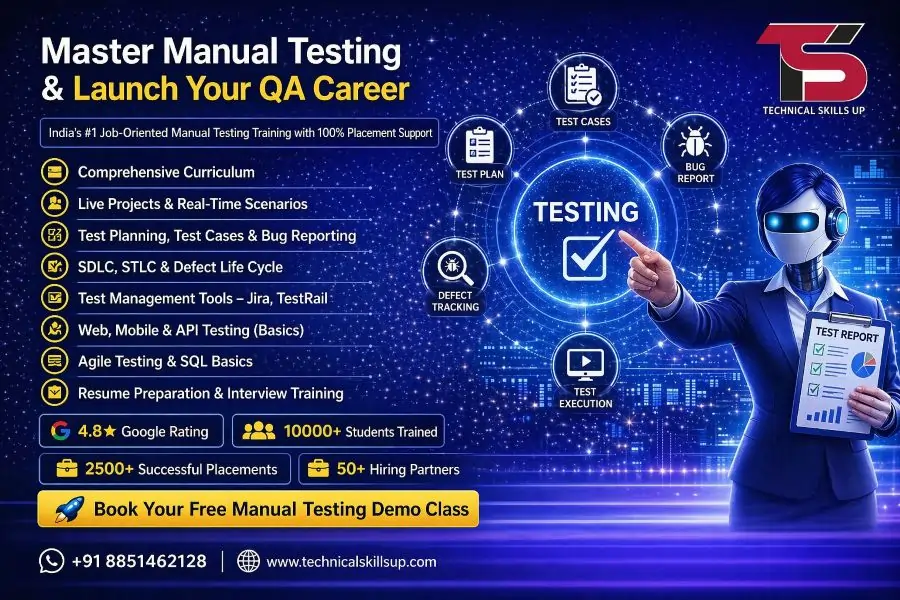
Best Manual Testing Course in Delhi with Placement

A successful career in software testing begins with the right foundation. Technical Skills Up offers a Manual Testing Course in Delhi designed for beginners, graduates, and working professionals who want to enter the IT industry with confidence. This program focuses on real-world skills, practical learning, and industry-relevant knowledge so students can easily understand and apply testing concepts.

Table of Contents

Why Choose Manual Testing as a Career?

Software testing plays a critical role in delivering high-quality applications. Every company needs skilled testers to ensure that their products work smoothly without errors. Manual testing remains the base of all testing processes, even in automation environments.

Manual testing helps you:

  • Understand software functionality deeply
  • Identify bugs before product release
  • Build a strong foundation for automation testing
  • Enter the IT field without coding knowledge

Demand for skilled testers continues to grow across industries such as banking, healthcare, e-commerce, and IT services.

About Technical Skills Up

Technical Skills Up is a trusted name for quality training and skill development. The institute focuses on practical learning and career-oriented programs. Experienced trainers guide students step-by-step so they can understand concepts clearly and apply them in real projects.

Training programs are designed based on current industry requirements. Students receive complete support from learning to placement.

Manual Testing Training in Delhi – Course Overview

This Manual Testing Training in Delhi covers all essential concepts required to become a professional tester. The course starts from basics and gradually moves to advanced topics.

Key highlights of the course:

  • Beginner-friendly curriculum
  • Real-time project exposure
  • Industry-based case studies
  • Practical assignments and tasks
  • Resume building and interview preparation

Students gain hands-on experience with real testing scenarios.

What You Will Learn

The course is structured to give complete knowledge of manual testing. Every module is explained in simple words so that even non-technical students can understand easily.

1. Introduction to Software Testing

  • Basics of software testing
  • Importance of testing in development
  • Types of testing

2. Software Development Life Cycle (SDLC)

  • Different SDLC models
  • Agile and Waterfall methodology
  • Role of testers in each phase

3. Software Testing Life Cycle (STLC)

  • Testing phases and processes
  • Requirement analysis
  • Test planning and execution

4. Test Case Design

  • Writing effective test cases
  • Test scenarios and test data
  • Positive and negative testing

5. Bug Life Cycle

  • Defect reporting process
  • Bug tracking tools
  • Severity and priority concepts

6. Types of Testing

  • Functional testing
  • Regression testing
  • Integration testing
  • System testing
  • User acceptance testing

7. Documentation and Reporting

  • Test plan creation
  • Test reports
  • Daily status reports

8. Real-Time Project Work

  • Working on live projects
  • Understanding real client requirements
  • Practical implementation

Manual Testing Classes in Delhi – Practical Approach

Learning becomes effective when theory meets practice. Technical Skills Up focuses heavily on practical training. Every concept is supported with examples and hands-on exercises.

Students work on:

  • Real-time projects
  • Live testing environments
  • Industry-based case studies

Practice sessions help build confidence and improve problem-solving skills. Trainers guide students during practical tasks so they can learn step-by-step.

Who Can Join This Course?

This Manual Testing Classes in Delhi program is suitable for:

  • Fresh graduates (B.A, B.Com, B.Sc, B.Tech, etc.)
  • Students from non-technical backgrounds
  • Job seekers looking for IT careers
  • Working professionals who want to switch careers

Basic computer knowledge is enough to start learning manual testing.

Benefits of Manual Testing Training

Choosing the right training program can shape your career. Technical Skills Up offers multiple benefits that help students grow professionally.

1. Easy to Understand Learning

Simple explanations help beginners understand concepts quickly. No complex language is used.

2. Industry-Relevant Skills

Course content is updated based on current industry trends.

3. Hands-on Practice

Regular assignments and projects improve practical knowledge.

4. Expert Trainers

Experienced trainers share real-world knowledge and tips.

5. Career Support

Guidance for resume building and interviews is provided.

Manual Testing Training Institute in Delhi – Placement Support

Technical Skills Up provides complete placement assistance to students. Training does not end with learning; the institute helps students get jobs in top companies.

Placement support includes:

  • Resume preparation
  • Mock interviews
  • Interview questions practice
  • Job referrals

Dedicated support increases chances of getting hired quickly.

Career Opportunities After Manual Testing Course

Completing this Manual Testing Training Institute in Delhi program opens many job opportunities. Companies are always looking for skilled testers.

Popular job roles include:

  • Software Tester
  • QA Tester
  • Manual Test Engineer
  • Quality Analyst

Entry-level salaries in this field are attractive, and growth opportunities are strong.

Skills You Will Gain

After completing the course, students develop essential skills such as:

  • Understanding software requirements
  • Writing test cases and scenarios
  • Identifying bugs effectively
  • Reporting defects clearly
  • Working in real-time testing environments

These skills help students perform confidently in interviews and jobs.

Why Technical Skills Up Stands Out

Many institutes offer training, but Technical Skills Up focuses on quality and results. The training approach is designed to make students job-ready.

Key reasons to choose Technical Skills Up:

  • Practical learning approach
  • Small batch sizes for better attention
  • Updated course content
  • Real project exposure
  • Strong placement support

Students receive personal guidance throughout the course.

Learning Environment

A supportive learning environment helps students grow faster. Technical Skills Up provides a comfortable and focused environment where students can learn without pressure.

Interactive sessions encourage students to ask questions and clear doubts. Trainers ensure every student understands the topic before moving forward.

Real-World Exposure

Understanding theory alone is not enough in today’s competitive world. Real-world exposure makes a big difference in learning.

Students work on:

  • Live projects
  • Industry case studies
  • Real testing scenarios

This experience helps students handle actual job responsibilities with ease.

Duration and Training Mode

The course is designed to be flexible for students and working professionals.

Options include:

  • Classroom training
  • Weekend batches
  • Fast-track courses

Flexible timing allows students to learn at their own pace.

Importance of Manual Testing in Industry

Manual testing remains an essential part of software development. Many companies rely on manual testers to ensure quality before automation.

Manual testing helps in:

  • Understanding application behavior
  • Detecting usability issues
  • Improving user experience

Strong manual testing skills make it easier to learn automation tools later.

Build Your IT Career Today

Starting a career in IT does not always require coding knowledge. Manual testing offers a great opportunity to enter the tech industry with the right training.

Technical Skills Up helps students build a strong foundation and gain practical skills. Support from experienced trainers ensures students are ready for real job challenges.

Conclusion

A career in software testing can be both stable and rewarding. Technical Skills Up provides the right platform to learn, practice, and grow. This Manual Testing Course in Delhi is designed to make learning simple, practical, and effective.

Students who complete this training gain confidence, knowledge, and skills needed to succeed in the IT industry. Choosing the right institute can change your career path, and Technical Skills Up stands as a reliable choice for quality training.

Start your journey today and move one step closer to a successful IT career with the best Manual Testing Training in Delhi.

Online Courses

Related Courses in Noida

Related Courses in Delhi

FAQs:

Q1. What is a Manual Testing Course?

Ans: A Manual Testing Course is a program designed to teach you how to test software without the use of any automation tools. In this course, you learn how to identify errors (bugs) within a website or application and how to report them effectively.

Q2. Who is eligible to learn Manual Testing?

Ans: Anyone can take this course, including:

  • Students who have passed the 12th grade
  • Graduates (B.A, B.Com, B.Sc, B.Tech)
  • Individuals with an IT or Non-IT background
  • Professionals looking to switch careers
Q3. What is the duration of the Manual Testing Course?

Ans: Typically, this course lasts for 2 to 3 months. Some institutes also offer fast-track courses that can be completed in 1 to 1.5 months.

Q4. Is coding knowledge required?

Ans: No, coding knowledge is not required for Manual Testing. It is considered one of the easiest IT courses for beginners.

Q5. What topics are covered in the Manual Testing Course?

Ans: This course covers the following topics:

  • Software Testing Basics
  • SDLC & STLC
  • Test Case Writing
  • Bug Reporting
  • Types of Testing
  • Agile Methodology
Q6. What are the job opportunities after learning Manual Testing?

Ans: After completing the Manual Testing course, you can work in the following roles:

  • Software Tester
  • QA Engineer
  • Test Analyst
  • QA Executive
Q7. What is the salary range for a fresher?

Ans: In Delhi, a fresher’s starting salary can range from ₹15,000 to ₹30,000 per month. As your experience grows, your salary increases rapidly.

Q8. Does this course offer placement assistance?

Ans: Yes, institutes like “Technical Skills Up” provide placement assistance, which includes interview preparation, resume building, and job support.

Q9. What is the difference between Manual Testing and Automation Testing?

Ans: In Manual Testing, testing is performed manually, whereas Automation Testing utilizes tools and scripts. Manual Testing is the best option for beginners.

Q10. Is this course available online?

Ans: Yes, this course is available in both online and offline modes. You can choose any option according to your convenience.

Q11. Is practical training provided?

Ans: Yes, this course includes real-time projects and live practice sessions, providing you with valuable industry experience.

Q12. Can non-technical students also learn this?

Ans: Yes, students with a non-technical background can easily learn Manual Testing, as it does not require any coding skills.

Q13. Which tools are used in Manual Testing?

Ans: Some common tools include:

  • JIRA (Bug Tracking)
  • TestRail
  • Bugzilla
Q14. Is a certification provided after the course?

Ans: Yes, upon completing the course, you will receive a certificate from the institute, which is beneficial for job prospects.

Q15. Why should one pursue a Manual Testing course?

Ans: Manual Testing is the easiest way to enter the IT field. It offers excellent career opportunities with a low investment, along with rapid professional growth.

Related Post

Docker Course in Noida with Placement

Technology companies across India are rapidly adopting containerization and cloud-native development. A professional Docker Course in Noida helps students, working professionals, and IT beginners learn modern deployment methods used by top organizations. Technical Skills Up provides practical training with real-time projects, live server practice, and expert guidance to help learners build strong technical skills. Training sessions focus on industry requirements so students can understand Docker concepts in a simple and practical way. Modern software companies need professionals who can manage applications, containers, and cloud environments efficiently. Docker has become one of the most important tools for DevOps, cloud computing, and software deployment. Technical Skills Up offers hands-on learning that helps students understand container creation, image management, networking, orchestration basics, and deployment processes. Every module follows current industry standards and supports career growth in the IT sector. About Technical Skills Up Technical Skills Up provides industry-focused IT training programs designed for career-oriented learners. The institute focuses on practical learning instead of only theoretical concepts. Trainers guide students with live examples, assignments, and project-based learning methods that improve confidence and technical understanding. Learning support includes doubt-clearing sessions, interview preparation, resume building assistance, and placement guidance. Students receive updated study materials and practical exercises that help them gain real-world experience. Why Learn Docker? Docker simplifies software deployment by packaging applications and dependencies into containers. Companies prefer Docker because it improves scalability, portability, and development speed. Professionals with Docker skills are highly valued in DevOps and cloud-related job roles. Key Benefits of Learning Docker Faster application deployment Better resource utilization Easy scalability for applications Simplified software management Improved collaboration between development and operations teams Consistent application environments Reduced infrastructure issues High demand in the IT industry Knowledge of Docker also creates opportunities to learn Kubernetes, cloud computing, CI/CD pipelines, and DevOps tools. Docker Training in Noida for Career Growth Practical technical education helps students become job-ready. Docker Training in Noida at Technical Skills Up focuses on real-world implementation instead of only theoretical explanations. Trainers explain every topic step by step in easy language so beginners can learn comfortably. Course modules are designed according to current industry standards. Students practice Docker commands, container deployment, networking, image creation, Docker Compose, and cloud integration during training sessions. Hands-on learning improves technical confidence and prepares learners for professional environments. Career Opportunities After Docker Training Docker skills are useful for multiple IT job roles, including: DevOps Engineer Cloud Engineer System Administrator Site Reliability Engineer Linux Administrator Software Deployment Engineer Automation Engineer Infrastructure Engineer Demand for DevOps and containerization experts continues to increase because companies are moving applications to cloud platforms. Features of Docker Classes in Noida Professional learning environments help students understand technical concepts more effectively. Docker Classes in Noida at Technical Skills Up include practical labs, live projects, and expert trainer support. Important Training Features 1. Practical Learning Sessions Students practice Docker commands and deployment tasks during every class. Real-time implementation improves understanding and confidence. 2. Experienced Trainers Industry professionals with practical experience guide students through advanced concepts and deployment techniques. 3. Updated Course Modules Training content follows current market trends and industry requirements. 4. Flexible Batch Timings Morning, evening, and weekend batches help students and working professionals manage their schedules comfortably. 5. Live Projects Project-based learning helps students gain real-world technical exposure. 6. Placement Support Career guidance sessions help learners prepare for interviews and job opportunities. 7. Interview Preparation Mock interviews and technical discussions improve communication and technical presentation skills. 8. Study Materials Students receive notes, assignments, and practice resources for better learning. Who Can Join This Course? Technical Skills Up welcomes learners from different educational and professional backgrounds. Suitable Candidates Computer science students IT professionals Software developers Linux administrators Cloud computing learners DevOps beginners System engineers Fresh graduates Basic knowledge of Linux and networking can help learners understand concepts faster, but beginners can also join the course. Course Modules Covered The training program covers beginner to advanced Docker concepts in a structured way. 1. Introduction to Docker Basics of containerization Difference between virtual machines and containers Docker architecture Docker installation 2. Docker Images and Containers Creating containers Managing Docker images Running applications in containers Container lifecycle management 3. Docker Commands Important Docker CLI commands Managing containers Monitoring container performance Docker logs and debugging 4. Docker Networking Bridge networks Host networking Container communication Network configuration 5. Docker Volumes Persistent storage Data sharing between containers Volume management 6. Docker Compose Multi-container applications YAML configuration Service management 7. Docker Registry Docker Hub usage Image pushing and pulling Private repositories 8. CI/CD Basics Docker integration with CI/CD pipelines Deployment automation basics 9. Introduction to Kubernetes Container orchestration basics Kubernetes overview Deployment concepts Advantages of Learning Through Practical Projects Practical implementation improves technical confidence and problem-solving ability. Students work on projects that simulate real business environments. Project Benefits Better understanding of deployment processes Experience with real server environments Improved troubleshooting skills Strong portfolio development Industry-ready practical exposure Hands-on practice also helps students perform better during technical interviews. Docker Training Institute in Noida with Industry-Focused Learning Technical Skills Up follows a structured training approach that combines theory, practice, and project implementation. Docker Training Institute in Noida provides learning support that helps students understand both basic and advanced deployment concepts. Industry-focused training helps learners stay updated with modern technologies used in software development and cloud infrastructure management. Students receive guidance from experienced trainers who explain concepts using practical examples and easy explanations. Importance of Docker in Modern IT Industry Containerization has transformed software development and deployment processes. Companies use Docker to improve efficiency, scalability, and consistency across environments. Industries Using Docker IT services E-commerce companies Banking and finance Healthcare technology Cloud computing organizations Software development companies Startup businesses Professionals with Docker expertise can explore opportunities in multiple industries because containerization technology is widely adopted. Learning Environment at Technical Skills Up A positive and practical learning environment helps students understand technical topics effectively. Training sessions include interactive discussions, lab practice, and project implementation. Student Support Services Doubt-clearing sessions Practice assignments Technical guidance Resume

Best SAP SD Course in Noida with Placement

If you are looking to build a strong career in SAP Sales and Distribution, enrolling in a professional SAP SD Course in Noida can help you gain the skills required to work in top MNCs and IT companies. SAP SD is one of the most in-demand functional modules in SAP, widely used by organizations for managing sales, customer distribution, billing, and order processing. This comprehensive SAP SD training program is designed for beginners, working professionals, and graduates who want to start or switch their career into SAP. The course focuses on real-time project-based learning, practical SAP server access, and industry-oriented training to ensure learners gain hands-on experience. With expert trainers, structured modules, and placement support, this SAP SD course helps you understand business processes and implement them using SAP S/4HANA environment. What is SAP SD? SAP SD (Sales and Distribution) is a core functional module in SAP ERP that manages sales processes including quotation, sales order, delivery, billing, and customer management. It integrates with other SAP modules such as MM, FICO, and PP to provide a complete business solution. SAP SD is widely used in industries such as: Manufacturing Retail E-commerce Logistics Pharmaceuticals Automobile FMCG IT Services Because every company needs a strong sales and distribution system, SAP SD professionals are always in high demand. Why Choose SAP SD Training? SAP SD is ideal for candidates who want to enter functional consulting without programming. This module focuses on business logic and process implementation rather than coding. Key benefits of learning SAP SD: High demand in IT and MNC companies No coding required Good salary packages Multiple job roles available Fast career growth Global opportunities Easy to learn for freshers This course is structured to help learners understand both theoretical and practical aspects of SAP SD. SAP SD Course Highlights This training program includes everything needed to become a SAP SD consultant: Live Instructor-Led Training Real-Time Project Exposure SAP Server Access End-to-End SAP SD Configuration Case Study Based Learning Resume Building Support Mock Interview Preparation Placement Assistance Recorded Sessions Certification Guidance The course is designed according to current industry standards and SAP S/4HANA environment. SAP SD Course Modules Introduction to SAP & ERP What is ERP Introduction to SAP SAP Architecture SAP Modules Overview SAP GUI Navigation SAP Project Landscape Enterprise Structure in SAP SD Company Code Sales Organization Distribution Channel Division Sales Area Plant Assignment Master Data in SAP SD Customer Master Data Material Master Customer Material Info Record Output Master Data Business Partner Concept Sales Document Configuration Inquiry Quotation Sales Order Sales Document Types Item Categories Schedule Line Categories Pricing and Condition Technique Pricing Procedure Condition Tables Access Sequence Condition Types Pricing Determination Discounts & Surcharges Availability Check ATP Check Transfer of Requirements Availability Control Backorder Processing Delivery Processing Outbound Delivery Picking Packing Post Goods Issue Delivery Document Configuration Billing Process Billing Document Invoice Credit Memo Debit Memo Proforma Invoice Billing Types Configuration Credit Management Credit Control Area Credit Limit Risk Category Credit Check Text Determination Header Text Item Text Text Procedure Output Determination Output Types Print Configuration Email Output Partner Determination Partner Functions Partner Procedure Account Determination Revenue Account Determination FI Integration Integration with Other Modules SD with MM SD with FICO SD with PP SAP SD End-to-End Cycle Inquiry to Cash Process Order to Cash Scenario Real-Time Project Who Can Join SAP SD Course? This course is suitable for: B.Com Students BBA / MBA Students Commerce Graduates Marketing Professionals Sales Executives Supply Chain Professionals Freshers Working Professionals ERP Users Career Switchers Even candidates without technical background can easily learn SAP SD. SAP SD Training Methodology The training methodology focuses on practical learning. The course includes: Instructor-Led Live Sessions Classes are conducted by experienced SAP consultants who explain concepts with real-time scenarios. Practical Server Access Students get SAP server access to practice configurations and transactions. Real-Time Case Studies Industry-based examples help students understand business flow. Assignments and Practice Daily assignments improve learning and confidence. Interview Preparation Students get commonly asked SAP SD interview questions. Resume Building Professional resume creation for SAP jobs. Placement Assistance Job support and interview scheduling. SAP SD Training Features Small Batch Size Flexible Batch Timings Weekday & Weekend Batches Online & Classroom Training Recorded Sessions Lifetime Access to Material Hands-on Practice Certification Support Job Assistance SAP SD Course Duration The course duration typically depends on batch type: Fast Track: 4 Weeks Regular Batch: 6 Weeks Weekend Batch: 8 Weeks Each session includes theory + practical implementation. SAP SD Career Opportunities After completing SAP SD training, you can apply for roles such as: SAP SD Consultant SAP SD End User SAP SD Support Consultant SAP Functional Consultant Order Management Executive Sales Operations Analyst SAP Business Analyst SAP Implementation Consultant Top SAP SD consultants are required in almost every industry. SAP SD Salary in India SAP SD salary depends on experience: Freshers:3 LPA – 5 LPA 1–3 Years Experience:5 LPA – 9 LPA 3–5 Years Experience:8 LPA – 15 LPA Experienced Consultants:15 LPA – 25 LPA With real-time experience, salary increases rapidly. Why Choose SAP SD Training in Noida? Noida has become a major IT hub with many MNC companies and SAP implementation partners. Learning SAP SD here provides better job exposure and networking opportunities. Advantages include: IT Company Exposure Better Placement Opportunities Industry Trainers Corporate Training Environment Networking Opportunities Job Openings in Nearby Cities This makes SAP SD Training in Noida a smart choice for career growth. Practical Learning Approach Students learn complete end-to-end business process: Customer Inquiry → Quotation → Sales Order → Delivery → Billing → Payment This complete order-to-cash cycle helps learners understand real SAP project scenarios. SAP SD Certification After completing the training, students receive: Course Completion Certificate Project Experience Certificate Interview Preparation Material Students can also prepare for SAP global certification. SAP SD Placement Support Placement assistance includes: Resume Preparation Interview Questions Mock Interviews Job Referrals LinkedIn Profile Optimization HR Interview Preparation This helps students get job-ready. Learning Outcomes After completing the course, you will be able to: Understand SAP SD business process

Azure DevOps Course in Noida with Placement

Technology continues to transform the way organizations build, test, and deliver software products. Modern businesses need faster development cycles, better collaboration between teams, and reliable deployment processes to stay competitive. Companies across industries are adopting DevOps practices to improve productivity and deliver high-quality software solutions. Technical Skills Up offers a comprehensive Azure DevOps Course in Noida designed to help students, IT professionals, software developers, system administrators, and cloud enthusiasts gain practical knowledge of modern DevOps practices. Strong demand for DevOps professionals has created excellent career opportunities across the technology sector. Organizations seek professionals who can automate workflows, manage cloud environments, improve collaboration, and ensure smooth software delivery. This training program combines theoretical concepts with practical implementation to help learners develop industry-ready skills. Real-world projects, expert guidance, and hands-on exercises provide a learning experience that aligns with current industry standards. Azure DevOps Training in Noida for Modern IT Careers Software development has evolved significantly over the last decade. Traditional development methods often created communication gaps between development and operations teams. DevOps emerged as a solution that brings people, processes, and technology together. Azure DevOps helps organizations streamline software development and deployment processes. Microsoft has developed a powerful platform that supports planning, coding, testing, deployment, and monitoring within a unified environment. Technical Skills Up provides industry-focused learning that helps learners understand: DevOps culture and principles Continuous Integration (CI) Continuous Deployment (CD) Infrastructure as Code Source code management Automated testing Release management Cloud deployment strategies Monitoring and feedback systems Knowledge gained during the course helps learners understand how modern software organizations operate and deliver applications efficiently. Course Overview Modern enterprises rely on automation and cloud technologies to manage software delivery pipelines. Understanding Azure DevOps tools and practices has become essential for IT professionals who want to remain competitive. This course is designed for: Fresh graduates Software developers System administrators Cloud engineers IT support professionals Project managers Testing professionals Network engineers DevOps enthusiasts Learning modules focus on practical implementation rather than only theoretical concepts. Industry-relevant examples allow students to understand how DevOps concepts are applied in real business environments. Training includes: Instructor-led sessions Live project work Practical assignments Case studies Lab exercises Interview preparation Placement assistance Every module is structured to provide a clear understanding of concepts before moving toward advanced implementations. Why Azure DevOps Matters in Today’s Industry Organizations today release software updates much more frequently than before. Customers expect fast improvements, quick bug fixes, and stable applications. Businesses that fail to deliver updates efficiently often struggle to compete. DevOps bridges the gap between development and operations teams by encouraging collaboration, automation, and continuous improvement. Benefits organizations receive from Azure DevOps include: Faster software delivery Improved collaboration Better code quality Reduced deployment risks Increased operational efficiency Enhanced customer satisfaction Faster issue resolution Greater scalability Many multinational companies, startups, and technology firms have adopted DevOps methodologies as a core business strategy. Professionals who understand Azure DevOps practices often become valuable assets within their organizations because they contribute directly to business growth and operational efficiency. Azure DevOps Classes in Noida with Practical Learning Learning DevOps requires more than reading concepts. Practical implementation plays a critical role in developing real-world expertise. Technical Skills Up focuses heavily on hands-on learning. Students work with tools, pipelines, repositories, cloud services, and deployment environments throughout the training program. Practical sessions help learners: Create DevOps pipelines Configure repositories Manage build processes Automate deployments Monitor application performance Troubleshoot deployment issues Implement security practices Industry scenarios are incorporated into classroom exercises so learners understand how challenges are solved in professional environments. Regular lab sessions help build confidence and improve technical problem-solving skills. Skills Covered in the Program DevOps professionals require a combination of technical knowledge, automation expertise, and cloud skills. This program covers a broad range of competencies that align with industry expectations. DevOps Fundamentals Students begin with the foundations of DevOps culture and methodologies. Topics include: DevOps lifecycle Agile concepts Scrum methodology Collaboration principles Continuous improvement practices Version Control Management Source code management is a critical part of software development. Key concepts include: Git fundamentals Branching strategies Merge processes Repository management Collaboration workflows Continuous Integration Modern software teams use continuous integration to improve code quality. Training covers: Build automation Code validation Pipeline creation Automated testing Integration workflows Continuous Deployment Deployment automation reduces human errors and increases efficiency. Students learn: Release pipelines Deployment strategies Environment configuration Deployment approvals Rollback mechanisms Infrastructure as Code Infrastructure management has become increasingly automated. Topics include: Infrastructure provisioning Configuration management Automation techniques Cloud resource deployment Monitoring and Performance Management Monitoring helps organizations identify issues before they affect users. Skills covered include: Application monitoring Log analysis Performance tracking Alert configuration Troubleshooting techniques Tools and Technologies Covered Successful DevOps professionals work with multiple tools across development and deployment environments. Technical Skills Up introduces learners to widely used technologies. Azure DevOps Services Training includes extensive practice on: Azure Boards Azure Repos Azure Pipelines Azure Test Plans Azure Artifacts Git and GitHub Students learn version control and collaboration practices using Git-based repositories. Docker Containerization has become essential in modern application deployment. Training covers: Docker architecture Container creation Image management Container orchestration basics Kubernetes Organizations increasingly use Kubernetes to manage containerized applications. Topics include: Cluster management Pod deployment Service configuration Scaling applications Jenkins Automation remains a key DevOps practice. Students gain exposure to: Jenkins installation Job creation Build automation Pipeline implementation Microsoft Azure Cloud expertise significantly improves career opportunities. Modules include: Azure fundamentals Virtual machines Storage services Networking concepts Cloud deployment Terraform Infrastructure automation skills are highly valued. Training introduces: Terraform basics Resource provisioning State management Infrastructure automation Azure DevOps Certification Course in Noida Professional certification helps validate technical knowledge and demonstrates commitment to continuous learning. Certification preparation included in the course helps learners: Understand exam objectives Practice real-world scenarios Review important concepts Improve confidence Strengthen professional credibility Employers often prefer candidates who possess recognized certifications because certifications indicate validated technical skills. Guidance provided by experienced trainers helps students prepare effectively for certification examinations. Career Opportunities After Azure DevOps Training Demand for