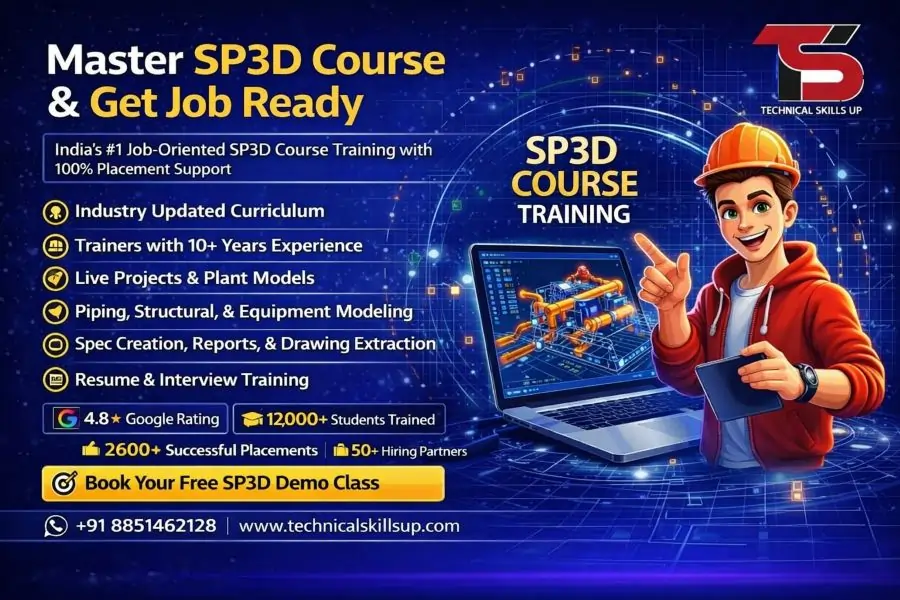
Gaining mastery in 3D design is a gateway to high-paying engineering roles in the global industrial landscape. Noida has emerged as a premier hub for technical education, offering specialized training that bridges the gap between traditional engineering and modern digital modeling. SmartPlant 3D (SP3D) is the industry-standard software used by engineering giants to design complex plants, and securing the right training can redefine your professional trajectory.
SP3D Course in Noida: A Path to Engineering Excellence
Modern engineering projects in the oil, gas, and power sectors demand more than just conceptual knowledge. They require precision, data integration, and the ability to work within a collaborative 3D environment. This course is meticulously designed to provide students with a comprehensive understanding of the SmartPlant 3D environment. By enrolling in an SP3D course in Noida, you align yourself with the requirements of top-tier EPC (Engineering, Procurement, and Construction) companies.
Training modules typically start with the fundamentals of the software interface, ensuring that even those new to 3D modeling feel comfortable. From there, the curriculum dives into specialized domains such as piping, equipment placement, and structural modeling. The goal is to transform a student into a versatile designer capable of handling various aspects of a plant’s lifecycle.
SP3D Training in Noida: Bridging the Skill Gap
Practical application is the cornerstone of effective technical education. SP3D training in Noida focuses heavily on hands-on sessions where learners work on real-world project simulations. This approach ensures that you aren’t just memorizing commands but understanding how to solve design challenges efficiently.
Experienced mentors, often with over a decade of industry experience, guide you through the nuances of the software. They share insights into industry best practices, such as adhering to international codes and standards like ASME and ANSI. This level of mentorship is crucial because it prepares you for the high-pressure environment of actual industrial projects where accuracy is paramount.
SP3D Classes in Noida: Flexible Learning for Everyone
Flexibility is a major advantage of attending SP3D classes in Noida. Whether you are a fresh engineering graduate or a working professional looking to upgrade your skills, there are schedules tailored to your needs. Many institutes offer weekend batches, fast-track programs, and even evening classes to accommodate diverse lifestyles.
The classroom environment fosters collaboration. Interacting with peers from different engineering backgrounds—mechanical, civil, or electrical—provides a holistic view of how different departments interact within a single 3D model. This interdisciplinary understanding is a highly valued trait in senior design roles.
Choosing the Best SP3D Training Institute in Noida
Selecting the right institute is the first step toward a successful career. A top-tier SP3D training institute in Noida will offer more than just a certificate; it will provide a complete ecosystem for growth. Key features to look for include:
- Modern Infrastructure: Labs equipped with the latest software versions and high-performance hardware.
- Industry-Aligned Curriculum: A syllabus that is updated regularly to reflect the changing needs of the global engineering market.
- Expert Faculty: Trainers who have a background in working with MNCs and large-scale industrial projects.
Placement Assistance: Dedicated support for resume building, mock interviews, and connecting students with potential employers.
Institutes like Technical Skills Up prioritize these aspects, ensuring that their students are not just certified but are truly “industry-ready.”
Comprehensive Course Syllabus and Modules
The depth of the course is what determines your proficiency. A standard SP3D program covers several critical modules that form the backbone of plant design:
1. Introduction to the SP3D Environment
This module covers the basic navigation, software architecture, and the importance of the Task-based environment. You learn how to manage workspace and filter data effectively.
2. Piping Design and Routing
Piping is the heart of most industrial plants. You will learn:
Piping hierarchy and specifications.
Route piping and placing components like valves and flanges.
Isometric drawing extraction and spool generation.
3. Equipment Modeling
Learn to place and manipulate standard equipment like pumps, heat exchangers, and vessels. Understanding nozzle orientation and coordinate systems is a key part of this module.
4. Structural Modeling
This involves creating the steel and concrete framework of the plant.
Placing grids and coordinate systems.
Modeling linear members (beams and columns).
Creating slabs, walls, and foundations.
5. Electrical and Instrumentation
Modern plants are automated and powered. You will learn to route cable trays, conduits, and place electrical equipment within the 3D model to ensure there are no clashes with piping or structures.
Why SP3D Skills are in High Demand in 2026
The year 2026 has seen a massive shift toward digital twins and automated engineering. Companies are no longer looking for just “drafters”; they want “intelligent modelers.” SP3D is unique because it is data-centric. Every object placed in the model carries metadata that is used for procurement, construction, and maintenance.
With the expansion of renewable energy plants, hydrogen facilities, and the modernization of existing refineries, the demand for SP3D experts has skyrocketed. Professionals who can navigate this software are seeing significant salary hikes and opportunities for international placements in regions like the Middle East, Europe, and North America.
Career Opportunities After Certification
Completing your training opens doors to various prestigious roles:
Piping Design Engineer: Focus on the complex network of pipes that transport fluids and gases.
- 3D Modeler: Create the visual and data-rich representation of the entire facility.
SP3D Administrator: A high-level role managing the software environment, databases, and project backups.
Structural Designer: Focus on the stability and framework of the plant.
- EPC Consultant: Provide expert advice on project execution and software implementation.
The Impact of SP3D on Project Efficiency
One of the main reasons industries prefer SP3D is its ability to reduce rework. Traditional 2D designs often lead to “clashes”—where a pipe might hit a beam during construction. SP3D’s automated clash detection allows engineers to find and fix these errors in the digital phase, saving millions of dollars in field corrections.
By learning SP3D, you become a part of the solution that makes engineering projects faster, safer, and more cost-effective. Your ability to extract accurate reports, such as Bill of Materials (BOM), directly from the model ensures that the procurement process is seamless.
Global Recognition and Certification
A certification from a reputable institute in Noida holds weight globally. Engineering is a universal language, and SP3D is the tool used by the world’s most successful firms. Having this skill on your resume tells employers that you are familiar with global standards and are ready to contribute to international projects from day one.
International standards like ISO and ASME are integrated into the training, ensuring that your designs are compliant no matter where the project is located. This global relevance is what makes SP3D one of the most bankable skills in the modern job market.
Final Thoughts on Your Learning Journey
Investing in an SP3D course in Noida is an investment in your future. The combination of expert guidance, practical exposure, and a robust curriculum prepares you for the challenges of the 21st-century engineering industry. Whether you are aiming for a role in a local firm or a global MNC, the skills you acquire here will serve as a solid foundation for your career.
Technical Skills Up is committed to providing top-notch education that empowers students. By focusing on quality training and student success, we ensure that every learner leaves our doors with the confidence and competence to excel in the world of 3D design. Take the first step today and join the ranks of elite designers shaping the world of tomorrow.
FAQs:
Q1. What is SP3D, and where is it used?
Ans: SP3D (SmartPlant 3D) is a 3D design software primarily used in heavy industries—such as oil and gas, petrochemicals, and power plants—for plant design and piping.
Q2. What are the educational qualifications required to pursue an SP3D course in Noida?
Ans: Typically, a diploma or a degree (B.E./B.Tech) in Mechanical, Civil, Electrical, or Chemical Engineering is required.
Q3. Can freshers join this course?
Ans: Yes, freshers can pursue this course. It helps you transition from the field of drafting to build a career in 3D modeling and design.
Q4. What are the main modules taught in SP3D?
Ans: The course primarily covers modules such as Piping, Equipment, Structure, Grids, Ducting, and Hangers & Supports.
Q5. What is the duration of the SP3D course in Noida?
Ans: The course typically lasts between 1 to 2 months, depending on the training center’s schedule and your individual learning pace.
Q6. Is training provided on live projects during the course?
Ans: Yes, most reputed institutes in Noida provide hands-on practice using real-time industrial projects to ensure you gain practical experience.
Q7. What is the difference between SP3D and PDMS?
Ans: PDMS is an older, command-based software, whereas SP3D is a modern, data-driven, and user-friendly software. Nowadays, most major companies prioritize SP3D.
Q8. Is knowledge of AutoCAD necessary for this course?
Ans: It is not mandatory; however, if you have an understanding of AutoCAD or engineering drawings, you will be able to learn SP3D much faster and more effectively.
Q9. What kind of job roles can one secure after completing this course?
Ans: You can work as an SP3D Designer, Piping Engineer, Layout Designer, or Plant 3D Modeler.
Q10. What is the average fee for this course in Noida?
Ans: The fee for this course in Noida typically ranges between ₹15,000 and ₹30,000, depending on the facilities provided by the institute and the depth of the training.
Q11. Is a certificate provided after the training?
Ans: Yes, upon successful completion of the course, you are awarded a training certificate, which enhances the value of your resume.
Q12. Do institutes in Noida assist with job placement?
Ans: Many top institutes in Noida (such as Technical Skills Up) provide placement assistance and conduct mock interview sessions to help students secure jobs in multinational companies (MNCs).
Q13. What is the salary package for skilled SP3D professionals?
Ans: At the entry level, one can expect to earn between ₹3 lakhs and ₹5 lakhs per annum. With experience—particularly in Gulf countries—this package can be significantly higher.
Q14. Can this course be pursued online?
Ans: Yes, many institutes do offer online training; however, for 3D modeling, offline or lab-based training is generally considered more effective.
Q15. What is the biggest advantage of learning SP3D?
Ans: The greatest advantage is that you become a highly sought-after professional for EPC (Engineering, Procurement, and Construction) companies—a sector where there is a perpetual shortage of skilled designers.