
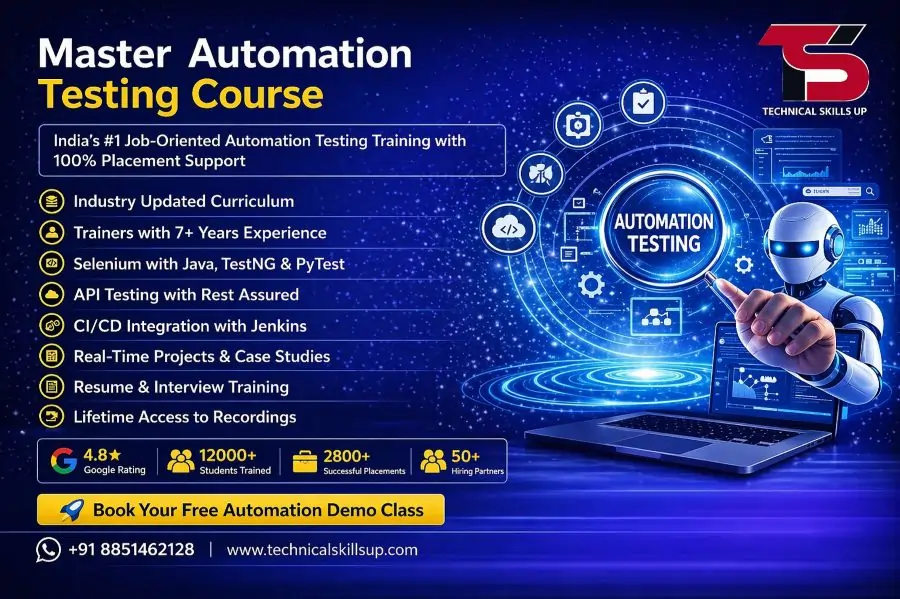
Automation Testing Course in Delhi with Placement

Automation testing has become a must-have skill in today’s fast-growing IT industry. Companies now prefer faster, more accurate, and efficient testing methods to deliver high-quality software. Manual testing alone cannot handle the speed of modern development cycles, which is why automation testing plays a key role.

Technical Skills Up offers a practical and career-focused Automation Testing Course in Delhi designed for beginners as well as working professionals. This course helps you learn real-world skills, tools, and techniques that companies actually use. Every topic is explained in simple language so learners can easily understand and apply concepts in real projects.

Table of Contents

Why Choose Automation Testing as a Career

Growing demand for automation testers makes this field highly rewarding. Organizations want faster product delivery, and automation helps achieve that by reducing manual effort and errors.

High salary packages attract many students and professionals toward this field. Skilled automation testers often get better opportunities compared to manual testers.

Career growth remains strong because automation testing connects with DevOps, Agile, and continuous integration processes. Professionals can move into roles like Test Engineer, Automation Engineer, QA Lead, or even DevOps Engineer.

Job security increases due to continuous demand across industries such as banking, healthcare, e-commerce, and IT services.

About Automation Testing Training in Delhi

Technical Skills Up provides industry-oriented Automation Testing Training in Delhi with a strong focus on practical learning. Trainers use real-time examples to help students understand how automation works in actual projects.

Course structure covers all important tools and technologies needed to become a skilled automation tester. Learning starts from basic concepts and gradually moves toward advanced frameworks and real-time scenarios.

Hands-on practice plays a major role in this training. Students get access to live projects, assignments, and case studies to build confidence and experience.

Key Highlights of the Course

Comprehensive curriculum ensures that learners cover all essential topics related to automation testing. Every module is designed according to current industry requirements.

Experienced trainers guide students with step-by-step explanations and real project insights. Trainers share practical knowledge instead of only theoretical concepts.

Live project work helps learners gain real-world experience. Students learn how to automate test cases for web applications and APIs.

Flexible batch timings support both students and working professionals. Weekend and weekday batches are available.

Placement support helps students prepare for interviews and secure jobs. Resume building and mock interviews improve confidence.

Automation Testing Classes in Delhi – What You Will Learn

Basics of Software Testing

Understanding software testing fundamentals builds a strong foundation. Topics include SDLC, STLC, testing types, and defect lifecycle.

Concept clarity helps learners understand why automation is needed and where it should be used.

Introduction to Automation Testing

Automation testing concepts explain how tools help execute test cases automatically. Students learn advantages, limitations, and real-world usage.

Knowledge of automation benefits helps in deciding when to use automation instead of manual testing.

Selenium WebDriver

Selenium WebDriver is one of the most popular tools used in automation testing. Students learn how to automate web applications using Selenium.

Practical sessions include handling web elements, forms, alerts, dropdowns, and dynamic elements.

Framework development using Selenium helps students understand how large projects are managed.

Programming Basics (Java/Python)

Basic programming knowledge helps in writing automation scripts. Students learn core concepts like variables, loops, conditions, and functions.

Simple coding approach ensures that even non-technical learners can understand programming easily.

TestNG Framework

TestNG helps manage and execute test cases efficiently. Students learn annotations, test execution, reporting, and grouping.

Understanding TestNG improves automation script organization and execution.

Maven and Jenkins

Maven helps in project management and dependency handling. Jenkins supports continuous integration and automation execution.

Integration of tools provides real industry exposure and prepares students for DevOps environments.

API Testing

API testing plays a major role in backend validation. Students learn tools like Postman and automation of APIs.

Practical knowledge of API testing increases job opportunities.

Git and Version Control

Version control tools like Git help manage code changes and collaboration.

Understanding Git helps students work in team environments and manage automation scripts effectively.

Practical Learning Approach

Hands-on training makes learning more effective. Students work on real-time projects to understand how automation testing works in companies.

Assignments and exercises help in improving problem-solving skills. Regular practice ensures better understanding of tools and concepts.

Real project exposure builds confidence and prepares students for job roles.

Who Can Join This Course

Fresh graduates looking to start a career in software testing can benefit from this course.

Manual testers who want to upgrade their skills to automation testing can join.

Working professionals from non-technical backgrounds can also learn automation with proper guidance.

Students from BCA, MCA, B.Tech, or any IT-related field find this course highly useful.

Automation Testing Training Institute in Delhi – Why Technical Skills Up

Technical Skills Up stands out as a trusted Automation Testing Training Institute in Delhi due to its practical approach and industry-focused training.

Quality training ensures that students learn skills that companies actually require.

Affordable course fees make training accessible for everyone.

Small batch sizes allow trainers to give personal attention to each student.

Updated syllabus keeps learners aligned with current industry trends.

Strong placement support increases chances of getting hired.

Tools Covered in the Course

Learning multiple tools helps students become versatile automation testers.

Selenium WebDriver remains the primary tool for web automation.

TestNG helps manage test execution and reporting.

Maven supports project structure and dependency management.

Jenkins enables continuous integration and automation runs.

Postman helps in API testing and validation.

Git supports version control and team collaboration.

Real-Time Project Experience

Working on live projects gives students a clear understanding of industry workflows. Students learn how to create automation frameworks from scratch.

Exposure to real-world scenarios helps in handling complex testing situations.

Project experience improves resume value and increases chances of selection in interviews.

Placement Assistance

Technical Skills Up provides strong placement support to help students start their careers.

Resume building sessions help create professional resumes.

Mock interviews prepare students for real interview situations.

Interview questions and answers help in understanding what companies expect.

Job assistance connects students with hiring companies.

Career Opportunities After Course

Automation testing opens doors to multiple job roles.

Automation Test Engineer role focuses on creating and executing automated test scripts.

QA Engineer role includes both manual and automation testing responsibilities.

SDET (Software Development Engineer in Test) role combines development and testing skills.

Performance Tester role focuses on testing application speed and stability.

DevOps Engineer role becomes possible with additional skills and experience.

Benefits of Learning Automation Testing

Faster testing process improves efficiency and productivity.

Reduced manual effort saves time and resources.

Better accuracy reduces chances of human error.

Improved test coverage ensures higher software quality.

Continuous testing support helps in Agile and DevOps environments.

Course Duration and Structure

Course duration usually ranges from 2 to 3 months depending on the batch type.

Each module is designed to cover theory and practical sessions.

Regular assessments help track progress and understanding.

Flexible schedule supports working professionals and students.

Learning Outcome

Students gain strong knowledge of automation testing concepts and tools.

Ability to write automation scripts independently improves confidence.

Understanding of real-world testing scenarios prepares students for jobs.

Practical experience helps in cracking interviews easily.

Why Automation Testing is Future-Proof

Technology keeps evolving, and automation testing continues to grow with it. Companies adopt Agile and DevOps practices, increasing the need for automation testers.

Cloud-based testing, AI in testing, and continuous integration make automation skills even more valuable.

Future opportunities remain strong for professionals who upgrade their skills regularly.

Conclusion

Automation testing offers excellent career opportunities for anyone interested in software testing and development. Technical Skills Up provides a well-structured and practical Automation Testing Course in Delhi that helps learners build strong skills and confidence.

Simple teaching methods, real-time projects, and placement support make this course a great choice for beginners and professionals. Learning automation testing today can open doors to a successful and stable career in the IT industry.

Taking the right step at the right time can shape your future. Joining a professional Automation Testing Training in Delhi can be the beginning of a rewarding journey in the world of software testing.

Online Courses

Related Courses in Noida

Related Courses in Delhi

FAQs:

Q1. What is Automation Testing?

Ans: Automation Testing is a process in which software testing is performed using tools and scripts, rather than through manual methods. It involves automating repetitive test cases, thereby saving time and enhancing accuracy. In today’s landscape, companies increasingly prefer Automation Testing to ensure rapid delivery and high quality.

Q2. Why should one pursue an Automation Testing Course in Delhi?

Ans: Delhi serves as a prominent IT and training hub, offering access to reputable institutes and abundant placement opportunities. Pursuing an Automation Testing course equips you with practical skills, significantly boosting your chances of securing a job in the IT sector. This course is highly beneficial for fostering career growth.

Q3. What are the key highlights of the Automation Testing Course at Technical Skills Up?

Ans: Technical Skills Up offers an industry-aligned curriculum, hands-on live projects, instruction from experienced trainers, and dedicated placement support. Here, students receive training in a real-time environment, ensuring they become job-ready upon completion.

Q4. Which tools are taught in this course?

Ans: This course covers tools such as Selenium, TestNG, JUnit, Maven, Jenkins, and introduces basic Java or Python. All these tools are widely utilized across the industry.

Q5. What are the eligibility criteria for learning Automation Testing?

Ans: Basic computer literacy is a prerequisite for this course. While having some prior knowledge of programming is advantageous, beginners can also easily master this course.

Q6. What is the duration of the Automation Testing Course?

Ans: Typically, this course spans a duration of 2 to 4 months. Some institutes also offer fast-track or weekend batches, making it convenient for working professionals to acquire these skills.

Q7. Does this course guarantee a job placement?

Ans: If you undergo proper training and engage in consistent practice, your chances of securing a job increase significantly. Technical Skills Up also provides placement assistance to help students navigate the interview process effectively.

Q8. What is the difference between Automation Testing and Manual Testing?

Ans: In Manual Testing, a tester manually executes test cases, whereas in Automation Testing, the testing process is performed automatically with the aid of scripts and tools. Automation Testing is generally faster and more accurate than Manual Testing.

Q9. How much does an Automation Testing Course cost?

Ans: The fees may vary depending on the institute and the course content. Generally, the fee for an Automation Testing Course in Delhi ranges from β‚Ή20,000 to β‚Ή50,000.

Q10. Can non-technical students also take this course?

Ans: Yes, non-technical students can certainly take this course. Programming basics are taught at the beginning, enabling any student to learn with ease.

Q11. What is the career scope in Automation Testing?

Ans: The career scope in Automation Testing is excellent. IT companies are in high demand for automation testers. As your experience grows, both your salary and opportunities increase.

Q12. Does this course include work on live projects?

Ans: Yes, at Technical Skills Up, students get the opportunity to work on live projects. This enhances practical knowledge and strengthens their resume.

Q13. How long does it take to learn Automation Testing?

Ans: It takes 2–3 months to learn the basics, but regular practice is essential to become an expert. The more you practice, the faster your skills will improve.

Q14. Are both online and offline options available?

Ans: Yes, both online and offline training modes are available at Technical Skills Up. Students can choose whichever mode suits their convenience.

Q15. What is the starting salary after completing an Automation Testing Course?

Ans: As a fresher, the starting salary for an Automation Tester can range from approximately β‚Ή3 lakhs to β‚Ή6 lakhs per annum. Salary increases rapidly based on experience and skills.

Related Post

AWS DevOps Course in Noida with Placement

Modern IT industry continues to grow at a rapid pace, creating strong demand for cloud professionals across the world, especially for learners exploring an AWS DevOps Course in Noida that builds real-world, job-ready skills. Companies are actively shifting their infrastructure to cloud platforms, and DevOps practices have become a core part of software delivery pipelines. This shift has created massive opportunities for skilled professionals who understand automation, cloud computing, deployment strategies, and infrastructure management. Technical Skills Up focuses on providing practical, industry-oriented learning that helps students and working professionals build strong expertise in AWS and DevOps technologies. The goal of this program is not only to teach concepts but also to develop hands-on confidence so learners can work in real corporate environments. With a structured curriculum, live projects, and expert guidance, this training helps learners move toward a successful cloud career with clarity and confidence. Course Overview of AWS DevOps Training in Noida Modern cloud adoption has changed the way applications are built, deployed, and managed. Technical Skills Up offers a structured learning path designed for beginners as well as experienced professionals who want to upgrade their cloud skills. Structured Learning Path for Career Growth The program begins with fundamental cloud concepts and gradually moves toward advanced DevOps practices. Learners understand how AWS services work together and how automation improves software delivery speed and reliability. Key learning stages include: Introduction to cloud computing concepts AWS core services and architecture DevOps lifecycle and principles Continuous integration and continuous deployment (CI/CD) Infrastructure as Code (IaC) implementation Monitoring, logging, and optimization techniques Real-World Project-Based Learning Practical exposure plays a key role in this program. Students work on real-time scenarios that simulate industry environments. This helps in building confidence and problem-solving skills required in professional roles. Importance of AWS DevOps Training in Noida in Today’s Industry Cloud computing and DevOps have become essential pillars of modern software development. Organizations prefer professionals who can manage both development and operations efficiently. Growing Demand in IT Companies Companies are increasingly adopting cloud-native technologies to improve scalability and performance. This shift has created a strong demand for skilled professionals trained in AWS and DevOps practices. Benefits of learning DevOps with AWS: Faster software deployment cycles Improved system reliability Reduced operational costs Better collaboration between teams Scalable infrastructure management Career-Driven Skill Development Learning AWS DevOps is not just about technical knowledge; it is about building a career foundation in one of the fastest-growing domains in IT. Training from Technical Skills Up ensures learners stay aligned with industry expectations. Skills Covered in AWS DevOps Classes in Noida The curriculum is designed to cover both foundational and advanced skills required for real-world job roles. Core Technical Skills Learners gain strong understanding of: Linux fundamentals for cloud operations AWS architecture and services Networking basics in cloud environments Version control using Git and GitHub Containerization using Docker Kubernetes orchestration basics DevOps Engineering Skills Advanced DevOps concepts include: CI/CD pipeline creation and management Automation scripting using Shell and Python Configuration management tools Infrastructure automation techniques Cloud monitoring and performance optimization Problem-Solving and Analytical Skills Along with technical expertise, learners develop: Logical thinking for system design Troubleshooting production issues Optimization of cloud resources Deployment strategy planning Tools and Technologies Covered in AWS DevOps Training Institute in Noida Modern DevOps engineers rely on multiple tools to manage infrastructure and automation. This program ensures learners get exposure to industry-standard technologies. AWS Cloud Services Students work on essential AWS services such as: EC2 for virtual servers S3 for storage management RDS for database solutions IAM for access control VPC for network configuration CloudWatch for monitoring DevOps Tools Ecosystem Hands-on training includes tools widely used in IT companies: Jenkins for CI/CD automation Docker for container management Kubernetes for orchestration Git for version control Ansible for configuration management Terraform for infrastructure as code Supporting Technologies Additional tools help strengthen overall learning: Linux command line Bash scripting Python basics for automation YAML configuration files Career Opportunities After AWS DevOps Certification Course in Noida The IT industry offers strong career opportunities for skilled DevOps professionals. Completing this training opens multiple job roles across different domains. Popular Job Roles Learners can apply for positions such as: DevOps Engineer Cloud Engineer AWS Solutions Architect (Junior Level) Site Reliability Engineer (SRE) Build and Release Engineer Infrastructure Engineer Salary Growth Potential DevOps professionals are among the highest-paid in the IT industry. Salary packages increase significantly with experience and certifications. Entry-level professionals can expect strong starting packages, while experienced engineers often move into high-paying global roles. Freelancing and Remote Work Options Cloud skills also open opportunities for: Remote DevOps projects Freelance cloud consulting International contract-based roles Industry Demand and Future Scope of AWS DevOps Training in Noida The future of IT is heavily dependent on cloud and automation technologies. DevOps continues to evolve as a critical discipline in software development. Cloud-First Approach in Businesses Organizations are moving toward cloud-first strategies to improve performance and reduce infrastructure costs. AWS remains one of the leading platforms in this transformation. Automation Driving Future Growth Automation is becoming essential in every IT process. DevOps professionals who understand automation tools are highly valued in the industry. Long-Term Career Stability Cloud and DevOps skills offer long-term career stability due to: Continuous industry demand Global job opportunities Constant technological evolution High salary growth potential Why Choose Technical Skills Up for AWS DevOps Classes in Noida Technical Skills Up focuses on delivering practical and career-oriented education rather than just theoretical knowledge. Experienced Industry Trainers Training is delivered by professionals with real industry experience. Learners gain insights into how companies actually work with AWS and DevOps pipelines. Job-Oriented Curriculum The curriculum is designed based on current industry requirements. It ensures learners are prepared for real job roles from day one. Personalized Learning Support Students receive guidance based on their learning speed and background. Doubt-clearing sessions help strengthen understanding. Key benefits include: Step-by-step learning approach Real-time project exposure Career counseling support Interview preparation assistance Training Methodology for AWS DevOps Training Institute in Noida The teaching approach

Revit MEP Course in Noida with Placement

Modern construction projects demand smart building design, accurate planning, and efficient coordination between teams. Strong knowledge of MEP systems helps professionals work on real-world projects with confidence and better technical understanding. Technical Skills Up offers a practical learning environment for students, working professionals, and job seekers who want to improve their design and BIM skills through a professional Revit MEP Course in Noida. Industry-focused training, live project practice, and expert mentorship help learners gain practical exposure that matches current market needs. Every module focuses on real project workflows so students can understand HVAC, electrical, and plumbing systems in a better way. Professional guidance, structured learning, and hands-on exercises make the training easy to understand for beginners as well as experienced candidates looking for career growth. Why Learn Revit MEP? Building projects now depend heavily on BIM technology for planning and execution. Companies prefer professionals who understand smart modeling, clash detection, and coordinated design workflows. Revit MEP helps engineers and designers create accurate building system models with improved productivity. Benefits of Learning Revit MEP Helps create intelligent 3D models for building systems Improves coordination between architecture, structure, and MEP teams Reduces project errors and rework Enhances project visualization and documentation Supports faster project delivery Increases career opportunities in construction and BIM industries Builds practical knowledge for real-time projects Helps professionals work on international standards About Technical Skills Up Technical Skills Up focuses on practical and career-oriented technical training programs. Expert trainers with industry experience guide students using real examples and project-based learning methods. Training sessions help learners understand concepts step by step in simple language. Key Highlights of Training Industry-expert trainers Practical project-based learning Updated course curriculum Hands-on software practice Interview preparation support Flexible class timings Online and classroom training options Career guidance sessions Certification support Placement assistance Revit MEP Classes Designed for Beginners and Professionals Many learners join technical courses with different educational and professional backgrounds. Simple teaching methods and structured modules help every student learn comfortably. Trainers explain concepts with practical examples to make learning easy and effective. Suitable for Mechanical engineers Electrical engineers Civil engineers Diploma holders Architects BIM professionals Site engineers HVAC professionals Fresh graduates Working professionals Industry-Focused Revit MEP Course Modules Every topic in the course focuses on practical implementation and real project requirements. Step-by-step learning helps students gain confidence while working on software tools and project documentation. Introduction to BIM and Revit Students first learn the fundamentals of Building Information Modeling and software interface understanding. Topics Covered BIM concepts Revit interface Project setup Navigation tools Templates and settings Worksharing basics Mechanical Module Mechanical systems form an important part of modern building projects. Detailed HVAC modeling practice helps learners understand practical workflows. Mechanical Topics HVAC fundamentals Duct creation and modification Air terminals Mechanical equipment placement System connections HVAC documentation Schedules and annotations Electrical Module Electrical design training focuses on practical modeling and system coordination. Key Electrical Topics Electrical settings Lighting systems Cable tray modeling Power circuits Electrical fixtures Panel schedules Electrical documentation Plumbing Module Plumbing system training helps students create accurate piping systems for building projects. Key Plumbing Topics Pipe modeling Plumbing fixtures Pipe fittings Water supply systems Drainage systems Pipe schedules Plumbing layouts Coordination and Clash Detection Coordination between disciplines improves project quality and reduces design conflicts. Important Concepts Linked models Coordination review Clash understanding Interdisciplinary workflow Model collaboration Project Documentation Professional documentation skills play an important role in project execution. Documentation Topics Sheet creation View templates Annotation tools Dimensioning Legends and schedules Printing and exporting Practical Learning with Live Projects Practical exposure improves technical confidence and software understanding. Students work on industry-based assignments and projects to understand real workflows used by companies. Practical Training Features Real project exercises Lab-based practice sessions Industry case studies Assignment-based learning Model creation practice Project documentation tasks Strong practical exposure helps students prepare for professional job responsibilities in BIM and MEP industries. Career Opportunities After Revit MEP Training in Noida Construction, infrastructure, and BIM industries continuously look for skilled professionals who can manage building system design using advanced software tools. Career opportunities increase significantly after gaining practical software skills. Popular Job Roles Revit MEP Designer BIM Modeler HVAC Designer Plumbing Modeler Electrical BIM Engineer MEP Coordinator BIM Engineer Project Design Engineer Industries Hiring Revit MEP Professionals Construction companies Architectural firms MEP consultancies BIM companies Infrastructure projects Engineering design firms Smart building projects Professional Trainers with Industry Experience Experienced trainers help students understand professional workflows and industry standards. Practical knowledge shared by experts gives learners better understanding of project execution and software implementation. Trainer Support Includes Live software demonstrations Project guidance Doubt-solving sessions Career counseling Portfolio guidance Industry tips and best practices Professional mentorship helps students improve both technical and practical knowledge. Easy-to-Understand Learning Approach Complex technical topics become easier when training follows a structured and practical method. Technical Skills Up focuses on simplified explanations and real examples instead of confusing theoretical teaching. Learning Advantages Simple explanations Step-by-step software practice Practical assignments Interactive sessions Beginner-friendly teaching Revision support Comfortable learning methods help students gain confidence faster during training. Modern Infrastructure and Lab Support A professional learning environment improves the overall training experience. Proper software setup and practical labs help students practice efficiently. Training Facilities Advanced computer labs Updated software tools Projector-based learning High-speed internet support Comfortable classrooms Practice support sessions Professional infrastructure creates a better environment for skill development. Flexible Training Options Different students and professionals require different learning schedules. Flexible training options help learners manage education, jobs, and personal commitments easily. Available Training Modes Classroom training Online instructor-led training Weekend batches Weekday batches Fast-track training Flexible schedules help working professionals continue learning without disturbing their jobs. Certification Support for Career Growth Professional certification helps improve resume value and industry recognition. Technical Skills Up provides guidance to help students complete training confidently and prepare for professional opportunities. Certification Benefits Improves professional profile Enhances job opportunities Demonstrates software knowledge Builds industry credibility Helps during interviews Strong certification support increases confidence among students preparing for technical careers. Placement Assistance for Students

Ansible Course in Delhi | Ansible Training in Delhi

Technology continues to change the way organizations manage servers, applications, cloud platforms, and IT infrastructure. Companies now prefer automation over manual processes because automation reduces errors, saves time, and improves efficiency. Modern businesses need professionals who can automate deployment, configuration management, application provisioning, and infrastructure tasks. Technical Skills Up offers an industry-focused Ansible Course in Delhi designed for students, working professionals, system administrators, cloud engineers, and DevOps enthusiasts who want to gain practical automation skills. The program combines theoretical concepts with hands-on training to help learners understand real-world automation workflows used across industries. Learning automation has become an important step for professionals who want to advance their careers in cloud computing, DevOps, infrastructure management, and software deployment. Practical exposure, project-based learning, and expert guidance help learners gain confidence while working on enterprise-level environments. Strong automation knowledge not only improves technical skills but also opens doors to exciting career opportunities in leading organizations. Through structured learning, practical assignments, and expert mentorship, learners can develop the expertise required to work confidently with modern IT infrastructure and automation platforms. Ansible Training in Delhi – Course Overview Organizations across industries use automation tools to simplify repetitive IT tasks and improve operational efficiency. Ansible has emerged as one of the most popular automation platforms because of its simplicity, flexibility, and agentless architecture. This training program has been carefully designed to help learners understand automation concepts from beginner to advanced levels. Every topic follows a step-by-step approach so that students can build a strong foundation before moving toward advanced automation scenarios. Key Highlights of the Program Instructor-led live sessions Practical lab environment Real-world automation projects Industry-relevant curriculum Cloud and DevOps integration concepts Resume preparation guidance Interview preparation support Certification assistance Placement support Flexible learning options Practical implementation remains the core focus throughout the training program. Learners work on multiple automation scenarios to understand how automation improves operational efficiency in enterprise environments. Why Automation Skills Matter in Modern IT Businesses manage hundreds or even thousands of servers, applications, and cloud resources. Manual management consumes significant time and increases the possibility of configuration errors. Automation helps organizations: Reduce operational costs Improve deployment speed Maintain consistency Increase productivity Minimize human errors Enhance infrastructure reliability Accelerate software delivery Modern DevOps practices rely heavily on automation tools. Employers actively seek professionals who can automate infrastructure and deployment processes to improve business outcomes. Growing digital transformation initiatives have increased the demand for automation specialists across industries such as banking, healthcare, e-commerce, telecommunications, education, manufacturing, and IT services. Ansible Classes in Delhi with Practical Learning Learning becomes more effective when theoretical knowledge is supported by hands-on practice. Technical Skills Up focuses heavily on practical training to ensure learners gain real implementation experience. Dedicated lab sessions allow participants to work on automation tasks that closely resemble industry environments. Every concept is demonstrated through practical examples before learners perform the same tasks independently. Practical Activities Included Server configuration automation Application deployment automation User management automation Package installation automation Infrastructure provisioning Configuration management Security automation tasks Multi-server orchestration Cloud automation exercises DevOps workflow implementation Hands-on exposure helps learners understand how automation works in real business scenarios rather than only learning theoretical concepts. Skills Covered in the Program Successful automation professionals require both technical understanding and practical implementation skills. The curriculum covers a wide range of topics to prepare learners for real-world job roles. Fundamentals of Automation Understanding automation concepts forms the foundation of successful implementation. Learners explore automation principles, benefits, workflows, and business applications. Topics include: Introduction to automation Infrastructure automation concepts Configuration management basics Automation architecture IT operations automation Enterprise automation practices Ansible Architecture A clear understanding of architecture helps learners design efficient automation workflows. Coverage includes: Control node concepts Managed node communication Inventory management SSH communication Agentless architecture Configuration files Playbooks and YAML Playbooks are the heart of automation workflows. Students learn: YAML fundamentals Playbook structure Tasks and modules Variables Conditions Loops Handlers Tags Inventory Management Efficient inventory management enables organizations to manage multiple systems easily. Topics include: Static inventory Dynamic inventory Inventory groups Host variables Group variables Environment management Advanced Automation Concepts Advanced topics help learners build enterprise-level automation solutions. Coverage includes: Roles Templates Jinja2 Vault Collections Reusable automation components Tools and Technologies Covered Modern automation environments involve multiple technologies. Learners gain exposure to tools commonly used in enterprise environments. Linux Administration Strong Linux knowledge supports automation implementation. Topics include: File management User management Package management Permissions Services Networking basics Version Control Automation projects often require collaboration and version tracking. Coverage includes: Git fundamentals Repository management Branching concepts Version control workflows Cloud Platforms Cloud automation skills are highly valuable in today’s market. Learners understand automation concepts related to: Amazon Web Services Microsoft Azure Google Cloud Platform DevOps Integration Automation plays a critical role within DevOps workflows. Topics include: Continuous Integration Continuous Deployment Infrastructure as Code Release automation Configuration management Container Technologies Modern deployment environments often use containers. Exposure includes: Docker fundamentals Container automation concepts Deployment workflows Ansible Certification Course in Delhi for Career Growth Professional certifications help validate technical skills and improve credibility in the job market. Training at Technical Skills Up prepares learners with the knowledge required to understand certification objectives and industry expectations. Certification preparation support includes: Concept revision sessions Practice exercises Mock assessments Project implementation Interview-oriented discussions Employers often value certified professionals because certifications demonstrate commitment to professional development and continuous learning. Real-World Projects Included Project-based learning helps bridge the gap between training and industry requirements. Participants work on practical projects such as: Infrastructure Automation Project Learners automate server configuration and infrastructure deployment processes. Application Deployment Project Projects focus on automating application installation and deployment across multiple servers. Configuration Management Project Students implement configuration consistency across large environments. Cloud Automation Project Practical exercises demonstrate automation workflows in cloud-based environments. Enterprise Automation Project Complex automation scenarios help learners understand enterprise implementation strategies. Project experience strengthens practical understanding and enhances resume quality. Career Opportunities After Training Automation skills are highly valued across various technology domains. Organizations actively hire professionals who can