
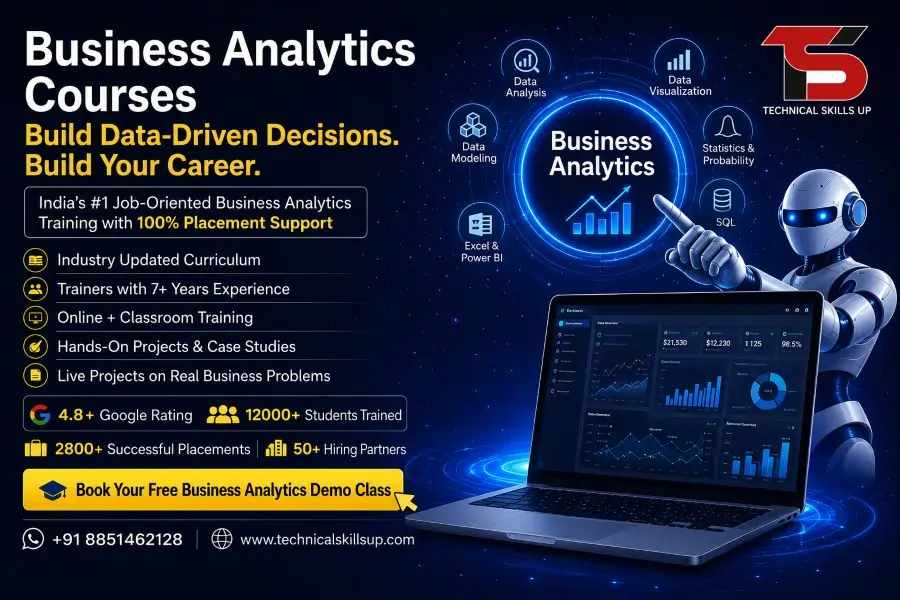
The Business Analytics Course in Delhi offered by Technical Skills Up focuses on building strong analytical thinking and practical data skills required in modern business environments. This program helps learners understand how raw data transforms into meaningful insights that support better decision-making in companies. Students gain exposure to real business problems, case studies, and industry-based scenarios that improve their analytical mindset. The training structure supports beginners as well as working professionals who want to upgrade their skills in analytics and reporting. Strong emphasis remains on practical learning, hands-on exercises, and tool-based training so that learners become job-ready. The program also builds confidence in working with data visualization, dashboards, and business intelligence concepts that are widely used in the corporate world today.
Importance of Business Analytics in Modern Industry
Modern businesses depend heavily on data-driven decision-making to stay competitive and efficient. Organizations collect large volumes of data from customers, sales, marketing campaigns, and operations. Proper analysis of this data helps companies understand trends, customer behavior, and market opportunities. Business analytics plays a major role in improving business performance by identifying problems early and suggesting effective solutions. Companies across finance, healthcare, retail, IT, and e-commerce rely on analytics professionals to guide strategic decisions. Growing demand for skilled analysts makes this field one of the most promising career paths for fresh graduates and professionals. Strong analytical knowledge helps businesses reduce risks, improve profitability, and enhance customer satisfaction.
Course Objectives and Learning Approach
Learning outcomes of this program focus on developing a strong foundation in data interpretation, statistical analysis, and business intelligence tools. Students understand how to clean, organize, and analyze data using structured methods. Training sessions include step-by-step guidance to ensure clarity of concepts even for beginners. Practical assignments help learners apply theoretical knowledge in real-world scenarios. Industry-focused curriculum ensures alignment with current job market requirements. Development of problem-solving skills remains a key objective so learners can confidently handle business challenges using data insights. Communication skills for presenting analytical findings also form an important part of the training approach.
Curriculum Structure and Key Modules
Structured curriculum design covers essential topics required for a successful career in business analytics. Learners start with foundational concepts of data handling and gradually move toward advanced analytical techniques. Key modules include data analysis fundamentals, Excel for analytics, SQL for database management, Power BI dashboard creation, and introduction to Python for data analysis. Each module includes practical assignments that reinforce learning. Case studies based on real business scenarios help students understand how analytics functions in corporate environments. The course also includes visualization techniques that help in presenting data in a clear and impactful manner.
Tools and Technologies Covered
Hands-on training includes widely used industry tools that enhance job readiness. Microsoft Excel remains a core tool for data analysis and reporting. SQL helps in managing and extracting data from databases efficiently. Power BI supports advanced dashboard creation and data visualization. Python introduces learners to data manipulation, automation, and basic machine learning concepts. Exposure to these tools ensures that students develop practical skills required by employers. Regular practice sessions and assignments strengthen technical confidence and improve accuracy in data handling tasks.
Skills Developed During Training
Strong analytical thinking ability develops throughout the training program. Learners gain expertise in interpreting complex data sets and converting them into meaningful business insights. Technical skills include data cleaning, data visualization, and report generation. Problem-solving ability improves through case-based learning methods. Communication skills enhance as students learn to present findings in a structured and professional manner. Logical reasoning and decision-making skills also grow significantly. Confidence in working with business intelligence tools prepares learners for real corporate environments.
Training Methodology and Learning Experience
Interactive training methodology ensures better understanding and long-term retention of concepts. Classroom and online sessions include live demonstrations, practical exercises, and real-time problem solving. Experienced trainers with industry backgrounds guide students through complex topics in a simplified manner. Regular practice assignments and quizzes help in tracking progress. Doubt-clearing sessions ensure clarity on every topic. Project-based learning encourages students to apply knowledge in realistic business scenarios. Continuous feedback helps learners improve performance and build confidence.
Real World Projects and Practical Exposure
Practical exposure plays a major role in skill development. Students work on industry-based projects such as sales analysis, customer segmentation, financial reporting, and marketing performance evaluation. These projects help learners understand how businesses use analytics to improve decision-making. Real datasets provide experience similar to actual workplace environments. Project work enhances analytical thinking and improves technical implementation skills. Portfolio development through projects helps students showcase their abilities during job interviews.
Career Opportunities After Completion
Career paths in business analytics open doors to multiple job roles across different industries. Common roles include business analyst, data analyst, reporting analyst, and junior data scientist. Organizations in IT, banking, consulting, and e-commerce regularly hire skilled analytics professionals. Entry-level opportunities also exist for fresh graduates with strong analytical and technical skills. Career growth in this field remains strong due to increasing demand for data-driven decision-making. Long-term opportunities include senior analyst, analytics manager, and business intelligence consultant roles.
Certification Value and Industry Recognition
Certification from Technical Skills Up adds value to professional profiles by validating skills and knowledge in business analytics. Employers recognize certified professionals as more reliable and job-ready. Certification demonstrates practical understanding of tools and techniques used in analytics projects. Resume strength improves significantly after completion of the course. Interview performance also enhances due to practical exposure gained during training. Industry-oriented certification supports career advancement and helps in securing better job opportunities.
Why Choose Technical Skills Up for Analytics Training
Experienced trainers with real industry exposure provide quality education and practical insights. Learning environment focuses on skill development rather than only theoretical knowledge. Updated curriculum ensures alignment with current industry requirements and job trends. Small batch sizes allow personalized attention for each learner. Continuous mentorship supports students throughout the learning journey. Practical training approach ensures readiness for corporate challenges. Strong focus on E-E-A-T principles builds trust and credibility among learners. Consistent support system helps students achieve career goals effectively.
Placement Assistance and Career Support
Dedicated placement support system helps students prepare for job interviews and recruitment processes. Resume building sessions improve professional presentation of skills and experience. Mock interviews help candidates gain confidence and understand interview patterns. Job referrals and networking opportunities increase chances of employment. Guidance on communication and technical rounds prepares students for real interview scenarios. Career counseling sessions help learners choose the right job roles based on their strengths and interests. Continuous support remains available until successful placement.
Industry Relevance and Market Demand
Growing importance of data analytics across industries increases demand for skilled professionals. Companies rely on analytics to improve efficiency, reduce costs, and enhance customer satisfaction. Digital transformation has made data one of the most valuable business assets. Organizations prefer candidates with practical knowledge of analytics tools and techniques. Demand continues to rise in sectors such as finance, healthcare, retail, and technology. Strong industry relevance makes business analytics a stable and future-proof career choice.
Learning Outcomes and Professional Growth
Completion of this program builds strong technical and analytical capabilities required in modern workplaces. Learners become capable of handling data-driven tasks with confidence and accuracy. Ability to create dashboards, generate reports, and analyze business performance improves significantly. Problem-solving mindset strengthens through continuous practice and project work. Professional communication skills help in presenting insights clearly to management teams. Overall development ensures readiness for entry-level as well as advanced analytics roles in the industry.
Final Perspective on Career Development
A structured learning journey in business analytics builds a strong foundation for long-term career success. Practical exposure, industry-relevant tools, and expert mentorship create a complete learning experience. Growth opportunities in this field continue to expand as organizations increasingly depend on data insights. Strong technical skills combined with analytical thinking create a powerful career advantage. Technical Skills Up ensures that learners gain both knowledge and confidence required to succeed in competitive job markets.
FAQs:
Q1. What is a Business Analytics Course?
Ans: A Business Analytics Course is a program designed to provide training on how to make business decisions by analyzing data. It covers subjects such as Excel, SQL, Power BI, Tableau, and Data Interpretation.
Q2. Is this course suitable for beginners?
Ans: Yes, this course is suitable for beginners as well. It offers step-by-step training, ranging from basic fundamentals to advanced levels.
Q3. Which tools are taught in the Business Analytics course?
Ans: This course covers tools such as Excel, SQL, Python, Power BI, Tableau, and various Data Visualization tools.
Q4. What is the duration of this course?
Ans: The duration of the Business Analytics course typically ranges from 3 to 6 months, depending on the specific training program.
Q5. Does Technical Skills Up provide placement assistance?
Ans: Yes, Technical Skills Up provides students with placement assistance, interview preparation, and resume-building support.
Q6. What are the job opportunities available after completing this course?
Ans: After completing this course, you can pursue roles such as Data Analyst, Business Analyst, MIS Executive, and Reporting Analyst.
Q7. Is this course available in both online and offline modes?
Ans: Yes, this course is available in both online and offline modes, allowing students to learn according to their own convenience.
Q8. Does the course include real-time projects?
Ans: Yes, students get the opportunity to work on industry-based, real-time projects, which helps enhance their practical knowledge.
Q9. Is coding knowledge required to learn Business Analytics?
Ans: Coding is not required at the basic level; however, learning Python and SQL is beneficial for advanced analytics.
Q10. What is the fee for this course?
Ans: The fee depends on the specific course modules and duration. For detailed information, it is best to contact Technical Skills Up directly.
Q11. Is this a job-oriented course?
Ans: Yes, this is a completely job-oriented course that focuses on developing practical skills and preparing students for interviews.
Q12. Is a certificate provided upon completion?
Ans: Yes, upon successful completion of the course, a certificate is awarded by Technical Skills Up.
Q13. Who can enroll in this course?
Ans: Graduates, freshers, working professionals, and anyone interested in data analytics can enroll in this course.
Q14. Is interview preparation also provided?
Ans: Yes, mock interviews, practice for HR questions, and technical interview preparation are provided.
Q15. Why should one pursue a Business Analytics course?
Ans: In today’s times, data-driven decision-making is extremely important; therefore, a Business Analytics course offers high-demand skills and better career opportunities.