
Artificial Intelligence (AI) is becoming an important part of modern technology. It is used in search engines, chatbots, recommendation systems, healthcare, finance, education, marketing, software development, and many other industries. Because of this growth, many students and professionals want to learn AI and build a career in this field.
The good news is that you do not need to be an AI expert to get started. You can begin with basic computer knowledge and gradually learn programming, mathematics, data analysis, machine learning, deep learning, and Generative AI.
This guide explains how to learn AI from scratch in a simple step-by-step way. It also covers the skills you need, useful tools, project ideas, common mistakes, portfolio building, and a practical six-month learning roadmap.
What Is Artificial Intelligence?
Artificial Intelligence is a technology that allows computers and machines to perform tasks that normally require human intelligence.
These tasks can include:
- Understanding language
- Recognizing images
- Finding patterns in data
- Making predictions
- Answering questions
- Recommending products
- Understanding speech
- Generating text and images
For example, when a shopping website recommends products based on your previous searches, AI may be working behind the system.
Similarly, voice assistants, chatbots, fraud detection systems, face recognition, and many recommendation engines use AI technologies.
Artificial Intelligence in Simple Terms
Think of AI as a system that learns from information and uses that learning to produce useful results.
For example, suppose you give a computer thousands of pictures of cats and dogs. With suitable training, a machine learning model can learn patterns in those images. Later, it may predict whether a new picture contains a cat or a dog.
AI does not simply mean robots. It is a much wider field that includes software, algorithms, data, models, and computing systems.
AI, Machine Learning, and Deep Learning
These terms are related but not exactly the same.
Artificial Intelligence is the broad field of making machines perform intelligent tasks.
Machine Learning is a part of AI where computers learn patterns from data instead of being programmed for every individual decision.
Deep Learning is a part of machine learning that uses neural networks with multiple layers.
Generative AI focuses on systems that can create new content such as text, images, audio, video, and code.
A simple way to understand the relationship is:
AI → Machine Learning → Deep Learning
Generative AI uses several modern AI techniques, including deep learning and large language models.
Where Is AI Used?
AI is already being used across many industries.
Some common examples include:
- Healthcare: Medical image analysis and patient support
- Finance: Fraud detection and risk analysis
- E-commerce: Product recommendations
- Education: Personalized learning tools
- Manufacturing: Quality control and predictive maintenance
- Marketing: Customer analysis and content assistance
- Cybersecurity: Threat detection
- Software: Code assistance and automation
- Transportation: Navigation and intelligent systems
This wide range of applications is one reason AI skills are becoming valuable across different careers.
Can You Learn AI from Scratch Without Experience?
Yes. Beginners can learn AI without previous professional experience.
However, AI includes several different subjects, so trying to learn everything at once can become confusing. A structured learning path makes the process much easier.
You do not need to master advanced mathematics or complex programming on your first day.
Start with the basics and increase the difficulty gradually.
A beginner can follow this sequence:
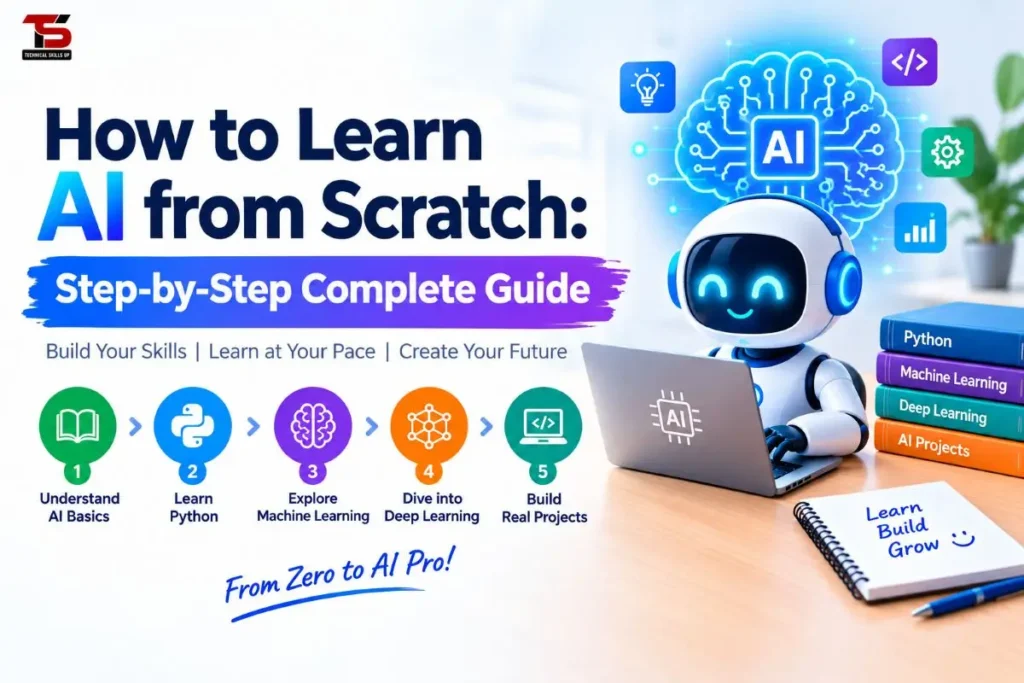
AI Fundamentals → Python → Mathematics → Data Analysis → Machine Learning → Deep Learning → Generative AI → Projects → Portfolio
Do You Need a Computer Science Degree?
A computer science degree can be helpful, but it is not the only way to enter AI.
Students from engineering, mathematics, statistics, science, business, commerce, marketing, and other backgrounds can learn AI if they develop the required technical skills.
Your learning path may depend on your starting point.
For example:
- A programmer may spend more time on machine learning.
- A mathematics student may focus more on programming.
- A complete beginner may first learn computer and Python basics.
- A working professional may prefer project-based learning.
The important thing is to build skills step by step.
How Long Does It Take to Learn AI?
There is no fixed time because every learner has a different background.
A reasonable beginner roadmap may look like this:
| Learning Stage | Approximate Time |
|---|---|
| Python Basics | 3–6 weeks |
| Mathematics Fundamentals | 3–6 weeks |
| Machine Learning | 6–10 weeks |
| Deep Learning | 6–10 weeks |
| Generative AI | 3–6 weeks |
| Projects | Continuous |
These are only general estimates. Someone who already knows Python may progress faster, while a complete beginner may need more time.
The goal should not be to finish as quickly as possible. Understanding concepts and building projects are more important.
Step-by-Step AI Learning Roadmap for Beginners
Step 1 – Understand AI Fundamentals
Before writing complex code, understand the basic concepts of AI.
Start with:
- What AI means
- What machine learning means
- What deep learning means
- What data is
- What an algorithm is
- What a model is
- Training and testing
- Features and labels
- Prediction
- Model evaluation
You do not need to memorize every definition.
Try to understand how the different parts work together.
For example, a simple machine learning process can be understood as:
Data → Preparation → Training → Model → Prediction → Evaluation
Once these concepts become clear, learning technical subjects becomes easier.
Step 2 – Learn Python Programming
Python is one of the most commonly used programming languages in AI and machine learning.
If you are completely new to programming, start with basic Python.
Learn:
- Variables
- Data types
- Operators
- Conditions
- Loops
- Functions
- Lists
- Tuples
- Dictionaries
- Sets
- Strings
- File handling
- Error handling
- Basic object-oriented programming
Do not try to learn every Python feature before moving forward.
Learn enough Python to work with data and build AI projects.
Python Libraries for AI
After learning Python basics, become familiar with important libraries.
NumPy helps with numerical operations and arrays.
Pandas is widely used for working with structured data.
Matplotlib helps create charts and visualizations.
Scikit-learn provides many tools for machine learning.
Later, you can explore deep learning frameworks such as TensorFlow and PyTorch.
Simple Python Practice Projects
Beginners can start with small projects such as:
- Calculator
- Number guessing game
- Student marks analyzer
- Simple expense tracker
- Basic data analysis program
Small projects help you become comfortable with coding.
Step 3 – Learn the Mathematics Required for AI
Many beginners become nervous when they hear the word mathematics.
You do not need to become a mathematics expert before learning AI.
Focus on the mathematics that is useful for understanding models and data.
Linear Algebra
Start with:
- Vectors
- Matrices
- Matrix operations
- Dimensions
- Basic transformations
Linear algebra becomes especially useful when studying machine learning and neural networks.
Probability and Statistics
Learn basic concepts such as:
- Mean
- Median
- Mode
- Variance
- Standard deviation
- Probability
- Distributions
- Correlation
Statistics helps you understand data and evaluate model results.
Basic Calculus
You can start with:
- Functions
- Derivatives
- Gradients
- Basic optimization concepts
You do not need advanced calculus at the beginning.
Why Mathematics Matters in AI
Mathematics helps explain what happens inside many AI models.
For example, optimization methods use mathematical concepts to reduce errors during model training.
The best approach is to learn mathematics alongside AI instead of spending months studying mathematics alone.
Step 4 – Learn Data Handling and Analysis
Data is one of the most important parts of AI.
A machine learning model cannot produce useful results from poor-quality data.
Learn how to:
- Load data
- Understand datasets
- Find missing values
- Remove duplicate records
- Clean data
- Convert data into useful formats
- Analyze patterns
- Visualize information
- Select useful features
Tools for Data Analysis
You can practice using:
- Python
- NumPy
- Pandas
- Matplotlib
- Jupyter Notebook
Learning data analysis will also improve your understanding of real-world AI projects.
Step 5 – Learn Machine Learning
Machine learning is one of the most important stages in an AI learning journey.
Start with the basic types of machine learning.
Supervised Learning
In supervised learning, a model learns from data where the expected result is known.
Common algorithms include:
- Linear Regression
- Logistic Regression
- Decision Trees
- Random Forest
- Support Vector Machines
For example, you can train a model using historical house prices and use it to estimate the price of a new house.
Unsupervised Learning
Unsupervised learning works with data where predefined answers are not available.
Common techniques include:
- K-Means Clustering
- Hierarchical Clustering
- Dimensionality Reduction
A business might use clustering to group customers based on similar behavior.
Model Evaluation
Building a model is not enough. You also need to understand how well it performs.
Learn concepts such as:
- Accuracy
- Precision
- Recall
- F1-score
- Confusion matrix
- Cross-validation
The right evaluation method depends on the problem you are solving.
Step 6 – Learn Deep Learning
After becoming comfortable with machine learning, you can move toward deep learning.
Deep learning uses neural networks to learn complex patterns.
Start with:
- Neural networks
- Neurons
- Layers
- Activation functions
- Forward propagation
- Backpropagation
- Loss functions
- Optimizers
You do not need to understand every advanced concept immediately.
First understand how a neural network receives data, processes it, learns from errors, and improves its predictions.
Deep Learning Frameworks
Two important frameworks are:
- TensorFlow
- PyTorch
You can choose one framework for deeper practice after understanding the basic concepts.
Areas of Deep Learning
Deep learning can lead to several specializations.
Computer Vision focuses on images and video.
Natural Language Processing (NLP) focuses on human language.
Speech AI works with spoken language and audio.
Choose a specialization based on your interests and career goals.
Step 7 – Learn Generative AI
Generative AI has become an important part of modern AI applications.
These systems can generate:
- Text
- Images
- Code
- Audio
- Video
- Summaries
- Other forms of content
Beginners should understand concepts such as:
- Large Language Models
- Generative AI
- Prompt engineering
- Embeddings
- Vector databases
- Retrieval-Augmented Generation
- AI APIs
- AI agents
You do not need to learn all of these concepts on the same day.
Start with how Generative AI systems work and then move toward practical applications.
Beginner Generative AI Projects
You can build projects such as:
- AI chatbot
- Document question-answering system
- Content assistant
- AI search application
- Text summarization tool
- Simple AI agent
Projects help you understand how AI technologies are used in real applications.
Step 8 – Build Practical AI Projects
Projects are one of the most important parts of AI learning.
Watching tutorials can help you understand concepts, but building something yourself teaches you how to solve problems.
Beginner AI Projects
Start with:
- House price prediction
- Spam detection
- Customer segmentation
- Simple recommendation system
Intermediate Projects
After gaining confidence, try:
- Sentiment analysis
- Image classification
- Resume screening system
- Customer support chatbot
Advanced Projects
Later, you can work on:
- RAG applications
- AI agents
- Computer vision applications
- Domain-specific AI assistants
Do not focus only on the number of projects.
Three well-documented projects can be more useful than ten copied projects.
Create an AI Learning Environment
You need a suitable environment for coding and experiments.
Software and Tools
Useful tools include:
- Python
- Jupyter Notebook
- Visual Studio Code
- Git
- GitHub
Jupyter Notebook is especially useful when learning data analysis and machine learning because you can run code step by step.
Cloud Platforms
Beginners can also use cloud-based environments.
For example, Google Colab allows learners to run Python notebooks without setting up a complete local environment.
Cloud platforms can also provide access to computing resources for certain AI experiments.
Learn Git and GitHub
Git helps track changes in your code.
GitHub allows you to store and share your projects.
A well-organized GitHub profile can become an important part of your technical portfolio.
Best Way to Practice AI as a Beginner
A simple learning cycle is:
Learn → Practice → Build → Document → Review
First learn a concept.
Then write code related to it.
Next, build a small project.
Document what you learned.
Finally, review your mistakes and improve the project.
This method is more effective than watching tutorials continuously without practice.
Daily AI Learning Routine
If you have around two to three hours each day, you can create a simple routine.
For example:
- 30 minutes — Learn theory
- 45 minutes — Practice coding
- 45 minutes — Work on a project
- 15 minutes — Review
You do not have to follow these exact timings.
The important thing is consistency.
Avoid Tutorial Hell
Tutorial hell happens when a learner watches many courses but struggles to build something independently.
To avoid it:
- Stop copying every line blindly.
- Try to write code yourself.
- Change examples and test different inputs.
- Build small projects.
- Read documentation.
- Solve problems without watching the solution first.
Feeling confused sometimes is normal. Problem-solving is part of learning AI.
How to Choose an AI Learning Course
Self-learning can work well, but some learners prefer structured training and mentor support.
When selecting a training program, check the curriculum carefully.
Look for:
- Updated AI concepts
- Python programming
- Machine learning
- Deep learning
- Generative AI
- Practical projects
- Assignments
- Experienced trainers
- Doubt support
- Certification
- Career guidance
- Placement support, if offered
Do not select a course only because it has a large number of topics.
A good program should give you enough time to practice what you learn.
A structured Artificial Intelligence Course can be useful for learners who want a guided path instead of studying different topics separately.
Learning AI Through Training in Different Locations
AI training is available through classroom, online, and hybrid learning models.
Your choice can depend on your location, schedule, budget, and preferred learning style.
Artificial Intelligence Course in India
Learners in India can choose from online programs, classroom training, university programs, and professional learning platforms.
When comparing options, check the curriculum, trainer experience, practical work, projects, and support provided.
The best choice is not always the most expensive one. Focus on the quality and relevance of the training.
Artificial Intelligence Course in Noida
Noida has a growing technology and business ecosystem, making it a practical location for students and working professionals interested in technology skills.
Learners can compare classroom and online options based on their schedule and career goals.
A local classroom program may be useful for people who prefer direct interaction with trainers and other learners.
Artificial Intelligence Course in Delhi
Delhi and the wider NCR region provide different learning options for students and professionals.
Before joining a program, review the course curriculum and confirm whether it includes practical assignments and current AI technologies.
Learners should also consider travel time, class schedule, trainer support, and project opportunities.
Artificial Intelligence Course in USA
Learners in the USA can explore university programs, professional training, online courses, bootcamps, and self-learning resources.
Working professionals may prefer flexible online learning, while students may choose a longer academic program.
The right option depends on the learner’s existing skills and career objectives.
Artificial Intelligence Course in UK
The UK offers several ways to develop AI skills, including academic education, professional programs, online training, and practical learning.
Before selecting a program, check whether the curriculum matches your intended career path.
Practical projects can be especially useful when building experience alongside theoretical knowledge.
Artificial Intelligence Course in Canada
Learners in Canada can choose between academic programs, professional training, online education, and independent learning.
When comparing programs, look at the technologies covered, practical training, project work, trainer support, and overall learning format.
A structured program can help beginners follow a clear path without jumping randomly between different AI topics.
How to Learn AI Without a Computer Science Degree
A computer science degree is not the only path to AI skills.
People from different educational backgrounds can learn the subject by developing the required technical foundation.
For example:
Engineering students can build on their programming and mathematics knowledge.
Mathematics or statistics students can focus more on Python, data handling, and machine learning implementation.
Business professionals can start with data analysis and practical AI applications.
Digital professionals can explore AI automation, Generative AI, analytics, and AI-powered business tools.
Complete beginners should start with Python and basic AI concepts before moving into machine learning.
Your previous education may change your starting point, but consistent practice remains important for everyone.
Common Mistakes Beginners Make While Learning AI
Many beginners make similar mistakes.
1. Starting With Advanced Topics
Jumping directly into advanced neural networks or AI agents can create confusion.
Build the foundation first.
2. Ignoring Python
AI involves a lot of practical coding.
Learning Python makes it easier to implement models and work with data.
3. Avoiding Mathematics Completely
You do not need advanced mathematics immediately, but basic statistics, probability, linear algebra, and calculus concepts are useful.
4. Only Watching Videos
Learning becomes much stronger when you practice.
Write code and build projects regularly.
5. Building No Projects
Projects help connect theory with real-world problems.
Try to build something after every major learning stage.
6. Learning Too Many Tools at Once
Do not try to learn every AI framework, library, and platform together.
Master the basics first.
7. Copying Code Without Understanding It
Copied code may work, but it does not necessarily improve your skills.
Change the code and understand why each part exists.
8. Ignoring GitHub
A GitHub portfolio can help demonstrate your practical skills.
Keep your repositories clean and explain your projects clearly.
9. Memorizing Instead of Understanding
AI is not about remembering hundreds of definitions.
Focus on understanding how and why a method works.
10. Expecting Immediate Career Results
Learning AI takes time.
Focus first on skills, projects, problem-solving ability, and practical experience.
How to Build an AI Portfolio
A portfolio shows what you can actually build.
It can be useful when applying for internships, jobs, freelance work, or advanced learning opportunities.
What Should an AI Portfolio Include?
Try to include three to five strong projects.
Each project should explain:
- Project objective
- Problem being solved
- Dataset used
- Technologies used
- Approach
- Model or method
- Results
- Challenges
- Improvements
- Screenshots or demo
- GitHub repository
Do not simply upload code without explanation.
How to Showcase AI Projects
You can showcase projects through:
- GitHub
- Personal website
- Resume
- Online project demonstrations
A good portfolio should make it easy for another person to understand what you built and what you learned.
Career Opportunities After Learning AI
AI skills can lead to different technical and technology-related roles.
Possible career paths include:
- AI Engineer
- Machine Learning Engineer
- Data Scientist
- NLP Engineer
- Computer Vision Engineer
- Generative AI Developer
- AI Consultant
- AI Research-oriented roles
The exact requirements differ between companies and job roles.
Skills Employers Look For
Employers may look for a combination of:
- Python
- Machine learning
- Data analysis
- Model evaluation
- Deep learning
- Generative AI
- Problem-solving
- Programming
- Project experience
- Communication skills
Having knowledge of a technology is different from being able to use it to solve a problem.
That is why practical projects are important.
A 6-Month AI Learning Roadmap
Here is a simple six-month plan for beginners.
| Month | Main Focus |
|---|---|
| Month 1 | Python + AI Fundamentals |
| Month 2 | Mathematics + Data Analysis |
| Month 3 | Machine Learning |
| Month 4 | Advanced Machine Learning + Projects |
| Month 5 | Deep Learning + NLP or Computer Vision |
| Month 6 | Generative AI + Portfolio |
Month 1: Build the Foundation
Learn Python basics and understand important AI concepts.
Build small Python projects.
Month 2: Work With Data
Learn statistics basics and data analysis.
Practice with real datasets.
Month 3: Learn Machine Learning
Study supervised and unsupervised learning.
Build your first prediction and classification projects.
Month 4: Improve Your Projects
Learn model evaluation and improve your existing projects.
Start building more realistic applications.
Month 5: Explore Deep Learning
Learn neural networks and select an area such as NLP or computer vision.
Build at least one project.
Month 6: Learn Generative AI
Explore large language models, embeddings, RAG, AI APIs, and agents.
At the same time, organize your GitHub portfolio and prepare a resume.
What to Do After Six Months
After completing the basic roadmap:
- Build advanced projects
- Improve your GitHub profile
- Update your resume
- Practice technical interviews
- Explore internships or jobs
- Select a specialization
- Continue learning new AI technologies
Six months should be viewed as a strong learning phase, not the end of the journey.
Free vs Paid AI Learning: Which Is Better?
Both options can work.
| Free Learning | Paid Training |
|---|---|
| Low or no cost | Usually structured |
| Flexible schedule | Guided learning |
| Self-paced | Trainer or mentor support may be available |
| Many resources | Curriculum is usually organized |
| Requires strong discipline | Regular assignments may be included |
Free learning is a good option for self-motivated learners.
Paid training may be useful for people who want a structured curriculum, mentor support, practical assignments, or a fixed learning schedule.
The quality of the specific program matters more than whether it is free or paid.
How to Stay Updated in Artificial Intelligence
AI changes quickly.
New models, tools, libraries, and applications appear regularly.
You should develop a habit of continuous learning.
Useful activities include:
- Reading official documentation
- Following reliable AI research
- Building new projects
- Testing new tools
- Reading technical articles
- Following reputable AI communities
- Learning from practical examples
Do not try to learn every new AI tool.
Instead, understand the fundamentals and then learn new technologies when they are relevant to your goals.
Frequently Asked Questions About Learning AI
Can I learn AI from scratch?
Yes. Start with basic AI concepts, Python, mathematics, data analysis, and machine learning. Then move toward deep learning and Generative AI. Regular practice and projects will make the learning process much easier.
Can I learn AI without coding?
You can understand basic AI concepts without coding, but coding becomes important if you want to build AI and machine learning applications. Python is a good starting language for beginners.
Is Python necessary for AI?
Python is not the only programming language used in AI, but it is one of the most useful choices for beginners because of its large ecosystem of AI, data science, and machine learning libraries.
How much mathematics is required for AI?
You need basic statistics, probability, linear algebra, and some calculus. The amount of mathematics depends on your career goal. Research-focused roles may require much deeper mathematical knowledge.
How long does it take to learn AI?
The time depends on your background, daily study hours, and learning goals. A beginner may spend several months building a strong foundation and then continue developing advanced skills through projects and specialization.
Is AI difficult for beginners?
AI can feel difficult at first because it combines programming, mathematics, data, and problem-solving. A step-by-step learning path makes it much easier to manage.
What should I learn first, Python or AI?
Start with basic AI concepts and learn Python alongside them. You do not need to master Python completely before understanding AI fundamentals.
Can non-technical students learn AI?
Yes. Non-technical students can start with basic programming and gradually develop mathematics, data analysis, and machine learning skills.
What AI projects should beginners build?
Good beginner projects include house price prediction, spam detection, customer segmentation, sentiment analysis, and simple recommendation systems.
Is AI a good career option?
AI is a broad technology field with applications across many industries. Career opportunities depend on your skills, experience, specialization, location, and the requirements of individual employers.
Final AI Learning Roadmap
Learning AI from scratch becomes easier when you follow a clear order.
The complete roadmap can be summarized as:
AI Fundamentals → Python → Mathematics → Data Analysis → Machine Learning → Deep Learning → Generative AI → Projects → Portfolio → Career Preparation
Do not worry if the journey feels slow in the beginning. Programming and mathematics may take time to understand.
Focus on one topic at a time.
Learn the concept, practice it with code, build a small project, and then move to the next stage.
The most important part is consistency. Instead of trying to learn every AI technology at once, build a strong foundation and gradually develop advanced skills.
Conclusion
AI is a large and continuously developing field, but beginners can enter it by following a structured learning path.
Start with basic AI concepts and Python. Learn the mathematics that supports AI, become comfortable working with data, and then move into machine learning. Once your foundation is strong, explore deep learning and Generative AI.
Most importantly, build practical projects throughout your learning journey. Projects help you understand how AI works in real situations and give you something useful to showcase in your portfolio.
Whether your goal is to improve your current skills, change careers, build AI applications, or explore a new technology field, consistent learning and practical experience can help you move forward.
The best time to start is not when you know everything. Start with the basics, practice regularly, and improve one step at a time.