
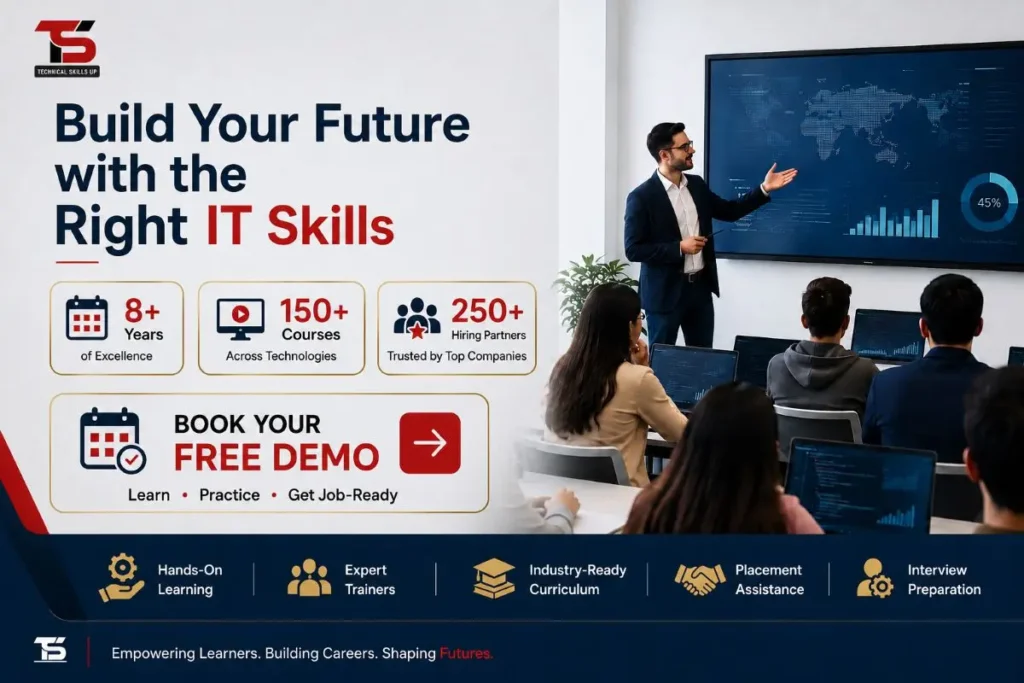
Technical Skills Up offers an Artificial Intelligence Course in India designed for students, graduates, working professionals, developers, and learners who want to build practical AI skills. The program covers Python, Machine Learning, Deep Learning, Natural Language Processing, Computer Vision, Generative AI, Large Language Models, and other important AI concepts. Learners work on practical assignments and projects to understand how AI is used in real-world applications.
The training is designed to build both technical knowledge and practical skills. Depending on the available batch, learners can choose online or classroom-based training. The course also includes career guidance, interview preparation, certification support, and placement assistance.
About Artificial Intelligence Training in India
Artificial Intelligence is changing how businesses build products, automate tasks, analyze information, and serve customers. As AI adoption grows across industries, professionals with practical AI skills can explore opportunities in software development, data science, automation, analytics, and other technology roles.
Our Artificial Intelligence Training in India focuses on learning by doing. Instead of only covering theoretical concepts, the training introduces learners to practical tools, coding exercises, model-building tasks, and project work.
The curriculum is structured progressively. Beginners can start with the foundations of Python and AI before moving toward Machine Learning, Deep Learning, NLP, Computer Vision, and Generative AI.
Key Learning Areas
- Python programming for AI
- Artificial Intelligence fundamentals
- Data preparation and preprocessing
- Machine Learning
- Deep Learning
- Neural networks
- Natural Language Processing
- Computer Vision
- Generative AI
- Large Language Models
- Prompt Engineering
- AI tools and applications
- Practical AI projects
Why Learn Artificial Intelligence in India?
AI skills are becoming useful across many technology and business functions. Companies use AI for automation, prediction, recommendation systems, customer support, document processing, content generation, fraud detection, image analysis, and many other applications.
Learning AI can help you understand how intelligent systems are designed and deployed. It can also provide a foundation for advanced areas such as Machine Learning, Deep Learning, Generative AI, and AI automation.
Students and professionals can choose AI training to:
- Build practical technology skills
- Understand modern AI applications
- Learn Machine Learning and Deep Learning
- Develop AI-based projects
- Improve programming and analytical skills
- Prepare for AI-related interviews
- Explore career opportunities in AI and related fields
- Build a foundation for advanced AI technologies
Artificial Intelligence Course Curriculum
The course curriculum is designed to take learners from fundamental concepts to practical AI applications.
1: Introduction to Artificial Intelligence
- What is Artificial Intelligence?
- History and evolution of AI
- Types of AI
- AI applications
- AI vs Machine Learning
- AI vs Deep Learning
- AI development lifecycle
- Real-world AI use cases
2: Python for Artificial Intelligence
- Python fundamentals
- Variables and data types
- Operators
- Conditional statements
- Loops
- Functions
- Lists, tuples, sets, and dictionaries
- Object-oriented programming basics
- File handling
- Exception handling
- NumPy
- Pandas
- Matplotlib
3: Mathematics and Statistics for AI
- Basic statistics
- Mean, median, and mode
- Probability fundamentals
- Data distributions
- Correlation
- Linear algebra basics
- Vectors and matrices
- Concepts required for Machine Learning
4: Data Preparation and Preprocessing
- Data collection concepts
- Data cleaning
- Missing-value handling
- Outlier detection
- Feature selection
- Feature engineering
- Data transformation
- Training and testing datasets
5: Machine Learning
- Machine Learning fundamentals
- Supervised learning
- Unsupervised learning
- Regression
- Classification
- Clustering
- Decision Trees
- Random Forest
- Support Vector Machines
- K-Nearest Neighbors
- Model training
- Model evaluation
- Cross-validation
6: Deep Learning
- Introduction to Deep Learning
- Neural networks
- Artificial neurons
- Activation functions
- Forward propagation
- Backpropagation
- Loss functions
- Optimization
- Introduction to TensorFlow/Keras
- Deep Learning applications
7: Natural Language Processing
- NLP fundamentals
- Text preprocessing
- Tokenization
- Stop-word removal
- Stemming and lemmatization
- Text classification
- Sentiment analysis
- Named Entity Recognition
- NLP applications
8: Computer Vision
- Introduction to Computer Vision
- Image processing concepts
- Image classification
- Feature extraction
- Object detection concepts
- Computer Vision applications
- Practical image-based projects
9: Generative AI
- Introduction to Generative AI
- Generative AI applications
- Large Language Models
- Text generation
- AI-assisted content generation
- AI tools
- Prompt Engineering fundamentals
- Responsible use of Generative AI
10: Large Language Models and Prompt Engineering
- LLM fundamentals
- How language models work
- Prompt structure
- Prompt techniques
- Context and instructions
- Few-shot prompting
- Output evaluation
- Practical LLM applications
11: AI Tools and Applications
- AI productivity tools
- AI automation concepts
- AI-assisted development
- Business applications of AI
- Workflow automation
- Practical AI use cases
12: Practical AI Projects
Learners apply their knowledge through practical projects based on the course curriculum.
Possible projects include:
- AI chatbot
- Sentiment analysis system
- Recommendation system
- Image classification project
- Text classification project
- Generative AI application
- AI-powered automation workflow
Project availability may vary by batch and training mode.
What Will You Learn in This AI Course?
After completing the training, learners can develop an understanding of:
- AI concepts and applications
- Python programming
- Data preparation
- Machine Learning algorithms
- Model training and evaluation
- Neural networks
- Deep Learning
- NLP
- Computer Vision
- Generative AI
- Large Language Models
- Prompt Engineering
- AI project development
The goal is not only to understand terminology but also to develop the ability to apply concepts through practical exercises and projects.
Artificial Intelligence Online Course in India
Technical Skills Up also provides an Artificial Intelligence Online Course in India for learners who prefer to study remotely. Online training can be useful for students and working professionals who need flexibility without relocating to a training center.
Depending on the selected batch, online learning may include live instructor-led sessions, practical assignments, project guidance, doubt support, and career preparation.
Benefits of Online AI Training
- Learn from your preferred location
- Flexible learning for working professionals
- Live interaction with trainers
- Practical coding exercises
- Project guidance
- Doubt-solving support
- Access to course learning material
- Career and interview guidance
Learners should confirm the exact batch schedule, learning mode, and available facilities before enrollment.
Course Duration and Fees
| Course Detail | Information |
| Course Name | Artificial Intelligence Course |
| Duration | 4–5 Weeks |
| Course Fee in India | ₹25,000 |
| Training Mode | Online / Classroom* |
| Curriculum | Practical AI-focused curriculum |
| Projects | Practical projects |
| Certification | Available after course completion* |
| Placement Support | Placement assistance* |
*Availability can depend on the selected batch and training plan.
Who Can Join the Artificial Intelligence Course?
The course can be suitable for learners from different educational and professional backgrounds.
Students
Students who want to build skills in AI, Python, Machine Learning, and modern AI technologies can start with the foundational modules.
Graduates
Graduates can use the training to build practical technical skills and develop projects for their portfolio.
Working Professionals
Professionals from IT, software development, analytics, marketing, finance, and other fields can learn AI concepts relevant to their work.
Software Developers
Developers can learn how AI and Machine Learning can be integrated into software applications.
Data Professionals
Data analysts and professionals working with data can explore Machine Learning, Deep Learning, and AI applications.
Career Switchers
Learners planning a move toward AI-related technology roles can use the course as a structured starting point.
Basic programming knowledge can be helpful, but the exact prerequisites depend on the selected training level.
Career Opportunities After Artificial Intelligence Training
Artificial Intelligence skills can support career paths across several technology areas. Depending on your educational background, practical skills, experience, and additional qualifications, you may explore roles such as:
- AI Engineer
- Machine Learning Engineer
- AI Developer
- Machine Learning Developer
- Data Scientist
- NLP Engineer
- Computer Vision Engineer
- Generative AI Specialist
- AI Automation Specialist
- AI Application Developer
Career outcomes vary by individual. Completing a training course does not by itself guarantee employment. Practical skills, projects, interview performance, experience, and the requirements of employers also matter.</span>
Practical Projects and Hands-On Learning
Live Practical experience is an important part of learning Artificial Intelligence. Learners can apply concepts through coding exercises, assignments, and project-based learning.
Projects help learners understand the complete process, including:
- Understanding a problem
- Preparing data
- Selecting an appropriate approach
- le=”font-family: helvetica, arial, sans-serif;”>Building a model or AI application
- Testing the solution
- Evaluating results
- Improving the solution
- Presenting the final project
This practical approach can also help learners create a portfolio that demonstrates their technical abilities.
Certification for Artificial Intelligence Training
Learners who successfully complete the required course and assessment criteria can receive an Artificial Intelligence course certificate, subject to the applicable training terms.
A certificate can document course completion and learning participation. However, it should not be treated as a substitute for practical skills or professional experience.
For better career preparation, learners should combine certification with:
- Practical projects
- Python skills
- Machine Learning knowledge
- Problem-solving ability
- Portfolio development
- Interview preparation
Placement Assistance
Technical Skills Up focuses on career-oriented learning and may provide placement assistance to eligible learners according to the applicable training program.
Placement assistance can include:
- Resume guidance
- Interview preparation
- Mock interviews
- Career guidance
- Job-search support
- Interview opportunity guidance
Placement assistance does not mean a guaranteed job. Employment depends on the learner’s skills, experience, interview performance, employer requirements, and available opportunities.
Why Choose Technical Skills Up for AI Training?
Choosing the right training provider is important when learning a technical subject such as Artificial Intelligence. Technical Skills Up focuses on practical and career-oriented learning.
Industry-Relevant Curriculum
The curriculum covers important AI technologies, from Python and Machine Learning to Deep Learning and Generative AI.
Practical Learning
Assignments and projects help learners apply concepts instead of relying only on theoretical study.
Experienced Trainers
Training is designed to be guided by instructors with relevant technical knowledge and practical exposure.
Career-Focused Approach
The program includes career guidance and interview preparation to help learners understand how to apply their skills professionally.
Certification Support
Eligible learners can receive course certification after completing the applicable requirements.
Placement Assistance
Learners can receive placement-oriented support according to the applicable training program.
Training Options Across India
Technical Skills Up serves learners looking for AI training in different parts of India. The India-level course page provides an overview of the program, while dedicated city pages can provide location-specific information.
Explore:
Learners from other locations can also enquire about available online training options.
Artificial Intelligence Course in India vs Online Training
| Feature | Classroom Training | Online Training |
| Learning Location | Training center | Learner’s preferred location |
| Trainer Interaction | Live | Live online |
| Practical Learning | Yes | Yes |
| Projects | Yes | Yes |
| Doubt Support | Available | Available |
| Flexibility | Depends on batch | Generally, more flexible |
| Suitable For | Local learners | Learners across India |
The exact facilities and schedule depend on the selected batch.
Artificial Intelligence Course FAQs
Q1. What is an Artificial Intelligence Course in India?
Ans: An Artificial Intelligence course teaches the concepts and practical skills used to build and apply AI systems. The curriculum can include Python, Machine Learning, Deep Learning, NLP, Computer Vision, and Generative AI.
Q2. Who can join an AI course in India?
Ans: Students, graduates, working professionals, developers, data professionals, and career switchers can consider AI training. Basic programming knowledge can be helpful for advanced modules.
Q3. What is the duration of the AI course?
Ans: The Artificial Intelligence training program at Technical Skills Up is designed for approximately 4–5 weeks, depending on the selected batch and training schedule.
Q4. What is the fee for the AI course in India?
Ans: The current listed course fee is ₹25,000. Learners should confirm the latest fee and batch details before enrollment.
Q5. Is the Artificial Intelligence course available online?
Ans: Yes, online training options may be available for learners in India. The exact schedule, delivery mode, and facilities depend on the selected batch.
Q6. What topics are covered in the AI curriculum?
Ans: The curriculum can cover Python, Machine Learning, Deep Learning, NLP, Computer Vision, Generative AI, Large Language Models, Prompt Engineering, AI tools, and practical projects.
Q7. Do I need programming knowledge to learn Artificial Intelligence?
Ans: Programming knowledge is helpful, especially for practical AI development. The course introduces Python fundamentals before progressing toward advanced AI concepts.
Q8. Will I receive an Artificial Intelligence course certificate?
Ans: Eligible learners can receive a certificate after meeting the applicable course completion requirements.
Q9. Does Technical Skills Up provide placement assistance?
Ans: Placement assistance may be provided according to the applicable training program. Support can include resume guidance, interview preparation, mock interviews, and career guidance. Placement assistance is not a job guarantee.
Q10.What career opportunities are available after AI training?
Ans: Depending on your skills and experience, you can explore roles such as AI Engineer, Machine Learning Engineer, AI Developer, Data Scientist, NLP Engineer, Computer Vision Engineer, and Generative AI Specialist.
Q11. Start Your Artificial Intelligence Training in India
Ans: Build practical AI skills with a structured curriculum covering Python, Machine Learning, Deep Learning, NLP, Computer Vision, Generative AI, and modern AI applications