
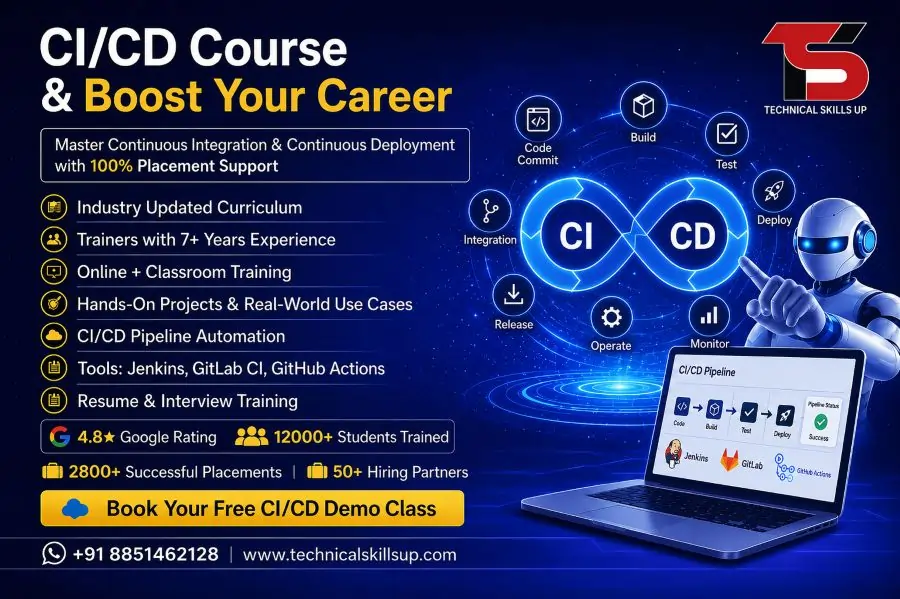
Modern software development depends on speed, quality, and automation. Organizations want applications to reach users faster without compromising performance or reliability. Growing demand for automated deployment pipelines has created excellent opportunities for professionals who understand modern development workflows. A well-structured CI/CD Course helps learners gain practical knowledge of software automation, deployment strategies, testing workflows, and DevOps practices used by leading companies worldwide.
Technical Skills Up offers industry-focused learning designed for students, software developers, IT professionals, system administrators, and technology enthusiasts. Practical projects, expert guidance, and hands-on exercises help learners understand how continuous integration and continuous delivery work in real business environments. Every module focuses on job-ready skills that can be applied immediately in professional projects.
Course Overview
Software teams release updates more frequently than ever before. Manual processes often create delays, increase errors, and reduce productivity. Continuous Integration and Continuous Delivery solve these challenges through automation, testing, and streamlined deployment workflows.
This program is designed to help learners understand the complete software delivery lifecycle. Training begins with fundamental concepts and gradually moves toward advanced deployment strategies, automation techniques, cloud integration, and production-ready pipelines.
The curriculum focuses on practical implementation rather than theoretical knowledge alone. Learners build automated pipelines, configure testing frameworks, integrate source code repositories, and deploy applications using industry-standard tools.
Who Should Join This Program?
This training program is suitable for:
- Software Developers
- DevOps Engineers
- System Administrators
- Cloud Engineers
- Site Reliability Engineers
- IT Support Professionals
- Engineering Students
- Computer Science Graduates
- Project Managers involved in software delivery
- Professionals planning a DevOps career
Strong programming expertise is not mandatory for beginners. Basic knowledge of software development and operating systems can help learners progress faster.
Why CI/CD Matters in Modern Software Development
Technology companies compete on speed, innovation, and customer experience. Faster release cycles allow businesses to deliver new features quickly while maintaining application stability.
Continuous Integration enables developers to merge code changes frequently into a shared repository. Automated testing validates code quality and reduces integration problems.
Continuous Delivery ensures that applications remain deployment-ready at all times. Automated workflows minimize manual effort and increase reliability across environments.
Organizations implementing these practices often experience:
- Faster software releases
- Reduced deployment failures
- Improved application quality
- Better collaboration between teams
- Increased operational efficiency
- Enhanced customer satisfaction
- Faster bug detection and resolution
- Improved scalability
Global technology leaders rely heavily on CI/CD pipelines to maintain competitive advantages in rapidly changing markets.
Understanding the Role of CI/CD Training
Career-focused CI/CD Training helps learners develop practical expertise in automation and deployment workflows. Organizations prefer professionals who can design, implement, monitor, and optimize delivery pipelines.
Knowledge gained through structured training helps professionals:
- Reduce software deployment risks
- Automate repetitive tasks
- Improve release consistency
- Enhance development efficiency
- Support cloud-native applications
- Manage infrastructure automation
- Collaborate effectively with development teams
Practical exposure creates confidence when working on enterprise-level software projects.
Skills Covered in the Program
Success in DevOps requires a combination of technical knowledge, automation expertise, problem-solving ability, and operational understanding. This program covers all major skill areas required in modern software environments.
Version Control Management
Learners understand how source code management supports collaboration among development teams.
Topics include:
- Repository management
- Branching strategies
- Code merging
- Pull requests
- Conflict resolution
- Release management
Build Automation
Modern software development relies on automated build processes.
Key concepts include:
- Build lifecycle
- Dependency management
- Automated packaging
- Build optimization
- Artifact generation
Continuous Integration Practices
Practical exercises focus on:
- Automated code integration
- Source control integration
- Build triggers
- Automated testing
- Pipeline configuration
- Build monitoring
Automated Testing
Quality assurance remains a critical component of software delivery.
Coverage includes:
- Unit testing
- Integration testing
- Functional testing
- Regression testing
- Test automation strategies
- Test reporting
Deployment Automation
Deployment workflows are explored in detail.
Learners work on:
- Environment configuration
- Automated deployments
- Rollback strategies
- Release management
- Production deployment techniques
Monitoring and Logging
Real-world applications require constant monitoring.
Topics include:
- Log management
- Application monitoring
- Performance tracking
- Alert configuration
- Incident management
Infrastructure Concepts
Understanding infrastructure helps DevOps professionals manage scalable environments.
Key areas include:
- Server management
- Virtualization
- Infrastructure automation
- Configuration management
- Cloud infrastructure basics
Tools and Technologies Covered
Industry-relevant tools play a major role in practical learning. Technical Skills Up focuses on technologies widely used across global organizations.
Source Code Management Tools
- Git
- GitHub
- GitLab
- Bitbucket
Build Tools
- Maven
- Gradle
- Ant
Automation Servers
- Jenkins
- GitLab CI
- GitHub Actions
Containerization Platforms
- Docker
- Docker Compose
Orchestration Technologies
- Kubernetes
- Helm
Cloud Platforms
- Amazon Web Services (AWS)
- Microsoft Azure
- Google Cloud Platform
Monitoring Tools
- Prometheus
- Grafana
- ELK Stack
Testing Frameworks
- JUnit
- Selenium
- TestNG
Practical exercises ensure learners understand how these technologies interact within a complete DevOps ecosystem.
Hands-On CI/CD Classes for Practical Learning
Employers value practical experience more than theoretical understanding. Structured CI/CD Classes focus heavily on implementation, troubleshooting, and real-world projects.
Learning activities include:
- Pipeline creation
- Application deployment
- Docker container management
- Jenkins automation
- Cloud deployment exercises
- Repository integration
- Monitoring setup
- Deployment troubleshooting
Every major concept is reinforced through guided practice sessions.
Real-Time Project Experience
Projects help learners understand industry workflows.
Examples include:
- Web application deployment
- Automated testing pipelines
- Cloud-based deployment systems
- Containerized application delivery
- Multi-stage deployment environments
Project-based learning improves confidence and technical decision-making skills.
Benefits of Learning Through CI/CD Online Training
Flexibility has become essential for modern learners. Professional commitments, academic schedules, and personal responsibilities often make classroom learning difficult.
Comprehensive CI/CD Online Training provides:
- Flexible learning schedules
- Live instructor-led sessions
- Recorded classes
- Practical assignments
- Interactive doubt-solving sessions
- Project-based learning
- Industry-relevant curriculum
Online learning allows professionals from different locations to access quality education without relocation or travel expenses.
Interactive Learning Environment
Students participate in:
- Live demonstrations
- Guided labs
- Group discussions
- Project reviews
- Technical workshops
- Performance assessments
Engagement remains high throughout the learning journey.
Career Opportunities After Completing the Program
Demand for DevOps professionals continues to grow across industries. Companies seek candidates who can improve software delivery speed while maintaining quality standards.
Popular job roles include:
DevOps Engineer
Responsibilities include:
- Pipeline creation
- Deployment automation
- Infrastructure management
- Monitoring implementation
CI/CD Engineer
Key tasks include:
- Build automation
- Release management
- Pipeline optimization
- Deployment orchestration
Cloud Engineer
Responsibilities focus on:
- Cloud deployment
- Infrastructure automation
- Resource management
- Security implementation
Site Reliability Engineer
Core functions include:
- Reliability monitoring
- Incident response
- Performance optimization
- System scalability
Release Engineer
Professionals manage:
- Software releases
- Deployment planning
- Build validation
- Release coordination
Automation Engineer
Work areas include:
- Workflow automation
- Testing automation
- Infrastructure scripting
- Process optimization
Growing digital transformation initiatives continue creating opportunities across these domains.
Industry Demand and Future Scope
Technology adoption continues accelerating worldwide. Organizations increasingly depend on cloud-native applications, microservices, automation frameworks, and scalable infrastructure.
Industry trends driving demand include:
- Cloud computing adoption
- Agile transformation
- DevOps implementation
- Kubernetes growth
- Containerization expansion
- Digital product development
- Continuous deployment practices
Businesses aim to reduce software release cycles from months to days or even hours. Professionals with automation expertise play a vital role in achieving this objective.
Research from major technology consulting firms consistently highlights DevOps and automation skills among the most sought-after technical competencies.
Future Growth Areas
Emerging opportunities include:
- Platform Engineering
- GitOps
- DevSecOps
- Cloud Automation
- Infrastructure as Code
- AI-driven Operations
- Kubernetes Administration
- Multi-Cloud Management
Professionals who develop expertise in these areas can access long-term career growth opportunities.
Build Career Credibility with a CI/CD Certification Course
Professional certification helps validate skills and demonstrate commitment to continuous learning. A structured CI/CD Certification Course provides practical knowledge along with recognition that strengthens professional profiles.
Certification benefits include:
- Enhanced credibility
- Improved job opportunities
- Better interview performance
- Increased employer confidence
- Professional recognition
- Stronger resume value
Employers often prefer candidates who can demonstrate practical DevOps knowledge through projects and certifications.
Advantages of Choosing a CI/CD Online Course in India
India has become a major technology hub with growing demand for DevOps professionals. Businesses across software development, banking, healthcare, retail, telecommunications, and e-commerce sectors require automation experts.
A structured CI/CD Online Course in India offers:
- Access to industry experts
- Affordable learning options
- Career-oriented curriculum
- Practical project exposure
- Flexible schedules
- Placement assistance
- Industry-standard tools training
Learners can prepare for both domestic and international opportunities through globally relevant skills.
Why Choose Technical Skills Up
Educational quality plays a significant role in career success. Technical Skills Up focuses on practical learning, industry relevance, and student outcomes.
Industry-Oriented Curriculum
Course content reflects current industry requirements and emerging technologies.
Experienced Trainers
Learning sessions are conducted by professionals with real-world implementation experience.
Practical Learning Approach
Hands-on exercises help learners apply concepts immediately.
Live Projects
Real-world projects strengthen practical understanding.
Flexible Learning Modes
Students can learn according to their schedules.
Career Guidance
Professional mentoring helps learners plan career growth effectively.
Interview Preparation
Dedicated support improves technical and professional communication skills.
Placement Assistance
Career support services help learners connect with relevant employment opportunities.
Training Methodology
Learning effectiveness improves when theory and practical implementation work together.
Technical Skills Up follows a structured methodology that includes:
Instructor-Led Sessions
Experts explain concepts through practical demonstrations and real-world examples.
Guided Labs
Learners complete hands-on exercises under expert supervision.
Project-Based Learning
Projects reinforce technical understanding and problem-solving abilities.
Assignment-Based Evaluation
Regular assignments help measure learning progress.
Practical Assessments
Technical evaluations ensure learners can apply acquired knowledge.
Industry Case Studies
Real business scenarios help bridge the gap between training and workplace requirements.
Certification and Placement Support
Career success requires more than technical knowledge. Professional guidance and placement support play a major role in helping learners secure suitable opportunities.
Support services include:
- Resume building assistance
- LinkedIn profile optimization
- Mock interviews
- Technical interview preparation
- Career counseling
- Placement support sessions
Structured guidance increases confidence during recruitment processes.
Learners receive certification after successfully completing training requirements, projects, and assessments.
Learning Outcomes
Upon successful completion of the program, learners will be able to:
- Build complete CI/CD pipelines
- Automate software deployments
- Implement testing workflows
- Manage source code repositories
- Work with Docker containers
- Deploy applications on cloud platforms
- Configure Jenkins pipelines
- Monitor application performance
- Implement DevOps best practices
- Troubleshoot deployment issues
These skills prepare learners for real-world technical responsibilities across various industries.
Conclusion
Technology teams depend heavily on automation, reliability, and faster software delivery. Organizations continue investing in DevOps practices to improve efficiency and customer satisfaction. Strong knowledge of continuous integration and continuous delivery has become a valuable asset for developers, cloud professionals, and IT specialists.
Technical Skills Up provides practical learning, expert mentorship, hands-on projects, industry-relevant tools, certification support, and career guidance to help learners achieve professional growth. Whether you are starting your technology journey or upgrading existing skills, this program offers a structured path toward becoming a confident DevOps professional. Practical expertise, real-world projects, and modern industry knowledge make this training an excellent choice for building a successful career in software automation and deployment.
FAQs:
Q1. What is CI/CD and why is it important?
Ans: CI/CD stands for Continuous Integration and Continuous Deployment/Delivery. It is a modern DevOps process that makes software development faster, more secure, and more effective. With CI/CD, developers can test and deploy code rapidly. Currently, IT companies are increasingly demanding CI/CD experts, making this a valuable skill for career growth.
Q2. Who is the CI/CD Online Course in India with Placement suitable for?
Ans: This course is beneficial for a wide range of candidates:
- B.Tech, BCA, MCA, and Computer Science students
- Software Developers
- System Administrators
- DevOps Engineers
- IT Professionals
- Freshers aspiring to build a career in DevOps
The course curriculum is designed to cater to both beginners and experienced professionals.
Q3. What makes Technical Skills Up’s CI/CD Online Course different from others?
Ans: Technical Skills Up provides training aligned with industry requirements. Students gain not only theoretical knowledge but also hands-on experience through live projects and real-time practical exercises. Learning under the guidance of experienced instructors helps students understand actual workplace demands.
Q4. Which tools are taught in the CI/CD course?
Ans: The course covers popular industry-standard tools, including:
- Jenkins
- Git
- GitHub
- Docker
- Kubernetes
- Maven
- Ansible
- AWS
- SonarQube
Using these tools, students learn how to build a complete CI/CD pipeline.
Q5. Is programming knowledge required for this course?
Ans: While basic knowledge of programming and Linux is beneficial, it is not mandatory. At Technical Skills Up, essential concepts are explained simply for beginners, enabling them to learn CI/CD with ease.
Q6. What job profiles can one secure after completing the CI/CD Online Course?
Ans: After completing the course, candidates can apply for various roles such as:
- DevOps Engineer
- CI/CD Engineer
- Build and Release Engineer
- Cloud Engineer
- Site Reliability Engineer (SRE)
- Automation Engineer
The demand for these profiles is growing rapidly in both India and abroad.
Q7. Does Technical Skills Up provide placement assistance?
Ans: Yes, Technical Skills Up provides placement assistance to students. This may include services such as resume building, interview preparation, mock interviews, job referrals, and career guidance. The aim is to help students secure employment opportunities.
Q8. What is the duration of the CI/CD online course?
Ans: The course duration varies depending on the training modules. Typically, the course ranges from a few weeks to a few months. Students are given sufficient time to gain a practical understanding of all the tools and processes.
Q9. Do students work on live projects during the course?
Ans: Yes, live projects are a crucial part of this training. Students gain experience in building actual CI/CD pipelines, implementing automation processes, and integrating various DevOps tools. This experience is highly beneficial for securing a job.
Q10. What are the career benefits of learning CI/CD?
Ans: Learning CI/CD offers several benefits to candidates:
- Opportunity to enter a DevOps career
- Better job prospects
- High industry demand
- Development of automation skills
- Understanding of modern software development processes
This skill aids in the long-term career growth of technical professionals.
Q11. Is this course available with live online training?
Ans: Yes, Technical Skills Up’s CI/CD online course is available via live online training. During live sessions, students can ask questions directly to the instructor and learn through practical demonstrations.
Q12. What is the expected starting salary after the CI/CD course?
Ans: The salary depends on various factors such as skills, experience, location, and the company. Candidates with strong practical understanding and project experience can secure attractive career opportunities in DevOps and CI/CD-related roles.
Q13. Are CI/CD and DevOps the same?
Ans: No, they are not the same. DevOps is a broad culture and methodology, whereas CI/CD is a crucial component of DevOps. CI/CD is used to automate and accelerate the software development and deployment process.
Q14. Is a certificate provided for the CI/CD online course?
Ans: Yes, a certificate can be awarded upon successful completion of the course. This certificate can be useful for showcasing a student’s skills and aiding in job opportunities.
Q15. Why choose Technical Skills Up’s CI/CD online course?
Ans: Technical Skills Up focuses on providing industry-oriented training to students. Key benefits included in the course:
- Training by experienced instructors
- Live online classes
- Practical lab exercises
- Real-time projects
- Interview preparation
- Placement assistance
- Training on the latest DevOps and CI/CD tools
All these features help prepare students for employment and strengthen their technical skills.