
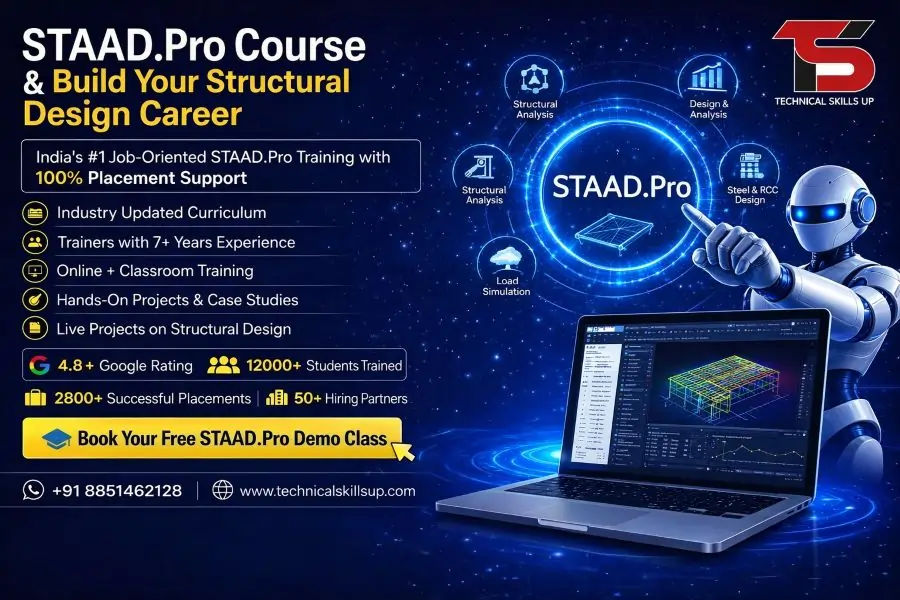
Modern construction projects demand accurate structural analysis and safe design practices. A strong understanding of structural engineering software helps professionals create reliable structures while improving productivity and project quality. STAAD.Pro Training at Technical Skills Up is designed for students, civil engineers, structural engineers, site professionals, and working experts who want to build practical design skills and advance their careers in the construction industry.
This industry-focused program combines theoretical concepts with hands-on practice to help learners understand structural analysis, load calculations, steel design, concrete design, and real-world project workflows. Every module is developed to match current industry requirements, allowing learners to gain practical experience that can be applied directly in professional projects.
Whether you are a beginner entering the field of structural engineering or an experienced professional looking to upgrade your technical skills, this training program provides the knowledge and confidence needed to work on complex structural projects.
Why Learn Structural Analysis Software?
Structural engineering projects require detailed calculations and accurate analysis to ensure safety and stability. Manual calculations can consume significant time and may increase the risk of errors in large projects.
Advanced structural design software helps engineers:
- Perform structural analysis efficiently
- Design steel and RCC structures accurately
- Reduce calculation errors
- Improve project productivity
- Generate professional reports
- Meet industry standards and design codes
- Complete projects within deadlines
Knowledge of modern design tools also increases employability and creates opportunities in construction companies, design consultancies, infrastructure firms, and engineering organizations.
About Technical Skills Up
Technical Skills Up focuses on practical learning, industry-relevant training, and career-oriented education. Training sessions are conducted by experienced professionals who understand current engineering practices and project requirements.
Students receive structured guidance throughout the learning process, helping them gain confidence in structural modeling, analysis, and design.
Key advantages include:
- Expert trainers
- Practical project-based learning
- Flexible learning options
- Industry-focused curriculum
- Career support guidance
- Certification assistance
- Real-world case studies
What You Will Learn
Training modules cover essential concepts required for structural analysis and design projects.
Introduction to Structural Engineering Concepts
Learning begins with fundamental concepts that create a strong technical foundation.
Topics include:
- Types of structures
- Structural components
- Load transfer mechanisms
- Building behavior under loads
- Design principles
- Engineering standards
Strong fundamentals help learners understand advanced analysis and design concepts more effectively.
Understanding the Software Interface
Proper navigation of the software environment is important for efficient project execution.
Key areas covered include:
- User interface overview
- Project setup
- Modeling tools
- Geometry creation
- Visualization options
- File management techniques
Practical exercises help students become comfortable with the software environment from the beginning.
Structural Modeling Techniques
Accurate modeling plays a critical role in obtaining reliable analysis results.
Learners practice:
- Creating nodes
- Defining beams
- Creating columns
- Developing structural frames
- Modeling trusses
- Creating plate elements
- Building complete structural systems
Hands-on assignments improve understanding of modeling best practices.
Load Application Methods
Every structure experiences different types of loads during its service life.
Training includes:
- Dead loads
- Live loads
- Wind loads
- Seismic loads
- Temperature loads
- Load combinations
- Dynamic loading concepts
Detailed exercises help learners understand how loads affect structural behavior.
Structural Analysis Procedures
Engineering decisions depend on accurate analysis results.
Students learn:
- Static analysis
- Dynamic analysis
- Deflection checks
- Force calculations
- Member behavior evaluation
- Structural performance assessment
- Stability verification
Practical examples help connect theoretical concepts with real-world applications.
Advanced Design Concepts
Professional engineers often work on complex structures that require advanced design approaches.
Steel Structure Design
Steel structures are widely used in industrial and commercial projects.
Training covers:
- Steel member design
- Beam design
- Column design
- Connection concepts
- Industrial building structures
- Design code implementation
- Structural optimization
Project-based learning improves practical understanding.
RCC Structure Design
Reinforced Cement Concrete structures remain one of the most common construction methods worldwide.
Topics include:
- RCC beam design
- RCC column design
- Slab design
- Footing design
- Reinforcement calculations
- Structural detailing concepts
Case studies help learners understand real project requirements.
Seismic Analysis and Design
Earthquake-resistant design has become increasingly important in modern construction.
Modules include:
- Seismic concepts
- Earthquake loads
- Response spectrum analysis
- Structural safety checks
- Design considerations for seismic zones
Practical examples improve understanding of structural behavior during earthquakes.
Practical Project Training
Employers often prefer candidates who possess practical project experience in addition to theoretical knowledge.
Project-based learning allows students to work on realistic engineering assignments.
Activities include:
- Residential building projects
- Commercial building projects
- Industrial structure projects
- Steel warehouse projects
- RCC frame structures
- Multi-storey building models
Practical exposure develops confidence and improves problem-solving abilities.
Industry-Relevant Applications
Structural analysis software is used across various sectors of the construction industry.
Common applications include:
- Residential construction
- Commercial buildings
- Industrial facilities
- Infrastructure projects
- Bridges
- Power plants
- Warehouses
- Educational institutions
- Healthcare facilities
Understanding these applications helps learners visualize real-world usage scenarios.
Benefits of Joining STAAD.Pro Classes
Professional training offers significant advantages compared to self-learning methods.
Major benefits include:
- Structured learning approach
- Expert guidance
- Practical exercises
- Project exposure
- Industry insights
- Faster skill development
- Better career opportunities
- Improved technical confidence
Regular practice sessions ensure strong concept clarity.
Flexible Learning Options
Every learner has unique educational and professional commitments. Flexible learning solutions help students continue their training without disrupting existing schedules.
Learning options may include:
- Weekend batches
- Weekday batches
- Fast-track training
- Instructor-led sessions
- Interactive practical classes
Flexible schedules make learning convenient for students and working professionals alike.
Certification Support
Professional certification helps demonstrate technical competency to employers and clients.
Certification benefits include:
- Enhanced professional credibility
- Better resume value
- Improved job prospects
- Increased employer confidence
- Recognition of acquired skills
Completion certificates validate the knowledge and practical skills gained during training.
Career Opportunities After Training
Growing infrastructure development and construction activities continue to create demand for skilled structural professionals.
Career opportunities may include:
- Structural Engineer
- Design Engineer
- Civil Design Engineer
- Project Engineer
- Structural Analyst
- Site Engineer
- Design Consultant
- Engineering Coordinator
Technical expertise combined with practical project knowledge can support long-term career growth.
Who Can Join This Program?
Learning opportunities are available for individuals from different educational and professional backgrounds.
Suitable participants include:
- Civil Engineering students
- Diploma holders
- B.Tech graduates
- Structural engineers
- Site engineers
- Construction professionals
- Design consultants
- Working professionals seeking skill upgrades
No matter your current experience level, consistent practice and expert guidance can help you develop valuable structural design capabilities.
Key Features of Our STAAD.Pro Online Course
Online learning provides convenience without compromising training quality.
Important features include:
- Live instructor-led sessions
- Interactive learning environment
- Practical demonstrations
- Project-based assignments
- Recorded session access
- Expert mentoring
- Doubt-clearing support
- Career guidance assistance
Remote learning allows participants to gain valuable skills from any location.
Why Choose Technical Skills Up?
Selecting the right training provider plays a major role in skill development and career success.
Technical Skills Up stands out because of:
- Experienced industry trainers
- Practical learning methodology
- Updated course curriculum
- Real project exposure
- Student-focused training approach
- Career-oriented guidance
- Professional learning environment
- Strong commitment to quality education
Continuous support throughout the learning journey helps students achieve their professional goals more effectively.
Build a Successful Career in Structural Engineering
Strong technical skills remain one of the most valuable assets in the engineering profession. The right training can help transform theoretical knowledge into practical expertise that employers actively seek. STAAD.Pro Certification Course at Technical Skills Up provides comprehensive learning, real-world project exposure, and professional guidance to help learners become confident structural design professionals.
A commitment to continuous learning, regular practice, and practical application can open doors to exciting opportunities in the construction and engineering industry. Join a professional learning environment, strengthen your structural design capabilities, and take a significant step toward a successful engineering career.
Online Courses
Related Courses in Noida
- ETABS Course in Noida
- STAAD.Pro Course in Noida
- Primavera P6 Course in Noida
- BIM Course in Noida
- Structural Design Course in Noida
Related Courses in Delhi
- ETABS Course in Delhi
- STAAD.Pro Course in Delhi
- Primavera P6 Course in Delhi
- BIM Course in Delhi
- Structural Design Course in Delhi
FAQs:
Q1. What is the STAAD.Pro Online Course?
Ans: The STAAD.Pro Online Course is a professional training program that teaches structural analysis and design. This course instructs participants on how to use the STAAD.Pro software for designing buildings, bridges, industrial structures, and various other engineering projects.
Q2. Who is the STAAD.Pro Online Course suitable for?
Ans: This course is suitable for Civil Engineering students, diploma holders, B.Tech graduates, structural engineers, and candidates aspiring to build a career in the construction industry.
Q3. Why choose Technical Skills Up’s STAAD.Pro Online Course?
Ans: Technical Skills Up offers live online training conducted by industry experts, practical projects, recorded sessions, certification, and placement assistance, thereby preparing students to be job-ready.
Q4. Does the STAAD.Pro Online Course include placement assistance?
Ans: Yes, Technical Skills Up provides placement assistance along with the STAAD.Pro Online Course. This includes resume building, interview preparation, and job assistance.
Q5. What are the prerequisites for learning STAAD.Pro?
Ans: Having a basic understanding of Civil Engineering concepts is beneficial for taking this course. However, beginners can also learn this course effectively with proper guidance.
Q6. What is the duration of the STAAD.Pro Online Course?
Ans: The duration of the course may vary depending on the specific training modules. Generally, the STAAD.Pro Online Course can be completed within 6 to 12 weeks.
Q7. Is a certificate provided upon completion of the course?
Ans: Yes, upon the successful completion of the training, a Course Completion Certificate is awarded by Technical Skills Up.
Q8. What job profiles can one pursue after learning STAAD.Pro?
Ans: After learning STAAD.Pro, opportunities may arise in roles such as Structural Design Engineer, Civil Design Engineer, Structural Analyst, Site Engineer, and Project Engineer.
Q9. Does the STAAD.Pro Online Course include live classes?
Ans: Yes, Technical Skills Up conducts live online classes led by experienced instructors, allowing students to ask questions directly and get their doubts resolved in real-time.
Q10. What topics are covered in the STAAD.Pro Online Course?
Ans: This course covers key topics such as Structural Modeling, Load Calculation, Analysis, Steel Design, RCC Design, Foundation Concepts, Project Work, and Report Generation.
Q11. Does this course involve working on practical projects?
Ans: Yes, students are given the opportunity to work on real-world, industry-based projects, which helps strengthen their practical understanding and skills.
Q12. Is the STAAD.Pro Online Course suitable for beginners?
Ans: Yes, the course is designed to progress from a basic to an advanced level, enabling new learners to grasp the concepts easily and gradually build expertise.
Q13. What is the current industry demand for STAAD.Pro?
Ans: STAAD.Pro is a widely popular software within the Infrastructure, Construction, and Structural Design industries. Consequently, there is a consistent and ongoing demand for professionals possessing this skill set.
Q14. What equipment is required for the Online STAAD.Pro Training?
Ans: To complete the training smoothly, students require an internet connection, a laptop or desktop computer, and a system capable of running the STAAD.Pro software.
Q15. How do I enroll in the STAAD.Pro Online Course?
Ans: The admission process can be completed via the Technical Skills Up website, a phone call, or email. Our counseling team provides guidance regarding course details, batch schedules, and fee structures.