
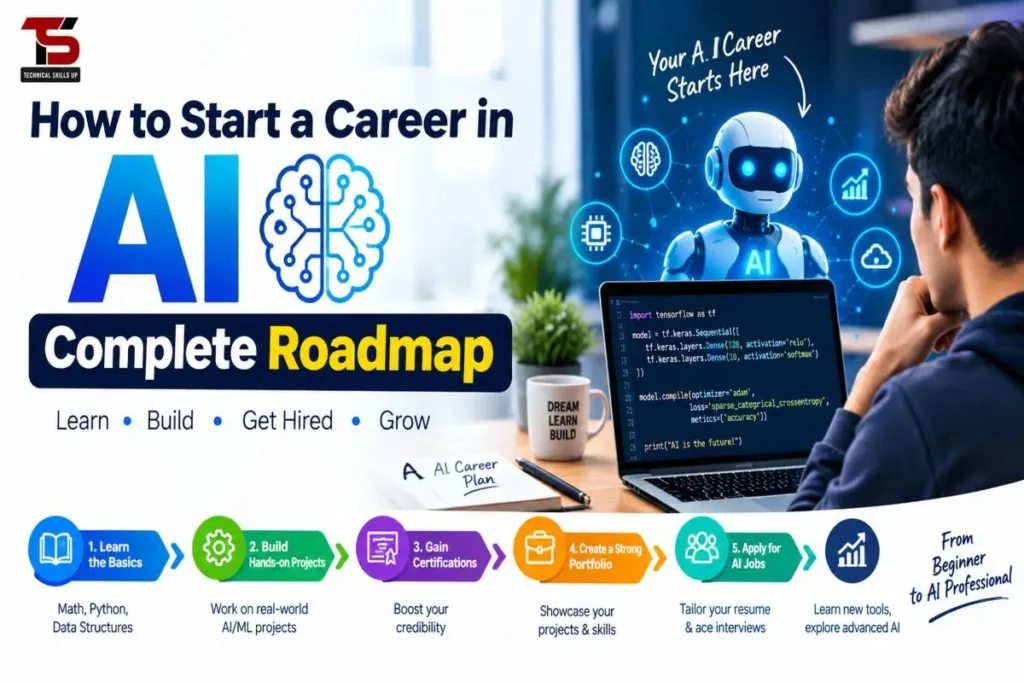
Artificial Intelligence is changing the way businesses work, products are developed, and decisions are made. From chatbots and recommendation systems to self-driving technology and Generative AI, artificial intelligence is now used across many industries. This growth has created new opportunities for people who want to build technical and professional skills in AI.
Starting an AI career does not mean learning every technology at once. A better approach is to follow a structured AI career roadmap that begins with fundamentals and gradually moves toward programming, Machine Learning, Deep Learning, Generative AI, and practical projects. This guide explains the major steps, skills, projects, and career options that can help beginners build a strong foundation in Artificial Intelligence.
What Is Artificial Intelligence?
Artificial Intelligence is a field of technology that enables computer systems to perform tasks that normally require human intelligence. These tasks can include understanding language, recognizing images, finding patterns, making predictions, and generating content.
AI works through different technologies and methods. Machine Learning allows systems to learn patterns from data, while Deep Learning uses neural networks for more complex tasks. Generative AI can create text, images, code, audio, and other types of content.
Common examples of AI include virtual assistants, fraud detection systems, recommendation engines, automated customer support, image recognition, and AI-powered software applications.
Is AI a Good Career Choice?
AI can be a strong career option for people interested in technology, programming, data, and problem-solving. Organizations across different industries are exploring AI to improve efficiency, automate repetitive tasks, understand data, and develop new products.
Another advantage is that AI offers multiple career paths. A learner can move toward Machine Learning, Generative AI, Data Science, Natural Language Processing, Computer Vision, or AI application development.
However, an AI career requires continuous learning. Tools and techniques change quickly, so professionals need to update their skills and gain practical experience instead of depending only on certificates.
AI Career Roadmap
A structured roadmap can make AI learning easier for beginners. The following steps provide a practical learning path.
Step 1 – Understand AI Fundamentals
Start by understanding the basic concepts before moving into advanced technologies.
Learn about:
- Artificial Intelligence
- Machine Learning
- Deep Learning
- Generative AI
- Neural Networks
- AI applications
- Data and model basics
Understanding how these technologies relate to each other will make advanced topics easier to learn.
Step 2 – Learn Mathematics and Statistics
You do not need to become a mathematics expert to begin learning AI. However, basic mathematical and statistical knowledge can help you understand how AI and Machine Learning models work.
Important areas include:
- Probability
- Statistics
- Linear Algebra
- Basic Calculus
- Data interpretation
Focus on practical understanding rather than memorizing formulas.
Step 3 – Learn Python
Python is widely used in Artificial Intelligence and Machine Learning because it has a large ecosystem of libraries and tools.
Start with:
- Variables and data types
- Conditions
- Loops
- Functions
- Lists and dictionaries
- Object-oriented programming basics
- File handling
After learning the fundamentals, explore libraries such as NumPy and Pandas for working with data.
Step 4 – Learn Machine Learning
Machine Learning is one of the most important areas of an AI career path. It allows computer systems to identify patterns in data and make predictions or decisions.
Learn concepts such as:
- Supervised learning
- Unsupervised learning
- Regression
- Classification
- Clustering
- Feature engineering
- Model evaluation
- Overfitting and underfitting
Use Python to implement basic models and understand how different algorithms behave with real datasets.
Step 5 – Learn Deep Learning
Deep Learning uses neural networks to solve complex problems involving large amounts of data.
Important topics include:
- Neural networks
- Activation functions
- Model training
- CNN
- RNN
- Training and validation
- Deep learning applications
Deep Learning is particularly useful in areas such as image recognition, speech processing, Natural Language Processing, and advanced AI applications.
Step 6 – Learn Generative AI
Generative AI has become an important part of modern AI development. It focuses on systems that can generate new content based on learned patterns.
Beginners can explore:
- Generative AI fundamentals
- Large Language Models
- Prompt Engineering
- AI APIs
- Retrieval-Augmented Generation
- AI-powered applications
- Responsible AI use
Rather than learning only how to use AI tools, try to understand how AI applications are designed and integrated into real workflows.
Step 7 – Choose an AI Specialization
After learning the fundamentals, choose an area that matches your career goals.
| Specialization | Main Focus |
|---|---|
| Machine Learning | Predictive models and algorithms |
| Generative AI | LLMs and content generation |
| AI Engineering | Building AI-powered applications |
| NLP | Text and language processing |
| Computer Vision | Images and video |
| Data Science | Data analysis and Machine Learning |
You do not need to master every specialization. Developing strong skills in one area can be more useful than having limited knowledge of many technologies.
Essential AI Skills to Learn
A successful AI career requires both technical and professional skills.
Technical Skills
Important technical skills include:
- Python
- Machine Learning
- Deep Learning
- Statistics
- Data handling
- SQL
- Generative AI
- APIs
- Model evaluation
- AI tools and frameworks
Professional Skills
Technical knowledge alone is not enough. AI professionals also benefit from:
- Problem-solving
- Analytical thinking
- Communication
- Research skills
- Teamwork
- Business understanding
- Continuous learning
Combining technical and professional skills can help you work more effectively on real-world AI problems.
Build AI Projects
Projects are one of the best ways to turn theoretical knowledge into practical experience.
Beginners can start with projects such as:
- Chatbot
- Sentiment analysis
- House price prediction
- Customer churn prediction
- Recommendation system
- Image classification
- Sales forecasting
- Generative AI application
Start with simple projects and gradually increase the complexity. Each project should explain the problem, data, approach, technology used, results, and possible improvements.
Create an AI Portfolio
A portfolio can demonstrate what you can actually build. Create a GitHub profile and organize your projects with clear documentation.
A useful project presentation can follow this structure:
Problem → Data → Approach → Model → Results → Application
You can also maintain a professional LinkedIn profile and include selected projects, technical skills, certifications, and relevant learning experience.
A strong portfolio is generally more useful when it demonstrates genuine work rather than a large collection of copied tutorial projects.
AI Certifications vs Practical Skills
Certifications can demonstrate that you completed structured training, but they should not be treated as a replacement for practical skills.
A balanced AI learning profile can include:
Knowledge + Certification + Projects + Portfolio + Practical Experience
When choosing a certification program, check the curriculum, trainer expertise, practical components, projects, and learning support instead of choosing a course based only on the certificate.
AI Career Opportunities
Key AI knowledge can support several career paths, depending on your technical background and specialization.
AI Engineer
Works on designing and integrating AI solutions into applications and business systems.
Machine Learning Engineer
Builds, tests, and improves Machine Learning models and related systems.
AI Developer
Develops applications that use AI models, APIs, and intelligent features.
Data Scientist
Uses data analysis, statistics, and Machine Learning to generate insights and build predictive solutions.
Generative AI Developer
Works with Large Language Models, AI APIs, prompts, and applications powered by Generative AI.
NLP Engineer
Works on systems that process and understand human language.
Computer Vision Engineer
Develops AI solutions for images, video, and visual data.
How Long Does It Take to Learn AI?
There is no fixed time required to learn Artificial Intelligence because learning speed depends on your previous knowledge, study time, programming experience, and career goal.
A practical progression can look like this:
Beginner: AI fundamentals
↓
Foundation: Python + Mathematics
↓
Intermediate: Machine Learning + Projects
↓
Advanced: Deep Learning + Generative AI
↓
Career Ready: Specialization + Portfolio + Interview Preparation
Consistent practice is generally more valuable than trying to complete the entire roadmap quickly.
AI Career Roadmap for Beginners
Beginners can follow a simple progression:
| Stage | Learning Focus |
|---|---|
| 1 | AI Fundamentals |
| 2 | Python |
| 3 | Mathematics & Statistics |
| 4 | Machine Learning |
| 5 | Deep Learning |
| 6 | Generative AI |
| 7 | Specialization |
| 8 | Practical Projects |
| 9 | Portfolio |
| 10 | Career Preparation |
Avoid jumping directly into advanced AI frameworks without understanding the fundamentals.
Common Mistakes to Avoid When Starting an AI Career
Many beginners make the learning process harder by trying to learn too many technologies at once.
Avoid these common mistakes:
- Learning too many tools simultaneously
- Skipping Python fundamentals
- Ignoring basic mathematics
- Depending only on certificates
- Not building projects
- Copying projects without understanding them
- Watching tutorials without practicing
- Ignoring portfolio development
- Using outdated learning resources
- Expecting immediate job results
A focused learning plan can help you make steady progress.
How to Get Your First AI Job
Once you have developed foundational skills, start preparing for the job market.
A practical process is:
- Build strong fundamentals.
- Complete several relevant projects.
- Create a professional portfolio.
- Prepare an AI-focused resume.
- Practice technical interview questions.
- Improve your communication skills.
- Apply for suitable entry-level opportunities.
- Continue improving your skills based on feedback.
Your first role does not necessarily need to have “AI” in the job title. Roles in data, software development, analytics, and automation can also provide useful experience for moving toward AI-focused positions.
AI Career Roadmap for Students and Working Professionals
For Students
Students can start with Python and AI fundamentals, followed by Machine Learning and practical projects. Internships, academic projects, competitions, and GitHub work can help develop practical experience.
For Working Professionals
Working professionals can combine AI with their existing domain knowledge. For example, a software developer can focus on AI application development, while a data analyst can move toward Machine Learning and Data Science.
Combining an existing professional skill with AI can create a more focused career path.
How to Keep Learning AI
Artificial Intelligence changes rapidly, so learning should continue after completing a course or certification.
Useful habits include:
- Follow official documentation
- Explore new AI tools
- Build practical projects
- Read reliable technical resources
- Follow AI research and industry developments
- Experiment with new models and APIs
- Update your portfolio regularly
Always verify important technical information through reliable and current sources because AI tools and capabilities can change quickly.
Learn AI with Structured Training
Self-learning can work well for motivated learners, but structured training can provide a clear curriculum, trainer guidance, practical exercises, and project support.
Technical Skills Up provides Artificial Intelligence training designed around practical learning and modern AI technologies. Learners can explore topics such as AI, Machine Learning, Deep Learning, Generative AI, Python, and practical applications.
For learners looking for structured training, you can explore the Artificial Intelligence Course in India or the Artificial Intelligence Course in USA based on your learning requirements.
Final AI Career Roadmap
Starting a career in Artificial Intelligence is a gradual process. You do not need to learn everything on the first day.
Follow a focused path:
AI Fundamentals → Mathematics → Python → Machine Learning → Deep Learning → Generative AI → Specialization → Projects → Portfolio → Career Preparation
The most important step is to keep practicing what you learn. Build projects, understand the technologies you use, maintain a professional portfolio, and continue updating your knowledge.
With consistent learning and practical experience, you can build a stronger foundation for exploring opportunities in the growing field of Artificial Intelligence.