
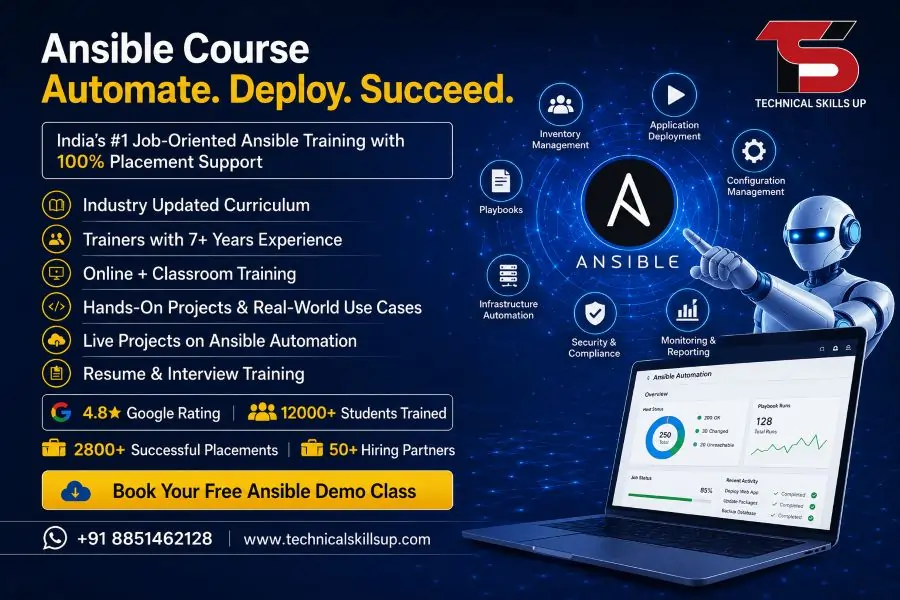
Technology-driven businesses need faster deployment, better automation, and reliable infrastructure management. Modern organizations are actively adopting automation tools to reduce manual work and improve operational efficiency. Professionals who understand infrastructure automation are becoming valuable assets for IT companies across the world. Technical Skills Up offers an industry-focused Ansible Course in Noida designed for students, system administrators, DevOps professionals, cloud engineers, and working professionals who want to build strong automation skills. The program combines theoretical knowledge with practical implementation to help learners understand real business requirements. Every module focuses on hands-on learning, real-time projects, and industry practices. Strong guidance from experienced trainers, practical lab sessions, and career-focused learning make this program suitable for beginners as well as experienced IT professionals seeking career growth in automation and DevOps technologies.
Course Overview
Automation has become a critical requirement in modern IT environments. Organizations manage hundreds or even thousands of servers, applications, and cloud resources. Manual configuration and deployment consume time and increase the chances of errors. Ansible helps organizations automate these tasks efficiently.
Technical Skills Up has developed a comprehensive training program that covers the complete lifecycle of automation using Ansible. Learners gain practical knowledge of configuration management, application deployment, infrastructure provisioning, orchestration, and automation workflows.
The curriculum is designed according to current industry requirements and focuses on practical implementation rather than just theoretical concepts. Real-world examples help learners understand how automation improves operational efficiency and business productivity.
Key Highlights of the Program
- Instructor-led live training
- Practical lab environment
- Industry-oriented curriculum
- Real-time project implementation
- Hands-on automation exercises
- Resume building support
- Interview preparation sessions
- Certification guidance
- Placement assistance
- Flexible learning schedules
Why Automation Skills Matter Today
Digital transformation has changed the way businesses operate. Companies are adopting cloud platforms, microservices, containers, and DevOps practices. Automation plays a central role in managing these complex environments.
Businesses seek professionals who can automate repetitive tasks, improve deployment speed, and maintain consistency across systems. Ansible has emerged as one of the most popular automation platforms because of its simplicity and agentless architecture.
Knowledge of automation helps organizations:
- Reduce manual efforts
- Improve operational efficiency
- Minimize configuration errors
- Accelerate application deployment
- Enhance infrastructure scalability
- Improve security compliance
- Support continuous delivery processes
Strong automation skills can significantly increase career opportunities in today’s technology landscape.
Ansible Training in Noida for Modern IT Professionals
Practical learning creates a solid foundation for success. Technical Skills Up focuses on industry-relevant training that prepares learners for real-world challenges.
Every training session includes demonstrations, exercises, and hands-on implementation. Learners understand how automation works across different environments including Linux servers, cloud platforms, networking devices, and enterprise applications.
Professional trainers explain complex concepts using simple examples, making learning easier for beginners and experienced professionals alike.
Who Should Join This Program?
The course is suitable for:
- System Administrators
- Linux Administrators
- Cloud Engineers
- DevOps Engineers
- Network Engineers
- Technical Support Professionals
- Software Engineers
- IT Graduates
- Computer Science Students
- Working Professionals seeking career growth
Previous automation experience is helpful but not mandatory.
Importance of Ansible in the IT Industry
Organizations across industries use Ansible to automate infrastructure management and deployment processes. Its simple YAML-based syntax makes it easy to learn and implement.
Many leading enterprises rely on Ansible for:
- Server configuration management
- Software deployment
- Cloud automation
- Security compliance management
- Application orchestration
- Network automation
- Infrastructure provisioning
Growing adoption of DevOps methodologies has increased the demand for professionals with Ansible expertise. Companies prefer candidates who can automate repetitive tasks and streamline IT operations.
Industry Benefits of Ansible
Faster Deployment
Automation reduces deployment time significantly and improves business productivity.
Better Consistency
Automated configurations eliminate variations between environments.
Improved Reliability
Repeatable automation processes reduce human errors.
Cost Optimization
Reduced manual effort lowers operational costs.
Enhanced Scalability
Organizations can manage larger infrastructures efficiently.
Skills Covered in the Program
Comprehensive training ensures learners gain practical expertise in all major aspects of Ansible automation.
Fundamentals of Automation
Learners begin with core concepts of automation and infrastructure management.
Topics include:
- Introduction to automation
- Configuration management concepts
- Infrastructure as Code fundamentals
- Automation strategies
- DevOps integration
Ansible Architecture
Understanding the architecture helps learners build strong foundational knowledge.
Topics include:
- Control node concepts
- Managed nodes
- Inventory management
- Agentless architecture
- Communication methods
Installation and Configuration
Practical sessions help learners set up and configure Ansible environments.
Coverage includes:
- Linux installation
- Environment setup
- SSH configuration
- Inventory creation
- Connectivity testing
Playbooks and YAML
Playbooks form the foundation of Ansible automation.
Topics include:
- YAML syntax
- Playbook structure
- Variables
- Conditions
- Loops
- Templates
- Error handling
Roles and Modules
Advanced automation requires modular development practices.
Learners understand:
- Built-in modules
- Custom modules
- Role creation
- Role management
- Reusable automation code
Configuration Management
Hands-on exercises focus on real infrastructure scenarios.
Coverage includes:
- Package management
- Service management
- User management
- File management
- Security configurations
Advanced Automation
Practical implementation of enterprise-level automation.
Topics include:
- Dynamic inventories
- Automation workflows
- Task orchestration
- Performance optimization
- Troubleshooting techniques
Tools and Technologies Covered
Modern IT environments require integration between multiple platforms and technologies. Technical Skills Up provides exposure to commonly used industry tools.
Linux Administration
Linux serves as the primary operating system for many enterprise environments.
Learners gain experience in:
- Linux commands
- File management
- User administration
- Networking basics
- Security management
Git Version Control
Version control is essential for modern automation projects.
Coverage includes:
- Repository management
- Branching strategies
- Code collaboration
- Version tracking
DevOps Concepts
Automation works closely with DevOps practices.
Topics include:
- CI/CD fundamentals
- Continuous integration
- Continuous deployment
- Infrastructure automation
Cloud Platforms
Cloud adoption continues to grow rapidly across industries.
Learners explore:
- Cloud automation concepts
- Resource provisioning
- Infrastructure management
- Cloud deployment workflows
Container Technologies
Modern application deployment often involves containers.
Coverage includes:
- Container fundamentals
- Container deployment
- Container orchestration basics
- Automation integration
Ansible Classes in Noida with Practical Learning
Theory alone cannot build technical expertise. Practical implementation remains the most important part of learning automation.
Technical Skills Up provides extensive hands-on training through:
- Live demonstrations
- Guided practical sessions
- Lab assignments
- Real-world scenarios
- Automation projects
- Deployment exercises
Every learner gets opportunities to work on automation tasks that mirror actual industry requirements.
Project-Based Learning Approach
Practical projects help students gain confidence and experience.
Projects may include:
- Server configuration automation
- Application deployment automation
- Cloud resource provisioning
- Security compliance automation
- Infrastructure management tasks
Real project exposure improves problem-solving skills and enhances employability.
Industry Demand and Future Scope
Automation continues to shape the future of information technology. Businesses are investing heavily in technologies that improve efficiency and reduce operational costs.
Market demand for automation professionals continues to increase because organizations require faster deployments and reliable infrastructure management.
Several technology trends support the growth of automation careers:
- Cloud computing expansion
- DevOps adoption
- Infrastructure as Code implementation
- Hybrid cloud environments
- Digital transformation initiatives
- Enterprise automation strategies
Companies seek professionals who understand automation tools and can contribute to operational excellence.
Future Opportunities
Growing demand exists across sectors such as:
- Information Technology
- Banking
- Healthcare
- Telecommunications
- E-commerce
- Manufacturing
- Consulting Services
- Cloud Service Providers
Career prospects remain strong for professionals with practical automation expertise.
Ansible Certification Course in Noida for Career Growth
Professional certification validates skills and increases credibility in the job market.
Technical Skills Up prepares learners with the knowledge and practical experience required to pursue industry-recognized certification paths.
Certification preparation includes:
- Concept clarification
- Practice exercises
- Mock assessments
- Scenario-based learning
- Interview-oriented training
Employers often prefer candidates who demonstrate verified technical expertise through certifications and practical project experience.
Benefits of Certification
Certification can help professionals:
- Strengthen resumes
- Improve career prospects
- Increase industry recognition
- Gain employer confidence
- Enhance technical credibility
- Access better job opportunities
Career Opportunities After Completing the Course
Automation expertise opens doors to multiple job roles across industries.
Popular career paths include:
DevOps Engineer
Professionals automate deployment pipelines and infrastructure management processes.
Automation Engineer
Experts develop automation solutions for operational efficiency.
Linux Administrator
Administrators manage and automate Linux-based environments.
Cloud Engineer
Engineers automate cloud resource provisioning and management.
Infrastructure Engineer
Professionals maintain and automate enterprise infrastructure systems.
Site Reliability Engineer
Experts focus on system reliability, monitoring, and automation.
Configuration Management Engineer
Professionals manage infrastructure consistency through automation.
Release Engineer
Engineers streamline software deployment and release processes.
Growing demand across these roles creates excellent career advancement opportunities.
Ansible Training Institute in Noida Focused on Real Skills
Technical Skills Up emphasizes practical learning, industry relevance, and career development.
Several factors distinguish the training approach:
Experienced Trainers
Industry professionals deliver training based on real-world experience and current market practices.
Updated Curriculum
Course modules align with current industry trends and employer expectations.
Hands-On Labs
Practical sessions provide valuable implementation experience.
Individual Attention
Smaller batches help trainers focus on learner progress and understanding.
Career Guidance
Professional mentoring supports long-term career development.
Flexible Learning Options
Training schedules accommodate students and working professionals.
Training Methodology
Effective learning requires a structured and practical approach.
Technical Skills Up follows a methodology designed to maximize knowledge retention and skill development.
Interactive Sessions
Learners actively participate in discussions, demonstrations, and exercises.
Practical Assignments
Assignments reinforce concepts learned during training.
Real-Time Projects
Industry-based projects provide hands-on implementation experience.
Case Studies
Practical case studies help learners understand business applications.
Continuous Assessment
Regular evaluations measure progress and identify improvement areas.
Online and Classroom Learning
Flexible learning modes allow students to choose the format that best fits their schedule.
Certification and Placement Support
Career support remains an important part of the learning journey. Technical Skills Up provides guidance beyond technical training.
Support services include:
- Resume preparation
- LinkedIn profile optimization
- Interview preparation
- Mock interview sessions
- Technical assessment practice
- Job application guidance
- Placement assistance
Professional mentoring helps learners present their skills confidently during recruitment processes.
Interview Preparation
Dedicated sessions focus on:
- Technical questions
- Practical scenarios
- Problem-solving techniques
- Industry expectations
- Communication skills
Strong preparation improves confidence and increases employment opportunities.
Why Technical Skills Up is the Right Choice
Selecting the right training provider plays a crucial role in career success.
Technical Skills Up delivers value through:
- Industry-oriented curriculum
- Practical learning approach
- Experienced trainers
- Modern training infrastructure
- Flexible schedules
- Career-focused mentoring
- Project-based learning
- Certification guidance
- Placement support
Learners receive comprehensive training designed to meet current industry demands and future career goals.
Learning Outcomes
After completing the program, learners will be able to:
- Understand automation concepts
- Configure Ansible environments
- Create automation playbooks
- Manage infrastructure efficiently
- Automate deployment processes
- Implement configuration management
- Work with cloud automation workflows
- Troubleshoot automation issues
- Apply DevOps best practices
- Handle real-world automation projects
These skills help professionals become productive contributors in modern IT environments.
Conclusion
Modern organizations rely heavily on automation to improve efficiency, reduce errors, and accelerate business operations. Strong knowledge of Ansible can help professionals build rewarding careers in DevOps, cloud computing, infrastructure management, and automation engineering. Technical Skills Up provides comprehensive training that combines expert guidance, practical implementation, industry-focused projects, and career support. Every module is designed to deliver real-world skills that employers value. Learners gain confidence through hands-on experience and structured mentoring. A well-planned learning journey, practical exposure, and professional development support make this course an excellent choice for anyone looking to advance in the rapidly growing field of IT automation and infrastructure management.
FAQs:
Q1. What is the Ansible Course in Noida?
Ans: The Ansible Course in Noida is a professional training program that teaches students server management, configuration management, and IT automation using the Ansible automation tool. At Technical Skills Up, this course is taught using an industry-oriented curriculum, enabling students to learn by working on real-world projects.
Q2. Who is the Ansible Training in Noida suitable for?
Ans: This course is suitable for the following individuals:
- DevOps Engineers
- System Administrators
- Cloud Professionals
- Linux Administrators
- IT Students
- Working Professionals
While prior experience makes learning easier, beginners can also take this course.
Q3. What skills are required to take the Ansible Course?
Ans: Having some basic technical knowledge is beneficial for learning Ansible.
- Basic understanding of Linux
- Knowledge of networking
- Use of the command line
- Knowledge of IT infrastructure
At Technical Skills Up, beginners are also guided starting from fundamental concepts.
Q4. What kind of placement assistance is provided with the Ansible Course in Noida?
Ans: Yes, Technical Skills Up provides placement assistance to students. This includes resume building, interview preparation, mock interviews, and job referral support. The goal is to help students secure better career opportunities in the industry.
Q5. What is the duration of the Ansible Training in Noida?
Ans: The course duration may vary depending on the batch and training mode. Generally, the Ansible Training in Noida is completed within 6 to 10 weeks. Both weekend and weekday batches may be available.
Q6. What topics are covered in the Ansible Course?
Ans: The course covers several important topics:
- Introduction to Ansible
- Inventory Management
- Playbooks
- Roles and Modules
- Variables and Templates
- Automation Workflows
- Configuration Management
- Real-Time Projects
Students gain practical experience through these topics.
Q7. Are job opportunities available after learning Ansible?
Ans: Yes, the demand for Ansible professionals in the DevOps and Automation sectors is steadily increasing. After learning Ansible, one can apply for roles such as DevOps Engineer, Automation Engineer, System Administrator, and Cloud Engineer.
Q8. What makes the Technical Skills Up Ansible course different from others?
Ans: Technical Skills Up provides students with practical training in addition to theory. Features such as experienced trainers, live projects, interview preparation, and career support make this course highly valuable. The training focuses on real-world industry requirements.
Q9. Do students work on live projects during the Ansible course?
Ans: Yes, students work on live projects and real-time case studies. This gives them the opportunity to understand the actual work environment and develop industry-level skills.
Q10. What is the significance of Ansible Certification?
Ans: Ansible Certification demonstrates a candidate’s technical proficiency. The certificate strengthens the resume and helps make the candidate’s profile more attractive during the recruitment process.
Q11. What is the relationship between Ansible and DevOps?
Ans: Ansible is a crucial automation tool within the DevOps ecosystem. It simplifies infrastructure provisioning, configuration management, and application deployment. Ansible plays a vital role in making DevOps processes faster and more reliable.
Q12. Is online Ansible training available?
Ans: Yes, Technical Skills Up offers both online and offline training. Through online classes, students can receive training from anywhere and benefit from recorded sessions.
Q13. What is the fee for the Ansible course?
Ans: Course fees may vary depending on the batch, training mode, and additional features. Contacting the Technical Skills Up counseling team is the best way to get accurate fee information. Special offers and discounts are also frequently available.
Q14. How long does it take to learn Ansible?
Ans: The basic concepts of Ansible can be learned in a few weeks. However, regular practice is essential to master real-world projects and advanced automation techniques. Consistent practice enables students to achieve greater proficiency in less time.
Q15. What job roles can one pursue after completing the Ansible course?
Ans: Upon completing the Ansible course, one can apply for the following job profiles:
- DevOps Engineer
- Automation Engineer
- Linux Administrator
- Cloud Engineer
- Site Reliability Engineer (SRE)
- Infrastructure Engineer
- System Administrator
An understanding of Ansible automation is considered a crucial skill for these roles.