
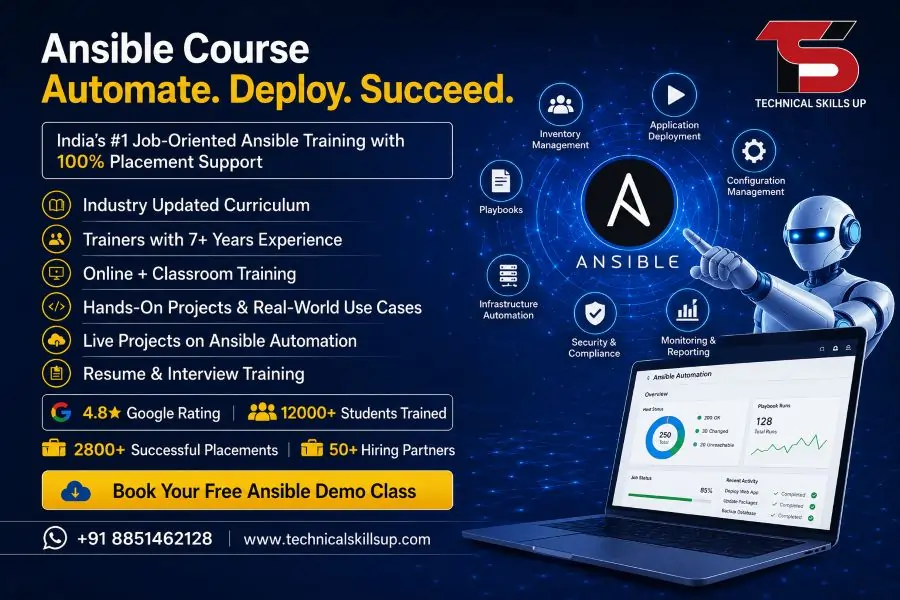
Modern IT environments require speed, consistency, and automation. Organizations across the world are adopting automation platforms to manage infrastructure, deploy applications, and reduce manual effort. Technical Skills Up brings a career-focused Ansible Course designed for students, system administrators, cloud professionals, DevOps engineers, and IT enthusiasts who want to build practical automation skills.
Technology teams often manage hundreds or even thousands of servers. Manual configuration takes time and increases the risk of errors. Automation solves this challenge by helping teams perform repetitive tasks quickly and accurately. This training program provides a structured learning path that helps learners understand automation concepts and apply them in real-world environments. Every module focuses on practical knowledge, industry-relevant skills, and hands-on learning. Learners gain confidence by working on projects that reflect actual business requirements. Strong industry guidance, expert mentorship, and practical exposure make this program suitable for beginners as well as experienced professionals looking to upgrade their skills.
Ansible Training for Modern IT Professionals
Automation has become a critical requirement in today’s technology landscape. Companies need professionals who can automate infrastructure management, application deployment, cloud operations, and configuration management. Our Ansible Training program helps learners understand these concepts through practical examples and real-world use cases.
Knowledge gained during the course can help professionals improve productivity and reduce operational complexity. Every topic is explained in a simple manner so that learners can build a strong foundation before moving to advanced concepts.
Key learning benefits include:
- Understanding automation fundamentals
- Managing servers efficiently
- Automating repetitive administrative tasks
- Learning infrastructure as code concepts
- Deploying applications using automation
- Managing cloud resources effectively
- Improving DevOps workflows
- Enhancing operational efficiency
Strong emphasis on practical implementation ensures that learners gain skills that can be applied immediately in professional environments.
Course Overview
Technical Skills Up has designed this program to match current industry expectations. Every module follows a structured approach that combines theory with hands-on practice.
Course highlights include:
- Beginner to advanced learning path
- Live instructor-led sessions
- Real-world assignments
- Practical lab exercises
- Industry-based projects
- Flexible learning schedules
- Career guidance support
- Interview preparation assistance
Learners receive detailed explanations of automation concepts along with practical demonstrations. Every session focuses on building job-ready skills rather than only covering theoretical topics.
Who Can Join This Course?
This program is suitable for:
- DevOps Engineers
- System Administrators
- Linux Administrators
- Cloud Engineers
- Network Engineers
- Software Developers
- IT Support Professionals
- Computer Science Students
- Fresh Graduates
- Technology Enthusiasts
Previous automation experience is not mandatory. Basic knowledge of Linux can be helpful but is not required for starting the course.
Importance of Automation in the Industry
Businesses today depend heavily on digital infrastructure. Managing complex environments manually creates operational challenges and increases downtime risks. Automation helps organizations maintain consistency, improve efficiency, and reduce human errors.
Organizations use automation for:
- Configuration management
- Application deployment
- Infrastructure provisioning
- Cloud management
- Security compliance
- Patch management
- Continuous delivery
- Server orchestration
Growing adoption of cloud computing, DevOps practices, and digital transformation initiatives has increased the demand for professionals who understand automation technologies.
Many enterprises now consider automation skills a core requirement for infrastructure and DevOps roles. Learning these skills can significantly improve career opportunities and professional growth.
Skills Covered in the Program
Technical Skills Up focuses on developing practical skills that employers actively seek. Every module builds upon previous concepts to create a comprehensive learning experience.
Automation Fundamentals
Learners begin by understanding automation principles and infrastructure management concepts.
Topics include:
- Introduction to automation
- Infrastructure management
- Configuration management basics
- Automation workflows
- Automation architecture
- Automation benefits and challenges
Linux Fundamentals
Practical Linux knowledge supports successful automation implementation.
Coverage includes:
- Linux commands
- File system management
- User administration
- Process management
- Networking basics
- Package management
Inventory Management
Managing infrastructure inventories forms a critical part of automation workflows.
Topics include:
- Static inventory
- Dynamic inventory
- Inventory groups
- Host variables
- Inventory best practices
Playbooks and Automation Tasks
Playbooks represent the foundation of automation workflows.
Learning areas include:
- YAML fundamentals
- Playbook creation
- Task execution
- Variables and facts
- Conditional statements
- Loops and iterations
- Error handling
Roles and Reusability
Efficient automation requires reusable components.
Learners understand:
- Role structure
- Role creation
- Role dependencies
- Best practices
- Project organization
Advanced Automation Concepts
Professional environments require advanced automation capabilities.
Coverage includes:
- Templates
- Filters
- Tags
- Handlers
- Vault
- Lookup plugins
- Custom modules
Practical exercises help learners gain confidence while working on advanced implementations.
Ansible Classes with Practical Learning
Many learners struggle when training focuses only on theory. Technical Skills Up addresses this challenge through practical learning sessions. Our Ansible Classes provide hands-on exercises that simulate real business environments.
Students work on:
- Server management tasks
- Infrastructure automation projects
- Configuration management scenarios
- Cloud automation exercises
- Deployment workflows
- Security implementation tasks
Hands-on practice improves understanding and helps learners gain confidence while solving industry-related problems.
Project-Based Learning
Projects form an important part of the learning experience.
Sample project areas include:
- Automated server provisioning
- Multi-server management
- Application deployment automation
- Cloud infrastructure automation
- Configuration standardization
- Environment setup automation
Project work helps learners apply concepts and build a portfolio that demonstrates practical expertise.
Tools and Technologies Covered
Technology professionals often work with multiple platforms and tools. Training at Technical Skills Up introduces learners to technologies commonly used alongside automation solutions.
Linux Environment
Linux remains one of the most widely used operating systems in enterprise environments.
Topics include:
- Ubuntu
- CentOS
- Red Hat environments
- Command-line operations
- Shell concepts
Version Control
Source code and automation scripts require effective version management.
Coverage includes:
- Git fundamentals
- Repository management
- Branching concepts
- Collaboration workflows
Cloud Platforms
Cloud environments continue to expand across industries.
Learners gain exposure to:
- Amazon Web Services concepts
- Microsoft Azure fundamentals
- Google Cloud basics
- Cloud automation workflows
DevOps Ecosystem
Modern automation often integrates with DevOps practices.
Related concepts include:
- Continuous Integration
- Continuous Delivery
- Infrastructure as Code
- Deployment automation
- Monitoring basics
Exposure to these technologies helps learners understand how automation fits into broader IT operations.
Ansible Online Training Designed for Flexibility
Busy professionals often need learning options that fit their schedules. Technical Skills Up offers Ansible Online Training that allows learners to study from any location.
Online learning benefits include:
- Live interactive sessions
- Recorded lectures
- Flexible schedules
- Remote lab access
- Expert guidance
- Doubt-clearing sessions
- Assignment support
Interactive training ensures that learners remain engaged throughout the program. Trainers encourage participation and provide individual attention whenever required.
Live Instructor-Led Sessions
Experienced trainers conduct live sessions that focus on practical implementation rather than memorization.
Learning experience includes:
- Real-time demonstrations
- Practical examples
- Case studies
- Interactive discussions
- Project guidance
Students can ask questions during sessions and receive immediate clarification.
Career Opportunities After Completing the Course
Automation skills open doors to a variety of technology roles. Organizations across industries actively seek professionals who can automate processes and improve operational efficiency.
Common job roles include:
- DevOps Engineer
- Automation Engineer
- Linux Administrator
- System Administrator
- Infrastructure Engineer
- Cloud Engineer
- Site Reliability Engineer
- Platform Engineer
- Release Engineer
- Configuration Management Specialist
Many employers value candidates who demonstrate practical experience with automation projects and real-world implementations.
Salary Growth Potential
Automation expertise can contribute to better career progression and compensation opportunities.
Factors influencing salary include:
- Technical skills
- Industry experience
- Certification credentials
- Project exposure
- Cloud knowledge
- DevOps expertise
Continuous learning and practical application help professionals remain competitive in the job market.
Industry Demand and Future Scope
Automation technology continues to gain importance as organizations modernize infrastructure and embrace cloud adoption. Businesses want faster deployments, consistent environments, and reduced operational costs.
Several factors contribute to growing demand:
- Expansion of cloud computing
- Growth of DevOps adoption
- Digital transformation initiatives
- Infrastructure scalability requirements
- Security compliance needs
- Operational efficiency goals
Future opportunities are expected to increase as companies automate more business-critical processes.
Why Automation Skills Matter
Technology environments are becoming increasingly complex. Organizations require professionals who can manage infrastructure efficiently while maintaining consistency and reliability.
Benefits of automation skills include:
- Better employability
- Career advancement opportunities
- Higher productivity
- Reduced manual effort
- Increased technical expertise
- Stronger industry relevance
Professionals who develop automation expertise often find opportunities across multiple industries including finance, healthcare, retail, manufacturing, telecommunications, and technology services.
Ansible Certification Course for Career Validation
Professional certifications help validate technical knowledge and practical capabilities. Our Ansible Certification Course prepares learners to understand industry standards and automation best practices.
Certification-focused preparation includes:
- Core automation concepts
- Practical implementation skills
- Scenario-based exercises
- Industry use cases
- Mock assessments
Certification can strengthen a professional profile and demonstrate commitment to continuous learning.
Benefits of Certification
Certification support provides several advantages:
- Improved credibility
- Better career opportunities
- Enhanced professional confidence
- Stronger resume value
- Industry recognition
Technical Skills Up helps learners prepare effectively through structured learning and practical exercises.
Why Choose Technical Skills Up
Selecting the right training provider plays a major role in career success. Technical Skills Up focuses on delivering quality education with practical relevance.
Key advantages include:
Industry-Experienced Trainers
Training sessions are conducted by professionals who understand current industry practices and real-world challenges.
Practical Learning Approach
Every module includes hands-on activities that reinforce theoretical concepts.
Updated Curriculum
Course content aligns with current market requirements and industry expectations.
Personalized Support
Learners receive guidance throughout the training journey.
Project-Based Training
Real-world projects help learners build practical expertise and confidence.
Interview Preparation
Career support sessions help learners prepare for technical interviews and professional discussions.
Affordable Learning
Quality education remains accessible through flexible learning options.
Ansible Online Course in India for Nationwide Learning
Students and professionals from different cities can access quality education through our Ansible Online Course in India. Geographic limitations no longer prevent learners from gaining industry-relevant skills.
Training benefits include:
- Access from anywhere
- Live virtual classrooms
- Recorded sessions
- Expert mentorship
- Practical assignments
- Career support
Flexible learning options help professionals balance work responsibilities and skill development goals.
Learning Experience Across India
Learners from metropolitan cities, emerging technology hubs, and smaller towns can join the same expert-led sessions.
Advantages include:
- Equal learning opportunities
- Industry-focused curriculum
- Interactive participation
- Continuous mentorship
- Collaborative learning environment
This approach ensures consistent learning quality regardless of location.
Training Methodology
Technical Skills Up follows a structured methodology that combines theoretical knowledge with practical implementation.
Learning framework includes:
Concept Learning
Every topic begins with clear explanations and real-world examples.
Demonstration Sessions
Trainers perform live demonstrations to explain practical implementation techniques.
Hands-On Labs
Learners practice concepts through guided exercises.
Assignments
Regular assignments reinforce learning and encourage independent problem-solving.
Project Work
Projects simulate actual workplace scenarios and improve practical skills.
Assessment
Periodic evaluations help learners track progress and identify improvement areas.
Strong focus on application-oriented learning ensures better retention and skill development.
Certification and Placement Support
Career growth requires more than technical knowledge. Technical Skills Up supports learners through certification guidance and placement preparation activities.
Placement assistance includes:
- Resume building support
- Interview preparation
- Technical mock interviews
- Career guidance sessions
- Professional profile improvement
- Job application support
Learners receive practical advice that helps them present their skills effectively during recruitment processes.
Career Readiness Support
Training extends beyond classroom learning.
Support areas include:
- Communication improvement
- Interview confidence building
- Technical discussion preparation
- Industry awareness
- Professional networking guidance
Comprehensive support helps learners move closer to their career goals.
Build a Strong Future with Automation Skills
Technology continues to evolve, and automation remains one of the most valuable skills in modern IT environments. Organizations need professionals who can improve efficiency, reduce operational complexity, and support digital transformation initiatives. Technical Skills Up delivers practical learning, expert mentorship, industry-relevant projects, and career-focused guidance that help learners achieve professional success. Whether you are a student beginning your journey or a working professional seeking career advancement, this training program provides the knowledge, confidence, and practical expertise required to succeed in today’s competitive technology landscape. Strong automation skills can create long-term career opportunities, making this course a valuable investment in your professional future.
FAQs:
Q1. What is the Ansible Online Course in India with Placement?
Ans: The Ansible Online Course in India with Placement is a professional training program that teaches skills in IT automation, configuration management, application deployment, and infrastructure management. Offered by Technical Skills Up, this course is suitable for both beginners and experienced professionals. The training includes live projects, practical labs, and industry-based case studies to help students understand real-world work environments.
Q2. Who is eligible to take the Ansible course?
Ans: This course is beneficial for a wide range of professionals and students:
- DevOps Engineers
- System Administrators
- Linux Administrators
- Cloud Professionals
- IT Students
- Software Engineers
While basic knowledge of Linux and networking makes learning easier, beginners can also enroll in this course.
Q3. What are the benefits of taking the Ansible Online Course in India with Placement?
Ans: Learning Ansible equips you with a high-demand skill in IT automation. Key benefits include:
- Understanding infrastructure automation
- Ability to automate manual tasks
- Better career opportunities in DevOps
- Opportunities to work on cloud and automation projects
- Access to placement assistance
These skills help candidates remain competitive in the industry.
Q4. Why is Technical Skills Up’s Ansible Online Course different from others?
Ans: Technical Skills Up provides training tailored to industry requirements. The course features live projects, experienced trainers, recorded sessions, interview preparation, and placement support. Students gain practical experience alongside theoretical knowledge, preparing them to work on real-world projects.
Q5. What topics are covered in the Ansible course?
Ans: The course includes several key modules:
- Introduction to Ansible
- Ansible Architecture
- Inventory Management
- Playbooks
- Roles and Modules
- Variables and Templates
- Configuration Management
- Automation Projects
- CI/CD Integration
- Cloud Automation
These topics are explained using practical examples.
Q6. Is placement assistance provided with the Ansible Online Course?
Ans: Yes, Technical Skills Up provides placement assistance to students. This includes resume building, mock interviews, job referrals, profile optimization, and career guidance. This support helps candidates secure better job opportunities.
Q7. What job profiles are available after learning Ansible?
Ans: Several career options become available after learning Ansible:
- DevOps Engineer
- Automation Engineer
- Linux Administrator
- Cloud Engineer
- Site Reliability Engineer
- Infrastructure Engineer
These roles involve tasks related to automation and deployment.
Q8. What is the duration of the Ansible online course?
Ans: The course duration may vary depending on the training modules. Generally, the Ansible online course can be completed within 6 to 10 weeks. With regular practice and project work, students can achieve greater proficiency in less time.
Q9. Does this course include live projects?
Ans: Yes, live projects are included in Technical Skills Up’s Ansible online course. Project-based training allows students to understand real-world industry problems and learn how to work on solutions for them. This boosts confidence for both interviews and actual jobs.
Q10. Is knowledge of Linux essential for learning Ansible?
Ans: Basic Linux knowledge is beneficial but not mandatory. Essential Linux concepts are also explained during the course so that beginners can easily learn Ansible automation and perform practical tasks.
Q11. What is the significance of Ansible Certification?
Ans: Ansible Certification validates a candidate’s automation and configuration management skills. The certification demonstrates your technical proficiency to employers and enhances your chances of securing a job.
Q12. What kind of support is provided during the online training?
Ans: Technical Skills Up offers comprehensive support to students:
- Live Instructor Support
- Doubt-clearing sessions
- Practice assignments
- Recorded classes
- Project guidance
- Career counseling
This makes the learning process more effective and streamlined.
Q13. What is the relationship between Ansible and DevOps?
Ans: Ansible is a crucial automation tool within the DevOps ecosystem. It simplifies infrastructure provisioning, configuration management, and application deployment. Ansible is widely used to bring speed and accuracy to DevOps processes.
Q14. What is the expected starting salary after learning Ansible?
Ans: Salary depends on the candidate’s experience, skills, and the company. The demand for Ansible and DevOps automation is constantly rising, offering trained candidates attractive career opportunities. Acquiring additional cloud and DevOps skills can further enhance career growth.
Q15. Why choose the Ansible online course from Technical Skills Up?
Ans: Technical Skills Up’s Ansible online course (with placement support) is designed according to industry standards. Experienced trainers, practical training, live projects, interview preparation, and placement assistance make it an excellent choice. The course helps students develop real-world automation skills while preparing them for employment.