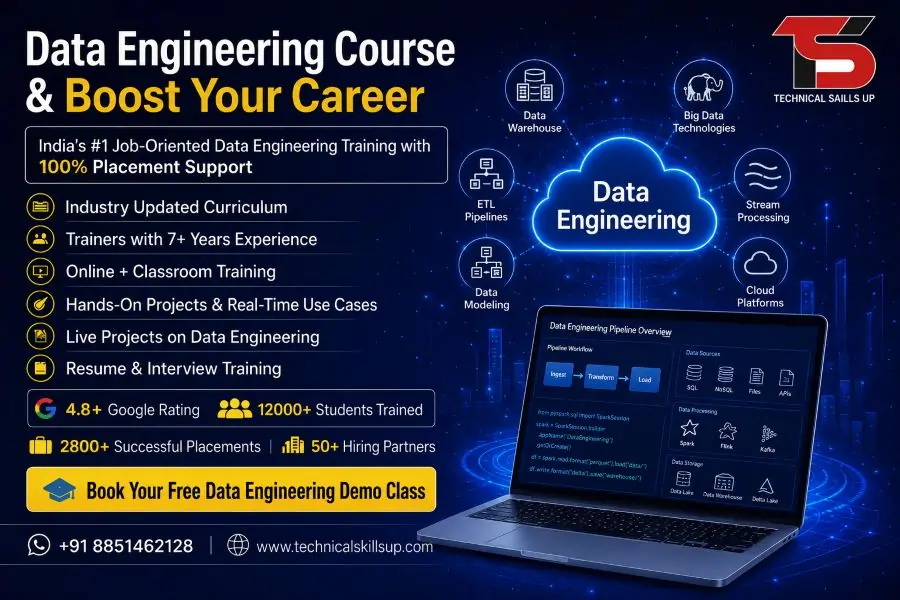
Data Engineering Course in Delhi with Placement

Modern businesses generate huge amounts of data every day. Organizations rely on this data to make better decisions, improve customer experiences, and drive growth. Skilled professionals who can collect, manage, process, and organize data are becoming essential across industries. A well-structured Data Engineering Course in Delhi helps learners build practical knowledge of data pipelines, cloud platforms, databases, big data technologies, and modern analytics systems. Technical Skills Up has designed this program to help students, fresh graduates, IT professionals, and career switchers gain industry-relevant expertise. Practical projects, expert mentorship, real-world case studies, and hands-on assignments create a strong learning environment that prepares learners for today’s competitive technology landscape. Every module focuses on practical implementation so learners can understand how data systems work in real business scenarios and confidently pursue rewarding opportunities in the growing field of data engineering.

Table of Contents

Course Overview

Data engineering plays a critical role in the modern data ecosystem. Companies need professionals who can build reliable systems that collect, store, transform, and deliver data efficiently.

Technical Skills Up offers a comprehensive training program designed to help learners understand both foundational and advanced concepts of data engineering. The curriculum focuses on practical learning and industry standards.

The program is suitable for:

  • Fresh graduates seeking technology careers
  • Software developers looking to upgrade skills
  • Database professionals
  • Data analysts moving toward engineering roles
  • Working professionals seeking career growth
  • IT professionals interested in cloud technologies

Learning modules are structured to ensure gradual skill development, allowing participants to build confidence at every stage.

Data Engineering Training in Delhi for Career Growth

Businesses today depend on accurate and accessible data. Every digital interaction creates valuable information that organizations use to improve products, services, and operations.

Growing demand for data-driven decision-making has created a significant need for trained data engineers. Companies require professionals who can manage large-scale datasets and build systems that support analytics and business intelligence.

Technical Skills Up provides industry-focused learning that helps learners understand:

  • Data architecture concepts
  • Data integration processes
  • Data transformation techniques
  • Data storage management
  • Data quality frameworks
  • Data security practices

Practical exposure ensures learners understand how these concepts are applied in real business environments.

Importance of Data Engineering in Today’s Industry

Data engineering forms the backbone of modern analytics and artificial intelligence systems. Without properly managed data, businesses cannot generate meaningful insights.

Organizations across sectors depend on efficient data infrastructure, including:

  • Banking and finance
  • Healthcare
  • Retail and e-commerce
  • Telecommunications
  • Manufacturing
  • Logistics
  • Education
  • Government sectors

Strong data engineering systems help organizations:

  • Improve operational efficiency
  • Reduce manual processes
  • Enable real-time reporting
  • Support machine learning initiatives
  • Enhance customer experiences
  • Increase business profitability

As data volumes continue to grow, organizations need skilled professionals capable of handling complex data environments.

Skills Covered in the Program

Technical Skills Up focuses on practical and job-oriented skills that employers actively seek.

Database Management Skills

Strong database knowledge forms the foundation of data engineering.

Topics include:

  • Relational databases
  • Database design
  • SQL fundamentals
  • Advanced SQL queries
  • Database optimization
  • Data normalization
  • Data indexing

Hands-on exercises help learners understand database structures and query optimization techniques.

Data Processing Skills

Data engineers spend significant time transforming raw data into useful information.

Training includes:

  • Data extraction methods
  • Data cleaning techniques
  • Data transformation processes
  • Data validation methods
  • Workflow automation
  • Data enrichment strategies

Practical scenarios help learners understand real-world data challenges.

Big Data Fundamentals

Large organizations manage massive datasets that traditional systems cannot efficiently process.

Learning areas include:

  • Big data concepts
  • Distributed computing
  • Data partitioning
  • Cluster architecture
  • Data scalability
  • Performance optimization

These concepts help learners understand modern enterprise environments.

Data Pipeline Development

Reliable data pipelines are essential for smooth business operations.

Key topics include:

  • Pipeline architecture
  • Data ingestion
  • Workflow scheduling
  • Error handling
  • Monitoring systems
  • Data orchestration

Project-based learning helps participants develop practical implementation skills.

Data Engineering Classes in Delhi with Practical Learning

Learning theory alone is not enough for today’s technology roles. Employers expect candidates to demonstrate practical skills and problem-solving abilities.

Technical Skills Up emphasizes hands-on learning through:

  • Live projects
  • Industry case studies
  • Practical assignments
  • Lab sessions
  • Real-world datasets
  • Guided exercises

Each module includes implementation activities that reinforce classroom concepts.

Practical exposure helps learners:

  • Build confidence
  • Improve technical abilities
  • Understand business challenges
  • Develop troubleshooting skills
  • Create project portfolios

These experiences significantly improve job readiness.

Tools and Technologies Covered

Modern data engineering requires familiarity with a variety of technologies and platforms.

SQL

SQL remains one of the most important skills for data professionals.

Learners gain experience with:

  • Data querying
  • Data manipulation
  • Stored procedures
  • Joins and subqueries
  • Performance optimization

Practical exercises focus on real-world business datasets.

Python

Python has become a leading programming language for data engineering.

Topics include:

  • Python fundamentals
  • Data processing
  • Automation scripts
  • File handling
  • Data transformation
  • Error management

Coding assignments help learners build practical development skills.

Apache Hadoop

Big data environments frequently rely on Hadoop ecosystems.

Coverage includes:

  • Hadoop architecture
  • HDFS concepts
  • Distributed storage
  • Data processing workflows

Learners understand how large-scale data systems operate.

Apache Spark

Modern organizations use Spark for fast and scalable data processing.

Training covers:

  • Spark fundamentals
  • DataFrames
  • Spark SQL
  • Distributed computing
  • Performance tuning

Hands-on exercises provide valuable implementation experience.

ETL Tools

Data movement is a core responsibility of data engineers.

Topics include:

  • ETL processes
  • Data integration
  • Workflow creation
  • Data transformation
  • Data validation

Real-world examples improve understanding of enterprise processes.

Cloud Platforms

Cloud computing has transformed the way organizations manage data.

Learners are introduced to:

  • Cloud architecture
  • Cloud storage
  • Cloud databases
  • Data migration
  • Scalable infrastructure

Understanding cloud technologies increases employability across industries.

Data Engineering Certification Course in Delhi

Professional certification helps validate technical skills and demonstrates commitment to career growth.

Technical Skills Up provides structured learning and assessment processes that support skill validation.

Benefits of certification include:

  • Enhanced professional credibility
  • Improved job prospects
  • Better interview performance
  • Recognition of technical expertise
  • Increased confidence

Employers often prefer candidates who can demonstrate both practical skills and verified knowledge.

Certification also helps learners stand out in competitive job markets.

Real-World Projects Included in Training

Project experience plays a major role in building practical expertise.

Training includes project-based learning opportunities that simulate actual business scenarios.

Examples may include:

  • Data warehouse projects
  • Data migration projects
  • ETL pipeline development
  • Analytics infrastructure setup
  • Data quality monitoring systems
  • Cloud-based data processing solutions

Project work helps learners understand how concepts come together in professional environments.

Portfolio development also improves interview readiness and employer confidence.

Career Opportunities After Completion

Data engineering offers excellent career opportunities across multiple industries.

Graduates can pursue roles such as:

Data Engineer

Responsibilities include:

  • Building data pipelines
  • Managing databases
  • Processing large datasets
  • Supporting analytics teams

Junior Data Engineer

Entry-level professionals work on:

  • Data preparation
  • Pipeline monitoring
  • Data validation
  • Workflow maintenance

ETL Developer

Focus areas include:

  • Data integration
  • Data transformation
  • Workflow automation
  • System optimization

Big Data Engineer

Responsibilities involve:

  • Distributed systems
  • Large-scale data processing
  • Cluster management
  • Performance optimization

Data Platform Engineer

Professionals manage:

  • Enterprise data infrastructure
  • Cloud platforms
  • Storage solutions
  • Data delivery systems

Cloud Data Engineer

Growing cloud adoption has increased demand for specialists who understand modern cloud-based architectures.

Industry Demand and Future Scope

Data engineering continues to be one of the fastest-growing technology domains worldwide.

Several factors contribute to increasing demand:

  • Digital transformation initiatives
  • Cloud adoption
  • Artificial intelligence growth
  • Business analytics expansion
  • Data-driven decision making
  • Automation requirements

Organizations generate massive amounts of information every second. Efficient management of this information requires skilled professionals who understand data architecture and engineering principles.

Industry reports consistently show strong demand for data engineering talent across global markets.

Future opportunities are expected to expand further as businesses continue investing in data infrastructure.

Data Engineering Training Institute in Delhi with Industry-Focused Learning

Technical Skills Up focuses on bridging the gap between academic knowledge and industry expectations.

Training programs are designed with practical relevance in mind.

Key benefits include:

  • Updated curriculum
  • Expert trainers
  • Practical assignments
  • Industry case studies
  • Hands-on projects
  • Career guidance

Learning experiences are aligned with current market requirements to improve employability outcomes.

Students gain exposure to technologies and workflows commonly used by leading organizations.

Why Choose Technical Skills Up

Choosing the right training provider plays an important role in career success.

Technical Skills Up offers a learning environment focused on practical skill development and professional growth.

Experienced Trainers

Industry professionals bring valuable real-world insights into the classroom.

Learners benefit from:

  • Practical examples
  • Industry best practices
  • Problem-solving strategies
  • Career guidance

Comprehensive Curriculum

Course content covers foundational and advanced topics required by modern employers.

Training remains aligned with industry trends and technology advancements.

Practical Learning Approach

Hands-on implementation forms a major part of the learning process.

Participants work on:

  • Assignments
  • Projects
  • Case studies
  • Labs
  • Simulations

Career-Oriented Training

Every module focuses on skills that support real job responsibilities.

Training helps learners develop technical capabilities that employers value.

Flexible Learning Options

Different learning formats accommodate varying schedules and professional commitments.

Students can balance learning with existing responsibilities.

Training Methodology: Online and Practical Learning

Effective technical education requires a combination of theory and practical implementation.

Technical Skills Up follows a structured methodology that promotes active learning.

Instructor-Led Sessions

Expert trainers explain concepts using simple language and practical examples.

Interactive sessions encourage participation and knowledge retention.

Hands-On Labs

Practical exercises allow learners to apply concepts immediately.

Lab activities strengthen technical understanding and improve confidence.

Project-Based Learning

Projects simulate workplace challenges and encourage critical thinking.

Participants learn how to design, implement, and optimize solutions.

Case Study Discussions

Industry case studies provide insights into real business scenarios.

These discussions help learners understand practical applications of data engineering concepts.

Continuous Evaluation

Regular assessments help track progress and identify areas for improvement.

Feedback from trainers supports ongoing skill development.

Certification and Placement Support

Career preparation remains an important part of the learning journey.

Technical Skills Up offers support services designed to improve employment opportunities.

Resume Development

Professional resume guidance helps learners highlight relevant skills and achievements.

Interview Preparation

Mock interviews and technical discussions prepare students for recruitment processes.

Career Counseling

Experienced mentors provide guidance on career paths, skill development, and industry expectations.

Portfolio Building

Project work contributes to a strong professional portfolio that demonstrates practical capabilities.

Job Assistance

Placement support activities help learners connect with relevant employment opportunities.

Career-focused services improve confidence and readiness for the job market.

Who Should Join This Program

This course is suitable for individuals from various educational and professional backgrounds.

Ideal candidates include:

  • Computer science graduates
  • IT professionals
  • Software developers
  • Database administrators
  • Data analysts
  • Cloud professionals
  • Career changers
  • Technology enthusiasts

Basic computer knowledge can help learners progress more effectively through the program.

Learning Outcomes

Upon successful completion, learners will be able to:

  • Understand modern data engineering concepts
  • Build data pipelines
  • Work with databases efficiently
  • Process large datasets
  • Apply ETL techniques
  • Use cloud technologies
  • Implement data workflows
  • Manage data infrastructure
  • Solve practical business problems
  • Prepare for professional roles

These outcomes support long-term career growth and professional development.

Conclusion

Strong technical skills, practical experience, and industry knowledge are essential for success in today’s data-driven economy. Organizations across every sector rely on skilled professionals who can build reliable data systems and support business intelligence initiatives. Technical Skills Up delivers comprehensive training that combines expert instruction, hands-on projects, modern tools, and career-focused learning. Learners gain practical exposure to real-world scenarios while developing the confidence needed to work in professional environments. A structured curriculum, experienced mentors, certification support, and placement assistance make this program a valuable choice for aspiring data professionals. Students and working professionals looking to build a future in data engineering can benefit from industry-relevant training that aligns with current market demands and prepares them for long-term career success.

FAQs:

Q1. What is the Data Engineering Course in Noida?

Ans: The Data Engineering Course in Noida is a professional training program that teaches students and working professionals techniques for data collection, data processing, data storage, and building data pipelines. The course covers key topics such as SQL, Python, ETL, Big Data, Cloud Platforms, and Data Warehousing.

Q2. Who can apply for the Data Engineering Course in Noida?

Ans: Graduates, students pursuing B.Tech, BCA, MCA, or B.Sc (IT/Computer Science), IT professionals, and candidates looking to switch careers can enroll in this course. Basic computer knowledge is beneficial.

Q3. How is Technical Skills Up’s Data Engineering Training in Noida different from other institutes?

Ans: Technical Skills Up offers industry-oriented training, live projects, experienced trainers, interview preparation, resume building, and placement assistance. The training focuses on practical skill development rather than just theory.

Q4. What is the duration of the Data Engineering Course in Noida?

Ans: The course duration may vary depending on the training modules. Typically, the Data Engineering Training in Noida is completed within 3 to 6 months, including practical lab sessions and project work.

Q5. Is Python taught in the Data Engineering Course?

Ans: Yes, Python is a crucial part of Data Engineering. The course covers topics related to Python programming, data processing, automation, and ETL development in detail.

Q6. Which tools are taught during the Data Engineering Course in Noida?

Ans: The course covers modern tools and technologies such as SQL, Python, Apache Spark, Hadoop, Kafka, Airflow, Data Warehouse concepts, ETL tools, and Cloud technologies.

Q7. Do students get the opportunity to work on live projects in this course?

Ans: Yes, at Technical Skills Up, students are given the opportunity to work on real-world, industry-based projects. This provides them with practical experience and strengthens their portfolios.

Q8. What are the benefits of a Data Engineering course in Noida that includes placement support?

Ans: Taking a course with placement support helps students secure job opportunities. Features such as interview preparation, mock interviews, resume optimization, and job referrals aid in career growth.

Q9. What job profiles are available after completing Data Engineering training in Noida?

Ans: Upon course completion, one can pursue a career in roles such as Data Engineer, ETL Developer, Big Data Engineer, Data Analyst, Cloud Data Engineer, and Database Developer.

Q10. Is learning SQL necessary for the Data Engineering course?

Ans: SQL is a crucial component of Data Engineering. There is no need to worry if you lack basic SQL knowledge, as the course provides training starting from the fundamentals.

Q11. Is prior programming experience required for the Data Engineering course in Noida?

Ans: While prior programming experience can be beneficial, it is not mandatory. The training is designed in a simple, step-by-step manner suitable even for beginners.

Q12. What is the expected starting salary after completing the Data Engineering course?

Ans: The salary depends on the candidate’s skills, project experience, interview performance, and the hiring company. Strong technical knowledge and practical experience help in securing better opportunities.

Q13. Does Technical Skills Up provide a certificate?

Ans: Yes, upon successful completion of the training, students receive a Course Completion Certificate that validates their skills and training.

Q14. Is the Data Engineering course in Noida available in both online and offline modes?

Ans: Yes, Technical Skills Up offers both online and classroom training options to suit students’ convenience, allowing students from various cities to undergo the training.

Q15. What is the career outlook for Data Engineering?

Ans: Driven by the growing need for data, Data Engineering is currently one of the fastest-growing technical fields. Various industries are emphasizing data-driven decision-making, leading to a constantly rising demand for skilled Data Engineers. A Data Engineering course in Noida provides a strong foundation for building a successful career in this field.
Related Post

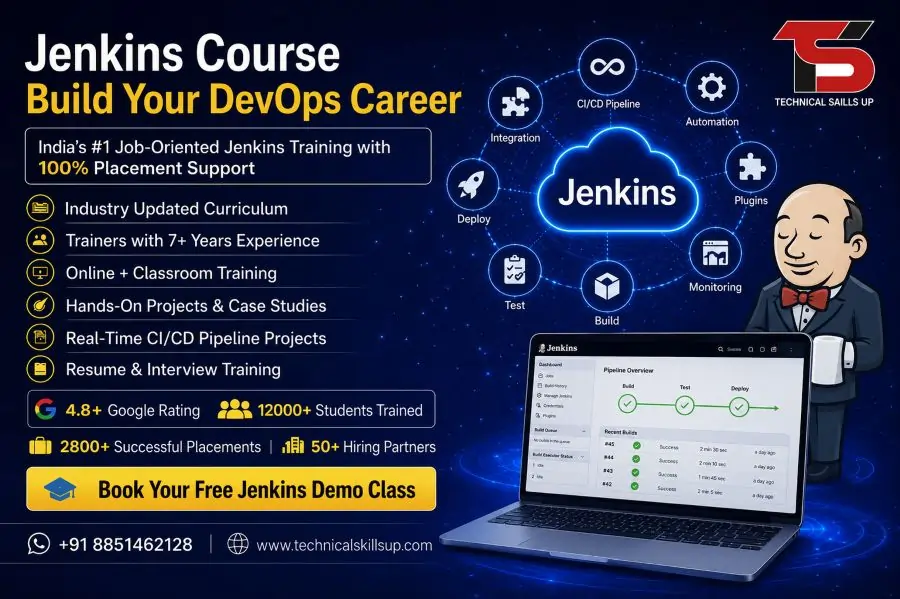
Jenkins Course

Jenkins Course in Noida | Jenkins Training in Noida

Modern software development has become faster, more automated, and highly dependent on continuous integration and continuous delivery practices. Organizations today expect developers and DevOps engineers to deliver code quickly without compromising quality or stability. Automation tools like Jenkins play a major role in achieving this goal by streamlining build, test, and deployment processes. A structured learning path such as the Jenkins Course in Noida offered by Technical Skills Up helps learners gain practical knowledge of CI/CD pipelines, automation workflows, and real-world DevOps practices that are widely used across IT companies.

This training program is designed for beginners, IT professionals, and working developers who want to upgrade their skills in automation and DevOps. Learners gain hands-on exposure to real projects, industry-based scenarios, and tool integrations that reflect current job requirements. The course focuses on building strong fundamentals along with advanced Jenkins concepts, ensuring that students are prepared for real industry challenges and interviews.

Course Overview

The Jenkins training program at Technical Skills Up is structured to provide a complete understanding of continuous integration and continuous delivery pipelines. The learning journey starts with basic DevOps concepts and gradually moves toward advanced Jenkins automation workflows used in production environments.

The Jenkins Training in Noida program focuses on practical implementation rather than just theoretical knowledge. Students work on real-time projects that simulate enterprise-level environments. This approach helps learners understand how software builds, testing, and deployments are managed in modern IT organizations.

Key learning stages include:

  • Introduction to DevOps and CI/CD principles
  • Jenkins installation and configuration
  • Creating and managing build pipelines
  • Integration with version control systems like Git
  • Automated testing and deployment workflows
  • Advanced pipeline scripting and job automation

Each module is carefully designed to ensure learners gain both conceptual clarity and technical confidence.

Importance of the Course in Industry

Automation has become a core requirement in modern software development lifecycles. Companies are increasingly adopting DevOps practices to reduce manual efforts and increase deployment speed. Jenkins stands out as one of the most widely used automation servers in the industry.

Professionals trained through structured Jenkins Classes in Noida gain a competitive advantage in the job market because they understand how real-world CI/CD pipelines function. Businesses rely on skilled DevOps engineers to maintain continuous integration systems that ensure faster releases and improved product quality.

The importance of Jenkins knowledge can be understood through its industry applications:

  • Faster software delivery cycles
  • Reduced manual errors in deployment
  • Improved collaboration between development and operations teams
  • Continuous testing and monitoring of applications
  • Efficient handling of large-scale cloud-based systems

Organizations prefer candidates who can manage automation tools effectively, making this course highly valuable for career growth.

Skills Covered in the Program

The Jenkins certification program focuses on building both foundational and advanced technical skills. Students gain a deep understanding of automation processes and real-world deployment pipelines.

Core skills developed during training include:

  • Continuous Integration and Continuous Delivery concepts
  • Jenkins job creation and pipeline configuration
  • Scripted and declarative pipeline development
  • Build automation and scheduling
  • Source code management integration
  • Error handling and debugging in pipelines
  • Plugin management and system configuration
  • Deployment automation strategies

Along with technical skills, learners also develop problem-solving abilities and workflow optimization techniques that are essential for DevOps roles.

Practical assignments ensure that every learner applies concepts in real-time scenarios, which strengthens understanding and boosts confidence.

Tools and Technologies Covered

A strong DevOps professional must be familiar with multiple tools used in modern development environments. The Jenkins Training Institute in Noida program integrates several essential technologies to prepare learners for industry demands.

Tools covered during training include:

  • Jenkins for automation and CI/CD pipelines
  • Git and GitHub for version control
  • Docker for containerization
  • Maven for build automation
  • Kubernetes for container orchestration basics
  • Linux commands for server management
  • AWS basics for cloud deployment integration
  • Selenium for automated testing integration

Exposure to these tools ensures that learners understand how different technologies work together in a real DevOps ecosystem. Practical labs and guided projects help students gain hands-on experience with each tool.

Career Opportunities

A strong demand exists for professionals skilled in Jenkins and DevOps automation. Companies across IT services, product development, and cloud computing sectors actively hire candidates with CI/CD expertise.

After completing the course, learners can explore various job roles such as:

  • DevOps Engineer
  • Build and Release Engineer
  • Automation Engineer
  • Software Configuration Manager
  • Cloud DevOps Associate
  • CI/CD Pipeline Developer

These roles are available in startups, multinational companies, and cloud-based organizations. Salary packages often depend on experience, but even entry-level professionals with Jenkins skills can secure attractive opportunities.

Career growth becomes faster when learners combine Jenkins knowledge with cloud platforms and containerization tools. The demand for automation experts continues to grow as companies move toward digital transformation.

Industry Demand and Future Scope

The future of software development is heavily driven by automation and cloud technologies. Jenkins remains a key tool in the DevOps ecosystem due to its flexibility, open-source nature, and strong community support.

Industry trends show that organizations are increasingly adopting:

  • Cloud-native development practices
  • Automated deployment pipelines
  • Microservices architecture
  • Continuous monitoring systems
  • Scalable container-based environments

Professionals trained in Jenkins Training in Noida are better prepared for these evolving industry requirements. Companies prefer candidates who understand both development and deployment processes, making DevOps expertise highly valuable.

Future scope of Jenkins expertise includes:

  • Advanced DevOps engineering roles
  • Cloud architecture positions
  • Automation consulting opportunities
  • Site reliability engineering roles
  • Tech lead positions in DevOps teams

Continuous learning and tool adaptation further enhance long-term career stability in this domain.

Why Choose Technical Skills Up

Technical Skills Up is committed to providing high-quality technical education with a strong focus on practical learning and industry readiness. The training approach is designed to bridge the gap between academic knowledge and real-world job requirements.

Reasons to choose this institute include:

  • Industry-experienced trainers with real project exposure
  • Structured curriculum aligned with current DevOps practices
  • Hands-on lab sessions for better understanding
  • Real-time project implementation
  • Personalized doubt-solving support
  • Updated course content based on industry trends

The Jenkins Course in Noida offered by Technical Skills Up is designed to ensure learners gain job-ready skills that can be applied directly in professional environments.

Focus is placed on building confidence, technical clarity, and problem-solving ability so that students can perform effectively in interviews and workplace scenarios.

Training Methodology (Online + Practical Learning)

Effective learning requires a balanced approach between theory and practice. The training methodology at Technical Skills Up follows a structured and interactive learning model.

Learning approach includes:

  • Live instructor-led sessions
  • Practical demonstrations of Jenkins workflows
  • Hands-on lab exercises for every module
  • Real-time project assignments
  • Interactive doubt-clearing sessions
  • Recorded sessions for revision and practice

Each topic is explained with real-world examples to ensure better understanding. Learners are encouraged to practice continuously, which helps in retaining concepts effectively.

Practical exposure is a major focus area, ensuring that students understand how Jenkins is used in actual enterprise environments rather than just theoretical setups.

Certification and Placement Support

Certification plays an important role in validating technical skills and improving job opportunities. Upon successful completion of the Jenkins Certification Course in Noida, learners receive a recognized certificate from Technical Skills Up.

Certification benefits include:

  • Proof of technical expertise in Jenkins and DevOps
  • Improved resume credibility
  • Better job interview opportunities
  • Industry recognition of skills

Placement support is also provided to help learners start their careers. Support services include:

  • Resume building assistance
  • Interview preparation sessions
  • Mock technical interviews
  • Job referral opportunities
  • Career counseling guidance

The placement assistance team works closely with students to ensure they are well-prepared for job opportunities in the DevOps and automation domain.

Conclusion

A strong foundation in DevOps automation can significantly enhance career growth in today’s competitive IT industry. Jenkins has become an essential tool for managing continuous integration and deployment pipelines, making it a valuable skill for aspiring professionals.

The Jenkins Course in Noida offered by Technical Skills Up provides a complete learning experience that combines theoretical knowledge with practical implementation. Learners gain exposure to real-world tools, industry practices, and hands-on projects that prepare them for professional roles.

Consistent training, expert guidance, and practical exposure help students build confidence and technical expertise. This program is designed not only to teach Jenkins but also to develop a strong DevOps mindset that aligns with modern software development practices.

Choosing the right training institute can make a significant difference in career success, and Technical Skills Up aims to support learners at every step of their professional journey.

FAQs:

Q1. What is the Jenkins course, and why should one learn it?

Ans: Jenkins is an open-source automation tool used in DevOps for Continuous Integration (CI) and Continuous Delivery (CD). In this course, you learn how to automatically build, test, and deploy code.

  • There is a huge demand for Jenkins in today’s IT industry because companies are shifting their focus from manual deployment to automation. Learning Jenkins makes you eligible for high-paying roles such as DevOps Engineer, Build Engineer, and Release Engineer.
Q2. What is taught in the Jenkins course in Noida?

Ans: This course provides comprehensive training on Jenkins, covering everything from beginner to advanced levels, such as:

  • Jenkins installation and setup
  • Creating CI/CD pipelines
  • Git and GitHub integration
  • Maven and Gradle integration
  • Automated testing
  • Jenkins integration with Docker
  • Real-time projects and case studies

The training focuses primarily on practical learning to ensure students become industry-ready.

Q3. Is coding knowledge required to learn Jenkins?

Ans: Basic coding knowledge is helpful but not mandatory.

  • Having basic knowledge of Java, Python, or a scripting language makes understanding Jenkins easier.
  • Training is conducted using step-by-step practical examples, making it easy for beginners to learn.
Q4. What is the duration of the Jenkins course?

Ans: The duration of the Jenkins course is typically 6 to 10 weeks.

  • The duration depends on the batch type and training mode (online/offline).
  • Weekend batches and fast-track batches are also available, especially for working professionals.
Q5. What jobs can one get after learning Jenkins?

Ans: After learning Jenkins, you can apply for the following roles:

  • DevOps Engineer
  • Build and Release Engineer
  • Automation Engineer
  • Site Reliability Engineer (SRE)
  • Cloud Engineer

These roles offer attractive salary packages and strong growth opportunities.

Q6. Is placement support provided with the Jenkins course?

Ans: Yes, training institutes like Technical Skills Up provide placement support to students. It includes:

  • Resume building
  • Mock interviews
  • Interview preparation sessions
  • Job referrals
  • Guidance for the HR round

Placement depends entirely on the student’s performance and skills.

Q7. What is the relationship between Jenkins and DevOps?

Ans: Jenkins is a crucial tool in DevOps. The primary goal of DevOps is to integrate development and operations.
Jenkins automates processes such as:

  • Code integration
  • Testing automation
  • Deployment automation

That is why Jenkins is often referred to as the backbone of DevOps.

Q8. Is the Jenkins course suitable for beginners?

Ans: Yes, this course is suitable for beginners as well.

  • The training is designed to take you from the basics to an advanced level.
  • Learning is made easier through real-time projects and hands-on practice.
Q9. What is a CI/CD pipeline in Jenkins?

Ans: A CI/CD pipeline is an automated process in which code is continuously integrated, tested, and deployed.

  • CI (Continuous Integration): Frequently integrating code
  • CD (Continuous Delivery/Deployment): Automatically deploying code

Jenkins manages this entire pipeline, making development faster and error-free.

Q10. Are Docker and Cloud also taught alongside Jenkins?

Ans: Yes, advanced Jenkins training includes Docker and Cloud integration.
You learn:

  • How Jenkins works with Docker containers
  • How to deploy on AWS or Azure
  • How to implement CI/CD in cloud environments
  • These skills make you industry-ready.
Q11. What is the fee for the Jenkins course?

Ans: Jenkins course Fees:

  • The fee depends on the institute and the training mode. Generally, the fee for a Jenkins course ranges from ₹15,000 to ₹40,000.
  • Courses that include placement support and advanced modules may have slightly higher fees.
    Many institutes also offer installment options.
Q12. Can I get freelance work after learning Jenkins?

Ans: Yes, you can take up freelance projects after learning Jenkins.

  • You can work on tasks such as CI/CD pipeline setup, automation scripting, and DevOps consulting.
  • There is a high demand for DevOps skills on platforms like Upwork, Fiverr, and Freelancer.
Q13. What is the future scope of Jenkins?

Ans: The future of Jenkins is very promising because:

  • The demand for automation is growing rapidly
  • The DevOps industry is continuously expanding
  • Companies are shifting from manual deployment to automated systems

Therefore, the demand for Jenkins experts will increase further in the coming years.

Q14. Why choose the Technical Skills Up Jenkins course?

Ans: Technical Skills Up is a practical-based training institute that offers:

  • Industry-expert trainers
  • Real-time project training
  • An updated DevOps syllabus
  • Placement assistance
  • Interview preparation

The institute focuses on equipping students with job-ready skills.

Q15. How do I enroll in the Jenkins course?

Ans: The enrollment process is very simple:

  • Make an inquiry via the institute’s website or contact number
  • Attend a counseling session
  • Choose a suitable batch (online/offline)
  • Complete the registration
  • Start the training

You can also attend a demo class before starting the training to understand the course structure.

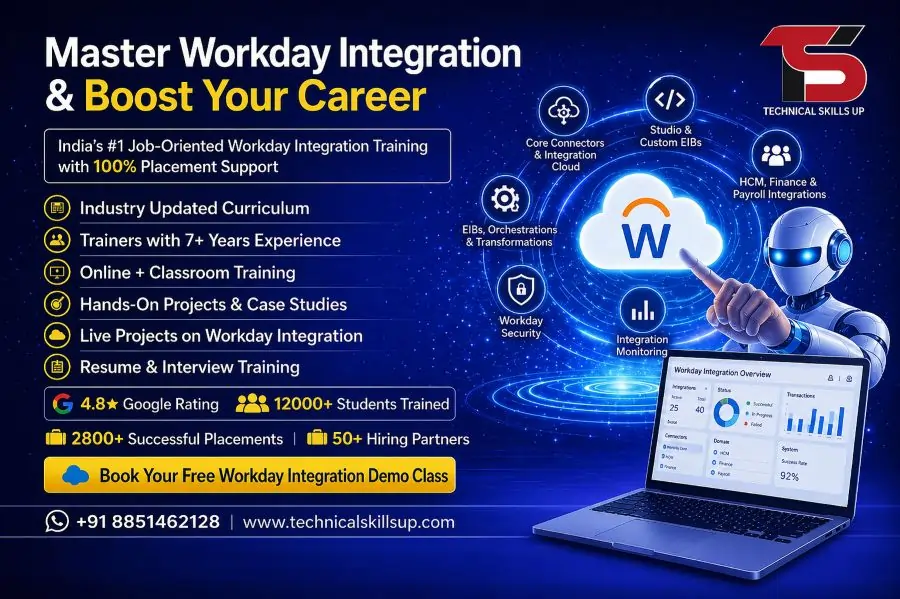
Workday Integration Course

Workday Integration Course in Noida with Placement

Career growth in today’s competitive IT environment depends on strong, practical skills and the ability to work with enterprise tools. Workday stands out as a leading cloud-based platform used by global organizations for HR, finance, and business operations. Technical Skills Up brings a structured and industry-focused learning approach through its Workday Integration Course in Noida, designed to help learners gain real-time expertise, hands-on practice, and confidence to work on live projects. Learning here focuses on practical exposure, expert mentorship, and a career-oriented roadmap that prepares students for high-demand roles in top companies.

Why Choose Workday Integration as a Career?

Growing demand for Workday professionals has created excellent opportunities for freshers and experienced candidates. Organizations rely on seamless data flow between systems, and integration specialists play a key role in making that possible.

Key Benefits of Learning Workday Integration

  • High demand in global job markets
  • Attractive salary packages for skilled professionals
  • Opportunities to work with MNCs and top IT companies
  • Exposure to real-time enterprise-level projects
  • Continuous learning and career growth

Strong technical knowledge combined with hands-on practice creates a solid base for long-term success in this domain.

About Technical Skills Up

Technical Skills Up focuses on delivering quality education with a practical approach. Training programs are designed to match industry requirements and help learners build job-ready skills.

What Makes Technical Skills Up Different?

  • Industry-experienced trainers
  • Real-time project-based learning
  • Updated course curriculum
  • Placement-focused training approach
  • Personal mentorship and doubt sessions

Learning environment encourages growth, consistency, and confidence, helping students move toward successful careers.

Workday Integration Training in Noida

Learning becomes effective when theory and practice go hand in hand. This training program focuses on both concepts and real-world implementation to ensure deep understanding.

Training Highlights

  • Introduction to Workday architecture
  • Core integration concepts and tools
  • Data transformation techniques
  • Web services and APIs
  • Error handling and troubleshooting
  • Real-time integration scenarios

Practical assignments and case studies help learners understand how integration works in real business environments.

Course Curriculum Overview

Structured curriculum ensures step-by-step learning from basics to advanced concepts. Each module builds a strong foundation and prepares students for real projects.

Introduction to Workday

  • Overview of Workday platform
  • Navigation and user interface
  • Basic concepts and terminology

Integration Fundamentals

  • Types of integrations
  • Workday integration architecture
  • Data flow understanding

Core Connectors

  • Overview of core connectors
  • Configuration and usage
  • Practical implementation

EIB (Enterprise Interface Builder)

  • Basics of EIB
  • Inbound and outbound integrations
  • File handling and transformations

Workday Studio

  • Introduction to Workday Studio
  • Integration development
  • Debugging and testing

Web Services

  • SOAP and REST APIs
  • API integration techniques
  • Data exchange methods

Advanced Concepts

  • Error handling strategies
  • Security in integrations
  • Performance optimization

Real-Time Projects

  • Live project implementation
  • Scenario-based learning
  • Industry use cases

Workday Integration Classes in Noida

Interactive classes help learners understand concepts easily and build confidence. Each session focuses on clarity, practice, and real-world application.

Class Features

  • Live instructor-led sessions
  • Hands-on practical exercises
  • Real-time doubt clearing
  • Recorded sessions for revision
  • Flexible batch timings

Learning becomes simple and engaging with structured sessions and expert guidance.

Hands-On Project Experience

Practical exposure plays a key role in mastering Workday Integration. Real-time projects help learners apply concepts in actual scenarios.

Project Benefits

  • Understanding real business workflows
  • Experience with live integration tasks
  • Building a strong portfolio
  • Improving problem-solving skills

Projects simulate real industry challenges and prepare learners for job roles.

Placement Assistance

Career support remains a priority at Technical Skills Up. Placement-focused training helps students prepare for interviews and secure jobs.

Placement Support Includes

  • Resume building guidance
  • Mock interview sessions
  • Interview question preparation
  • Job referrals and assistance
  • Soft skills training

Strong preparation increases confidence and improves chances of selection in top companies.

Workday Integration Training Institute in Noida

Choosing the right institute makes a big difference in career growth. Technical Skills Up stands as a trusted name for professional training with a focus on quality and results.

Why Choose This Institute?

  • Proven track record of successful placements
  • Industry-aligned curriculum
  • Experienced trainers with real-world exposure
  • Practical learning approach
  • Supportive learning environment

Focused training helps learners achieve their career goals efficiently.

Skills You Will Gain

Learning Workday Integration builds both technical and professional skills required in the industry.

Technical Skills

  • Integration development
  • Data transformation
  • API handling
  • Error troubleshooting

Professional Skills

  • Problem-solving ability
  • Analytical thinking
  • Communication skills
  • Project management basics

Balanced skill development prepares learners for real-world challenges.

Career Opportunities After Course

Workday Integration professionals enjoy excellent career growth and job opportunities across industries.

Job Roles

  • Workday Integration Developer
  • Integration Consultant
  • Workday Technical Analyst
  • Workday Integration Specialist

Industries Hiring

  • IT companies
  • Consulting firms
  • MNCs
  • HR and finance organizations

Growing demand ensures long-term stability and career progression.

Learning Approach

Effective learning requires the right strategy and consistent practice. This course follows a structured approach to ensure better understanding.

Key Learning Methods

  • Step-by-step concept explanation
  • Practical assignments
  • Real-time case studies
  • Regular assessments
  • Continuous feedback

Simple and clear teaching methods make learning easy for beginners and professionals.

Flexible Learning Options

Different learners have different schedules. Flexible options help students learn without affecting their routine.

Available Options

  • Weekday batches
  • Weekend batches
  • Online and offline classes
  • Recorded sessions for revision

Flexible scheduling ensures convenience and better learning experience.

Certification

Certification adds value to your profile and increases job opportunities. Completing this course provides recognition of your skills and knowledge.

Certification Benefits

  • Enhances resume value
  • Validates technical skills
  • Improves job prospects
  • Builds professional credibility

Recognized certification helps learners stand out in competitive job markets.

Who Can Join This Course?

This course suits anyone looking to build a career in Workday Integration.

Suitable For

  • Fresh graduates
  • IT professionals
  • HR professionals
  • Career switchers

Basic knowledge of IT concepts can be helpful but not mandatory.

Tools and Technologies Covered

Learning modern tools and technologies helps students stay updated with industry trends.

Tools Included

  • Workday Studio
  • EIB
  • Core Connectors
  • Web Services (SOAP/REST)

Hands-on practice with these tools ensures job readiness.

Real-World Use Cases

Understanding real-world scenarios helps learners apply concepts effectively.

Examples Covered

  • Employee data integration
  • Payroll system integration
  • Third-party application connectivity
  • Data migration projects

Practical examples improve understanding and build confidence.

Student Support

Continuous support helps learners stay on track and solve doubts quickly.

Support

  • Dedicated mentor support
  • Doubt clearing sessions
  • Community discussions
  • Career guidance

Strong support system ensures smooth learning experience.

Conclusion

Building a successful career in Workday Integration requires the right training, practical exposure, and consistent effort. Technical Skills Up provides a complete learning environment that focuses on real-world skills, industry knowledge, and career growth. Structured curriculum, expert trainers, and placement assistance together create a strong foundation for learners. Choosing the right training program can open doors to exciting opportunities and long-term success in the IT industry.

Online Courses

Related Courses in Noida

Related Courses in Delhi

FAQs:

Q1. What is a Workday Integration Course?

Ans: A Workday Integration Course is a professional training program that teaches the techniques for connecting (integrating) the Workday system with other applications. It covers the usage of tools such as APIs, EIB, Core Connectors, and Workday Studio.

Q2. Why is learning Workday Integration important?

Ans: Learning Workday Integration opens up new career opportunities in IT and HR technology. Companies prioritize professionals who are skilled in data integration and automation.

Q3. Are there any prerequisites for the Workday Integration Course?

Ans: Basic IT knowledge, along with an understanding of XML, Web Services, and data structures, is helpful. However, the course content is explained in a simplified manner, making it accessible even to beginners.

Q4. What is taught in the Workday Integration Course?

Ans: This course covers EIB, Core Connectors, Workday Studio, Web Services, API Integration, and real-time project work.

Q5. Why choose Workday Integration training at Technical Skills Up?

Ans: Technical Skills Up provides high-quality education featuring industry-expert trainers, live projects, and practical training, thereby giving students real-world experience.

Q6. What is the duration of the Workday Integration Course?

Ans: This course typically lasts for 2 to 3 months, encompassing both theoretical and practical sessions.

Q7. Can I get a job after completing this course?

Ans: Yes, with proper training and practice, there are excellent job opportunities available in the field of Workday Integration. Many institutes also provide placement assistance.

Q8. How much does the Workday Integration Course cost?

Ans: The course fee may vary depending on the institute and the quality of training provided. It is essential to choose the right institute to ensure you receive superior training.

Q9. Does this course include live projects?

Ans: Yes, reputable training institutes incorporate live projects to enable students to gain practical, hands-on experience.

Q10. What are the career opportunities in Workday Integration?

Ans: This field offers a variety of roles, such as Workday Integration Developer, Consultant, and Analyst.

Q11. Is this course suitable for freshers?

Ans: Yes, this course is suitable for both freshers and experienced professionals, particularly those interested in the IT and HR domains.

Q12. How long does it take to learn Workday Integration?

Ans: It may take approximately 2–4 months to learn the subject from a basic to an advanced level, depending on your individual learning pace.

Q13. Is online Workday Integration training available?

Ans: Yes, training is available in both online and offline modes, allowing students to learn at their own convenience.

Q14. What is the salary potential after completing the Workday Integration course?

Ans: One can expect a competitive salary package at the entry level, which increases further with growing experience and skills.

Q15. How do I choose the right Workday Integration training institute?

Ans: Choose an institute that offers industry-expert trainers, practical training, live projects, and placement assistance.

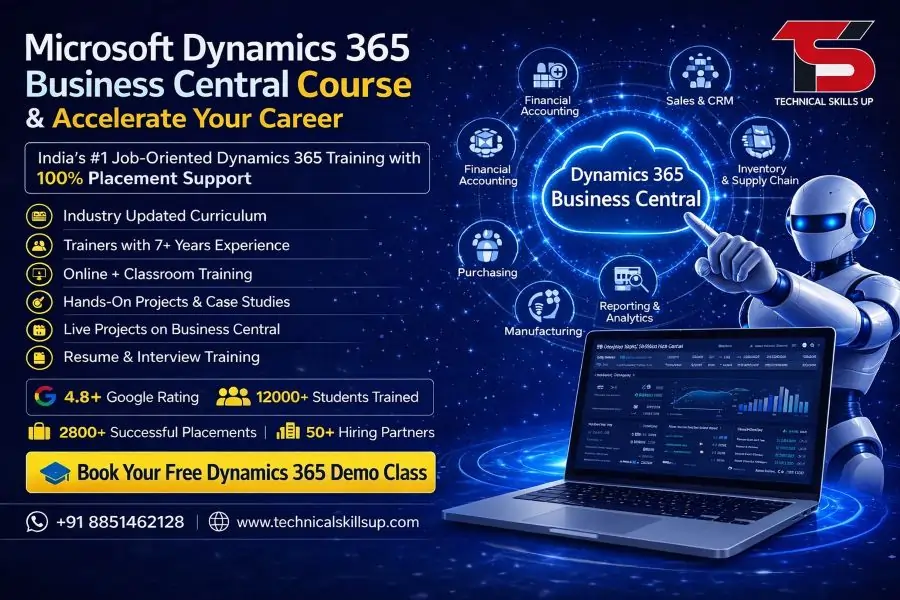
Microsoft Dynamics 365 Business Central Course

Microsoft Dynamics 365 Business Central Course in Delhi

Modern companies need smart software to manage finance, sales, inventory, customer records, reporting, and daily operations. Many businesses now prefer cloud-based ERP solutions because they improve productivity and reduce manual work. Technical Skills Up provides industry-focused training that helps students and working professionals learn practical ERP skills for real business environments. Microsoft Dynamics 365 Business Central Course in Delhi is designed for learners who want to build a successful career in ERP, finance management, and business operations.

Professional trainers at Technical Skills Up focus on practical learning instead of only theoretical concepts. Training sessions include real-time examples, hands-on projects, assignments, and case studies that improve understanding of business processes. Students learn how companies use Microsoft ERP solutions to automate accounting, inventory, purchasing, warehouse management, and reporting tasks. Every module follows industry standards and supports career growth for freshers as well as experienced professionals.

Why Learn Microsoft Dynamics 365 Business Central

ERP software has become important for small, medium, and large organizations. Business Central helps companies manage operations from a single platform. Knowledge of this software creates strong career opportunities in finance, ERP consulting, implementation, and support roles.

Major Benefits of Learning Business Central

  • Improves ERP and accounting knowledge
  • Helps manage finance and inventory operations
  • Supports automation of business processes
  • Creates opportunities in IT and finance industries
  • Enhances reporting and analytical skills
  • Increases chances of getting high-paying jobs
  • Provides practical experience with cloud ERP solutions
  • Supports career growth in multinational companies

About Technical Skills Up

Technical Skills Up is known for providing quality professional training with practical exposure. Training programs are designed according to current industry requirements so students can gain job-ready skills. Expert mentors guide learners step by step and help them understand difficult concepts in simple language.

Key Features of Technical Skills Up

  • Experienced corporate trainers
  • Practical learning environment
  • Industry-based projects
  • Flexible class schedules
  • Interview preparation support
  • Resume building assistance
  • Updated study material
  • Certification guidance
  • Placement support for students

Training sessions focus on real business scenarios that help learners gain confidence before entering the corporate sector.

Microsoft Dynamics 365 Business Central Course in Delhi

Businesses across industries use ERP software to improve efficiency and reduce operational errors. Technical Skills Up offers a complete learning program that covers important modules of Business Central with practical implementation methods. Students receive detailed knowledge of finance, inventory, sales, purchasing, reporting, and administration features.

Topics Covered in the Course

Introduction to ERP and Business Central

  • ERP fundamentals
  • Overview of Microsoft Dynamics 365
  • Cloud ERP concepts
  • Navigation and dashboard understanding
  • Role center management

Financial Management

  • General ledger setup
  • Chart of accounts
  • Bank account management
  • Cash flow monitoring
  • Budget management
  • Financial reporting

Sales and Customer Management

  • Customer creation and setup
  • Sales quotes and invoices
  • Payment tracking
  • Customer ledger entries
  • Sales order processing

Purchase Management

  • Vendor setup
  • Purchase order creation
  • Invoice processing
  • Vendor payment management
  • Procurement workflows

Inventory Management

  • Item creation and classification
  • Warehouse operations
  • Stock transfer process
  • Inventory valuation
  • Product tracking methods

Reporting and Analytics

  • Business reports generation
  • Data analysis techniques
  • Dashboard management
  • Performance tracking
  • Financial reporting tools

Administration and Security

  • User management
  • Access control setup
  • Security roles
  • Data management
  • System configuration

Microsoft Dynamics 365 Business Central Training in Delhi

Professional training helps learners understand software implementation and business workflows in a better way. Technical Skills Up focuses on practical sessions that simulate real company environments. Trainers explain each module with live demonstrations so students can easily understand the concepts.

Training Highlights

  • Live instructor-led sessions
  • Practical assignments
  • Real-time project work
  • Industry use cases
  • Doubt clearing sessions
  • Hands-on ERP practice
  • Updated curriculum
  • Learning support from experts

Corporate-style training methods help students become familiar with real workplace requirements.

Skills You Can Learn During Training

ERP training develops both technical and business management skills. Students gain confidence while working on real-time business scenarios.

Important Skills Covered

  • ERP software management
  • Business process understanding
  • Financial accounting operations
  • Inventory tracking methods
  • Sales and purchase management
  • Report generation techniques
  • Cloud application handling
  • Data analysis skills
  • Workflow automation understanding

Strong ERP skills improve job opportunities in different sectors including manufacturing, retail, healthcare, logistics, and finance.

Microsoft Dynamics 365 Business Central Classes in Delhi

Classroom and online learning options help students choose schedules according to their convenience. Trainers focus on interactive learning methods that improve engagement and understanding.

Classroom Training Benefits

  • Face-to-face interaction with trainers
  • Better practical understanding
  • Group discussions and activities
  • Immediate doubt resolution
  • Professional learning environment

Online Training Benefits

  • Learn from home comfort
  • Flexible timing options
  • Access to recorded sessions
  • Live practical demonstrations
  • Easy communication with trainers

Both learning modes include practical projects, assignments, and career guidance support.

Who Can Join This Course

ERP training is suitable for learners from different educational and professional backgrounds. Knowledge of finance or business operations can be helpful, but beginners can also join because training starts from basic concepts.

Suitable Candidates

  • B.Com students
  • MBA graduates
  • Finance professionals
  • Accountants
  • ERP beginners
  • Working professionals
  • Business analysts
  • IT professionals
  • Fresh graduates

Career-focused training helps learners develop practical knowledge for professional growth.

Career Opportunities After Business Central Training

ERP professionals are in high demand because companies need skilled experts to manage business operations efficiently. Knowledge of Microsoft ERP solutions opens opportunities in different industries.

Popular Job Roles

  • ERP Consultant
  • Functional Consultant
  • Business Analyst
  • ERP Support Executive
  • Finance Executive
  • ERP Administrator
  • Accounts Manager
  • Inventory Analyst
  • Implementation Consultant

Organizations prefer skilled candidates who can manage ERP systems and improve business workflows.

Industry Demand for Business Central Professionals

Digital transformation has increased demand for cloud ERP professionals. Many organizations now shift from traditional systems to advanced business management software for better performance and automation.

Industries Hiring ERP Professionals

  • Manufacturing companies
  • Retail businesses
  • Healthcare organizations
  • IT companies
  • Logistics firms
  • Financial institutions
  • E-commerce companies
  • Service industries

Practical ERP knowledge helps professionals work in both domestic and international markets.

Practical Learning Approach at Technical Skills Up

Learning becomes more effective when students work on practical projects and real business examples. Technical Skills Up provides hands-on sessions that improve technical understanding and confidence.

Practical Training Methods

  • Live ERP implementation practice
  • Real business case studies
  • Workflow management exercises
  • Finance and inventory simulations
  • Project-based learning
  • Interactive practical labs

Students gain real-world exposure that prepares them for professional environments.

Certification Support

Professional certification improves career value and increases job opportunities. Trainers guide students about certification preparation and exam concepts.

Certification Advantages

  • Enhances professional credibility
  • Improves resume value
  • Helps during interviews
  • Builds industry recognition
  • Supports career advancement

Certification preparation sessions include important concepts, practical exercises, and guidance from experienced trainers.

Placement Assistance for Students

Career support plays an important role in professional training programs. Technical Skills Up helps students prepare for interviews and improve communication skills.

Placement Support Includes

  • Resume preparation
  • Mock interview sessions
  • Technical interview guidance
  • Personality development support
  • Career counseling
  • Job assistance programs

Professional guidance helps students perform confidently during interviews.

Learning Environment and Infrastructure

A comfortable and professional learning environment improves student performance and focus. Technical Skills Up provides updated infrastructure for better practical learning.

Facilities Available

  • Modern computer labs
  • High-speed internet access
  • Practical ERP environment
  • Updated software tools
  • Interactive classrooms
  • Study materials and notes

Students receive proper technical support throughout the training duration.

Advantages of Choosing Technical Skills Up

Choosing the right institute is important for skill development and career growth. Technical Skills Up focuses on quality education, practical exposure, and student success.

Reasons to Choose Technical Skills Up

  • Industry-experienced trainers
  • Job-oriented curriculum
  • Practical training sessions
  • Flexible batch timings
  • Affordable course fees
  • Real project exposure
  • Career support services
  • Professional learning atmosphere

Training programs are regularly updated according to current industry requirements.

Soft Skills and Professional Development

Technical knowledge alone is not enough for career success. Professional development sessions help students improve workplace communication and confidence.

Additional Development Areas

  • Communication skills
  • Presentation techniques
  • Team collaboration
  • Professional behavior
  • Interview confidence
  • Problem-solving skills

Corporate-focused preparation helps learners become job-ready professionals.

Future Scope of Microsoft Dynamics 365 Business Central

Cloud ERP technology continues to grow rapidly across industries. Companies prefer integrated systems that improve efficiency and support business growth. Skilled professionals with ERP knowledge can build long-term careers in consulting, implementation, administration, and support.

Future Career Benefits

  • Growing global demand
  • Better salary opportunities
  • International career scope
  • Stable professional growth
  • Opportunities in multiple industries
  • Strong long-term career potential

ERP expertise can help professionals achieve career advancement in competitive markets.

Course Duration and Learning Structure

Training programs are designed to provide balanced theoretical and practical knowledge. Structured modules help students understand concepts step by step.

Training Structure

  • Basic to advanced concepts
  • Practical assignments
  • Weekly assessments
  • Live project work
  • Industry case studies
  • Revision sessions

Systematic learning methods improve concept clarity and practical understanding.

Conclusion

Professional ERP skills can create excellent career opportunities in today’s digital business environment. Technical Skills Up provides industry-oriented training that helps students understand real business operations through practical learning methods. Microsoft Dynamics 365 Business Central Training Institute in Delhi focuses on hands-on practice, live projects, expert guidance, and career support to help learners become job-ready professionals.

Comprehensive training modules, experienced trainers, flexible learning options, and placement assistance make Technical Skills Up a reliable choice for ERP education. Students gain practical knowledge, technical confidence, and business understanding that support long-term professional growth in the ERP and finance industry.

FAQs:

Q1. What is the Microsoft Dynamics 365 Business Central Course?

Ans: The Microsoft Dynamics 365 Business Central Course is an ERP training program. It covers Finance, Sales, Inventory, Accounting, Purchasing, Warehousing, and Business Management. At Technical Skills Up, this course is conducted using live projects and practical training to ensure students become industry-ready.

Q2. Who is the Microsoft Dynamics 365 Business Central Course in Delhi suitable for?

Ans: This course is ideal for B.Com, BBA, and MBA graduates, commerce students, working professionals, accountants, and candidates aspiring to build a career in ERP. Freshers can also easily master this course.

Q3. Why choose Technical Skills Up for Microsoft Dynamics 365 Business Central Training in Delhi?

Ans: Technical Skills Up offers expert trainers, practical sessions, live projects, interview preparation, certification support, and placement assistance. The training is delivered in simple, easy-to-understand language to facilitate rapid learning for students.

Q4. What is the duration of the Microsoft Dynamics 365 Business Central classes in Delhi?

Ans: The duration of this course is typically 2 to 4 months. The exact duration also depends on the training mode and the student’s individual learning schedule.

Q5. Is coding required for the Microsoft Dynamics 365 Business Central Course?

Ans: No, advanced coding skills are not required for this course. Students can easily undertake this training even with just basic computer knowledge.

Q6. What job opportunities are available after completing the Microsoft Dynamics 365 Business Central Certification Course?

Ans: Upon completing the course, opportunities become available for roles such as ERP Consultant, Functional Consultant, Business Analyst, Support Executive, and Microsoft Dynamics Consultant.

Q7. Does Technical Skills Up provide placement support?

Ans: Yes, Technical Skills Up provides students with placement assistance, resume building support, interview preparation, and career guidance to help them build a successful career.

Q8. Which modules are covered in the Microsoft Dynamics 365 Business Central training in Delhi?

Ans: This training covers topics such as Finance Management, Sales Management, Purchase Management, Inventory Management, Warehouse Management, Reporting, and Business Automation.

Q9. What is the fee for the Microsoft Dynamics 365 Business Central Course in Delhi?

Ans: The fees depend on the training mode, batch timings, and course modules. For accurate information regarding fees and offers, you may contact Technical Skills Up.

Q10. Are both Online and Offline classes available?

Ans: Yes, Technical Skills Up offers both online and offline training options. Students can choose a batch according to their convenience.

Q11. What salary can one expect after completing the Microsoft Dynamics 365 Business Central training?

Ans: Freshers can secure attractive salary packages at the entry level. Salary growth also accelerates as one gains more experience and skills.

Q12. Does this course involve working on live projects?

Ans: Yes, students are assigned real-time projects and practical assignments to help them gain industry-relevant experience.

Q13. What is the future scope of the Microsoft Dynamics 365 Business Central course?

Ans: The demand for ERP and cloud-based business solutions is growing rapidly. Consequently, there will be a significant demand for Microsoft Dynamics 365 Business Central professionals in the future.

Q14. Does Technical Skills Up provide certification?

Ans: Yes, students are awarded a training certificate upon successful completion of the course. Additionally, assistance is provided to help students prepare for Microsoft certification exams.

Q15. How should one choose a Microsoft Dynamics 365 Business Central training institute in Delhi?

Ans: When selecting an institute, be sure to evaluate factors such as trainer experience, practical training methodology, live projects, student reviews, placement support, and updated course modules. Technical Skills Up is considered an excellent choice for industry-oriented training.