
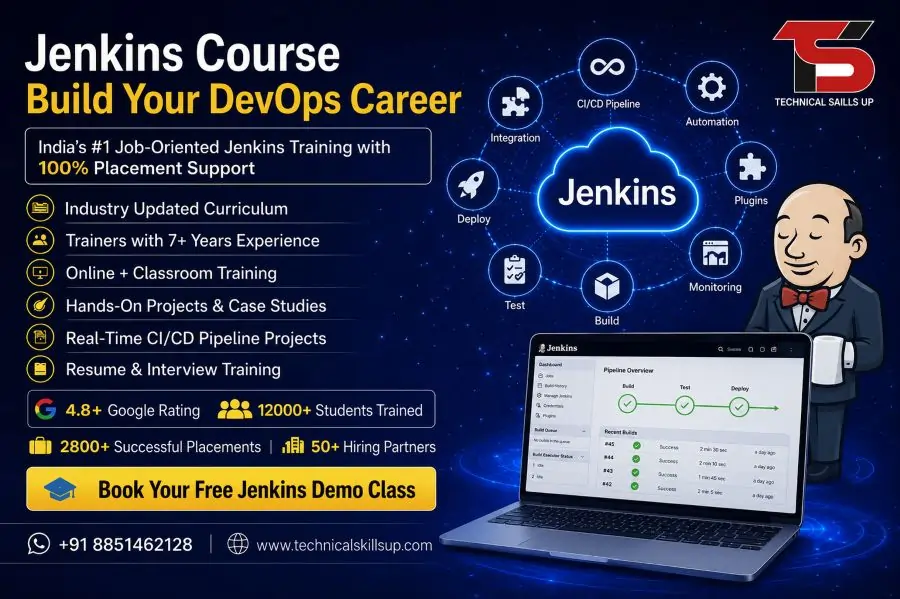
Modern software development has become faster, more automated, and highly dependent on continuous integration and continuous delivery practices. Organizations today expect developers and DevOps engineers to deliver code quickly without compromising quality or stability. Automation tools like Jenkins play a major role in achieving this goal by streamlining build, test, and deployment processes. A structured learning path such as the Jenkins Course in Noida offered by Technical Skills Up helps learners gain practical knowledge of CI/CD pipelines, automation workflows, and real-world DevOps practices that are widely used across IT companies.
This training program is designed for beginners, IT professionals, and working developers who want to upgrade their skills in automation and DevOps. Learners gain hands-on exposure to real projects, industry-based scenarios, and tool integrations that reflect current job requirements. The course focuses on building strong fundamentals along with advanced Jenkins concepts, ensuring that students are prepared for real industry challenges and interviews.
Course Overview
The Jenkins training program at Technical Skills Up is structured to provide a complete understanding of continuous integration and continuous delivery pipelines. The learning journey starts with basic DevOps concepts and gradually moves toward advanced Jenkins automation workflows used in production environments.
The Jenkins Training in Noida program focuses on practical implementation rather than just theoretical knowledge. Students work on real-time projects that simulate enterprise-level environments. This approach helps learners understand how software builds, testing, and deployments are managed in modern IT organizations.
Key learning stages include:
- Introduction to DevOps and CI/CD principles
- Jenkins installation and configuration
- Creating and managing build pipelines
- Integration with version control systems like Git
- Automated testing and deployment workflows
- Advanced pipeline scripting and job automation
Each module is carefully designed to ensure learners gain both conceptual clarity and technical confidence.
Importance of the Course in Industry
Automation has become a core requirement in modern software development lifecycles. Companies are increasingly adopting DevOps practices to reduce manual efforts and increase deployment speed. Jenkins stands out as one of the most widely used automation servers in the industry.
Professionals trained through structured Jenkins Classes in Noida gain a competitive advantage in the job market because they understand how real-world CI/CD pipelines function. Businesses rely on skilled DevOps engineers to maintain continuous integration systems that ensure faster releases and improved product quality.
The importance of Jenkins knowledge can be understood through its industry applications:
- Faster software delivery cycles
- Reduced manual errors in deployment
- Improved collaboration between development and operations teams
- Continuous testing and monitoring of applications
- Efficient handling of large-scale cloud-based systems
Organizations prefer candidates who can manage automation tools effectively, making this course highly valuable for career growth.
Skills Covered in the Program
The Jenkins certification program focuses on building both foundational and advanced technical skills. Students gain a deep understanding of automation processes and real-world deployment pipelines.
Core skills developed during training include:
- Continuous Integration and Continuous Delivery concepts
- Jenkins job creation and pipeline configuration
- Scripted and declarative pipeline development
- Build automation and scheduling
- Source code management integration
- Error handling and debugging in pipelines
- Plugin management and system configuration
- Deployment automation strategies
Along with technical skills, learners also develop problem-solving abilities and workflow optimization techniques that are essential for DevOps roles.
Practical assignments ensure that every learner applies concepts in real-time scenarios, which strengthens understanding and boosts confidence.
Tools and Technologies Covered
A strong DevOps professional must be familiar with multiple tools used in modern development environments. The Jenkins Training Institute in Noida program integrates several essential technologies to prepare learners for industry demands.
Tools covered during training include:
- Jenkins for automation and CI/CD pipelines
- Git and GitHub for version control
- Docker for containerization
- Maven for build automation
- Kubernetes for container orchestration basics
- Linux commands for server management
- AWS basics for cloud deployment integration
- Selenium for automated testing integration
Exposure to these tools ensures that learners understand how different technologies work together in a real DevOps ecosystem. Practical labs and guided projects help students gain hands-on experience with each tool.
Career Opportunities
A strong demand exists for professionals skilled in Jenkins and DevOps automation. Companies across IT services, product development, and cloud computing sectors actively hire candidates with CI/CD expertise.
After completing the course, learners can explore various job roles such as:
- DevOps Engineer
- Build and Release Engineer
- Automation Engineer
- Software Configuration Manager
- Cloud DevOps Associate
- CI/CD Pipeline Developer
These roles are available in startups, multinational companies, and cloud-based organizations. Salary packages often depend on experience, but even entry-level professionals with Jenkins skills can secure attractive opportunities.
Career growth becomes faster when learners combine Jenkins knowledge with cloud platforms and containerization tools. The demand for automation experts continues to grow as companies move toward digital transformation.
Industry Demand and Future Scope
The future of software development is heavily driven by automation and cloud technologies. Jenkins remains a key tool in the DevOps ecosystem due to its flexibility, open-source nature, and strong community support.
Industry trends show that organizations are increasingly adopting:
- Cloud-native development practices
- Automated deployment pipelines
- Microservices architecture
- Continuous monitoring systems
- Scalable container-based environments
Professionals trained in Jenkins Training in Noida are better prepared for these evolving industry requirements. Companies prefer candidates who understand both development and deployment processes, making DevOps expertise highly valuable.
Future scope of Jenkins expertise includes:
- Advanced DevOps engineering roles
- Cloud architecture positions
- Automation consulting opportunities
- Site reliability engineering roles
- Tech lead positions in DevOps teams
Continuous learning and tool adaptation further enhance long-term career stability in this domain.
Why Choose Technical Skills Up
Technical Skills Up is committed to providing high-quality technical education with a strong focus on practical learning and industry readiness. The training approach is designed to bridge the gap between academic knowledge and real-world job requirements.
Reasons to choose this institute include:
- Industry-experienced trainers with real project exposure
- Structured curriculum aligned with current DevOps practices
- Hands-on lab sessions for better understanding
- Real-time project implementation
- Personalized doubt-solving support
- Updated course content based on industry trends
The Jenkins Course in Noida offered by Technical Skills Up is designed to ensure learners gain job-ready skills that can be applied directly in professional environments.
Focus is placed on building confidence, technical clarity, and problem-solving ability so that students can perform effectively in interviews and workplace scenarios.
Training Methodology (Online + Practical Learning)
Effective learning requires a balanced approach between theory and practice. The training methodology at Technical Skills Up follows a structured and interactive learning model.
Learning approach includes:
- Live instructor-led sessions
- Practical demonstrations of Jenkins workflows
- Hands-on lab exercises for every module
- Real-time project assignments
- Interactive doubt-clearing sessions
- Recorded sessions for revision and practice
Each topic is explained with real-world examples to ensure better understanding. Learners are encouraged to practice continuously, which helps in retaining concepts effectively.
Practical exposure is a major focus area, ensuring that students understand how Jenkins is used in actual enterprise environments rather than just theoretical setups.
Certification and Placement Support
Certification plays an important role in validating technical skills and improving job opportunities. Upon successful completion of the Jenkins Certification Course in Noida, learners receive a recognized certificate from Technical Skills Up.
Certification benefits include:
- Proof of technical expertise in Jenkins and DevOps
- Improved resume credibility
- Better job interview opportunities
- Industry recognition of skills
Placement support is also provided to help learners start their careers. Support services include:
- Resume building assistance
- Interview preparation sessions
- Mock technical interviews
- Job referral opportunities
- Career counseling guidance
The placement assistance team works closely with students to ensure they are well-prepared for job opportunities in the DevOps and automation domain.
Conclusion
A strong foundation in DevOps automation can significantly enhance career growth in today’s competitive IT industry. Jenkins has become an essential tool for managing continuous integration and deployment pipelines, making it a valuable skill for aspiring professionals.
The Jenkins Course in Noida offered by Technical Skills Up provides a complete learning experience that combines theoretical knowledge with practical implementation. Learners gain exposure to real-world tools, industry practices, and hands-on projects that prepare them for professional roles.
Consistent training, expert guidance, and practical exposure help students build confidence and technical expertise. This program is designed not only to teach Jenkins but also to develop a strong DevOps mindset that aligns with modern software development practices.
Choosing the right training institute can make a significant difference in career success, and Technical Skills Up aims to support learners at every step of their professional journey.
FAQs:
Q1. What is the Jenkins course, and why should one learn it?
Ans: Jenkins is an open-source automation tool used in DevOps for Continuous Integration (CI) and Continuous Delivery (CD). In this course, you learn how to automatically build, test, and deploy code.
- There is a huge demand for Jenkins in today’s IT industry because companies are shifting their focus from manual deployment to automation. Learning Jenkins makes you eligible for high-paying roles such as DevOps Engineer, Build Engineer, and Release Engineer.
Q2. What is taught in the Jenkins course in Noida?
Ans: This course provides comprehensive training on Jenkins, covering everything from beginner to advanced levels, such as:
- Jenkins installation and setup
- Creating CI/CD pipelines
- Git and GitHub integration
- Maven and Gradle integration
- Automated testing
- Jenkins integration with Docker
- Real-time projects and case studies
The training focuses primarily on practical learning to ensure students become industry-ready.
Q3. Is coding knowledge required to learn Jenkins?
Ans: Basic coding knowledge is helpful but not mandatory.
- Having basic knowledge of Java, Python, or a scripting language makes understanding Jenkins easier.
- Training is conducted using step-by-step practical examples, making it easy for beginners to learn.
Q4. What is the duration of the Jenkins course?
Ans: The duration of the Jenkins course is typically 6 to 10 weeks.
- The duration depends on the batch type and training mode (online/offline).
- Weekend batches and fast-track batches are also available, especially for working professionals.
Q5. What jobs can one get after learning Jenkins?
Ans: After learning Jenkins, you can apply for the following roles:
- DevOps Engineer
- Build and Release Engineer
- Automation Engineer
- Site Reliability Engineer (SRE)
- Cloud Engineer
These roles offer attractive salary packages and strong growth opportunities.
Q6. Is placement support provided with the Jenkins course?
Ans: Yes, training institutes like Technical Skills Up provide placement support to students. It includes:
- Resume building
- Mock interviews
- Interview preparation sessions
- Job referrals
- Guidance for the HR round
Placement depends entirely on the student’s performance and skills.
Q7. What is the relationship between Jenkins and DevOps?
Ans: Jenkins is a crucial tool in DevOps. The primary goal of DevOps is to integrate development and operations.
Jenkins automates processes such as:
- Code integration
- Testing automation
- Deployment automation
That is why Jenkins is often referred to as the backbone of DevOps.
Q8. Is the Jenkins course suitable for beginners?
Ans: Yes, this course is suitable for beginners as well.
- The training is designed to take you from the basics to an advanced level.
- Learning is made easier through real-time projects and hands-on practice.
Q9. What is a CI/CD pipeline in Jenkins?
Ans: A CI/CD pipeline is an automated process in which code is continuously integrated, tested, and deployed.
- CI (Continuous Integration): Frequently integrating code
- CD (Continuous Delivery/Deployment): Automatically deploying code
Jenkins manages this entire pipeline, making development faster and error-free.
Q10. Are Docker and Cloud also taught alongside Jenkins?
Ans: Yes, advanced Jenkins training includes Docker and Cloud integration.
You learn:
- How Jenkins works with Docker containers
- How to deploy on AWS or Azure
- How to implement CI/CD in cloud environments
- These skills make you industry-ready.
Q11. What is the fee for the Jenkins course?
Ans: Jenkins course Fees:
- The fee depends on the institute and the training mode. Generally, the fee for a Jenkins course ranges from ₹15,000 to ₹40,000.
- Courses that include placement support and advanced modules may have slightly higher fees.
Many institutes also offer installment options.
Q12. Can I get freelance work after learning Jenkins?
Ans: Yes, you can take up freelance projects after learning Jenkins.
- You can work on tasks such as CI/CD pipeline setup, automation scripting, and DevOps consulting.
- There is a high demand for DevOps skills on platforms like Upwork, Fiverr, and Freelancer.
Q13. What is the future scope of Jenkins?
Ans: The future of Jenkins is very promising because:
- The demand for automation is growing rapidly
- The DevOps industry is continuously expanding
- Companies are shifting from manual deployment to automated systems
Therefore, the demand for Jenkins experts will increase further in the coming years.
Q14. Why choose the Technical Skills Up Jenkins course?
Ans: Technical Skills Up is a practical-based training institute that offers:
- Industry-expert trainers
- Real-time project training
- An updated DevOps syllabus
- Placement assistance
- Interview preparation
The institute focuses on equipping students with job-ready skills.
Q15. How do I enroll in the Jenkins course?
Ans: The enrollment process is very simple:
- Make an inquiry via the institute’s website or contact number
- Attend a counseling session
- Choose a suitable batch (online/offline)
- Complete the registration
- Start the training
You can also attend a demo class before starting the training to understand the course structure.