















Learn Today, Lead Tomorrow

Upgrade your knowledge with Technical Skills Up and stay ahead in the digital era. Learn today with real-world training and build the technical expertise you need for tomorrow’s career opportunities.

Explore Our Top Programs

Discover industry-focused courses designed to build practical skills and advance your career.

Workday Courses ServiceNow Courses SAP Courses Salesforce Courses SEO Courses Software Testing Courses Project Management Courses Programming Courses Plant Design Courses

Build Your Future with Industry-Ready Skills.

Gain practical skills, learn from experienced trainers, and prepare yourself for real-world career opportunities.

Top Hiring Partners

Connecting Skilled Professionals with Leading Companies

Our Learners Transformed Their Careers:

Discover how practical learning, expert guidance, and career-focused training have helped our learners move closer to their professional goals.

Highest Salary Offered
0 Lakhs
Average Salary Hike
0 %
Years of Excellence
0 +
Students Placed
0 K+

Meet Your Mentors & Instructors:

Learn from experienced industry professionals who bring real-world knowledge, practical skills, and career-focused guidance to every course.

Ravendra Singh

Ravendra Singh

Digital Marketing Manager

Rohit-Sharma

Rohit Sharma

SR. Data Scientist

Shivani

Shivani Gupta

Power Bi Developer

Sumit Gupta

Sumit Gupta

Salesforce Developer

What Our Students Say:

Real Feedback from Our Students and Professionals.

I recently completed the Power BI course from Technical Skills Up. The training was easy to understand and focused on practical learning. I learned how to create dashboards, work with data, and build useful reports. The trainer explained concepts with real examples, which made the sessions more interesting.

Rakesh Singh

Good experience with the Data Analytics course at Technical Skills Up. The training covered important tools and concepts required for beginners. The trainer explained each topic with examples and encouraged us to practice during the sessions. I would recommend it to someone starting their analytics learning journey.

Neha Jain

Our Recently Placed Students:

Celebrating the success of our students as they begin their professional journey.

Frequently Asked Questions. (FAQs)

Get quick and helpful answers about our training programs and learning process.

Ans: Technical Skills Up is an IT training platform that helps students, freshers, working professionals, and career switchers develop practical technology skills. Our training focuses on industry-relevant learning, hands-on practice, experienced trainers, and career preparation.

Ans: Our courses are suitable for students, fresh graduates, working professionals, IT professionals, and beginners who want to build or upgrade their technical skills. Course prerequisites may vary depending on the subject and level.

Ans: Yes. Many courses are designed with beginners in mind and start with fundamental concepts before moving to advanced topics. The learning approach depends on the specific course, so learners should check the course requirements before enrolling.

Ans: Yes. Our training approach emphasizes practical learning, hands-on exercises, real-world examples, and project-based practice wherever applicable. This helps learners understand how technical concepts are used in professional environments.

Ans: Training is delivered by professionals and experienced trainers with knowledge of their respective technology domains. The trainer profile and experience can vary by course, so learners can check the relevant course page for specific trainer information.

Ans: Technical Skills Up offers online and classroom learning options, depending on the course and available training schedule. Learners can choose the format that best matches their learning requirements and location.

Ans: Certificate availability depends on the specific course and its completion requirements. Learners should check the individual course page or confirm the certification details with the Technical Skills Up team before enrollment.

Ans: Technical Skills Up provides career and placement support, which may include resume guidance, interview preparation, mock interviews, aptitude preparation, and assistance with job-related skills. Placement support does not mean a guaranteed job, and actual opportunities depend on the learner's skills, experience, and hiring requirements.

Ans: The right course depends on your current skills, education, professional experience, career goal, and preferred technology area. Beginners may start with foundational training, while working professionals may choose advanced or specialized courses. Our team can help you understand the course prerequisites and learning path before enrollment.

Ans: You can contact the Technical Skills Up team for information about courses, training formats, schedules, fees, prerequisites, and enrollment. You can reach us at +91 8851462128 or technicalskillsup@gmail.com, or visit www.technicalskillsup.com.

Latest Updates:

Stay updated with the latest courses, technology trends, career opportunities, and learning resources from Technical Skills Up.

Top Artificial Intelligence Interview Questions and Answers

Top Artificial Intelligence Interview Questions and Answers

Artificial Intelligence is changing how businesses work, make decisions, and serve customers. As AI adoption grows, companies need professionals who understand AI concepts and can apply them to real-world problems. Because of this, AI-related roles are becoming an important career option for students, freshers, and working professionals. Preparing for an AI interview requires more than memorizing definitions. Interviewers often check your understanding of Artificial Intelligence, Machine Learning, Deep Learning, Generative AI, data, model evaluation, and practical problem-solving. They may also ask about projects and how you would use AI to solve a business problem. This guide covers 52 Artificial Intelligence interview questions and answers, starting with basic concepts and moving toward advanced and scenario-based questions. It can help beginners, experienced professionals, students, and job seekers prepare for technical interviews with greater confidence. How to Prepare for an Artificial Intelligence Interview Good preparation starts with strong fundamentals. Before attending an interview, make sure you understand the basic concepts and can explain them in your own words. Here are some useful preparation steps: Learn the fundamentals of Artificial Intelligence. Understand Machine Learning and its major types. Study basic Deep Learning concepts. Practice Python programming. Learn about data preprocessing and model evaluation. Understand common AI applications. Study Generative AI and Large Language Models. Build practical AI projects. Learn how to explain your projects clearly. Practice technical and scenario-based questions. Try to connect theoretical concepts with real-world examples. Interviewers usually value practical understanding more than memorized definitions. Top 52 Artificial Intelligence Interview Questions and Answers Basic Artificial Intelligence Interview Questions 1. What is Artificial Intelligence? Artificial Intelligence is a technology that enables computers and machines to perform tasks that normally require human intelligence. These tasks can include learning, reasoning, recognizing patterns, understanding language, making predictions, and solving problems. For example, recommendation systems, voice assistants, fraud detection, chatbots, and image recognition systems use AI. 2. How does Artificial Intelligence work? AI systems generally work by using data, algorithms, and computing power. A typical AI workflow includes: Collecting data Cleaning and preparing the data Selecting an appropriate algorithm or model Training the model Testing and evaluating the model Deploying the model Monitoring its performance The system learns patterns from available data and uses those patterns to produce predictions, classifications, recommendations, or other outputs. 3. What are the main goals of AI? The main goals of AI include: Solving complex problems Automating repetitive tasks Learning from data Recognizing patterns Supporting decision-making Understanding human language Perceiving images and other information Making predictions Improving efficiency The exact goal depends on the application and business problem. 4. What are the different types of Artificial Intelligence? AI is commonly discussed in terms of three levels: Narrow AI: Designed to perform a specific task. Most AI applications available today fall into this category. General AI: A theoretical form of AI that would be capable of performing a broad range of intellectual tasks similar to humans. Super AI: A hypothetical form of AI that would exceed human intelligence across many areas. Today’s practical AI systems are primarily narrow AI systems. 5. What is the difference between AI, Machine Learning, and Deep Learning? AI is the broader field of creating systems that can perform tasks associated with intelligence. Machine Learning is a subset of AI in which systems learn patterns from data instead of relying only on explicitly programmed rules. Deep Learning is a subset of Machine Learning that uses multi-layer neural networks to learn complex patterns. A simple relationship is: Artificial Intelligence → Machine Learning → Deep Learning 6. What are the main applications of AI? AI is used in many industries and applications, including: Healthcare Banking E-commerce Manufacturing Education Cybersecurity Marketing Transportation Customer service Finance Examples include fraud detection, recommendation systems, chatbots, medical image analysis, demand forecasting, and predictive maintenance. 7. What is an AI agent? An AI agent is a system that can observe its environment, process information, and take actions to achieve a particular goal. For example, a navigation system receives information about roads and traffic and recommends a route to reach a destination. An agent generally involves: Perception → Decision → Action 8. What is an intelligent agent? An intelligent agent is an agent that uses available information to make decisions and take actions toward achieving a goal. An intelligent agent may: Observe its environment Process information Evaluate possible actions Select an appropriate action Learn or improve based on experience Examples include virtual assistants, recommendation systems, and autonomous systems. 9. What is the difference between Narrow AI and General AI? Narrow AI is designed for a specific task or limited set of tasks. For example, an AI system designed to detect spam emails cannot automatically perform every other intellectual task. General AI refers to a theoretical system capable of understanding and performing a wide range of tasks at a human-like level. Narrow AI exists today, while General AI remains a research goal. 10. What are the advantages of Artificial Intelligence? Some major advantages of AI include: Automation of repetitive work Faster data analysis Improved productivity Pattern recognition Better forecasting Personalized customer experiences Reduced manual errors Support for business decisions Continuous operation However, AI also requires responsible development, quality data, human oversight, and proper security. Machine Learning and AI Interview Questions 11. What is Machine Learning? Machine Learning is a branch of AI that allows computer systems to learn patterns from data and use those patterns to make predictions or decisions. For example, a model can learn from historical customer data and predict whether a new customer is likely to purchase a product. 12. What are the main types of Machine Learning? The three commonly discussed types are: Supervised Learning: The model learns from labeled data. Unsupervised Learning: The model works with data without predefined labels to discover patterns or groups. Reinforcement Learning: An agent learns by interacting with an environment and receiving rewards or penalties. 13. What is supervised learning? Supervised learning is a Machine Learning approach where a model learns from labeled training data. For example, if
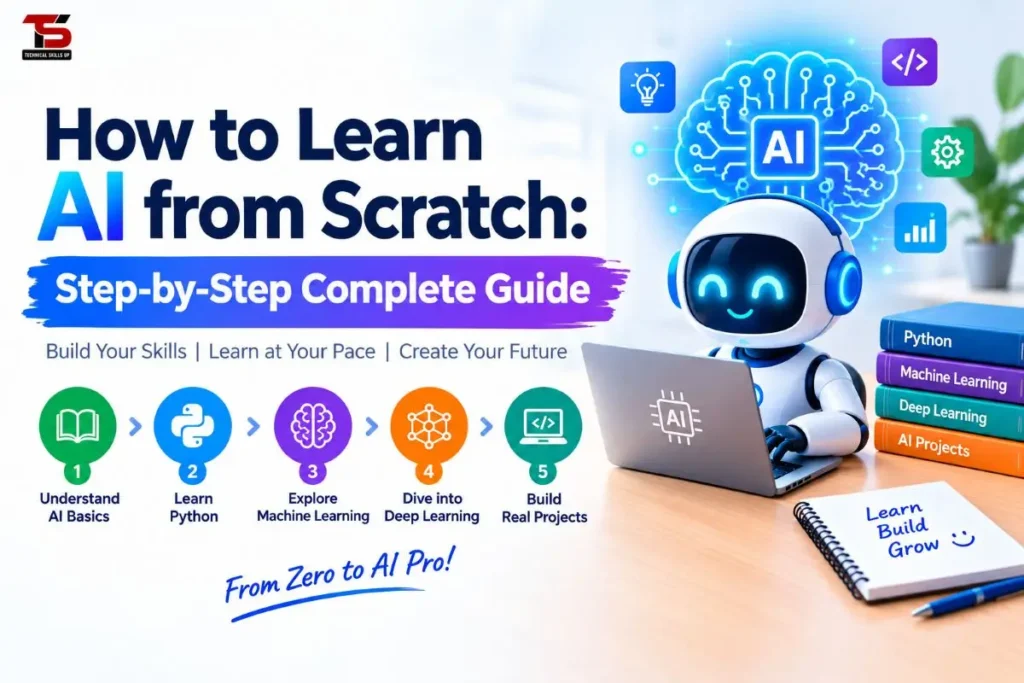
How to Learn AI from Scratch: Step-by-Step Complete Guide

How to Learn AI from Scratch: Step-by-Step Complete Guide

Artificial Intelligence (AI) is becoming an important part of modern technology. It is used in search engines, chatbots, recommendation systems, healthcare, finance, education, marketing, software development, and many other industries. Because of this growth, many students and professionals want to learn AI and build a career in this field. The good news is that you do not need to be an AI expert to get started. You can begin with basic computer knowledge and gradually learn programming, mathematics, data analysis, machine learning, deep learning, and Generative AI. This guide explains how to learn AI from scratch in a simple step-by-step way. It also covers the skills you need, useful tools, project ideas, common mistakes, portfolio building, and a practical six-month learning roadmap. What Is Artificial Intelligence? Artificial Intelligence is a technology that allows computers and machines to perform tasks that normally require human intelligence. These tasks can include: Understanding language Recognizing images Finding patterns in data Making predictions Answering questions Recommending products Understanding speech Generating text and images For example, when a shopping website recommends products based on your previous searches, AI may be working behind the system. Similarly, voice assistants, chatbots, fraud detection systems, face recognition, and many recommendation engines use AI technologies. Artificial Intelligence in Simple Terms Think of AI as a system that learns from information and uses that learning to produce useful results. For example, suppose you give a computer thousands of pictures of cats and dogs. With suitable training, a machine learning model can learn patterns in those images. Later, it may predict whether a new picture contains a cat or a dog. AI does not simply mean robots. It is a much wider field that includes software, algorithms, data, models, and computing systems. AI, Machine Learning, and Deep Learning These terms are related but not exactly the same. Artificial Intelligence is the broad field of making machines perform intelligent tasks. Machine Learning is a part of AI where computers learn patterns from data instead of being programmed for every individual decision. Deep Learning is a part of machine learning that uses neural networks with multiple layers. Generative AI focuses on systems that can create new content such as text, images, audio, video, and code. A simple way to understand the relationship is: AI → Machine Learning → Deep Learning Generative AI uses several modern AI techniques, including deep learning and large language models. Where Is AI Used? AI is already being used across many industries. Some common examples include: Healthcare: Medical image analysis and patient support Finance: Fraud detection and risk analysis E-commerce: Product recommendations Education: Personalized learning tools Manufacturing: Quality control and predictive maintenance Marketing: Customer analysis and content assistance Cybersecurity: Threat detection Software: Code assistance and automation Transportation: Navigation and intelligent systems This wide range of applications is one reason AI skills are becoming valuable across different careers. Can You Learn AI from Scratch Without Experience? Yes. Beginners can learn AI without previous professional experience. However, AI includes several different subjects, so trying to learn everything at once can become confusing. A structured learning path makes the process much easier. You do not need to master advanced mathematics or complex programming on your first day. Start with the basics and increase the difficulty gradually. A beginner can follow this sequence: AI Fundamentals → Python → Mathematics → Data Analysis → Machine Learning → Deep Learning → Generative AI → Projects → Portfolio Do You Need a Computer Science Degree? A computer science degree can be helpful, but it is not the only way to enter AI. Students from engineering, mathematics, statistics, science, business, commerce, marketing, and other backgrounds can learn AI if they develop the required technical skills. Your learning path may depend on your starting point. For example: A programmer may spend more time on machine learning. A mathematics student may focus more on programming. A complete beginner may first learn computer and Python basics. A working professional may prefer project-based learning. The important thing is to build skills step by step. How Long Does It Take to Learn AI? There is no fixed time because every learner has a different background. A reasonable beginner roadmap may look like this: Learning Stage Approximate Time Python Basics 3–6 weeks Mathematics Fundamentals 3–6 weeks Machine Learning 6–10 weeks Deep Learning 6–10 weeks Generative AI 3–6 weeks Projects Continuous These are only general estimates. Someone who already knows Python may progress faster, while a complete beginner may need more time. The goal should not be to finish as quickly as possible. Understanding concepts and building projects are more important. Step-by-Step AI Learning Roadmap for Beginners Step 1 – Understand AI Fundamentals Before writing complex code, understand the basic concepts of AI. Start with: What AI means What machine learning means What deep learning means What data is What an algorithm is What a model is Training and testing Features and labels Prediction Model evaluation You do not need to memorize every definition. Try to understand how the different parts work together. For example, a simple machine learning process can be understood as: Data → Preparation → Training → Model → Prediction → Evaluation Once these concepts become clear, learning technical subjects becomes easier. Step 2 – Learn Python Programming Python is one of the most commonly used programming languages in AI and machine learning. If you are completely new to programming, start with basic Python. Learn: Variables Data types Operators Conditions Loops Functions Lists Tuples Dictionaries Sets Strings File handling Error handling Basic object-oriented programming Do not try to learn every Python feature before moving forward. Learn enough Python to work with data and build AI projects. Python Libraries for AI After learning Python basics, become familiar with important libraries. NumPy helps with numerical operations and arrays. Pandas is widely used for working with structured data. Matplotlib helps create charts and visualizations. Scikit-learn provides many tools for machine learning. Later, you can explore deep learning frameworks such as TensorFlow and PyTorch. Simple Python

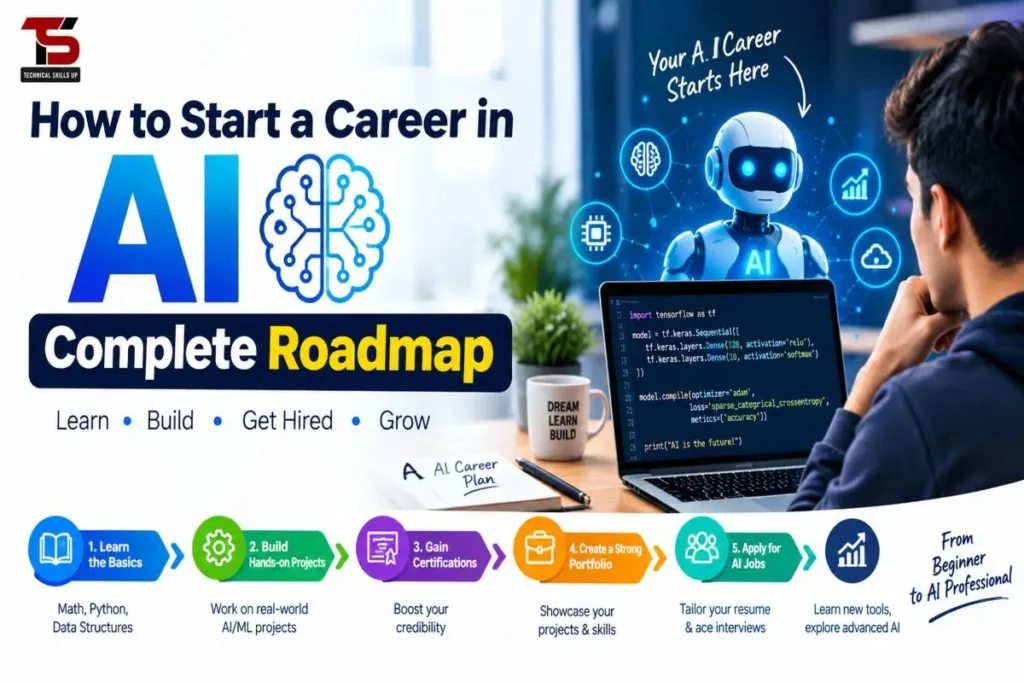
How to Start a Career in AI: Complete Roadmap

How to Start a Career in AI: Complete Roadmap

Artificial Intelligence is changing the way businesses work, products are developed, and decisions are made. From chatbots and recommendation systems to self-driving technology and Generative AI, artificial intelligence is now used across many industries. This growth has created new opportunities for people who want to build technical and professional skills in AI. Starting an AI career does not mean learning every technology at once. A better approach is to follow a structured AI career roadmap that begins with fundamentals and gradually moves toward programming, Machine Learning, Deep Learning, Generative AI, and practical projects. This guide explains the major steps, skills, projects, and career options that can help beginners build a strong foundation in Artificial Intelligence. What Is Artificial Intelligence? Artificial Intelligence is a field of technology that enables computer systems to perform tasks that normally require human intelligence. These tasks can include understanding language, recognizing images, finding patterns, making predictions, and generating content. AI works through different technologies and methods. Machine Learning allows systems to learn patterns from data, while Deep Learning uses neural networks for more complex tasks. Generative AI can create text, images, code, audio, and other types of content. Common examples of AI include virtual assistants, fraud detection systems, recommendation engines, automated customer support, image recognition, and AI-powered software applications. Is AI a Good Career Choice? AI can be a strong career option for people interested in technology, programming, data, and problem-solving. Organizations across different industries are exploring AI to improve efficiency, automate repetitive tasks, understand data, and develop new products. Another advantage is that AI offers multiple career paths. A learner can move toward Machine Learning, Generative AI, Data Science, Natural Language Processing, Computer Vision, or AI application development. However, an AI career requires continuous learning. Tools and techniques change quickly, so professionals need to update their skills and gain practical experience instead of depending only on certificates. AI Career Roadmap A structured roadmap can make AI learning easier for beginners. The following steps provide a practical learning path. Step 1 – Understand AI Fundamentals Start by understanding the basic concepts before moving into advanced technologies. Learn about: Artificial Intelligence Machine Learning Deep Learning Generative AI Neural Networks AI applications Data and model basics Understanding how these technologies relate to each other will make advanced topics easier to learn. Step 2 – Learn Mathematics and Statistics You do not need to become a mathematics expert to begin learning AI. However, basic mathematical and statistical knowledge can help you understand how AI and Machine Learning models work. Important areas include: Probability Statistics Linear Algebra Basic Calculus Data interpretation Focus on practical understanding rather than memorizing formulas. Step 3 – Learn Python Python is widely used in Artificial Intelligence and Machine Learning because it has a large ecosystem of libraries and tools. Start with: Variables and data types Conditions Loops Functions Lists and dictionaries Object-oriented programming basics File handling After learning the fundamentals, explore libraries such as NumPy and Pandas for working with data. Step 4 – Learn Machine Learning Machine Learning is one of the most important areas of an AI career path. It allows computer systems to identify patterns in data and make predictions or decisions. Learn concepts such as: Supervised learning Unsupervised learning Regression Classification Clustering Feature engineering Model evaluation Overfitting and underfitting Use Python to implement basic models and understand how different algorithms behave with real datasets. Step 5 – Learn Deep Learning Deep Learning uses neural networks to solve complex problems involving large amounts of data. Important topics include: Neural networks Activation functions Model training CNN RNN Training and validation Deep learning applications Deep Learning is particularly useful in areas such as image recognition, speech processing, Natural Language Processing, and advanced AI applications. Step 6 – Learn Generative AI Generative AI has become an important part of modern AI development. It focuses on systems that can generate new content based on learned patterns. Beginners can explore: Generative AI fundamentals Large Language Models Prompt Engineering AI APIs Retrieval-Augmented Generation AI-powered applications Responsible AI use Rather than learning only how to use AI tools, try to understand how AI applications are designed and integrated into real workflows. Step 7 – Choose an AI Specialization After learning the fundamentals, choose an area that matches your career goals. Specialization Main Focus Machine Learning Predictive models and algorithms Generative AI LLMs and content generation AI Engineering Building AI-powered applications NLP Text and language processing Computer Vision Images and video Data Science Data analysis and Machine Learning You do not need to master every specialization. Developing strong skills in one area can be more useful than having limited knowledge of many technologies. Essential AI Skills to Learn A successful AI career requires both technical and professional skills. Technical Skills Important technical skills include: Python Machine Learning Deep Learning Statistics Data handling SQL Generative AI APIs Model evaluation AI tools and frameworks Professional Skills Technical knowledge alone is not enough. AI professionals also benefit from: Problem-solving Analytical thinking Communication Research skills Teamwork Business understanding Continuous learning Combining technical and professional skills can help you work more effectively on real-world AI problems. Build AI Projects Projects are one of the best ways to turn theoretical knowledge into practical experience. Beginners can start with projects such as: Chatbot Sentiment analysis House price prediction Customer churn prediction Recommendation system Image classification Sales forecasting Generative AI application Start with simple projects and gradually increase the complexity. Each project should explain the problem, data, approach, technology used, results, and possible improvements. Create an AI Portfolio A portfolio can demonstrate what you can actually build. Create a GitHub profile and organize your projects with clear documentation. A useful project presentation can follow this structure: Problem → Data → Approach → Model → Results → Application You can also maintain a professional LinkedIn profile and include selected projects, technical skills, certifications, and relevant learning experience. A strong portfolio is generally more useful when it demonstrates genuine work rather than a large collection of copied tutorial projects.