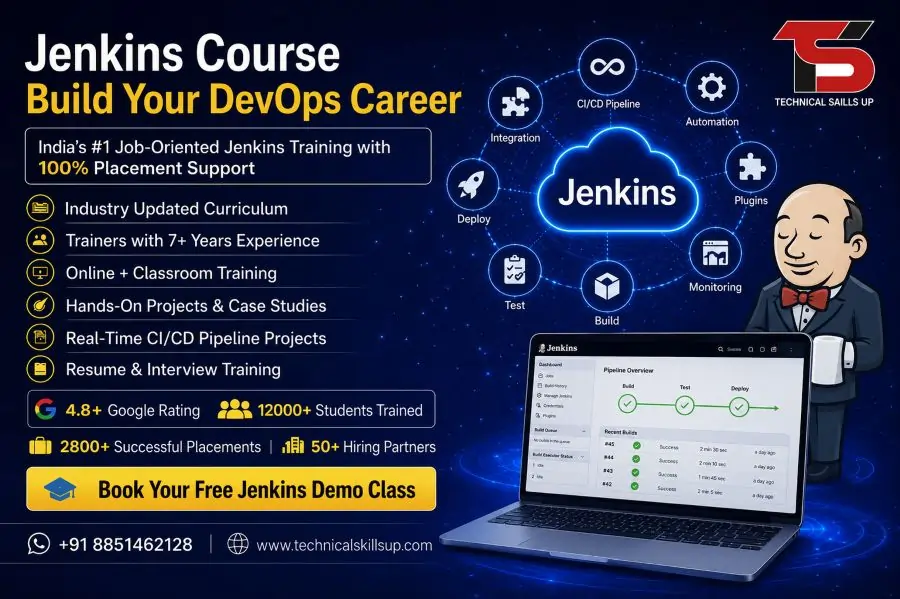
Jenkins Online Course in India with Placement

A modern software development environment demands speed, automation, and reliability to deliver high-quality applications. Continuous integration and continuous delivery have become essential practices for every IT organization aiming for faster release cycles and improved software quality. A well-structured Jenkins Course from Technical Skills Up helps learners build strong DevOps automation skills that are highly valued in today’s tech industry. This training is designed for students, fresh graduates, and working professionals who want to upgrade their career in DevOps and automation engineering. With a practical learning approach, the program focuses on real-world implementation rather than just theory, making learners job-ready for industry requirements.

Course Overview of Jenkins Training Program

A structured DevOps learning path begins with understanding automation principles and how modern CI/CD pipelines function. The Jenkins Training program at Technical Skills Up is designed to provide deep knowledge of build automation, continuous integration, and deployment workflows.

Learning starts with the fundamentals of Jenkins architecture and gradually moves toward advanced pipeline creation and integration with DevOps tools. Each concept is explained with real-time examples so learners can understand how automation works in live projects.

This Jenkins Online Training program is suitable for beginners as well as professionals who want to strengthen their DevOps skills. The course ensures learners gain hands-on experience in creating pipelines, managing builds, and automating deployments across environments.

Key learning highlights include:

  • Understanding CI/CD lifecycle in real-world projects
  • Setting up Jenkins on different environments
  • Creating automated build pipelines
  • Integrating source code repositories like Git
  • Managing plugins and system configurations
  • Working on real-time DevOps scenarios

The learning approach ensures strong practical exposure, making this Jenkins Online Course in India a complete solution for career growth in DevOps.

Importance of Jenkins Course in the IT Industry

Modern software companies rely heavily on automation to reduce manual errors and improve deployment speed. Continuous integration tools play a critical role in ensuring that code changes are tested and deployed efficiently.

A structured Jenkins Certification Course helps professionals understand how automation fits into software development pipelines. Organizations prefer candidates who can manage CI/CD tools effectively because it improves productivity and reduces deployment risks.

Companies working in cloud computing, fintech, e-commerce, and SaaS platforms actively use Jenkins for:

  • Automating software builds
  • Running test cases continuously
  • Managing deployment pipelines
  • Improving collaboration between development and operations teams

Strong expertise in Jenkins Training gives learners a competitive advantage in DevOps roles. It also helps organizations achieve faster product delivery cycles with higher stability.

Skills Covered in Jenkins Training Program

A strong DevOps foundation requires practical skills that can be applied directly in real-world environments. The Jenkins Classes at Technical Skills Up focus on developing both technical and analytical skills required for automation engineering roles.

Key skills developed during the program include:

  • CI/CD pipeline creation and management
  • Automated build and deployment processes
  • Git and version control integration
  • Jenkins job configuration and monitoring
  • Script-based pipeline development
  • Error handling and debugging in pipelines
  • Plugin installation and system customization
  • Multi-branch pipeline setup and execution
  • Integration with cloud and container tools

Hands-on practice ensures learners gain confidence in handling real-time DevOps workflows. Each topic is designed to build logical thinking and automation expertise step by step.

Tools and Technologies Covered in Jenkins Online Training

Modern DevOps environments rely on multiple tools working together. This training introduces learners to essential technologies used in automation and continuous delivery pipelines.

Tools covered in this program include:

  • Jenkins automation server
  • Git and GitHub for version control
  • Maven for build automation
  • Docker for containerization basics
  • Linux command line for server management
  • AWS cloud fundamentals for deployment
  • Selenium basics for automated testing integration
  • Kubernetes introduction for orchestration concepts

Practical exposure to these tools helps learners understand how Jenkins integrates with the DevOps ecosystem. Working with these technologies prepares students for industry-level challenges and real-time project scenarios.

Career Opportunities After Jenkins Certification Course

DevOps skills are among the most in-demand technical skills in the IT industry. Completing a Jenkins Certification Course opens multiple career paths in software development and IT operations.

Popular job roles include:

  • DevOps Engineer
  • Build and Release Engineer
  • Automation Engineer
  • Site Reliability Engineer
  • Cloud DevOps Associate
  • Software Configuration Manager

Organizations across sectors are hiring professionals who understand automation pipelines and CI/CD workflows. Entry-level candidates can start with junior DevOps roles, while experienced professionals can transition into senior automation positions.

Career growth opportunities also expand into cloud platforms such as AWS, Azure, and Google Cloud, where Jenkins plays a crucial role in deployment automation.

Industry Demand and Future Scope of Jenkins Online Course in India

The demand for DevOps professionals has increased significantly due to the rapid adoption of cloud computing and agile development practices. Companies are moving toward automation-first approaches to reduce manual workload and improve software reliability.

A Jenkins Online Course in India offers strong career prospects because:

  • Every major IT company uses CI/CD pipelines
  • Automation reduces development and deployment time
  • Cloud platforms depend heavily on DevOps tools
  • Startups require fast and reliable deployment systems

Future scope of Jenkins expertise includes integration with AI-driven DevOps, advanced cloud automation, and container orchestration systems. Professionals with Jenkins knowledge are expected to remain highly relevant in the evolving tech ecosystem.

Why Choose Technical Skills Up for Jenkins Training

Choosing the right training institute plays a major role in career success. Technical Skills Up focuses on practical learning, industry exposure, and career-oriented training modules.

Reasons to choose this platform include:

  • Industry-expert trainers with real project experience
  • Hands-on practice with live DevOps environments
  • Step-by-step learning approach for beginners
  • Updated curriculum aligned with industry standards
  • Flexible learning options for students and professionals
  • Real-time project assignments for better understanding
  • Career guidance and interview preparation support

The training environment ensures learners gain confidence and technical clarity before entering the job market.

Training Methodology for Jenkins Online Training

A structured learning methodology helps students understand complex DevOps concepts in a simple and practical way. The Jenkins Online Training program follows a balanced approach combining theory and hands-on practice.

Interactive Online Learning Sessions

Live sessions are conducted by experienced trainers who explain concepts in a simple and easy-to-understand manner. Learners can ask questions and get real-time solutions during classes.

Practical Lab-Based Learning

Practical exposure is a key part of the training program. Students work on real-world scenarios such as:

  • Creating CI/CD pipelines
  • Automating build processes
  • Deploying applications on test environments
  • Debugging pipeline errors

Project-Based Learning Approach

Real-time projects help learners understand how DevOps works in actual companies. Each project is designed to simulate industry environments, ensuring better skill development.

This combination of learning methods ensures strong conceptual clarity and job readiness.

Certification and Placement Support

A recognized certification adds strong value to a professional profile. After completing the Jenkins Certification Course, learners receive a certificate that validates their DevOps skills.

Certification benefits include:

  • Industry-recognized proof of skills
  • Better job opportunities in IT companies
  • Increased confidence during interviews
  • Validation of practical knowledge

Placement assistance provided by Technical Skills Up includes:

  • Resume building support
  • Mock interview sessions
  • Job referral guidance
  • Career counseling sessions
  • Interview preparation for DevOps roles

This support system helps learners transition smoothly from training to employment.

Conclusion

A strong foundation in automation and CI/CD practices has become essential for every IT professional aiming to build a successful DevOps career. The Jenkins Course offered by Technical Skills Up provides a complete learning experience that combines theory, practical exposure, and real-world project implementation.

Modern industries demand professionals who can streamline software delivery and improve system reliability through automation. This training program helps learners achieve that level of expertise with structured guidance and hands-on practice.

Career opportunities after completing this program continue to grow as more companies adopt DevOps practices across cloud and enterprise environments. With the right training, consistent practice, and industry-focused learning, learners can build a stable and high-growth career path in automation and DevOps engineering.

Technical Skills Up ensures that every learner gains practical knowledge, confidence, and career direction needed to succeed in today’s competitive IT landscape.

FAQs:

Q1. What is Jenkins?

Ans: Jenkins is an open-source automation tool used in software development for Continuous Integration (CI) and Continuous Delivery (CD).

Q2. What is a Jenkins course?

Ans: A Jenkins course teaches you about CI/CD pipelines, automation, DevOps tools, and real-time deployment processes.

Q3. Is learning Jenkins suitable for beginners?

Ans: Yes, beginners can learn Jenkins too, as the training covers everything step-by-step, from basic to advanced levels.

Q4. What is a Jenkins online course with placement in India?

Ans: It is a course that offers job placement support alongside Jenkins training.

Q5. What does Technical Skills Up provide in this course?

Ans: Technical Skills Up provides live classes, practical projects, training on real-time DevOps tools, and placement assistance.

Q6. Is practical training included in this course?

Ans: Yes, it includes real-time projects and hands-on lab practice.

Q7. What skills are required to learn Jenkins?

Ans: Basic knowledge of Linux, Git, and a programming language (Java/Python) is helpful.

Q8. What is the duration of the Jenkins course?

Ans: The course typically lasts between 6 to 10 weeks, depending on the training level.

Q9. Is this an online course, or is it available offline as well?

Ans: The Technical Skills Up Jenkins course is available online, allowing you to learn from home.

Q10. Can I get a job after completing this course?

Ans: Yes, with placement support, you can find job opportunities in roles such as DevOps Engineer, CI/CD Engineer, and Automation Engineer.

Q11. What is the career scope after learning Jenkins?

Ans: After learning Jenkins, you can work in roles such as DevOps Engineer, Build Engineer, or Release Engineer.

Q12. Do I get a certificate upon completing the course?

Ans: Yes, Technical Skills Up provides a certificate after the course is completed.

Q13. Is the course suitable for both beginners and working professionals?

Yes, this course is designed for both students and working professionals.

Q14. What topics are covered in the Jenkins course?

Ans: It covers topics such as CI/CD pipelines, Git integration, automation scripts, deployment processes, and Docker integration.

Q15. Why choose Technical Skills Up?

Ans: Technical Skills Up is known for its experienced trainers, practical training, live projects, and placement support, all of which make students job-ready.
Related Post

Terraform Course

Terraform Course in Noida with Placement

Modern IT companies need professionals who can manage cloud infrastructure quickly and securely. A professional Terraform Course in Noida helps students and working professionals learn Infrastructure as Code (IaC) with real industry projects. Technical Skills Up provides practical training with expert guidance, live projects, and placement support to help learners build strong cloud automation skills. Training sessions focus on real-world implementation instead of only theory. Every module covers important DevOps concepts, cloud deployment methods, automation practices, and configuration management techniques. Simple learning methods, hands-on assignments, and industry-focused projects make the training easy to understand for beginners as well as experienced professionals. Introduction to Terraform Terraform is an open-source Infrastructure as Code tool developed by HashiCorp. Developers and DevOps engineers use Terraform to automate cloud infrastructure management. Multiple cloud platforms such as Amazon Web Services, Microsoft Azure, and Google Cloud support Terraform integration. Companies prefer Terraform because automation reduces manual errors and saves deployment time. Infrastructure provisioning becomes easier with reusable code templates and automated workflows. Why Learn Terraform in 2026 Cloud computing adoption continues to grow rapidly across industries. Organizations now require automated infrastructure deployment to manage applications efficiently. Skilled Terraform professionals help businesses maintain scalable and secure cloud environments. Learning Terraform provides several career advantages: High demand in DevOps and Cloud Computing Better salary opportunities Strong career growth in automation roles Easy integration with cloud platforms Useful skill for CI/CD environments Supports multi-cloud infrastructure management Technical Skills Up focuses on practical learning that matches current industry requirements. About Technical Skills Up Technical Skills Up delivers industry-oriented IT training programs for students, job seekers, and working professionals. Experienced trainers conduct live practical sessions with real-time project exposure. Training methodology helps learners understand concepts step by step in simple language. Students receive: Practical lab sessions Live project experience Interview preparation support Resume building assistance Placement guidance Flexible batch timing Updated course modules Training quality and practical exposure help learners gain confidence for real job roles. Key Features of Terraform Training Practical Learning Approach Hands-on implementation remains the main focus during training. Students work on real cloud environments and infrastructure deployment tasks. Industry Expert Trainers Experienced professionals with real DevOps project exposure conduct training sessions. Trainers explain concepts using practical examples from the IT industry. Live Projects Real-time projects help learners understand how Terraform works in production environments. Project-based learning improves technical confidence. Placement Support Technical Skills Up provides career guidance and interview preparation sessions for students preparing for DevOps and cloud job roles. Updated Course Content Course modules follow the latest industry trends and cloud automation practices. Terraform Training in Noida for Beginners Beginners often worry about learning DevOps tools without coding experience. Technical Skills Up uses easy teaching methods that simplify complex concepts. Basic cloud computing and infrastructure concepts receive proper attention before advanced topics begin. Training includes: Basic DevOps concepts Cloud infrastructure fundamentals Terraform installation and setup Configuration file creation Infrastructure provisioning Resource management Automation practices Step-by-step guidance helps beginners learn confidently. Advanced Terraform Concepts Covered Advanced modules prepare learners for real-world enterprise projects. Infrastructure as Code Students learn how to manage infrastructure through reusable configuration files instead of manual deployment. Terraform Providers Training covers provider setup and integration with different cloud platforms. State Management Proper state file management improves infrastructure tracking and collaboration. Modules and Reusability Reusable modules simplify infrastructure deployment across multiple environments. Variables and Outputs Dynamic configurations become easier with variables and outputs. Remote Backend Configuration Remote state management improves team collaboration and security. Multi-Cloud Deployment Students learn deployment methods across multiple cloud platforms. Terraform Classes in Noida with Live Projects Live project training improves practical understanding. Real-time implementation helps learners gain industry-level experience. Projects may include: AWS infrastructure automation Virtual machine deployment Load balancer setup Kubernetes cluster provisioning Network configuration Security group management Cloud resource scaling Project experience strengthens technical skills and improves interview performance. Benefits of Learning Terraform Faster Infrastructure Deployment Automation reduces manual configuration tasks and speeds up deployment. Better Resource Management Terraform helps organize and manage cloud resources efficiently. Reduced Human Errors Automated infrastructure creation minimizes configuration mistakes. Scalability Cloud environments become easier to scale with Infrastructure as Code practices. Improved Collaboration Teams can manage infrastructure using version-controlled configuration files. Career Opportunities After Terraform Training Cloud and DevOps professionals remain in high demand worldwide. Terraform skills open opportunities in multiple job roles. Popular job profiles include: DevOps Engineer Cloud Engineer Site Reliability Engineer Infrastructure Engineer AWS DevOps Engineer Automation Engineer Cloud Consultant Companies across healthcare, finance, eCommerce, education, and IT services hire Terraform professionals. Who Can Join This Course Training programs suit different learners from technical and non-technical backgrounds. Suitable candidates include: College students IT graduates System administrators Network engineers Cloud professionals Software developers DevOps beginners Working professionals Basic computer knowledge helps learners understand concepts more easily. Course Modules Covered Introduction to DevOps DevOps lifecycle Automation basics CI/CD concepts Infrastructure management Cloud Computing Fundamentals Public cloud concepts Virtual machines Networking basics Storage services Terraform Basics Installation process Terraform commands Configuration syntax Resource creation AWS Integration EC2 deployment VPC setup IAM configuration Security management Advanced Automation Modules Workspaces Provisioners Remote backend Project Implementation Real-world deployment Infrastructure automation Cloud monitoring Troubleshooting Practical Skills Students Learn Hands-on practice helps students develop job-ready skills. Learners gain experience in: Cloud automation Infrastructure provisioning Terraform scripting AWS deployment Resource management CI/CD integration Infrastructure monitoring Configuration management Practical exposure improves confidence during interviews and project implementation. Why Companies Prefer Terraform Professionals Modern businesses depend heavily on cloud infrastructure. Automation tools reduce deployment time and improve operational efficiency. Terraform professionals help organizations maintain reliable and scalable cloud environments. Companies value professionals who can: Automate infrastructure deployment Reduce operational costs Improve cloud security Manage large-scale environments Support DevOps workflows Increase deployment efficiency Growing demand continues to create strong career opportunities. Learning Environment at Technical Skills Up Training quality plays an important role in skill development. Technical Skills Up provides an interactive learning environment with practical implementation sessions. Students receive: Trainer support Lab access Project practice Career guidance Doubt-clearing sessions Interview

Microsoft Dynamics 365 Finance Course

Microsoft Dynamics 365 Finance Course in Noida

Growing demand for ERP professionals has created excellent career opportunities in the corporate sector. Companies across finance, manufacturing, retail, supply chain, and banking industries depend on smart business management software to handle daily operations. Strong knowledge of finance modules, reporting systems, budgeting, taxation, and business processes helps professionals secure better career growth in India and abroad. Technical Skills Up offers a practical learning environment for students, working professionals, and job seekers who want to build expertise in enterprise resource planning software. Training sessions focus on real business scenarios, industry-level projects, and hands-on practice. Expert trainers guide learners step by step so they can understand concepts easily without confusion. Students searching for a reliable Microsoft Dynamics 365 Finance Course in Noida can gain industry-focused learning with practical assignments, interview preparation, and placement assistance. Course modules are designed according to current industry requirements so learners can develop both technical and functional skills in a professional environment. Why Learn Microsoft Dynamics 365 Finance Modern businesses require advanced financial management systems to improve productivity and accuracy. Manual accounting processes consume time and increase the risk of errors. Cloud-based ERP platforms help organizations automate operations and improve business performance. Learning finance management software provides multiple benefits: Better understanding of financial operations Knowledge of business automation tools Strong career opportunities in ERP industries High demand in multinational companies Better salary packages for skilled professionals Opportunities for global certifications Career growth in finance and technology domains Professional training also helps learners understand how large organizations manage accounting, reporting, budgeting, compliance, taxation, and procurement activities. Industry Demand for ERP Finance Professionals Large enterprises continuously search for trained ERP professionals who can manage financial operations efficiently. Demand for skilled candidates has increased in sectors like: Manufacturing Banking Retail Healthcare IT companies Logistics E-commerce Consulting firms ERP finance specialists work on implementation, support, consulting, reporting, and process management roles. Growing digital transformation in businesses has also increased the need for cloud ERP experts. Career Opportunities After Course Completion Professional training opens multiple career paths for learners interested in finance and ERP technologies. Companies hire trained candidates for various positions based on their knowledge and practical experience. Popular job roles include: ERP Finance Consultant Functional Consultant Finance Executive ERP Analyst Support Consultant Implementation Specialist Business Analyst Accounts Manager Financial Reporting Executive ERP Trainer Career opportunities are available for freshers as well as experienced professionals who want to upgrade their skills. Practical Learning Approach at Technical Skills Up Strong practical knowledge creates better confidence during interviews and live projects. Technical Skills Up focuses on hands-on learning methods instead of only theoretical explanations. Training sessions include: Real-time project practice Live server access Business case studies Practical assignments Industry scenarios Step-by-step demonstrations Interactive classroom sessions Trainers explain every module in simple language so students from technical and non-technical backgrounds can learn comfortably. Key Features of the Training Program Professional learning requires updated modules, practical exposure, and expert guidance. Training structure at Technical Skills Up helps learners build strong industry-ready skills. Main Highlights Experienced corporate trainers Practical-oriented sessions Updated course modules Flexible class timing Weekday and weekend batches Online and classroom training Interview preparation support Resume building assistance Placement guidance Lifetime access to study materials Skills You Will Learn During Training Comprehensive learning helps students understand different business processes used in organizations. Training covers finance management concepts along with ERP implementation knowledge. Important Skills Covered Financial management Ledger configuration Budget planning Tax management Accounts payable Accounts receivable Cash and bank management Financial reporting Procurement process Workflow management Business process automation ERP navigation skills Practical exercises improve confidence and help learners understand real-world business environments. Benefits of Joining Professional ERP Classes Structured learning from industry experts saves time and improves understanding. Professional classes also help students avoid confusion while learning complex ERP concepts. Major Advantages Better understanding of finance operations Guidance from experienced mentors Practical project experience Faster career growth Improved interview performance Access to updated industry knowledge Learning through real business examples Better confidence for client handling Students receive proper support throughout the learning process. Course Modules Covered During Training Training structure includes important finance and ERP concepts required in the industry. Every module focuses on practical implementation and business usage. Introduction to ERP and Finance Management ERP fundamentals Business process understanding Finance module overview Navigation and user interface Organizational setup Financial Management General ledger Chart of accounts Fiscal calendar setup Financial dimensions Budget configuration Accounts Payable Vendor management Purchase invoices Payment journals Vendor settlements Procurement workflow Accounts Receivable Customer setup Sales invoices Customer payments Collection management Credit management Cash and Bank Management Bank configuration Bank reconciliation Payment processing Cash flow handling Fixed Assets Management Asset creation Asset depreciation Asset transactions Asset reporting Budgeting and Forecasting Budget planning Budget control Financial forecasting Expense management Financial Reporting Report generation Management reporting Data analysis Financial statements Security and User Management User roles Permissions setup Security configuration Project and Practical Assignments Live implementation scenarios Business process execution Case studies Real-time practice Who Can Join This Training Program Learning ERP finance management does not require advanced technical expertise. Beginners and experienced professionals both can benefit from this course. Suitable candidates include: B.Com students MBA students M.Com graduates Working accountants Finance professionals ERP beginners Business analysts Job seekers IT professionals Entrepreneurs Basic computer knowledge helps students learn faster during practical sessions. Professional Trainers with Industry Experience Experienced mentors play an important role in professional learning. Corporate trainers at Technical Skills Up have strong industry knowledge and implementation experience. Training sessions focus on: Real-world business problems Industry best practices Practical demonstrations Interactive learning methods Interview-focused preparation Students receive guidance directly from professionals who understand current market requirements. Importance of Practical Projects Practical exposure helps learners understand how companies use ERP software in real business operations. Project-based learning improves confidence and technical skills. Training includes: Real business workflow execution Finance configuration practice Report generation exercises Transaction management Implementation scenarios Hands-on projects prepare students for corporate work environments. Placement Assistance and Career Support Professional training becomes more valuable when learners receive career

Workday HCM Course

Workday HCM Course in Noida with Placement

Modern businesses rely on smart HR systems to manage employees, payroll, hiring, and performance efficiently. Workday has become one of the most trusted cloud-based HR platforms used by top companies worldwide. Learning this technology can open strong career opportunities in the HR tech domain. Workday HCM Course in Noida offered by Technical Skills Up provides a practical, industry-focused learning experience that helps learners build real skills. Training focuses on hands-on projects, expert guidance, and job-oriented modules so that students gain confidence and become ready for real-world challenges. Structured learning combined with continuous practice helps create a solid foundation for a successful career. Why Choose Workday HCM as a Career? Growing demand for cloud-based HR solutions has increased the need for skilled Workday professionals. Companies prefer candidates who understand both HR processes and technical implementation. Key Benefits of Learning Workday HCM: High demand in multinational companies Attractive salary packages for skilled professionals Opportunity to work in HR, IT, and consulting roles Global career opportunities Continuous learning and career growth Strong understanding of Workday helps candidates stand out in competitive job markets. About Technical Skills Up Training Program Technical Skills Up focuses on delivering quality education with real-time practical exposure. Learning environment is designed to make complex concepts easy and understandable. Training Highlights: Industry-expert trainers with real experience Practical sessions with live projects Step-by-step learning approach Updated course content based on industry trends Career-focused training methodology Students gain both theoretical knowledge and practical skills required for job roles. Workday HCM Training in Noida Training program is designed to cover all major modules of Workday HCM. Course structure ensures that learners move from basic to advanced concepts smoothly. What You Will Learn: Introduction to Workday and Cloud ERP Workday Navigation and User Interface Organizational Structures Business Process Framework Staffing Models Job Profiles and Positions Compensation and Benefits Security Configuration Reporting and Analytics Each topic includes practical exercises for better understanding. Course Modules Breakdown 1. Workday Basics Overview of Workday architecture Understanding cloud-based systems Navigation and dashboard usage 2. Organization Setup Company structure creation Supervisory organizations Cost centers and hierarchies 3. Staffing Models Job management Position management Hiring processes 4. Business Process Framework Creating workflows Approval processes Business event configuration 5. Compensation Management Salary structures Bonus and incentives Compensation plans 6. Security and Access User roles Data security policies Permission settings 7. Reports and Analytics Custom report creation Data analysis Dashboard insights Detailed modules help learners understand every aspect of Workday HCM. Workday HCM Classes in Noida Classes are designed in a simple and interactive way so that every student can learn comfortably. Training includes both online and offline options. Class Features: Live instructor-led sessions Recorded sessions for revision Doubt-clearing sessions Practice assignments Real-time case studies Learning becomes easier when concepts are explained with practical examples. Practical Training Approach Practical exposure plays a key role in mastering Workday HCM. Training includes real-world scenarios to prepare students for actual job tasks. Practical Learning Includes: Live project work Hands-on system access Scenario-based assignments Mock implementation exercises Continuous practice improves confidence and technical skills. Workday HCM Training Institute in Noida Technical Skills Up is known for providing career-oriented training with placement support. Focus remains on building job-ready skills. Why Choose This Institute: Experienced trainers Updated curriculum Real-time project exposure Placement assistance Affordable course fees Students receive complete guidance from training to job placement. Career Opportunities After Course Workday HCM skills open doors to multiple job roles in HR and IT sectors. Job Roles: Workday HCM Consultant HRIS Analyst Workday Functional Consultant Workday Business Analyst HR Technology Specialist Each role offers growth and learning opportunities. Salary Expectations Salary depends on skills, experience, and company. Entry-level candidates can expect good starting packages. Average Salary Range: Freshers: ₹3 LPA – ₹6 LPA Experienced: ₹8 LPA – ₹15 LPA Advanced professionals: ₹20 LPA+ Continuous skill improvement helps increase salary potential. Skills You Will Develop Training helps in building both technical and professional skills. Technical Skills: Workday system configuration Reporting and analytics Business process setup Soft Skills: Communication Problem-solving Analytical thinking Balanced skill development improves job performance. Placement Support Our Placement assistance helps students start their careers confidently. Placement Services: Resume building guidance Interview preparation Mock interviews Job referrals Support system increases chances of getting placed quickly. Who Can Join This Course? Course is suitable for beginners as well as professionals. Suitable For: Fresh graduates HR professionals IT professionals Career switchers Basic computer knowledge is enough to start learning. Learning Methodology Simple teaching approach makes learning easy and effective. Training Method Includes: Step-by-step explanations Real-life examples Practical exercises Interactive sessions Students understand concepts quickly with this method. Certification Benefits Certification adds value to your resume and increases job opportunities. Advantages of Certification: Industry recognition Better job opportunities Higher salary chances Professional credibility Certified candidates are preferred by employers. Industry Demand for Workday Professionals Companies are moving towards cloud-based HR systems, increasing demand for Workday experts. Industries Hiring: IT companies MNCs Consulting firms Healthcare organizations Financial institutions Demand continues to grow every year. Flexible Learning Options Training program offers flexibility for working professionals and students. Options Available: Weekday batches Weekend batches Online classes Offline classes Students can choose according to their schedule. Real-Time Project Experience Project-based learning helps in understanding real-world applications. Project Work Includes: HR process implementation Workflow creation Report generation Practical exposure builds confidence for job roles. Key Features of Training Program Beginner to advanced level training Industry-relevant curriculum Hands-on learning approach Expert trainer support Job-oriented course structure Comprehensive training prepares students for real challenges. Importance of Workday in Modern HR Organizations need efficient systems to manage employees and data. Workday provides a complete solution for HR operations. Key Advantages: Cloud-based system Easy data management Real-time reporting Improved decision making Companies prefer Workday for its efficiency and scalability. Career Growth Path Learning Workday HCM can lead to long-term career growth. Growth Path: Junior Consultant Senior Consultant Project Manager Solution Architect Experience and skills help in career advancement. Conclusion Choosing the right course plays an important role in building a successful