
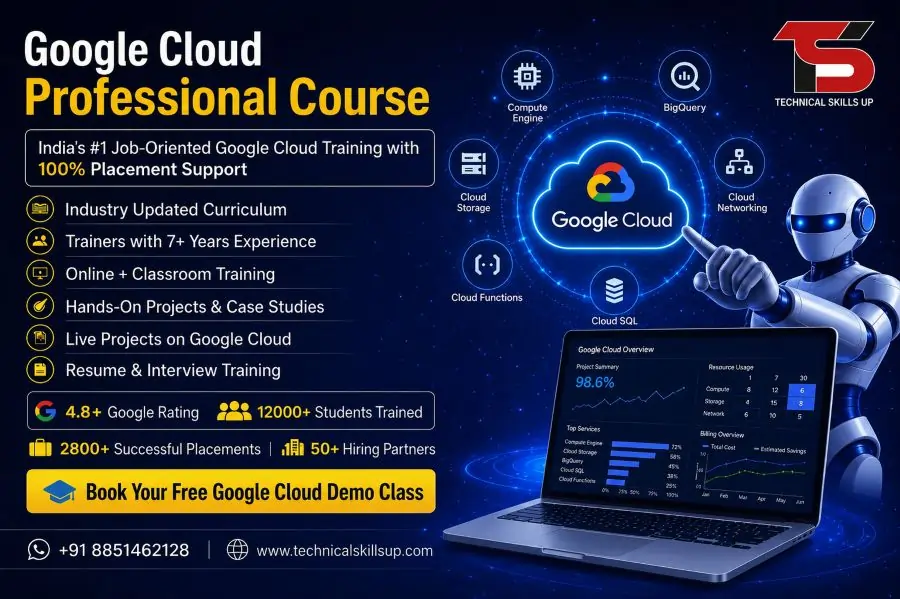
Modern businesses rely on cloud technology to manage applications, store data, improve security, and scale operations efficiently. Organizations across industries are moving their infrastructure to cloud platforms, creating a strong demand for professionals who can design, deploy, and manage cloud environments. Technical Skills Up offers a comprehensive Google Cloud Professional Course designed for students, IT professionals, system administrators, developers, and anyone who wants to build expertise in cloud computing. The program combines practical learning, real-world projects, expert guidance, and industry-relevant skills to help learners become job-ready. Every module focuses on hands-on implementation so participants can understand cloud concepts with confidence and apply them in real business environments. Learners gain exposure to modern cloud practices that align with industry requirements and prepare them for future career growth.
Google Cloud Professional Training for Modern IT Careers
Cloud computing has become a critical part of digital transformation. Companies need skilled professionals who understand cloud architecture, security, networking, migration strategies, automation, and infrastructure management. Technical Skills Up has designed this program to provide practical knowledge that helps learners work confidently with cloud technologies.
The training focuses on real-world implementation rather than only theoretical concepts. Learners work on practical exercises, case studies, and projects that reflect actual industry scenarios. This approach helps participants understand how cloud services are used in organizations of different sizes.
Course Overview
The program covers fundamental and advanced cloud concepts in a structured learning format. Each module is designed to help learners gradually develop expertise and confidence in managing cloud environments.
Key highlights of the program include:
- Comprehensive cloud computing concepts
- Cloud architecture fundamentals
- Compute and storage services
- Identity and access management
- Virtual networking concepts
- Security and compliance practices
- Cloud deployment strategies
- Monitoring and performance management
- Infrastructure automation
- Migration and modernization approaches
- Practical assignments
- Industry-focused projects
Strong emphasis on hands-on implementation helps learners understand how cloud technologies solve business challenges.
Why Cloud Skills Are Important in Today’s Industry
Businesses are rapidly adopting cloud platforms because they offer flexibility, scalability, cost efficiency, and better operational performance. Organizations across sectors such as healthcare, banking, retail, education, manufacturing, and technology are investing heavily in cloud infrastructure.
Cloud professionals help companies:
- Reduce infrastructure costs
- Improve business continuity
- Increase application performance
- Strengthen security practices
- Support digital transformation
- Enable remote collaboration
- Manage large-scale workloads
- Improve disaster recovery processes
Growing cloud adoption has created excellent career opportunities for skilled professionals who understand modern cloud ecosystems.
Growing Demand for Cloud Experts
Every year, organizations migrate more applications and workloads to the cloud. This transition creates a need for professionals who can manage cloud environments effectively.
Employers actively look for candidates who can:
- Design scalable cloud solutions
- Configure cloud infrastructure
- Implement security controls
- Monitor cloud resources
- Optimize cloud costs
- Automate operational processes
- Support cloud migration initiatives
Professionals with cloud expertise often enjoy better career growth and access to high-paying opportunities.
Google Cloud Professional Classes Designed for Practical Learning
Technical Skills Up believes that practical knowledge creates successful professionals. Every learning module includes hands-on exercises that allow learners to apply concepts in realistic environments.
Participants receive exposure to:
- Live demonstrations
- Practical assignments
- Guided lab exercises
- Industry case studies
- Real project implementation
- Cloud deployment scenarios
- Troubleshooting activities
This structured approach ensures learners understand both concepts and practical implementation techniques.
Learning Objectives
The course helps learners:
- Understand cloud computing architecture
- Build and manage cloud infrastructure
- Configure networking environments
- Secure cloud resources
- Monitor cloud performance
- Deploy cloud applications
- Automate infrastructure processes
- Manage storage solutions
- Implement cloud security practices
- Handle cloud migration projects
Knowledge gained during the training can be applied directly in professional environments.
Skills Covered in the Program
Cloud professionals require a combination of technical expertise, analytical thinking, and problem-solving capabilities. This training develops those essential skills through practical learning experiences.
Cloud Fundamentals
Learners start with core cloud concepts, including:
- Cloud computing models
- Service models
- Deployment models
- Resource management
- Scalability concepts
- Cloud economics
Strong fundamentals create a solid foundation for advanced topics.
Cloud Infrastructure Management
Participants learn how to:
- Create cloud environments
- Manage virtual resources
- Configure infrastructure components
- Monitor resource utilization
- Optimize performance
Practical activities help learners understand real-world infrastructure management.
Networking Concepts
Networking forms a critical part of cloud architecture.
Topics include:
- Virtual networks
- IP addressing
- Routing concepts
- Connectivity solutions
- Load balancing
- Network security
Practical exercises strengthen networking knowledge for cloud environments.
Security and Compliance
Security remains one of the most important aspects of cloud computing.
Learners explore:
- Identity management
- Access control
- Data protection
- Security monitoring
- Threat mitigation
- Compliance considerations
Security-focused training helps professionals support organizational requirements effectively.
Storage and Data Management
Modern organizations generate enormous volumes of data.
The course covers:
- Storage services
- Data lifecycle management
- Backup strategies
- Disaster recovery planning
- Data security practices
- Performance optimization
Understanding storage solutions helps professionals build reliable cloud environments.
Automation and DevOps Fundamentals
Automation improves efficiency and reduces operational complexity.
Learners gain exposure to:
- Infrastructure automation
- Configuration management
- Deployment automation
- Continuous integration concepts
- Continuous delivery concepts
- Operational best practices
Automation skills are highly valued in cloud-related roles.
Tools and Technologies Covered
Technical Skills Up focuses on industry-relevant tools and technologies that help learners build practical expertise.
Cloud Services and Platforms
Participants work with:
- Compute services
- Storage solutions
- Database services
- Networking components
- Security services
- Monitoring tools
Practical implementation builds confidence in handling cloud environments.
Infrastructure Management Tools
Learners understand:
- Resource provisioning
- Infrastructure monitoring
- Performance analysis
- Resource optimization
- Capacity planning
These skills support efficient cloud operations.
Security Technologies
Security-focused learning includes:
- Access management tools
- Authentication systems
- Encryption concepts
- Security monitoring solutions
- Compliance practices
Strong security awareness helps professionals manage cloud environments responsibly.
Monitoring and Reporting Solutions
Organizations require visibility into cloud operations.
Training covers:
- Monitoring techniques
- Performance tracking
- Resource reporting
- Alert management
- Operational analysis
Monitoring skills improve operational efficiency and reliability.
Google Cloud Professional Certification Course for Career Growth
Professional certification preparation can strengthen a candidate’s profile and demonstrate cloud expertise to employers. Technical Skills Up provides structured learning that helps participants understand industry-standard concepts and best practices.
The curriculum aligns with current industry expectations and focuses on practical implementation. Learners receive guidance from experienced trainers who share real-world knowledge and practical insights.
Benefits of Certification Preparation
Certification-oriented learning helps participants:
- Validate cloud knowledge
- Improve professional credibility
- Increase job opportunities
- Strengthen technical expertise
- Enhance career growth prospects
- Build employer confidence
Many organizations prefer candidates who demonstrate strong cloud knowledge through practical skills and professional learning.
Career Opportunities After Training
Cloud computing continues to create exciting career opportunities worldwide. Professionals with cloud expertise can work across industries and technology domains.
Popular career paths include:
- Cloud Engineer
- Cloud Administrator
- Cloud Consultant
- Cloud Support Engineer
- Infrastructure Engineer
- Solutions Architect
- DevOps Engineer
- Site Reliability Engineer
- Systems Engineer
- Cloud Operations Specialist
Demand for these roles continues to increase as organizations expand their cloud adoption strategies.
Entry-Level Opportunities
Students and fresh graduates can pursue roles such as:
- Junior Cloud Engineer
- Technical Support Associate
- Infrastructure Support Executive
- Cloud Operations Analyst
- System Support Engineer
Practical skills learned during training help learners become more competitive in the job market.
Opportunities for Experienced Professionals
Working professionals can leverage cloud expertise to transition into advanced roles.
Career progression opportunities include:
- Senior Cloud Engineer
- Cloud Architect
- Infrastructure Manager
- DevOps Specialist
- Technical Consultant
- Cloud Strategy Consultant
Cloud skills often open doors to leadership and specialized technology positions.
Industry Demand and Future Scope
Cloud technology continues to reshape the digital landscape. Organizations increasingly depend on cloud services to improve agility, reduce operational costs, and accelerate innovation.
Several trends contribute to growing demand:
- Digital transformation initiatives
- Remote work adoption
- Data-driven decision making
- Artificial intelligence integration
- Application modernization
- Hybrid cloud environments
- Automation strategies
- Security enhancement initiatives
Cloud computing remains one of the fastest-growing technology domains globally.
Future Opportunities in Cloud Computing
Future growth areas include:
- Artificial intelligence integration
- Machine learning deployment
- Cloud security specialization
- Hybrid cloud architecture
- Multi-cloud management
- Infrastructure automation
- Data analytics solutions
- Cloud-native application development
Professionals who develop cloud expertise today position themselves for long-term career success.
Google Cloud Professional Online Course for Flexible Learning
Many learners require flexibility while balancing work, studies, and personal commitments. Technical Skills Up provides learning options that support different schedules and learning preferences.
The online learning model allows participants to:
- Learn from any location
- Access expert guidance
- Participate in interactive sessions
- Complete practical assignments
- Review recorded content
- Continue learning at their own pace
Flexible learning helps working professionals upgrade their skills without disrupting existing responsibilities.
Advantages of Online Learning
Online training offers several benefits:
- Schedule flexibility
- Location independence
- Interactive sessions
- Expert mentorship
- Practical project exposure
- Career-focused learning
Learners receive structured guidance throughout their training journey.
Google Cloud Professional Online Course in India for Students and Professionals
India continues to experience rapid growth in cloud adoption across industries. Organizations are investing in cloud infrastructure to improve efficiency and support digital transformation goals.
Technical Skills Up offers industry-focused training designed to meet current market requirements. The curriculum addresses practical business challenges and helps learners develop skills relevant to today’s technology landscape.
Participants from different backgrounds can benefit, including:
- Students
- Graduates
- IT professionals
- Software developers
- System administrators
- Network engineers
- Technical support professionals
- Career transition candidates
Practical learning ensures that participants gain valuable industry-ready skills.
Why Choose Technical Skills Up
Selecting the right training institute plays a crucial role in career development. Technical Skills Up focuses on quality education, practical learning, and career-oriented training.
Experienced Trainers
Learners receive guidance from professionals with industry experience. Trainers share practical knowledge, implementation techniques, and real-world insights.
Industry-Relevant Curriculum
Course content reflects current industry requirements and evolving cloud technologies.
Practical Learning Approach
Hands-on projects, assignments, and lab activities help learners build confidence and technical expertise.
Student-Focused Learning Environment
Supportive learning experiences help participants understand concepts clearly and progress effectively.
Career-Oriented Training
Every module is designed to improve employability and professional growth.
Training Methodology
Technical Skills Up follows a structured learning approach that combines theory, practice, and project-based implementation.
Instructor-Led Sessions
Interactive classes help learners understand concepts through real-world examples and practical demonstrations.
Hands-On Practice
Every major topic includes practical exercises that reinforce learning outcomes.
Project-Based Learning
Projects simulate actual industry challenges and help learners develop problem-solving skills.
Assessments and Evaluation
Regular assessments help track progress and identify improvement areas.
Mentorship Support
Learners receive guidance throughout the training process to strengthen understanding and confidence.
Certification and Placement Support
Professional development extends beyond classroom learning. Technical Skills Up supports learners through career-focused services that improve employability.
Placement assistance includes:
- Resume guidance
- Interview preparation
- Career counseling
- Technical assessment support
- Professional profile improvement
- Job opportunity updates
Career support services help learners present their skills effectively to potential employers.
Interview Preparation
Dedicated interview support focuses on:
- Technical discussions
- Scenario-based questions
- Problem-solving approaches
- Communication improvement
- Confidence building
Preparation sessions help learners perform better during recruitment processes.
Learning Outcomes
After completing the training, learners will be able to:
- Understand cloud architecture concepts
- Configure cloud resources
- Manage cloud infrastructure
- Implement security controls
- Monitor cloud performance
- Support cloud migration projects
- Apply automation concepts
- Solve infrastructure challenges
- Work on cloud-based projects
- Contribute effectively to cloud teams
These outcomes help learners build strong foundations for successful cloud careers.
Conclusion
Technology continues to evolve rapidly, and cloud computing remains one of the most valuable skills in today’s digital economy. Technical Skills Up has designed a comprehensive learning program that combines industry knowledge, practical implementation, expert mentorship, and career-focused training. Learners gain real-world exposure, develop job-ready skills, and build confidence through hands-on experience. Whether you are a student starting your technology journey or a professional looking to advance your career, this training can help you achieve your goals. Strong cloud expertise can open doors to exciting opportunities across industries, making now the ideal time to invest in professional cloud education and build a future-ready career.
Online Courses
- AWS Course
- Cloud Computing Course
- Microsoft Azure Course
- Google Cloud Course
- Google Cloud Associate Course
Related Courses in Noida
- AWS Course in Noida
- Cloud Computing Course in Noida
- Microsoft Azure Course in Noida
- Google Cloud Course in Noida
- Google Cloud Associate Course in Noida
- Google Cloud Professional Course in Noida
Related Courses in Delhi
- AWS Course in Delhi
- Cloud Computing Course in Delhi
- Microsoft Azure Course in Delhi
- Google Cloud Course in Delhi
- Google Cloud Associate Course in Delhi
- Google Cloud Professional Course in Delhi
FAQs:
Q1. What is the Google Cloud Professional Online Course?
Ans: The Google Cloud Professional Online Course is an advanced training program that provides students and professionals with practical knowledge of Google Cloud Platform (GCP) services, cloud architecture, security, networking, storage, and deployment techniques. This course is designed to meet industry requirements.
Q2. Who can apply for the Google Cloud Professional Online Course?
Ans: This course is suitable for students pursuing B.Tech, BCA, MCA, B.Sc. IT, or Computer Science, as well as IT professionals, system administrators, DevOps engineers, and anyone interested in learning cloud technology.
Q3. What is taught in the Google Cloud Professional Online Course?
Ans: The course covers key topics such as Google Cloud Infrastructure, Compute Engine, Kubernetes Engine, Cloud Storage, IAM, Virtual Private Cloud (VPC), Cloud Security, Monitoring, Deployment, and Cloud Migration.
Q4. Is programming knowledge required for the Google Cloud Professional Online Course?
Ans: While basic knowledge of programming and networking can be beneficial, most training modules are designed to cater to both beginners and experienced learners.
Q5. What is the duration of the Google Cloud Professional Online Course?
Ans: The course duration varies depending on the training institute and the specific modules. Generally, the course can be completed within a period of 2 to 6 months.
Q6. Does the Google Cloud Professional Online Course include live projects?
Yes, quality training programs include real-world industry projects and case studies, enabling students to gain practical experience.
Q7. What job roles can one pursue after completing the Google Cloud Professional Online Course?
Ans: Upon completion, candidates can apply for roles such as Cloud Engineer, Cloud Administrator, Cloud Architect, DevOps Engineer, Site Reliability Engineer, and Cloud Consultant.
Q8. What does placement assistance entail in the Google Cloud Professional Online Course?
Ans: Placement assistance includes support with resume building, interview preparation, mock interviews, career guidance, and information regarding job opportunities.
Q9. What are the benefits of taking the Google Cloud Professional Online Course?
Ans: This course helps in developing cloud computing skills, learning in-demand industry technologies, boosting career growth, and securing high-paying job opportunities.
Q10. How is the Google Cloud Professional Online Course conducted?
Ans: The online training includes live instructor-led classes, recorded sessions, assignments, lab practice, project work, and doubt-clearing sessions.
Q11. Is a certificate awarded after completing the Google Cloud Professional Online Course?
Ans: Yes, a certificate is provided by the institute upon successful completion of the training. Many students also go on to prepare for Google Cloud Certification exams.
Q12. What skills are developed during the Google Cloud Professional Online Course?
Ans: This course helps develop key skills such as cloud architecture, infrastructure management, security, automation, container management, and problem-solving.
Q13. Is the Google Cloud Professional Online Course suitable for freshers?
Ans: Yes, with the right training and practical labs, this course can help freshers launch a career in the cloud computing sector.
Q14. Why is the demand for the Google Cloud Professional Online Course increasing in the industry?
Ans: Many companies are migrating their IT infrastructure to the cloud. Consequently, the demand for Google Cloud experts is steadily rising, creating more job opportunities for qualified professionals.
Q15. Why choose Technical Skills Up’s Google Cloud Professional Online Course?
Ans: Technical Skills Up helps students develop job-oriented skills through training by industry experts, live projects, practical labs, career guidance, interview preparation, and placement assistance.