
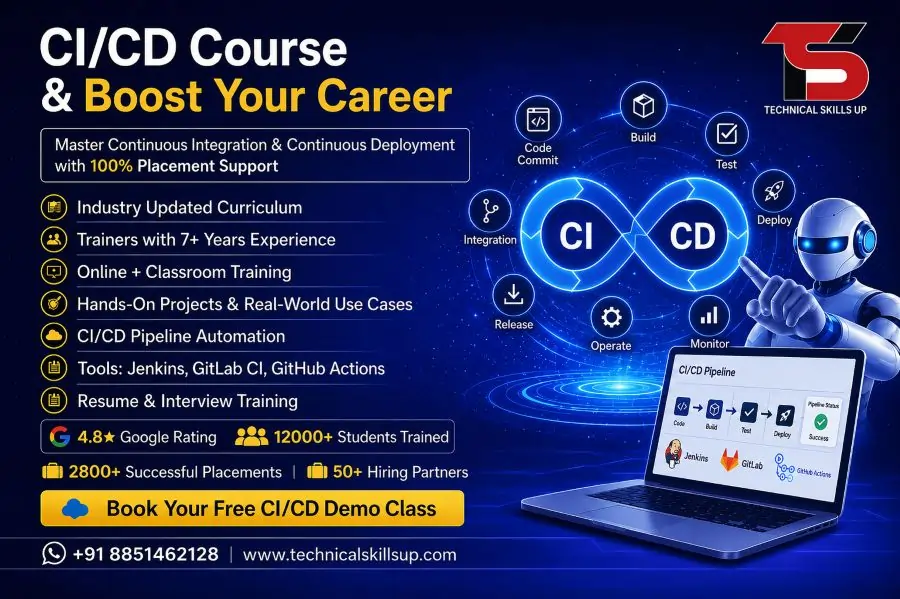
Technology teams across the world are moving toward faster software delivery, better collaboration, and automated development processes. Businesses now expect software updates to reach users quickly without compromising quality or security. Such expectations have created a strong demand for professionals who understand Continuous Integration and Continuous Deployment practices. A well-structured CI/CD Course in Delhi helps learners gain practical knowledge of automated software delivery pipelines, testing processes, deployment strategies, and DevOps practices. Technical Skills Up offers industry-focused training designed for students, IT professionals, software developers, testers, and system administrators who want to build successful careers in modern software development and DevOps environments. The course combines theoretical concepts with real-world projects, enabling learners to gain confidence in handling enterprise-level deployment workflows and automation tools used by leading organizations.
Course Overview
Continuous Integration and Continuous Deployment, commonly known as CI/CD, represent a modern software development approach that allows teams to automate code integration, testing, and deployment processes. Organizations use these practices to improve software quality, reduce development time, and ensure faster product releases.
Technical Skills Up has designed this training program to help learners understand every stage of the software delivery lifecycle. The curriculum covers foundational concepts, practical implementations, automation techniques, and industry-standard tools.
Learners receive hands-on experience through live projects, practical assignments, case studies, and guided exercises. Every module focuses on building job-ready skills that align with current industry requirements.
What You Will Learn
- Fundamentals of DevOps culture
- Continuous Integration concepts
- Continuous Deployment strategies
- Source code management
- Build automation
- Automated testing
- Pipeline creation and management
- Infrastructure automation
- Containerization concepts
- Cloud deployment practices
- Monitoring and performance tracking
- Release management techniques
Practical exposure throughout the course helps learners understand how software moves from development environments to production systems efficiently and securely.
Why CI/CD Has Become Essential in Modern Software Development
Software development has evolved significantly over the past decade. Traditional deployment methods often required manual intervention, leading to delays, errors, and increased operational costs.
Modern organizations prefer automation because it provides:
- Faster software releases
- Improved product quality
- Reduced deployment risks
- Better collaboration between teams
- Quick issue detection
- Enhanced customer satisfaction
- Consistent deployment processes
Companies adopting DevOps practices rely heavily on CI/CD pipelines to streamline software delivery. Professionals who understand these processes are highly valued across industries including finance, healthcare, e-commerce, telecommunications, education, and technology services.
Businesses need experts who can build, maintain, and optimize deployment pipelines. Such demand makes CI/CD skills a valuable addition to any technology professional’s profile.
CI/CD Training in Delhi for Career Growth
Many professionals seek practical learning opportunities to advance their careers in DevOps and automation. Quality CI/CD Training in Delhi provides structured learning paths that help learners develop both technical and practical expertise.
Training at Technical Skills Up focuses on real-world implementation rather than theoretical learning alone. Learners work on scenarios commonly encountered in professional environments.
Key benefits include:
- Industry-oriented curriculum
- Hands-on lab sessions
- Live deployment exercises
- Project-based learning
- Expert trainer guidance
- Career-focused skill development
- Exposure to enterprise tools
Working professionals can apply these concepts directly within their organizations to improve operational efficiency and deployment reliability.
Importance of CI/CD Skills in the Industry
Digital transformation has accelerated the adoption of cloud platforms, automation frameworks, and DevOps methodologies. Organizations require software updates more frequently than ever before.
Continuous delivery practices help companies:
Improve Software Quality
Automated testing catches issues early during development. Faster feedback allows teams to fix bugs before production deployment.
Accelerate Release Cycles
Automated workflows eliminate many manual processes, allowing organizations to release features more frequently.
Reduce Operational Risks
Automated deployment processes minimize human errors and create predictable release mechanisms.
Enhance Team Collaboration
Development, testing, and operations teams work together through shared workflows and automation pipelines.
Increase Business Agility
Organizations can respond quickly to customer feedback and market changes through continuous deployment practices.
Professionals with CI/CD expertise play a critical role in achieving these business objectives.
Skills Covered in the Program
Comprehensive learning helps learners gain confidence in managing deployment pipelines from start to finish.
Version Control Management
Participants learn how source code repositories function within modern development environments.
Topics include:
- Git fundamentals
- Branching strategies
- Repository management
- Merge operations
- Collaboration workflows
Build Automation
Automated builds are a critical component of CI/CD pipelines.
Learners gain experience with:
- Build configuration
- Dependency management
- Build optimization
- Error handling
- Build monitoring
Continuous Integration Practices
The course explains how developers integrate code changes continuously.
Training covers:
- Integration workflows
- Automated testing execution
- Pipeline triggers
- Quality checks
- Integration monitoring
Continuous Deployment Techniques
Modern deployment strategies reduce downtime and improve reliability.
Key concepts include:
- Automated deployments
- Deployment validation
- Rollback procedures
- Blue-green deployments
- Canary releases
Infrastructure Automation
Managing infrastructure through automation improves scalability and consistency.
Topics include:
- Infrastructure provisioning
- Configuration management
- Environment automation
- Infrastructure as Code concepts
Monitoring and Logging
Monitoring ensures application performance and operational visibility.
Learners understand:
- Log management
- Performance monitoring
- Alert configuration
- Incident detection
- System health analysis
Tools and Technologies Covered
Modern organizations use various tools to implement CI/CD workflows. Technical Skills Up provides practical exposure to widely used technologies.
Jenkins
Jenkins remains one of the most popular automation servers in DevOps environments.
Learners practice:
- Job creation
- Pipeline development
- Build automation
- Plugin management
- Deployment workflows
Git and GitHub
Source code management is a fundamental component of CI/CD pipelines.
Training includes:
- Repository creation
- Code collaboration
- Pull requests
- Branch management
- Version tracking
Docker
Containerization helps create consistent deployment environments.
Learners gain knowledge of:
- Docker architecture
- Container creation
- Image management
- Container deployment
- Multi-container environments
Kubernetes
Container orchestration is essential for modern applications.
Topics covered include:
- Cluster concepts
- Pod management
- Service deployment
- Scaling applications
- Resource management
Maven
Build automation and dependency management are important aspects of software delivery.
Participants learn:
- Project structure
- Dependency handling
- Build lifecycle
- Packaging techniques
Ansible
Automation becomes more efficient through configuration management tools.
Training includes:
- Playbook creation
- Automation workflows
- Infrastructure configuration
- Task orchestration
Cloud Platforms
Cloud environments play a significant role in deployment automation.
Exposure may include:
- Cloud deployment concepts
- Resource management
- Service integration
- Deployment pipelines
CI/CD Classes in Delhi with Practical Learning
Practical implementation remains the foundation of effective technical training. Classroom discussions alone cannot build deployment expertise.
Technical Skills Up provides practical sessions that allow learners to:
- Create CI/CD pipelines
- Configure build environments
- Deploy applications
- Manage containers
- Automate workflows
- Monitor applications
- Troubleshoot deployment issues
Real-world projects help learners understand how enterprise systems operate. Practical assignments reinforce concepts and improve confidence.
Project-Based Learning Experience
Projects may include:
- Web application deployment
- Automated testing implementation
- Multi-stage pipeline creation
- Containerized application deployment
- Infrastructure automation tasks
Hands-on practice ensures learners develop job-ready capabilities.
Career Opportunities After Completing the Course
Organizations across industries actively recruit professionals with DevOps and automation expertise.
Career opportunities include:
DevOps Engineer
Responsibilities include:
- Pipeline development
- Deployment automation
- Infrastructure management
- Monitoring implementation
CI/CD Engineer
Professionals focus on:
- Build automation
- Release management
- Pipeline optimization
- Deployment reliability
Site Reliability Engineer
Key tasks include:
- System monitoring
- Reliability improvement
- Incident management
- Automation development
Cloud Engineer
Cloud-focused professionals handle:
- Infrastructure deployment
- Resource management
- Cloud automation
- Platform optimization
Release Engineer
Responsibilities involve:
- Release planning
- Deployment coordination
- Version management
- Quality assurance processes
Automation Engineer
Automation specialists improve efficiency through automated workflows and infrastructure management.
Growing demand across industries creates numerous opportunities for skilled professionals.
Industry Demand and Future Scope
Automation continues to reshape software development and IT operations. Organizations increasingly invest in DevOps transformation initiatives to improve productivity and competitiveness.
Several trends support the growing demand for CI/CD professionals:
Rapid Cloud Adoption
Businesses continue migrating workloads to cloud platforms, increasing the need for deployment automation expertise.
DevOps Expansion
DevOps practices have become standard across many technology organizations.
Increased Software Releases
Customer expectations require frequent updates and faster feature delivery.
Digital Transformation
Organizations rely on automation to support innovation and operational efficiency.
Enterprise Automation Initiatives
Large enterprises seek professionals capable of implementing scalable automation frameworks.
Future job prospects remain strong due to continuous technological advancement and growing software development activities worldwide.
CI/CD Certification Course in Delhi for Professional Recognition
Employers value professionals who demonstrate validated technical skills. A recognized CI/CD Certification Course in Delhi helps learners showcase their knowledge and commitment to professional development.
Certification benefits include:
- Enhanced professional credibility
- Better job opportunities
- Improved resume strength
- Increased employer confidence
- Higher career growth potential
- Stronger industry recognition
Training combined with certification demonstrates practical expertise that employers seek when hiring DevOps and automation professionals.
Why Choose Technical Skills Up
Selecting the right training provider plays a major role in learning success. Technical Skills Up focuses on quality education, practical learning, and career-oriented training.
Experienced Trainers
Industry professionals guide learners through real-world scenarios and practical implementations.
Updated Curriculum
Course content reflects current industry practices, tools, and technologies.
Practical Learning Approach
Hands-on exercises help learners gain confidence through implementation.
Live Projects
Project experience provides exposure to realistic deployment environments.
Flexible Learning Options
Students and working professionals can choose learning schedules that fit their needs.
Career-Focused Training
Every module supports professional growth and employability.
Dedicated Student Support
Guidance remains available throughout the learning journey.
Industry-Relevant Skills
Training focuses on competencies demanded by modern employers.
CI/CD Training Institute in Delhi with Industry-Oriented Curriculum
Career-focused learning requires more than theoretical knowledge. A professional CI/CD Training Institute in Delhi should provide practical exposure, mentorship, and industry-relevant training.
Technical Skills Up emphasizes:
- Real deployment scenarios
- Enterprise tool exposure
- Hands-on assignments
- Practical troubleshooting
- Deployment automation exercises
- Performance optimization techniques
Learning outcomes align closely with employer expectations, helping learners become productive contributors in professional environments.
Training Methodology – Online and Practical Learning
Flexible learning options enable students and professionals to access training conveniently.
Instructor-Led Sessions
Experienced trainers explain concepts through structured lessons and demonstrations.
Practical Labs
Dedicated lab exercises allow learners to implement concepts immediately.
Live Demonstrations
Real-time demonstrations show how deployment pipelines operate in production-like environments.
Assignments and Assessments
Regular assessments help learners track progress and strengthen understanding.
Project Implementation
Projects provide valuable experience in solving real-world deployment challenges.
Online Learning Support
Virtual training options ensure accessibility regardless of location.
This blended learning model supports effective skill development and long-term retention.
Certification and Placement Support
Career support remains a key part of the learning experience at Technical Skills Up.
Placement assistance may include:
- Resume preparation guidance
- Interview preparation sessions
- Mock interviews
- Technical assessment practice
- Career counseling
- Job opportunity updates
Professional certification validates technical knowledge while placement support helps learners transition into new career opportunities.
Strong preparation increases confidence during recruitment processes and improves employability.
Learning Outcomes
Upon successful completion of the program, learners can:
- Build automated CI/CD pipelines
- Configure deployment workflows
- Manage source code repositories
- Implement automated testing
- Deploy containerized applications
- Work with DevOps tools confidently
- Monitor application performance
- Troubleshoot deployment issues
- Support cloud deployment processes
- Contribute effectively to DevOps teams
These outcomes prepare learners for real-world responsibilities within modern software development environments.
Conclusion
Modern software development depends heavily on automation, collaboration, and rapid deployment practices. Organizations seek professionals who can streamline software delivery while maintaining reliability and quality. Technical Skills Up offers comprehensive training designed to help learners build practical expertise in Continuous Integration and Continuous Deployment methodologies. Through hands-on projects, industry-relevant tools, expert guidance, and career-focused learning, students gain the skills needed to succeed in today’s competitive technology landscape. Anyone looking to strengthen DevOps knowledge, improve deployment automation skills, and explore rewarding career opportunities can benefit from this professionally designed training program and take a confident step toward long-term career growth.
FAQs:
Q1. What is a CI/CD Course?
Ans: A CI/CD course is a professional training program that teaches the complete process of Continuous Integration (CI) and Continuous Deployment (CD). This course provides practical training on tools such as Jenkins, Git, Docker, Kubernetes, GitHub Actions, and DevOps Automation, enabling students to understand modern deployment processes used in the industry.
Q2. Why should you take a CI/CD course in Delhi with placement support?
Ans: The biggest advantage of taking a CI/CD course in Delhi is the placement support. This course prepares students to build a career in the fields of DevOps and Automation.
Key benefits:
- Industry-ready skills
- Work on live projects
- Interview preparation
- Resume building support
- Placement assistance
Q3. How is Technical Skills Up’s CI/CD course different from others?
Ans: Technical Skills Up’s CI/CD course is designed by industry experts. It offers a blend of theory and hands-on practical training. Students gain experience through real-time projects and case studies, and receive placement assistance, which increases their chances of securing a job.
Q4. Who can apply for the CI/CD course?
Ans: This course is suitable for both beginners and working professionals.
Eligible candidates:
- B.Tech students
- BCA and MCA students
- Software developers
- System administrators
- DevOps enthusiasts
- IT professionals
Prior experience is not mandatory.
Q5. Which tools are taught in the CI/CD course?
Ans: The course covers modern DevOps and automation tools.
Some key tools:
- Git
- GitHub
- Jenkins
- Docker
- Kubernetes
- Maven
- Ansible
- AWS Integration
Practical usage of these tools is also taught.
Q6. What is the duration of the CI/CD course?
Ans: Typically, the duration of the CI/CD course ranges from 2 to 4 months. The duration depends on the batch type and training modules. Technical Skills Up may offer regular, weekend, and online batches, allowing students to learn at their convenience.
Q7. Does the CI/CD course include work on live projects?
Ans: Yes, students are given the opportunity to work on real-world, industry-based projects. Live projects help in understanding deployment pipelines, build automation, and continuous delivery processes, thereby providing practical experience.
Q8. What job profiles can one secure after completing the CI/CD course?
Ans: Several career options become available after completing the course.
Potential job roles:
- DevOps Engineer
- CI/CD Engineer
- Build and Release Engineer
- Cloud Engineer
- Automation Engineer
- Site Reliability Engineer (SRE)
The demand for these profiles is growing rapidly in the current IT industry.
Q9. Is programming knowledge necessary to learn CI/CD?
Ans: Basic programming knowledge is beneficial but not mandatory. At Technical Skills Up, concepts are explained in a simple manner so that even beginners can easily learn CI/CD workflows and automation processes.
Q10. What could be the starting salary after the CI/CD course?
Ans: Salary depends on the candidate’s skills, project experience, and interview performance. Freshers can typically start with an annual package of ₹4 to ₹8 lakhs, while experienced professionals can secure higher packages.
Q11. Is placement assistance provided along with the CI/CD course?
Ans: Yes, placement assistance helps students secure employment.
This includes:
- Resume Optimization
- Mock Interviews
- Technical Interview Preparation
- Job Referrals
- Career Guidance
This support boosts students’ confidence and increases their chances of selection.
Q12. Is the CI/CD course available in both online and offline modes?
Ans: Yes, many training institutes offer both online and classroom options. At Technical Skills Up, students can choose the training mode that best suits their convenience, schedule, and learning style.
Q13. What is the relationship between CI/CD and DevOps?
Ans: CI/CD is a crucial component of DevOps. DevOps fosters collaboration between software development and operations teams, whereas CI/CD accelerates and enhances the reliability of the process—from development to deployment—through automation.
Q14. Is a certification provided during the CI/CD course?
Ans: Yes, a certificate is awarded upon successful completion of the course. This certificate demonstrates your technical proficiency and strengthens your profile when applying for jobs.
Q15. How to choose the right institute for a CI/CD course in Delhi with placement?
Ans: You should consider the following factors when selecting the right institute:
- Experienced trainers
- Updated course content
- Live projects
- Placement support
- Student reviews
- Practical training environment
Choosing an institute like Technical Skills Up can help students receive quality training and access better career opportunities.