
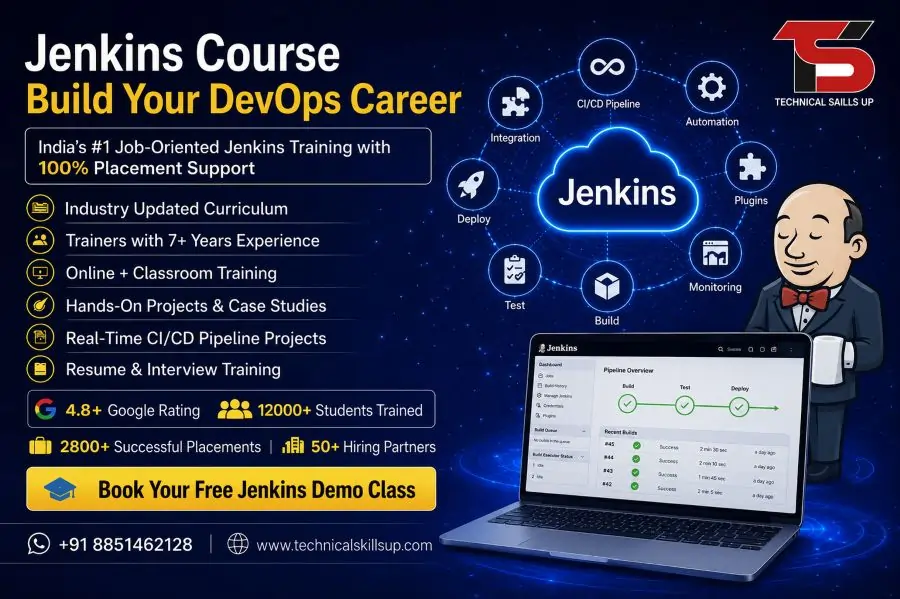
Technology teams across the world depend on automation to deliver software faster and with better quality. Modern organizations need professionals who can manage software development pipelines, automate deployment tasks, and improve collaboration between development and operations teams. Learning DevOps tools has become one of the most effective ways to build a strong career in the IT industry.
Technical Skills Up offers a comprehensive Jenkins Course in Delhi designed for students, software developers, system administrators, cloud professionals, and working IT experts who want to gain practical skills in automation and DevOps practices. The training program focuses on real-world projects, hands-on implementation, and industry-relevant concepts that help learners understand how Jenkins works in modern software development environments.
Every module has been structured to provide practical knowledge rather than only theoretical learning. Learners gain exposure to real deployment workflows, automation techniques, pipeline creation, and integration with popular development tools. Strong emphasis on practical implementation helps participants become job-ready and confident in handling enterprise-level DevOps environments.
Jenkins Training in Delhi for Modern IT Professionals
Software development has changed significantly over the last decade. Traditional development methods often resulted in slow releases, delayed updates, and communication gaps between teams. Modern organizations prefer automated workflows that enable rapid delivery and continuous improvement.
Professional DevOps tools help organizations automate repetitive tasks, reduce deployment errors, and improve software quality. Jenkins has become one of the most widely adopted automation servers because of its flexibility, scalability, and extensive plugin ecosystem.
Technical Skills Up has designed this training program to help learners understand every stage of the automation lifecycle. The curriculum covers installation, configuration, administration, pipeline creation, testing automation, deployment automation, and integration with cloud and container technologies.
Course Overview
The program starts with fundamental DevOps concepts and gradually moves toward advanced Jenkins implementation. Learners understand how continuous integration and continuous delivery improve software development processes.
Training sessions include:
- Introduction to DevOps culture
- Continuous Integration concepts
- Continuous Delivery workflows
- Jenkins architecture
- Jenkins installation and setup
- Build automation
- Pipeline creation
- Source code integration
- Automated testing
- Deployment automation
- Monitoring and maintenance
- Security best practices
- Cloud integration
- Container deployment
Practical exercises ensure learners understand each concept through implementation rather than memorization.
Importance of Jenkins in the IT Industry
Organizations today release software updates frequently. Faster release cycles require automated systems that can build, test, and deploy applications without manual intervention.
Jenkins plays a critical role in this process by acting as a central automation server. Development teams use Jenkins to automate repetitive tasks and maintain consistency throughout software delivery pipelines.
Major benefits of Jenkins include:
- Faster software releases
- Reduced deployment errors
- Improved team collaboration
- Better code quality
- Automated testing workflows
- Scalable automation infrastructure
- Support for multiple programming languages
- Integration with hundreds of development tools
Global enterprises, startups, cloud service providers, and software companies rely on Jenkins to manage DevOps workflows. Knowledge of this tool therefore creates strong career opportunities for IT professionals.
Jenkins Classes in Delhi with Practical Learning Approach
Learning DevOps requires hands-on experience. Reading concepts alone cannot prepare candidates for real industry projects.
Technical Skills Up follows a practical learning model where learners work on real scenarios and automation tasks. Every topic includes demonstrations, exercises, assignments, and project-based implementation.
Learning Through Real Projects
Participants gain exposure to industry-focused projects that simulate real development environments.
Project activities include:
- Creating automated build pipelines
- Integrating source code repositories
- Running automated test cases
- Deploying applications automatically
- Managing multiple environments
- Monitoring pipeline performance
- Handling deployment failures
- Implementing rollback strategies
Practical project work helps learners understand how organizations use Jenkins in daily operations.
Instructor-Led Training Sessions
Experienced trainers guide learners through every stage of the program. Sessions focus on concept clarity, practical implementation, troubleshooting techniques, and industry best practices.
Learners receive:
- Live demonstrations
- Practical exercises
- Case study discussions
- Assignment reviews
- Doubt-clearing sessions
- Interview preparation guidance
Strong mentorship helps participants gain confidence while working with complex automation workflows.
Skills Covered in the Program
A successful DevOps engineer requires both technical and practical expertise. The curriculum focuses on developing job-ready skills that employers actively seek.
DevOps Fundamentals
Learners understand:
- DevOps principles
- Agile development concepts
- Software development lifecycle
- Continuous integration strategies
- Continuous delivery processes
- Infrastructure automation basics
Jenkins Administration Skills
Training includes:
- Jenkins architecture
- Installation procedures
- Configuration management
- User management
- Security settings
- Plugin management
- Job scheduling
- System maintenance
Pipeline Development
Participants learn:
- Pipeline concepts
- Declarative pipelines
- Scripted pipelines
- Pipeline stages
- Build automation
- Deployment workflows
- Automated notifications
- Pipeline optimization
Source Code Management Integration
Important repository integrations covered include:
- Git repositories
- Branch management
- Version control workflows
- Webhooks configuration
- Repository monitoring
- Code synchronization
Automation Testing Integration
Testing automation modules include:
- Test execution automation
- Continuous testing
- Test reporting
- Quality assurance workflows
- Build validation processes
Deployment Automation
Students gain practical knowledge of:
- Application deployment
- Environment configuration
- Deployment pipelines
- Release management
- Rollback mechanisms
- Production deployment strategies
Tools and Technologies Covered
Modern DevOps environments involve multiple tools working together. Technical Skills Up ensures learners gain exposure to technologies commonly used alongside Jenkins.
Version Control Tools
Topics include:
- Git fundamentals
- Repository management
- Branching strategies
- Merge workflows
Build Tools
Participants work with:
- Maven
- Gradle
- Ant
Container Technologies
Training covers:
- Docker basics
- Container creation
- Container deployment
- Image management
Cloud Platforms
Learners understand integration concepts with:
- Amazon Web Services
- Microsoft Azure
- Google Cloud Platform
Monitoring Tools
Exposure includes:
- Log monitoring
- Build monitoring
- Performance tracking
- Notification systems
Configuration Management Concepts
Introduction to:
- Infrastructure automation
- Configuration consistency
- Environment management
Comprehensive exposure to these technologies helps learners understand complete DevOps ecosystems.
Jenkins Certification Course in Delhi for Career Growth
Employers increasingly prefer candidates who possess practical skills along with recognized certifications. Structured training combined with certification preparation improves professional credibility.
Technical Skills Up provides guidance that helps learners strengthen their understanding of DevOps concepts and prepare for industry-recognized certification pathways.
Benefits of certification-oriented training include:
- Enhanced professional profile
- Better interview opportunities
- Improved technical confidence
- Increased industry recognition
- Stronger career prospects
Certification preparation sessions focus on both conceptual understanding and practical implementation, helping learners perform effectively in professional environments.
Career Opportunities After Completing the Course
Demand for DevOps professionals continues to grow across industries. Organizations seek skilled professionals who can automate workflows and improve software delivery efficiency.
After completing training, learners can explore multiple career paths.
Popular Job Roles
Career opportunities include:
- DevOps Engineer
- Jenkins Administrator
- Build and Release Engineer
- Cloud Engineer
- Automation Engineer
- Site Reliability Engineer
- Infrastructure Engineer
- Continuous Integration Engineer
- Platform Engineer
- Deployment Engineer
Industries Hiring Jenkins Professionals
Several sectors actively recruit DevOps talent:
- Information Technology
- Software Development
- Cloud Computing
- E-commerce
- Banking
- Financial Services
- Healthcare Technology
- Telecommunications
- Manufacturing Technology
- Consulting Organizations
Growing digital transformation initiatives continue to create new opportunities for automation professionals.
Industry Demand and Future Scope
Businesses today depend heavily on rapid software delivery. Customers expect frequent updates, enhanced security, and uninterrupted digital experiences.
Automation tools therefore play a critical role in modern business operations. Jenkins remains one of the most trusted automation platforms used by organizations worldwide.
Why Demand Continues to Grow
Several factors contribute to increasing demand:
- Expansion of cloud computing
- Adoption of DevOps culture
- Growth of agile development
- Increased software releases
- Demand for automation
- Focus on operational efficiency
Organizations want professionals who can reduce manual effort and improve deployment speed.
Future Trends in DevOps
Industry trends indicate continued growth in:
- Cloud-native applications
- Container orchestration
- Infrastructure automation
- AI-assisted operations
- Continuous deployment
- Platform engineering
Professionals with Jenkins expertise remain valuable because automation continues to be a core component of software development strategies.
Jenkins Training Institute in Delhi with Industry-Relevant Curriculum
Choosing the right training provider plays a major role in career success. Technical Skills Up focuses on practical education, industry exposure, and learner support throughout the training journey.
The curriculum has been developed after analyzing industry requirements and employer expectations.
Key Features of the Program
Learners benefit from:
- Industry-focused syllabus
- Practical training sessions
- Real-time projects
- Expert instructors
- Flexible learning schedules
- Online training options
- Recorded session support
- Assignment-based learning
- Interview preparation assistance
- Career guidance support
Every learning module contributes to building practical expertise required in professional environments.
Why Choose Technical Skills Up
Technical Skills Up has established itself as a trusted learning platform for technology training. The organization focuses on skill development that aligns with current industry demands.
Experienced Trainers
Training is delivered by professionals who understand real industry challenges and implementation strategies.
Practical Learning Environment
Hands-on sessions help learners gain confidence through implementation rather than theory alone.
Updated Curriculum
Course content reflects current industry trends, DevOps practices, and automation requirements.
Personalized Guidance
Learners receive continuous support throughout training, assignments, projects, and career preparation activities.
Career-Oriented Approach
Every module is designed to improve employability and prepare learners for real-world responsibilities.
Flexible Learning Options
Both students and working professionals can choose schedules that fit their availability.
Online and Practical Training Methodology
Modern learners often require flexibility without compromising quality. Technical Skills Up combines instructor-led learning with practical implementation.
Live Online Sessions
Benefits include:
- Interactive learning
- Real-time instructor support
- Screen-sharing demonstrations
- Practical exercises
- Question-and-answer sessions
Hands-On Labs
Learners work directly on:
- Jenkins installation
- Pipeline creation
- Build automation
- Deployment workflows
- Cloud integrations
- Containerized environments
Project-Based Learning
Real-world projects provide practical exposure to enterprise DevOps workflows.
Project implementation helps learners:
- Understand industry expectations
- Build confidence
- Develop troubleshooting skills
- Strengthen technical expertise
Assignment and Assessment Process
Regular assessments help track learning progress and identify improvement areas.
Evaluation methods include:
- Practical assignments
- Lab exercises
- Mini projects
- Scenario-based tasks
- Technical discussions
Structured assessments ensure better learning outcomes.
Certification and Placement Support
Technical Skills Up focuses on helping learners move from training to employment successfully.
Certification Assistance
Participants receive guidance regarding:
- Certification preparation
- Exam-oriented concepts
- Practical implementation
- Industry best practices
Resume Building Support
Professional resume guidance includes:
- Project presentation
- Skill highlighting
- Technical profile optimization
- Industry-specific formatting
Interview Preparation
Preparation activities cover:
- Technical interview questions
- Scenario-based discussions
- Practical problem-solving
- Mock interviews
- HR interview guidance
Placement Assistance
Dedicated support helps learners connect with potential employment opportunities and improve job readiness.
Career support activities include:
- Job opportunity updates
- Interview scheduling assistance
- Profile evaluation
- Career counseling
- Professional guidance
Strong placement-oriented support helps learners pursue rewarding career opportunities in the DevOps domain.
Benefits of Learning Jenkins for Working Professionals
Working professionals often seek skills that can accelerate career growth and increase earning potential.
Jenkins training provides several professional advantages:
- Better understanding of DevOps practices
- Improved automation expertise
- Enhanced cloud deployment knowledge
- Stronger technical profile
- Higher career mobility
- Opportunities for role transitions
- Better salary prospects
- Increased industry relevance
Professionals from development, testing, operations, cloud computing, and system administration backgrounds can benefit significantly from acquiring Jenkins expertise.
Who Should Join This Course?
The training program is suitable for various learner categories.
Ideal participants include:
- Fresh graduates
- Software developers
- System administrators
- Technical support professionals
- QA engineers
- Cloud engineers
- IT professionals
- DevOps aspirants
- Engineering students
- Working professionals seeking career advancement
No matter the starting point, structured learning and practical exposure help learners build valuable automation skills.
Build a Future-Ready Career with Technical Skills Up
Modern organizations continue to invest heavily in automation, cloud technologies, and DevOps transformation. Professionals who understand continuous integration, automated deployment, and software delivery pipelines are becoming increasingly valuable across industries. Technical Skills Up provides comprehensive training that combines practical implementation, industry-focused projects, expert mentorship, and career-oriented guidance. Learners gain the confidence to work with real automation environments while developing skills that align with current market demands. Strong curriculum design, hands-on learning, certification support, and placement assistance make this program an excellent choice for anyone looking to establish or advance a career in DevOps. A structured learning journey today can open doors to rewarding opportunities tomorrow, helping learners become skilled professionals ready for the evolving technology landscape.
FAQs:
Q1. What is the Jenkins course, and why should one learn it?
Ans: Jenkins is an open-source automation tool used in DevOps for Continuous Integration (CI) and Continuous Delivery (CD). In this course, you learn how to automatically build, test, and deploy code.
- There is a huge demand for Jenkins in today’s IT industry because companies are shifting their focus from manual deployment to automation. Learning Jenkins makes you eligible for high-paying roles such as DevOps Engineer, Build Engineer, and Release Engineer.
Q2. What is taught in the Jenkins course in Noida?
Ans: This course provides comprehensive training on Jenkins, covering everything from beginner to advanced levels, such as:
- Jenkins installation and setup
- Creating CI/CD pipelines
- Git and GitHub integration
- Maven and Gradle integration
- Automated testing
- Jenkins integration with Docker
- Real-time projects and case studies
The training focuses primarily on practical learning to ensure students become industry-ready.
Q3. Is coding knowledge required to learn Jenkins?
Ans: Basic coding knowledge is helpful but not mandatory.
- Having basic knowledge of Java, Python, or a scripting language makes understanding Jenkins easier.
- Training is conducted using step-by-step practical examples, making it easy for beginners to learn.
Q4. What is the duration of the Jenkins course?
Ans: Course Duration:
- The duration of the Jenkins course is typically 6 to 10 weeks.
- The duration depends on the batch type and training mode (online/offline).
- Weekend batches and fast-track batches are also available, especially for working professionals.
Q5. What jobs can one get after learning Jenkins?
Ans: After learning Jenkins, you can apply for the following roles:
- DevOps Engineer
- Build and Release Engineer
- Automation Engineer
- Site Reliability Engineer (SRE)
- Cloud Engineer
These roles offer attractive salary packages and strong growth opportunities.
Q6. Is placement support provided with the Jenkins course?
Ans: Yes, training institutes like Technical Skills Up provide placement support to students. It includes:
- Resume building
- Mock interviews
- Interview preparation sessions
- Job referrals
- Guidance for the HR round
Placement depends entirely on the student’s performance and skills.
Q7. What is the relationship between Jenkins and DevOps?
Ans: Jenkins is a crucial tool in DevOps. The primary goal of DevOps is to integrate development and operations.
Jenkins automates processes such as:
- Code integration
- Testing automation
- Deployment automation
That is why Jenkins is often referred to as the backbone of DevOps.
Q8. Is the Jenkins course suitable for beginners?
Ans: Yes, this course is suitable for beginners as well.
- The training is designed to take you from the basics to an advanced level.
- Learning is made easier through real-time projects and hands-on practice.
Q9. What is a CI/CD pipeline in Jenkins?
Ans: A CI/CD pipeline is an automated process in which code is continuously integrated, tested, and deployed.
- CI (Continuous Integration): Frequently integrating code
- CD (Continuous Delivery/Deployment): Automatically deploying code
Jenkins manages this entire pipeline, making development faster and error-free.
Q10. Are Docker and Cloud also taught alongside Jenkins?
Ans: Yes, advanced Jenkins training includes Docker and Cloud integration.
You learn:
- How Jenkins works with Docker containers
- How to deploy on AWS or Azure
- How to implement CI/CD in cloud environments
These skills make you industry-ready.
Q11. What are the fees for the Jenkins course?
Ans: Course Fees
- Fees depend on the institute and the mode of training. Generally, Jenkins course fees range from ₹15,000 to ₹40,000.
- Courses offering placement support and advanced modules may have slightly higher fees.
- Many institutes also provide installment options.
Q12. Can I get freelance work after learning Jenkins?
Ans: Yes, you can take on freelance projects after learning Jenkins.
- You can work on tasks like CI/CD pipeline setup, automation scripting, and DevOps consulting.
- There is a high demand for DevOps skills on platforms like Upwork, Fiverr, and Freelancer.
Q13. What is the future scope of Jenkins?
Ans: The future of Jenkins is very strong because:
- The demand for automation is growing rapidly
- The DevOps industry is continuously expanding
- Companies are shifting from manual deployment to automated systems
Therefore, the demand for Jenkins experts will increase further in the coming years.
Q14. Why choose the Technical Skills Up Jenkins Course?
Ans: Technical Skills Up is a practical-based training institute offering:
- Industry-expert trainers
- Real-time project training
- An updated DevOps syllabus
- Placement assistance
- Interview preparation
The institute focuses on equipping students with job-ready skills.
Q15. How do I enroll in the Jenkins course?
Ans: The enrollment process is very simple:
- Make an inquiry via the institute’s website or contact number
- Attend a counseling session
- Choose a suitable batch (online/offline)
- Complete the registration
- Start the training
You can also attend a demo class before starting the training to understand the course structure.