
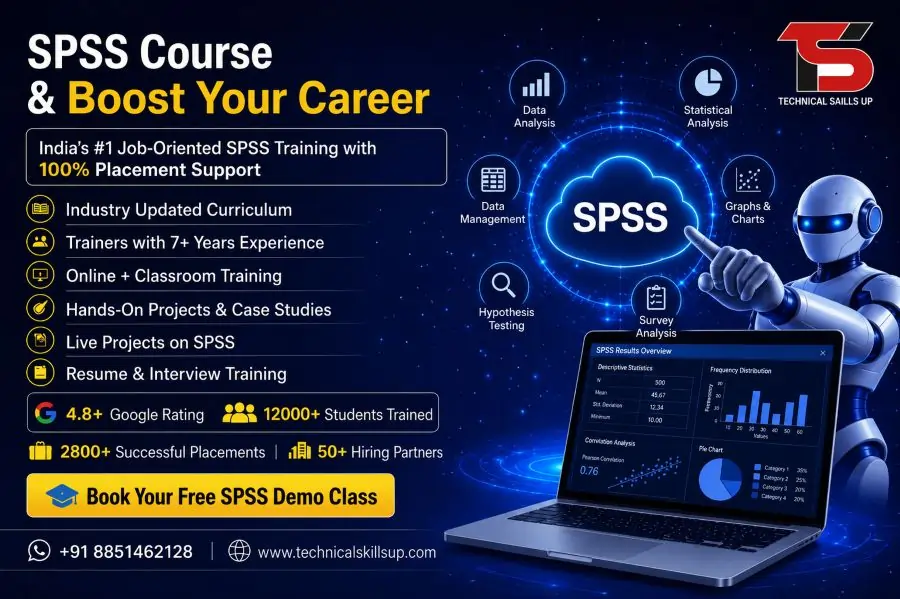
Data plays a major role in modern decision-making. Organizations across healthcare, education, banking, market research, government, retail, and information technology depend on accurate data analysis to improve performance and achieve business goals. Learning data analytics tools has become an important step for students and professionals who want to build a strong and future-ready career. A well-structured SPSS Course helps learners understand statistical analysis, data management, reporting, and research methodologies in a practical and industry-focused manner.
Technical Skills Up offers comprehensive training designed to help learners gain confidence in data analysis and statistical techniques. The program focuses on practical learning, real-world projects, and industry-relevant concepts. Whether you are a student, researcher, business analyst, healthcare professional, or working executive, this training program can help you develop valuable analytical skills that employers actively seek.
Growing demand for data-driven decision-making has increased the need for professionals who can collect, organize, analyze, and interpret information accurately. Strong knowledge of statistical tools can improve career opportunities across multiple industries. Technical Skills Up provides a learning environment where learners can gain hands-on experience and practical exposure while learning from experienced trainers.
SPSS Course Overview
Modern organizations generate large amounts of data every day. Making sense of this information requires specialized tools and analytical techniques. This training program introduces learners to the fundamentals and advanced concepts of statistical analysis using SPSS.
The curriculum has been designed to meet current industry requirements and academic standards. Every module focuses on practical implementation rather than theoretical learning alone. Learners work with datasets, perform analysis, create reports, and interpret results that can support business and research decisions.
The course is suitable for:
- College students
- University researchers
- Data analysts
- Market research professionals
- Healthcare professionals
- HR professionals
- Business executives
- Academic researchers
- Project managers
- Working professionals seeking career growth
Comprehensive learning modules help participants understand how statistical methods can be applied in real-world situations.
Why Statistical Analysis Matters in Today’s Industry
Business decisions are increasingly based on facts rather than assumptions. Organizations collect customer information, market trends, sales figures, employee performance metrics, and operational data. Proper analysis transforms raw information into actionable insights.
Statistical analysis supports organizations in:
- Identifying market trends
- Understanding customer behavior
- Improving business performance
- Reducing operational risks
- Enhancing decision-making
- Conducting research studies
- Measuring project outcomes
- Predicting future opportunities
Many industries rely heavily on data interpretation and statistical modeling. Professionals who understand analytical methods often enjoy better career prospects and higher earning potential.
Role of Data Analytics Across Industries
Several sectors use statistical tools for everyday operations:
Healthcare
Healthcare organizations use data analysis to study patient outcomes, treatment effectiveness, and disease patterns.
Education
Educational institutions analyze student performance, learning trends, and research data.
Banking and Finance
Financial organizations evaluate risk, customer behavior, and investment opportunities through statistical methods.
Market Research
Research agencies conduct surveys and analyze consumer preferences to support business strategies.
Human Resources
HR departments use workforce analytics to improve recruitment, retention, and employee performance.
SPSS Training Designed for Practical Learning
Learning becomes more effective when concepts are applied through practical exercises. Technical Skills Up emphasizes hands-on learning throughout the program.
Every module includes:
- Real-world datasets
- Practical assignments
- Case studies
- Industry examples
- Guided exercises
- Project-based learning
Practical implementation helps learners understand not only how a tool works but also why specific analytical techniques are used.
Experienced trainers explain concepts using simple language, making learning accessible even for beginners without a statistics background.
Skills Covered in the Program
A successful analytics professional requires both technical and analytical capabilities. This training program focuses on developing a balanced skill set.
Data Management Skills
Participants learn how to:
- Import data from various sources
- Clean and prepare datasets
- Handle missing values
- Organize variables
- Manage large datasets
- Transform data efficiently
Proper data preparation forms the foundation of accurate analysis.
Statistical Analysis Skills
Learners gain understanding of:
- Descriptive statistics
- Inferential statistics
- Hypothesis testing
- Correlation analysis
- Regression analysis
- Statistical significance
- Sampling methods
- Data interpretation
These concepts help professionals analyze information and draw meaningful conclusions.
Research Methodology Skills
Research projects require structured approaches to data collection and analysis.
Training includes:
- Research design
- Survey analysis
- Questionnaire evaluation
- Research reporting
- Statistical interpretation
- Result presentation
These skills are valuable for academic and professional research projects.
Reporting and Visualization Skills
Clear communication of findings is an important part of analytics.
Participants learn:
- Creating charts
- Building graphs
- Generating reports
- Presenting insights
- Data storytelling
- Visual interpretation
Effective reporting helps stakeholders understand complex information quickly.
Tools and Technologies Covered
A complete learning experience requires exposure to industry-relevant tools and techniques. Technical Skills Up provides detailed training on essential features and functionalities.
SPSS Interface and Navigation
Learners become familiar with:
- User interface
- Data editor
- Variable view
- Output viewer
- Syntax editor
- Data management options
Understanding the platform structure improves efficiency during analysis.
Data Preparation Techniques
Topics include:
- Data entry
- Variable creation
- Data coding
- Data transformation
- Sorting and filtering
- Data validation
Accurate preparation ensures reliable analytical results.
Statistical Testing Techniques
Participants learn:
- T-tests
- ANOVA
- Chi-square tests
- Correlation analysis
- Regression models
- Non-parametric tests
Knowledge of these techniques supports both academic and business research.
Advanced Analytical Methods
Advanced modules may cover:
- Predictive analytics
- Multivariate analysis
- Factor analysis
- Cluster analysis
- Reliability testing
- Advanced reporting
These capabilities help learners handle complex datasets and business scenarios.
SPSS Classes for Beginners and Professionals
Different learners have different goals. Some want academic support while others seek professional advancement. Technical Skills Up has structured learning paths that address varying skill levels.
Beginner-Friendly Learning Approach
New learners receive step-by-step guidance on:
- Statistical concepts
- Data handling
- Basic analysis
- Report creation
- Practical exercises
Simple explanations make learning comfortable for individuals with limited technical experience.
Professional-Level Training
Working professionals can strengthen existing skills through advanced modules.
Professional training focuses on:
- Business applications
- Research analytics
- Industry projects
- Advanced statistical methods
- Decision-making techniques
Practical exposure helps professionals apply concepts immediately in workplace environments.
Career Opportunities After Completing the Program
Data analysis skills create opportunities across numerous industries. Organizations actively seek professionals who can transform information into actionable insights.
Several career paths become accessible after completing training.
Data Analyst
Data analysts collect, organize, and interpret information to support business decisions.
Key responsibilities include:
- Data analysis
- Report generation
- Trend identification
- Business insights
Research Analyst
Research analysts evaluate data collected through surveys, studies, and research projects.
Responsibilities include:
- Statistical evaluation
- Survey analysis
- Research reporting
- Insight generation
Market Research Executive
Organizations rely on market research professionals to understand customer behavior and market trends.
Common duties include:
- Consumer analysis
- Survey interpretation
- Market forecasting
- Competitive analysis
Business Analyst
Business analysts use data-driven approaches to improve operational efficiency and business performance.
Typical responsibilities include:
- Requirement analysis
- Performance evaluation
- Process improvement
- Strategic recommendations
Healthcare Data Analyst
Healthcare organizations increasingly depend on data analytics for patient care and operational efficiency.
Professionals work on:
- Patient outcome analysis
- Healthcare research
- Operational reporting
- Clinical studies
Industry Demand and Future Scope
Demand for analytics professionals continues to grow worldwide. Organizations recognize the value of data-driven decision-making and actively invest in analytical capabilities.
Several factors contribute to increasing demand:
- Digital transformation initiatives
- Growing data volumes
- Research-driven strategies
- Business intelligence adoption
- Predictive analytics requirements
- Performance measurement needs
Employers seek professionals who understand both statistics and practical business applications. Learning analytical tools can significantly improve employability in competitive job markets.
Future of Data Analytics
Technology continues to generate vast amounts of information. Companies need skilled professionals who can interpret data and provide actionable recommendations.
Emerging trends include:
- Artificial intelligence integration
- Predictive modeling
- Data science expansion
- Business intelligence growth
- Research analytics advancement
- Automated reporting systems
Strong analytical capabilities will remain valuable for years to come.
Benefits of Joining an SPSS Certification Course
Professional certification demonstrates commitment to learning and skill development. Employers often prefer candidates who possess recognized training credentials.
Key benefits include:
- Validation of analytical skills
- Improved resume value
- Enhanced professional credibility
- Better interview opportunities
- Increased career confidence
- Stronger industry recognition
Certification also helps learners showcase their practical knowledge and technical competency.
Why Choose Technical Skills Up
Selecting the right training provider plays a crucial role in learning success. Technical Skills Up focuses on quality education, practical exposure, and learner support.
Several factors make the institute a preferred choice.
Experienced Trainers
Industry professionals and experienced instructors guide learners through each stage of training.
Benefits include:
- Real-world insights
- Practical examples
- Industry best practices
- Expert mentorship
Industry-Relevant Curriculum
Course content is updated to align with current industry requirements.
Training focuses on:
- Practical implementation
- Modern analytical techniques
- Research applications
- Career-oriented learning
Hands-On Learning Environment
Practical exposure helps learners build confidence and job-ready skills.
Participants gain experience through:
- Assignments
- Case studies
- Projects
- Data analysis exercises
Flexible Learning Options
Learners can choose schedules that suit their personal and professional commitments.
Flexible options support:
- Students
- Working professionals
- Researchers
- Career changers
Career-Focused Training
Every module is designed to improve employability and professional growth.
Training includes:
- Industry projects
- Resume guidance
- Interview preparation
- Career mentoring
SPSS Online Course in India for Flexible Learning
Online education has transformed professional skill development. Learners can now access quality training from anywhere without compromising learning outcomes.
Flexible online learning offers:
- Live instructor-led sessions
- Recorded lectures
- Practical assignments
- Project work
- Doubt-clearing sessions
- Interactive learning experience
Busy professionals can learn at their own pace while balancing work and personal responsibilities.
Advantages of Online Learning
Several benefits make online education highly effective:
- Location flexibility
- Time savings
- Convenient access
- Continuous support
- Recorded content availability
- Better work-study balance
Modern learning platforms create engaging experiences that support skill development and knowledge retention.
Training Methodology: Online and Practical Learning
Strong learning outcomes require a structured and practical approach. Technical Skills Up follows a methodology focused on application, engagement, and continuous improvement.
Instructor-Led Sessions
Expert trainers explain concepts through:
- Interactive lectures
- Demonstrations
- Practical examples
- Real-world applications
Project-Based Learning
Projects help learners apply theoretical concepts to realistic business scenarios.
Project work includes:
- Data preparation
- Statistical analysis
- Interpretation
- Reporting
Continuous Assessments
Regular assessments help measure progress and identify improvement areas.
Evaluation methods include:
- Assignments
- Practical exercises
- Mini projects
- Skill assessments
Personalized Support
Learning assistance remains available throughout the training journey.
Support includes:
- Doubt resolution
- Mentor guidance
- Technical assistance
- Career advice
Placement Support and Career Guidance
Learning new skills becomes more valuable when accompanied by career support. Technical Skills Up provides guidance designed to improve employment opportunities.
Placement-focused services include:
- Resume building assistance
- LinkedIn profile guidance
- Interview preparation
- Mock interviews
- Career counseling
- Job opportunity updates
Professional mentoring helps learners present their skills effectively during recruitment processes.
Interview Preparation
Candidates receive guidance on:
- Analytical concepts
- Statistical techniques
- Project discussions
- Problem-solving approaches
- Communication skills
Preparation improves confidence during interviews and professional interactions.
Learning Outcomes of the Program
After successful completion, learners will be able to:
- Manage and organize datasets
- Perform statistical analysis
- Interpret analytical results
- Create professional reports
- Apply research methodologies
- Use analytical techniques in real-world scenarios
- Support business decision-making
- Conduct survey analysis
- Build data-driven insights
- Communicate findings effectively
These outcomes help learners contribute meaningfully to research, analytics, and business functions.
Conclusion
Modern industries rely heavily on data to make informed decisions, improve efficiency, and achieve strategic goals. Strong analytical skills have become essential for students, researchers, and professionals seeking long-term career growth. Technical Skills Up provides comprehensive learning, practical exposure, expert guidance, and career-focused support that helps learners develop real-world capabilities. Through structured training, hands-on projects, industry-relevant concepts, and professional mentorship, participants gain the confidence needed to work with data effectively. Anyone looking to build expertise in statistical analysis, research methods, and business analytics can benefit from this comprehensive program and move closer to achieving their professional goals.
FAQs:
Q1. What is the SPSS Online Course in India?
Ans: The SPSS Online Course in India is a professional training program that teaches students how to use the Statistical Package for the Social Sciences (SPSS) software. The course covers data analysis, data management, reporting, and research techniques.
Q2. Who is the SPSS Online Course suitable for?
Ans: This course is suitable for students, research scholars, data analysts, market research professionals, healthcare researchers, and anyone aspiring to build a career in data analysis.
Q3. Why choose the SPSS Online Course from Technical Skills Up?
Ans: Technical Skills Up offers live training by industry experts, practical projects, recorded classes, interview preparation, and placement support, helping students secure better career opportunities.
Q4. What is the duration of the SPSS Online Course?
Ans: The course duration typically ranges from 4 to 8 weeks. The duration may vary depending on the batch, syllabus, and learning pace.
Q5. Is prior experience required for the SPSS Online Course?
Ans: No. The SPSS Online Course in India is designed for both beginners and experienced individuals. Basic computer knowledge is sufficient to learn effectively.
Q6. What topics are covered in the SPSS course?
Ans: The course covers key topics such as Data Entry, Data Cleaning, Descriptive Statistics, Hypothesis Testing, Correlation, Regression Analysis, ANOVA, Chi-Square Test, and Report Generation.
Q7. Is a certificate provided upon course completion?
Ans: Yes. Upon successful completion of the course, Technical Skills Up awards an industry-recognized certificate that you can add to your resume and LinkedIn profile.
Q8. Does the SPSS Online Course include live classes?
Ans: Yes. Students have access to live online classes, practical demos, doubt-clearing sessions, and recorded videos, allowing them to learn at their own convenience.
Q9. Is placement assistance provided with the SPSS Online Course?
Ans: Yes. Technical Skills Up provides placement assistance—such as resume building, mock interviews, career guidance, and job referrals—to enhance students’ chances of securing employment.
Q10. What job opportunities are available after learning SPSS?
Ans: After learning SPSS, one can apply for roles such as Data Analyst, Research Analyst, Market Research Executive, Statistical Analyst, Business Analyst, and Healthcare Data Analyst.
Q11. What is the fee for the SPSS online course?
Ans: Fees may vary depending on the batch, training mode, and additional features. It is best to contact the Technical Skills Up counseling team for precise fee details.
Q12. Are practical projects included in the course?
Ans: Yes. Students are assigned practical tasks and industry projects based on real-world datasets, enabling them to gain actual work experience.
Q13. In which sectors is SPSS used?
Ans: SPSS is widely used in education, healthcare, banking, market research, social science research, business analytics, and government research projects.
Q14. Can the SPSS online course be taken from home?
Ans: Yes. Since it is a fully online course, students can easily undergo training from any city in India using an internet connection.
Q15. What are the career growth prospects after completing the SPSS online course?
Ans: The demand for SPSS skills is steadily rising in the fields of data analytics and research. With the right skills and practical experience, candidates can secure better jobs, higher salaries, and opportunities for career advancement.