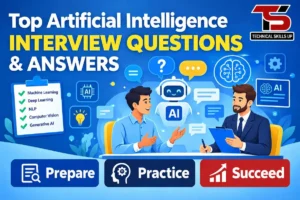
Top Artificial Intelligence Interview Questions and Answers

Top Artificial Intelligence Interview Questions and Answers

Artificial Intelligence is changing how businesses work, make decisions, and serve customers. As AI adoption grows, companies need professionals who understand AI concepts and can apply them to real-world problems. Because of this, AI-related roles are becoming an important career option for students, freshers, and working professionals. Preparing for an AI interview requires more than memorizing definitions. Interviewers often check your understanding of Artificial Intelligence, Machine Learning, Deep Learning, Generative AI, data, model evaluation, and practical problem-solving. They may also ask about projects and how you would use AI to solve a business problem. This guide covers 52 Artificial Intelligence interview questions and answers, starting with basic concepts and moving toward advanced and scenario-based questions. It can help beginners, experienced professionals, students, and job seekers prepare for technical interviews with greater confidence. How to Prepare for an Artificial Intelligence Interview Good preparation starts with strong fundamentals. Before attending an interview, make sure you understand the basic concepts and can explain them in your own words. Here are some useful preparation steps: Learn the fundamentals of Artificial Intelligence. Understand Machine Learning and its major types. Study basic Deep Learning concepts. Practice Python programming. Learn about data preprocessing and model evaluation. Understand common AI applications. Study Generative AI and Large Language Models. Build practical AI projects. Learn how to explain your projects clearly. Practice technical and scenario-based questions. Try to connect theoretical concepts with real-world examples. Interviewers usually value practical understanding more than memorized definitions. Top 52 Artificial Intelligence Interview Questions and Answers Basic Artificial Intelligence Interview Questions 1. What is Artificial Intelligence? Artificial Intelligence is a technology that enables computers and machines to perform tasks that normally require human intelligence. These tasks can include learning, reasoning, recognizing patterns, understanding language, making predictions, and solving problems. For example, recommendation systems, voice assistants, fraud detection, chatbots, and image recognition systems use AI. 2. How does Artificial Intelligence work? AI systems generally work by using data, algorithms, and computing power. A typical AI workflow includes: Collecting data Cleaning and preparing the data Selecting an appropriate algorithm or model Training the model Testing and evaluating the model Deploying the model Monitoring its performance The system learns patterns from available data and uses those patterns to produce predictions, classifications, recommendations, or other outputs. 3. What are the main goals of AI? The main goals of AI include: Solving complex problems Automating repetitive tasks Learning from data Recognizing patterns Supporting decision-making Understanding human language Perceiving images and other information Making predictions Improving efficiency The exact goal depends on the application and business problem. 4. What are the different types of Artificial Intelligence? AI is commonly discussed in terms of three levels: Narrow AI: Designed to perform a specific task. Most AI applications available today fall into this category. General AI: A theoretical form of AI that would be capable of performing a broad range of intellectual tasks similar to humans. Super AI: A hypothetical form of AI that would exceed human intelligence across many areas. Today’s practical AI systems are primarily narrow AI systems. 5. What is the difference between AI, Machine Learning, and Deep Learning? AI is the broader field of creating systems that can perform tasks associated with intelligence. Machine Learning is a subset of AI in which systems learn patterns from data instead of relying only on explicitly programmed rules. Deep Learning is a subset of Machine Learning that uses multi-layer neural networks to learn complex patterns. A simple relationship is: Artificial Intelligence → Machine Learning → Deep Learning 6. What are the main applications of AI? AI is used in many industries and applications, including: Healthcare Banking E-commerce Manufacturing Education Cybersecurity Marketing Transportation Customer service Finance Examples include fraud detection, recommendation systems, chatbots, medical image analysis, demand forecasting, and predictive maintenance. 7. What is an AI agent? An AI agent is a system that can observe its environment, process information, and take actions to achieve a particular goal. For example, a navigation system receives information about roads and traffic and recommends a route to reach a destination. An agent generally involves: Perception → Decision → Action 8. What is an intelligent agent? An intelligent agent is an agent that uses available information to make decisions and take actions toward achieving a goal. An intelligent agent may: Observe its environment Process information Evaluate possible actions Select an appropriate action Learn or improve based on experience Examples include virtual assistants, recommendation systems, and autonomous systems. 9. What is the difference between Narrow AI and General AI? Narrow AI is designed for a specific task or limited set of tasks. For example, an AI system designed to detect spam emails cannot automatically perform every other intellectual task. General AI refers to a theoretical system capable of understanding and performing a wide range of tasks at a human-like level. Narrow AI exists today, while General AI remains a research goal. 10. What are the advantages of Artificial Intelligence? Some major advantages of AI include: Automation of repetitive work Faster data analysis Improved productivity Pattern recognition Better forecasting Personalized customer experiences Reduced manual errors Support for business decisions Continuous operation However, AI also requires responsible development, quality data, human oversight, and proper security. Machine Learning and AI Interview Questions 11. What is Machine Learning? Machine Learning is a branch of AI that allows computer systems to learn patterns from data and use those patterns to make predictions or decisions. For example, a model can learn from historical customer data and predict whether a new customer is likely to purchase a product. 12. What are the main types of Machine Learning? The three commonly discussed types are: Supervised Learning: The model learns from labeled data. Unsupervised Learning: The model works with data without predefined labels to discover patterns or groups. Reinforcement Learning: An agent learns by interacting with an environment and receiving rewards or penalties. 13. What is supervised learning? Supervised learning is a Machine Learning approach where a model learns from labeled training data. For example, if

How to Learn AI from Scratch

How to Learn AI from Scratch: Step-by-Step Complete Guide

Artificial Intelligence (AI) is becoming an important part of modern technology. It is used in search engines, chatbots, recommendation systems, healthcare, finance, education, marketing, software development, and many other industries. Because of this growth, many students and professionals want to learn AI and build a career in this field. The good news is that you do not need to be an AI expert to get started. You can begin with basic computer knowledge and gradually learn programming, mathematics, data analysis, machine learning, deep learning, and Generative AI. This guide explains how to learn AI from scratch in a simple step-by-step way. It also covers the skills you need, useful tools, project ideas, common mistakes, portfolio building, and a practical six-month learning roadmap. What Is Artificial Intelligence? Artificial Intelligence is a technology that allows computers and machines to perform tasks that normally require human intelligence. These tasks can include: Understanding language Recognizing images Finding patterns in data Making predictions Answering questions Recommending products Understanding speech Generating text and images For example, when a shopping website recommends products based on your previous searches, AI may be working behind the system. Similarly, voice assistants, chatbots, fraud detection systems, face recognition, and many recommendation engines use AI technologies. Artificial Intelligence in Simple Terms Think of AI as a system that learns from information and uses that learning to produce useful results. For example, suppose you give a computer thousands of pictures of cats and dogs. With suitable training, a machine learning model can learn patterns in those images. Later, it may predict whether a new picture contains a cat or a dog. AI does not simply mean robots. It is a much wider field that includes software, algorithms, data, models, and computing systems. AI, Machine Learning, and Deep Learning These terms are related but not exactly the same. Artificial Intelligence is the broad field of making machines perform intelligent tasks. Machine Learning is a part of AI where computers learn patterns from data instead of being programmed for every individual decision. Deep Learning is a part of machine learning that uses neural networks with multiple layers. Generative AI focuses on systems that can create new content such as text, images, audio, video, and code. A simple way to understand the relationship is: AI → Machine Learning → Deep Learning Generative AI uses several modern AI techniques, including deep learning and large language models. Where Is AI Used? AI is already being used across many industries. Some common examples include: Healthcare: Medical image analysis and patient support Finance: Fraud detection and risk analysis E-commerce: Product recommendations Education: Personalized learning tools Manufacturing: Quality control and predictive maintenance Marketing: Customer analysis and content assistance Cybersecurity: Threat detection Software: Code assistance and automation Transportation: Navigation and intelligent systems This wide range of applications is one reason AI skills are becoming valuable across different careers. Can You Learn AI from Scratch Without Experience? Yes. Beginners can learn AI without previous professional experience. However, AI includes several different subjects, so trying to learn everything at once can become confusing. A structured learning path makes the process much easier. You do not need to master advanced mathematics or complex programming on your first day. Start with the basics and increase the difficulty gradually. A beginner can follow this sequence: AI Fundamentals → Python → Mathematics → Data Analysis → Machine Learning → Deep Learning → Generative AI → Projects → Portfolio Do You Need a Computer Science Degree? A computer science degree can be helpful, but it is not the only way to enter AI. Students from engineering, mathematics, statistics, science, business, commerce, marketing, and other backgrounds can learn AI if they develop the required technical skills. Your learning path may depend on your starting point. For example: A programmer may spend more time on machine learning. A mathematics student may focus more on programming. A complete beginner may first learn computer and Python basics. A working professional may prefer project-based learning. The important thing is to build skills step by step. How Long Does It Take to Learn AI? There is no fixed time because every learner has a different background. A reasonable beginner roadmap may look like this: Learning Stage Approximate Time Python Basics 3–6 weeks Mathematics Fundamentals 3–6 weeks Machine Learning 6–10 weeks Deep Learning 6–10 weeks Generative AI 3–6 weeks Projects Continuous These are only general estimates. Someone who already knows Python may progress faster, while a complete beginner may need more time. The goal should not be to finish as quickly as possible. Understanding concepts and building projects are more important. Step-by-Step AI Learning Roadmap for Beginners Step 1 – Understand AI Fundamentals Before writing complex code, understand the basic concepts of AI. Start with: What AI means What machine learning means What deep learning means What data is What an algorithm is What a model is Training and testing Features and labels Prediction Model evaluation You do not need to memorize every definition. Try to understand how the different parts work together. For example, a simple machine learning process can be understood as: Data → Preparation → Training → Model → Prediction → Evaluation Once these concepts become clear, learning technical subjects becomes easier. Step 2 – Learn Python Programming Python is one of the most commonly used programming languages in AI and machine learning. If you are completely new to programming, start with basic Python. Learn: Variables Data types Operators Conditions Loops Functions Lists Tuples Dictionaries Sets Strings File handling Error handling Basic object-oriented programming Do not try to learn every Python feature before moving forward. Learn enough Python to work with data and build AI projects. Python Libraries for AI After learning Python basics, become familiar with important libraries. NumPy helps with numerical operations and arrays. Pandas is widely used for working with structured data. Matplotlib helps create charts and visualizations. Scikit-learn provides many tools for machine learning. Later, you can explore deep learning frameworks such as TensorFlow and PyTorch. Simple Python

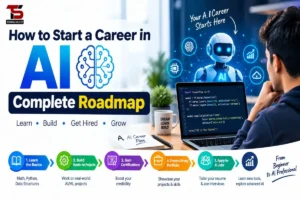
How to Start a Career in AI Complete Roadmap

How to Start a Career in AI: Complete Roadmap

Artificial Intelligence is changing the way businesses work, products are developed, and decisions are made. From chatbots and recommendation systems to self-driving technology and Generative AI, artificial intelligence is now used across many industries. This growth has created new opportunities for people who want to build technical and professional skills in AI. Starting an AI career does not mean learning every technology at once. A better approach is to follow a structured AI career roadmap that begins with fundamentals and gradually moves toward programming, Machine Learning, Deep Learning, Generative AI, and practical projects. This guide explains the major steps, skills, projects, and career options that can help beginners build a strong foundation in Artificial Intelligence. What Is Artificial Intelligence? Artificial Intelligence is a field of technology that enables computer systems to perform tasks that normally require human intelligence. These tasks can include understanding language, recognizing images, finding patterns, making predictions, and generating content. AI works through different technologies and methods. Machine Learning allows systems to learn patterns from data, while Deep Learning uses neural networks for more complex tasks. Generative AI can create text, images, code, audio, and other types of content. Common examples of AI include virtual assistants, fraud detection systems, recommendation engines, automated customer support, image recognition, and AI-powered software applications. Is AI a Good Career Choice? AI can be a strong career option for people interested in technology, programming, data, and problem-solving. Organizations across different industries are exploring AI to improve efficiency, automate repetitive tasks, understand data, and develop new products. Another advantage is that AI offers multiple career paths. A learner can move toward Machine Learning, Generative AI, Data Science, Natural Language Processing, Computer Vision, or AI application development. However, an AI career requires continuous learning. Tools and techniques change quickly, so professionals need to update their skills and gain practical experience instead of depending only on certificates. AI Career Roadmap A structured roadmap can make AI learning easier for beginners. The following steps provide a practical learning path. Step 1 – Understand AI Fundamentals Start by understanding the basic concepts before moving into advanced technologies. Learn about: Artificial Intelligence Machine Learning Deep Learning Generative AI Neural Networks AI applications Data and model basics Understanding how these technologies relate to each other will make advanced topics easier to learn. Step 2 – Learn Mathematics and Statistics You do not need to become a mathematics expert to begin learning AI. However, basic mathematical and statistical knowledge can help you understand how AI and Machine Learning models work. Important areas include: Probability Statistics Linear Algebra Basic Calculus Data interpretation Focus on practical understanding rather than memorizing formulas. Step 3 – Learn Python Python is widely used in Artificial Intelligence and Machine Learning because it has a large ecosystem of libraries and tools. Start with: Variables and data types Conditions Loops Functions Lists and dictionaries Object-oriented programming basics File handling After learning the fundamentals, explore libraries such as NumPy and Pandas for working with data. Step 4 – Learn Machine Learning Machine Learning is one of the most important areas of an AI career path. It allows computer systems to identify patterns in data and make predictions or decisions. Learn concepts such as: Supervised learning Unsupervised learning Regression Classification Clustering Feature engineering Model evaluation Overfitting and underfitting Use Python to implement basic models and understand how different algorithms behave with real datasets. Step 5 – Learn Deep Learning Deep Learning uses neural networks to solve complex problems involving large amounts of data. Important topics include: Neural networks Activation functions Model training CNN RNN Training and validation Deep learning applications Deep Learning is particularly useful in areas such as image recognition, speech processing, Natural Language Processing, and advanced AI applications. Step 6 – Learn Generative AI Generative AI has become an important part of modern AI development. It focuses on systems that can generate new content based on learned patterns. Beginners can explore: Generative AI fundamentals Large Language Models Prompt Engineering AI APIs Retrieval-Augmented Generation AI-powered applications Responsible AI use Rather than learning only how to use AI tools, try to understand how AI applications are designed and integrated into real workflows. Step 7 – Choose an AI Specialization After learning the fundamentals, choose an area that matches your career goals. Specialization Main Focus Machine Learning Predictive models and algorithms Generative AI LLMs and content generation AI Engineering Building AI-powered applications NLP Text and language processing Computer Vision Images and video Data Science Data analysis and Machine Learning You do not need to master every specialization. Developing strong skills in one area can be more useful than having limited knowledge of many technologies. Essential AI Skills to Learn A successful AI career requires both technical and professional skills. Technical Skills Important technical skills include: Python Machine Learning Deep Learning Statistics Data handling SQL Generative AI APIs Model evaluation AI tools and frameworks Professional Skills Technical knowledge alone is not enough. AI professionals also benefit from: Problem-solving Analytical thinking Communication Research skills Teamwork Business understanding Continuous learning Combining technical and professional skills can help you work more effectively on real-world AI problems. Build AI Projects Projects are one of the best ways to turn theoretical knowledge into practical experience. Beginners can start with projects such as: Chatbot Sentiment analysis House price prediction Customer churn prediction Recommendation system Image classification Sales forecasting Generative AI application Start with simple projects and gradually increase the complexity. Each project should explain the problem, data, approach, technology used, results, and possible improvements. Create an AI Portfolio A portfolio can demonstrate what you can actually build. Create a GitHub profile and organize your projects with clear documentation. A useful project presentation can follow this structure: Problem → Data → Approach → Model → Results → Application You can also maintain a professional LinkedIn profile and include selected projects, technical skills, certifications, and relevant learning experience. A strong portfolio is generally more useful when it demonstrates genuine work rather than a large collection of copied tutorial projects.

Ansible Course

Ansible Course in Delhi | Ansible Training in Delhi

Technology continues to change the way organizations manage servers, applications, cloud platforms, and IT infrastructure. Companies now prefer automation over manual processes because automation reduces errors, saves time, and improves efficiency. Modern businesses need professionals who can automate deployment, configuration management, application provisioning, and infrastructure tasks. Technical Skills Up offers an industry-focused Ansible Course in Delhi designed for students, working professionals, system administrators, cloud engineers, and DevOps enthusiasts who want to gain practical automation skills. The program combines theoretical concepts with hands-on training to help learners understand real-world automation workflows used across industries. Learning automation has become an important step for professionals who want to advance their careers in cloud computing, DevOps, infrastructure management, and software deployment. Practical exposure, project-based learning, and expert guidance help learners gain confidence while working on enterprise-level environments. Strong automation knowledge not only improves technical skills but also opens doors to exciting career opportunities in leading organizations. Through structured learning, practical assignments, and expert mentorship, learners can develop the expertise required to work confidently with modern IT infrastructure and automation platforms. Ansible Training in Delhi – Course Overview Organizations across industries use automation tools to simplify repetitive IT tasks and improve operational efficiency. Ansible has emerged as one of the most popular automation platforms because of its simplicity, flexibility, and agentless architecture. This training program has been carefully designed to help learners understand automation concepts from beginner to advanced levels. Every topic follows a step-by-step approach so that students can build a strong foundation before moving toward advanced automation scenarios. Key Highlights of the Program Instructor-led live sessions Practical lab environment Real-world automation projects Industry-relevant curriculum Cloud and DevOps integration concepts Resume preparation guidance Interview preparation support Certification assistance Placement support Flexible learning options Practical implementation remains the core focus throughout the training program. Learners work on multiple automation scenarios to understand how automation improves operational efficiency in enterprise environments. Why Automation Skills Matter in Modern IT Businesses manage hundreds or even thousands of servers, applications, and cloud resources. Manual management consumes significant time and increases the possibility of configuration errors. Automation helps organizations: Reduce operational costs Improve deployment speed Maintain consistency Increase productivity Minimize human errors Enhance infrastructure reliability Accelerate software delivery Modern DevOps practices rely heavily on automation tools. Employers actively seek professionals who can automate infrastructure and deployment processes to improve business outcomes. Growing digital transformation initiatives have increased the demand for automation specialists across industries such as banking, healthcare, e-commerce, telecommunications, education, manufacturing, and IT services. Ansible Classes in Delhi with Practical Learning Learning becomes more effective when theoretical knowledge is supported by hands-on practice. Technical Skills Up focuses heavily on practical training to ensure learners gain real implementation experience. Dedicated lab sessions allow participants to work on automation tasks that closely resemble industry environments. Every concept is demonstrated through practical examples before learners perform the same tasks independently. Practical Activities Included Server configuration automation Application deployment automation User management automation Package installation automation Infrastructure provisioning Configuration management Security automation tasks Multi-server orchestration Cloud automation exercises DevOps workflow implementation Hands-on exposure helps learners understand how automation works in real business scenarios rather than only learning theoretical concepts. Skills Covered in the Program Successful automation professionals require both technical understanding and practical implementation skills. The curriculum covers a wide range of topics to prepare learners for real-world job roles. Fundamentals of Automation Understanding automation concepts forms the foundation of successful implementation. Learners explore automation principles, benefits, workflows, and business applications. Topics include: Introduction to automation Infrastructure automation concepts Configuration management basics Automation architecture IT operations automation Enterprise automation practices Ansible Architecture A clear understanding of architecture helps learners design efficient automation workflows. Coverage includes: Control node concepts Managed node communication Inventory management SSH communication Agentless architecture Configuration files Playbooks and YAML Playbooks are the heart of automation workflows. Students learn: YAML fundamentals Playbook structure Tasks and modules Variables Conditions Loops Handlers Tags Inventory Management Efficient inventory management enables organizations to manage multiple systems easily. Topics include: Static inventory Dynamic inventory Inventory groups Host variables Group variables Environment management Advanced Automation Concepts Advanced topics help learners build enterprise-level automation solutions. Coverage includes: Roles Templates Jinja2 Vault Collections Reusable automation components Tools and Technologies Covered Modern automation environments involve multiple technologies. Learners gain exposure to tools commonly used in enterprise environments. Linux Administration Strong Linux knowledge supports automation implementation. Topics include: File management User management Package management Permissions Services Networking basics Version Control Automation projects often require collaboration and version tracking. Coverage includes: Git fundamentals Repository management Branching concepts Version control workflows Cloud Platforms Cloud automation skills are highly valuable in today’s market. Learners understand automation concepts related to: Amazon Web Services Microsoft Azure Google Cloud Platform DevOps Integration Automation plays a critical role within DevOps workflows. Topics include: Continuous Integration Continuous Deployment Infrastructure as Code Release automation Configuration management Container Technologies Modern deployment environments often use containers. Exposure includes: Docker fundamentals Container automation concepts Deployment workflows Ansible Certification Course in Delhi for Career Growth Professional certifications help validate technical skills and improve credibility in the job market. Training at Technical Skills Up prepares learners with the knowledge required to understand certification objectives and industry expectations. Certification preparation support includes: Concept revision sessions Practice exercises Mock assessments Project implementation Interview-oriented discussions Employers often value certified professionals because certifications demonstrate commitment to professional development and continuous learning. Real-World Projects Included Project-based learning helps bridge the gap between training and industry requirements. Participants work on practical projects such as: Infrastructure Automation Project Learners automate server configuration and infrastructure deployment processes. Application Deployment Project Projects focus on automating application installation and deployment across multiple servers. Configuration Management Project Students implement configuration consistency across large environments. Cloud Automation Project Practical exercises demonstrate automation workflows in cloud-based environments. Enterprise Automation Project Complex automation scenarios help learners understand enterprise implementation strategies. Project experience strengthens practical understanding and enhances resume quality. Career Opportunities After Training Automation skills are highly valued across various technology domains. Organizations actively hire professionals who can

Ansible Course

Ansible Course in Noida | Ansible Training in Noida

Technology-driven businesses need faster deployment, better automation, and reliable infrastructure management. Modern organizations are actively adopting automation tools to reduce manual work and improve operational efficiency. Professionals who understand infrastructure automation are becoming valuable assets for IT companies across the world. Technical Skills Up offers an industry-focused Ansible Course in Noida designed for students, system administrators, DevOps professionals, cloud engineers, and working professionals who want to build strong automation skills. The program combines theoretical knowledge with practical implementation to help learners understand real business requirements. Every module focuses on hands-on learning, real-time projects, and industry practices. Strong guidance from experienced trainers, practical lab sessions, and career-focused learning make this program suitable for beginners as well as experienced IT professionals seeking career growth in automation and DevOps technologies. Course Overview Automation has become a critical requirement in modern IT environments. Organizations manage hundreds or even thousands of servers, applications, and cloud resources. Manual configuration and deployment consume time and increase the chances of errors. Ansible helps organizations automate these tasks efficiently. Technical Skills Up has developed a comprehensive training program that covers the complete lifecycle of automation using Ansible. Learners gain practical knowledge of configuration management, application deployment, infrastructure provisioning, orchestration, and automation workflows. The curriculum is designed according to current industry requirements and focuses on practical implementation rather than just theoretical concepts. Real-world examples help learners understand how automation improves operational efficiency and business productivity. Key Highlights of the Program Instructor-led live training Practical lab environment Industry-oriented curriculum Real-time project implementation Hands-on automation exercises Resume building support Interview preparation sessions Certification guidance Placement assistance Flexible learning schedules Why Automation Skills Matter Today Digital transformation has changed the way businesses operate. Companies are adopting cloud platforms, microservices, containers, and DevOps practices. Automation plays a central role in managing these complex environments. Businesses seek professionals who can automate repetitive tasks, improve deployment speed, and maintain consistency across systems. Ansible has emerged as one of the most popular automation platforms because of its simplicity and agentless architecture. Knowledge of automation helps organizations: Reduce manual efforts Improve operational efficiency Minimize configuration errors Accelerate application deployment Enhance infrastructure scalability Improve security compliance Support continuous delivery processes Strong automation skills can significantly increase career opportunities in today’s technology landscape. Ansible Training in Noida for Modern IT Professionals Practical learning creates a solid foundation for success. Technical Skills Up focuses on industry-relevant training that prepares learners for real-world challenges. Every training session includes demonstrations, exercises, and hands-on implementation. Learners understand how automation works across different environments including Linux servers, cloud platforms, networking devices, and enterprise applications. Professional trainers explain complex concepts using simple examples, making learning easier for beginners and experienced professionals alike. Who Should Join This Program? The course is suitable for: System Administrators Linux Administrators Cloud Engineers DevOps Engineers Network Engineers Technical Support Professionals Software Engineers IT Graduates Computer Science Students Working Professionals seeking career growth Previous automation experience is helpful but not mandatory. Importance of Ansible in the IT Industry Organizations across industries use Ansible to automate infrastructure management and deployment processes. Its simple YAML-based syntax makes it easy to learn and implement. Many leading enterprises rely on Ansible for: Server configuration management Software deployment Cloud automation Security compliance management Application orchestration Network automation Infrastructure provisioning Growing adoption of DevOps methodologies has increased the demand for professionals with Ansible expertise. Companies prefer candidates who can automate repetitive tasks and streamline IT operations. Industry Benefits of Ansible Faster Deployment Automation reduces deployment time significantly and improves business productivity. Better Consistency Automated configurations eliminate variations between environments. Improved Reliability Repeatable automation processes reduce human errors. Cost Optimization Reduced manual effort lowers operational costs. Enhanced Scalability Organizations can manage larger infrastructures efficiently. Skills Covered in the Program Comprehensive training ensures learners gain practical expertise in all major aspects of Ansible automation. Fundamentals of Automation Learners begin with core concepts of automation and infrastructure management. Topics include: Introduction to automation Configuration management concepts Infrastructure as Code fundamentals Automation strategies DevOps integration Ansible Architecture Understanding the architecture helps learners build strong foundational knowledge. Topics include: Control node concepts Managed nodes Inventory management Agentless architecture Communication methods Installation and Configuration Practical sessions help learners set up and configure Ansible environments. Coverage includes: Linux installation Environment setup SSH configuration Inventory creation Connectivity testing Playbooks and YAML Playbooks form the foundation of Ansible automation. Topics include: YAML syntax Playbook structure Variables Conditions Loops Templates Error handling Roles and Modules Advanced automation requires modular development practices. Learners understand: Built-in modules Custom modules Role creation Role management Reusable automation code Configuration Management Hands-on exercises focus on real infrastructure scenarios. Coverage includes: Package management Service management User management File management Security configurations Advanced Automation Practical implementation of enterprise-level automation. Topics include: Dynamic inventories Automation workflows Task orchestration Performance optimization Troubleshooting techniques Tools and Technologies Covered Modern IT environments require integration between multiple platforms and technologies. Technical Skills Up provides exposure to commonly used industry tools. Linux Administration Linux serves as the primary operating system for many enterprise environments. Learners gain experience in: Linux commands File management User administration Networking basics Security management Git Version Control Version control is essential for modern automation projects. Coverage includes: Repository management Branching strategies Code collaboration Version tracking DevOps Concepts Automation works closely with DevOps practices. Topics include: CI/CD fundamentals Continuous integration Continuous deployment Infrastructure automation Cloud Platforms Cloud adoption continues to grow rapidly across industries. Learners explore: Cloud automation concepts Resource provisioning Infrastructure management Cloud deployment workflows Container Technologies Modern application deployment often involves containers. Coverage includes: Container fundamentals Container deployment Container orchestration basics Automation integration Ansible Classes in Noida with Practical Learning Theory alone cannot build technical expertise. Practical implementation remains the most important part of learning automation. Technical Skills Up provides extensive hands-on training through: Live demonstrations Guided practical sessions Lab assignments Real-world scenarios Automation projects Deployment exercises Every learner gets opportunities to work on automation tasks that mirror actual industry requirements. Project-Based Learning Approach Practical projects help students gain confidence and experience. Projects may include:

Ansible Course

Ansible Online Course in India | Ansible Certification Course

Modern IT environments require speed, consistency, and automation. Organizations across the world are adopting automation platforms to manage infrastructure, deploy applications, and reduce manual effort. Technical Skills Up brings a career-focused Ansible Course designed for students, system administrators, cloud professionals, DevOps engineers, and IT enthusiasts who want to build practical automation skills. Technology teams often manage hundreds or even thousands of servers. Manual configuration takes time and increases the risk of errors. Automation solves this challenge by helping teams perform repetitive tasks quickly and accurately. This training program provides a structured learning path that helps learners understand automation concepts and apply them in real-world environments. Every module focuses on practical knowledge, industry-relevant skills, and hands-on learning. Learners gain confidence by working on projects that reflect actual business requirements. Strong industry guidance, expert mentorship, and practical exposure make this program suitable for beginners as well as experienced professionals looking to upgrade their skills. Ansible Training for Modern IT Professionals Automation has become a critical requirement in today’s technology landscape. Companies need professionals who can automate infrastructure management, application deployment, cloud operations, and configuration management. Our Ansible Training program helps learners understand these concepts through practical examples and real-world use cases. Knowledge gained during the course can help professionals improve productivity and reduce operational complexity. Every topic is explained in a simple manner so that learners can build a strong foundation before moving to advanced concepts. Key learning benefits include: Understanding automation fundamentals Managing servers efficiently Automating repetitive administrative tasks Learning infrastructure as code concepts Deploying applications using automation Managing cloud resources effectively Improving DevOps workflows Enhancing operational efficiency Strong emphasis on practical implementation ensures that learners gain skills that can be applied immediately in professional environments. Course Overview Technical Skills Up has designed this program to match current industry expectations. Every module follows a structured approach that combines theory with hands-on practice. Course highlights include: Beginner to advanced learning path Live instructor-led sessions Real-world assignments Practical lab exercises Industry-based projects Flexible learning schedules Career guidance support Interview preparation assistance Learners receive detailed explanations of automation concepts along with practical demonstrations. Every session focuses on building job-ready skills rather than only covering theoretical topics. Who Can Join This Course? This program is suitable for: DevOps Engineers System Administrators Linux Administrators Cloud Engineers Network Engineers Software Developers IT Support Professionals Computer Science Students Fresh Graduates Technology Enthusiasts Previous automation experience is not mandatory. Basic knowledge of Linux can be helpful but is not required for starting the course. Importance of Automation in the Industry Businesses today depend heavily on digital infrastructure. Managing complex environments manually creates operational challenges and increases downtime risks. Automation helps organizations maintain consistency, improve efficiency, and reduce human errors. Organizations use automation for: Configuration management Application deployment Infrastructure provisioning Cloud management Security compliance Patch management Continuous delivery Server orchestration Growing adoption of cloud computing, DevOps practices, and digital transformation initiatives has increased the demand for professionals who understand automation technologies. Many enterprises now consider automation skills a core requirement for infrastructure and DevOps roles. Learning these skills can significantly improve career opportunities and professional growth. Skills Covered in the Program Technical Skills Up focuses on developing practical skills that employers actively seek. Every module builds upon previous concepts to create a comprehensive learning experience. Automation Fundamentals Learners begin by understanding automation principles and infrastructure management concepts. Topics include: Introduction to automation Infrastructure management Configuration management basics Automation workflows Automation architecture Automation benefits and challenges Linux Fundamentals Practical Linux knowledge supports successful automation implementation. Coverage includes: Linux commands File system management User administration Process management Networking basics Package management Inventory Management Managing infrastructure inventories forms a critical part of automation workflows. Topics include: Static inventory Dynamic inventory Inventory groups Host variables Inventory best practices Playbooks and Automation Tasks Playbooks represent the foundation of automation workflows. Learning areas include: YAML fundamentals Playbook creation Task execution Variables and facts Conditional statements Loops and iterations Error handling Roles and Reusability Efficient automation requires reusable components. Learners understand: Role structure Role creation Role dependencies Best practices Project organization Advanced Automation Concepts Professional environments require advanced automation capabilities. Coverage includes: Templates Filters Tags Handlers Vault Lookup plugins Custom modules Practical exercises help learners gain confidence while working on advanced implementations. Ansible Classes with Practical Learning Many learners struggle when training focuses only on theory. Technical Skills Up addresses this challenge through practical learning sessions. Our Ansible Classes provide hands-on exercises that simulate real business environments. Students work on: Server management tasks Infrastructure automation projects Configuration management scenarios Cloud automation exercises Deployment workflows Security implementation tasks Hands-on practice improves understanding and helps learners gain confidence while solving industry-related problems. Project-Based Learning Projects form an important part of the learning experience. Sample project areas include: Automated server provisioning Multi-server management Application deployment automation Cloud infrastructure automation Configuration standardization Environment setup automation Project work helps learners apply concepts and build a portfolio that demonstrates practical expertise. Tools and Technologies Covered Technology professionals often work with multiple platforms and tools. Training at Technical Skills Up introduces learners to technologies commonly used alongside automation solutions. Linux Environment Linux remains one of the most widely used operating systems in enterprise environments. Topics include: Ubuntu CentOS Red Hat environments Command-line operations Shell concepts Version Control Source code and automation scripts require effective version management. Coverage includes: Git fundamentals Repository management Branching concepts Collaboration workflows Cloud Platforms Cloud environments continue to expand across industries. Learners gain exposure to: Amazon Web Services concepts Microsoft Azure fundamentals Google Cloud basics Cloud automation workflows DevOps Ecosystem Modern automation often integrates with DevOps practices. Related concepts include: Continuous Integration Continuous Delivery Infrastructure as Code Deployment automation Monitoring basics Exposure to these technologies helps learners understand how automation fits into broader IT operations. Ansible Online Training Designed for Flexibility Busy professionals often need learning options that fit their schedules. Technical Skills Up offers Ansible Online Training that allows learners to study from any location. Online learning benefits include: Live interactive sessions Recorded lectures Flexible schedules Remote lab

CI CD Course

CI/CD Course in Delhi | CI/CD Training in Delhi

Technology teams across the world are moving toward faster software delivery, better collaboration, and automated development processes. Businesses now expect software updates to reach users quickly without compromising quality or security. Such expectations have created a strong demand for professionals who understand Continuous Integration and Continuous Deployment practices. A well-structured CI/CD Course in Delhi helps learners gain practical knowledge of automated software delivery pipelines, testing processes, deployment strategies, and DevOps practices. Technical Skills Up offers industry-focused training designed for students, IT professionals, software developers, testers, and system administrators who want to build successful careers in modern software development and DevOps environments. The course combines theoretical concepts with real-world projects, enabling learners to gain confidence in handling enterprise-level deployment workflows and automation tools used by leading organizations. Course Overview Continuous Integration and Continuous Deployment, commonly known as CI/CD, represent a modern software development approach that allows teams to automate code integration, testing, and deployment processes. Organizations use these practices to improve software quality, reduce development time, and ensure faster product releases. Technical Skills Up has designed this training program to help learners understand every stage of the software delivery lifecycle. The curriculum covers foundational concepts, practical implementations, automation techniques, and industry-standard tools. Learners receive hands-on experience through live projects, practical assignments, case studies, and guided exercises. Every module focuses on building job-ready skills that align with current industry requirements. What You Will Learn Fundamentals of DevOps culture Continuous Integration concepts Continuous Deployment strategies Source code management Build automation Automated testing Pipeline creation and management Infrastructure automation Containerization concepts Cloud deployment practices Monitoring and performance tracking Release management techniques Practical exposure throughout the course helps learners understand how software moves from development environments to production systems efficiently and securely. Why CI/CD Has Become Essential in Modern Software Development Software development has evolved significantly over the past decade. Traditional deployment methods often required manual intervention, leading to delays, errors, and increased operational costs. Modern organizations prefer automation because it provides: Faster software releases Improved product quality Reduced deployment risks Better collaboration between teams Quick issue detection Enhanced customer satisfaction Consistent deployment processes Companies adopting DevOps practices rely heavily on CI/CD pipelines to streamline software delivery. Professionals who understand these processes are highly valued across industries including finance, healthcare, e-commerce, telecommunications, education, and technology services. Businesses need experts who can build, maintain, and optimize deployment pipelines. Such demand makes CI/CD skills a valuable addition to any technology professional’s profile. CI/CD Training in Delhi for Career Growth Many professionals seek practical learning opportunities to advance their careers in DevOps and automation. Quality CI/CD Training in Delhi provides structured learning paths that help learners develop both technical and practical expertise. Training at Technical Skills Up focuses on real-world implementation rather than theoretical learning alone. Learners work on scenarios commonly encountered in professional environments. Key benefits include: Industry-oriented curriculum Hands-on lab sessions Live deployment exercises Project-based learning Expert trainer guidance Career-focused skill development Exposure to enterprise tools Working professionals can apply these concepts directly within their organizations to improve operational efficiency and deployment reliability. Importance of CI/CD Skills in the Industry Digital transformation has accelerated the adoption of cloud platforms, automation frameworks, and DevOps methodologies. Organizations require software updates more frequently than ever before. Continuous delivery practices help companies: Improve Software Quality Automated testing catches issues early during development. Faster feedback allows teams to fix bugs before production deployment. Accelerate Release Cycles Automated workflows eliminate many manual processes, allowing organizations to release features more frequently. Reduce Operational Risks Automated deployment processes minimize human errors and create predictable release mechanisms. Enhance Team Collaboration Development, testing, and operations teams work together through shared workflows and automation pipelines. Increase Business Agility Organizations can respond quickly to customer feedback and market changes through continuous deployment practices. Professionals with CI/CD expertise play a critical role in achieving these business objectives. Skills Covered in the Program Comprehensive learning helps learners gain confidence in managing deployment pipelines from start to finish. Version Control Management Participants learn how source code repositories function within modern development environments. Topics include: Git fundamentals Branching strategies Repository management Merge operations Collaboration workflows Build Automation Automated builds are a critical component of CI/CD pipelines. Learners gain experience with: Build configuration Dependency management Build optimization Error handling Build monitoring Continuous Integration Practices The course explains how developers integrate code changes continuously. Training covers: Integration workflows Automated testing execution Pipeline triggers Quality checks Integration monitoring Continuous Deployment Techniques Modern deployment strategies reduce downtime and improve reliability. Key concepts include: Automated deployments Deployment validation Rollback procedures Blue-green deployments Canary releases Infrastructure Automation Managing infrastructure through automation improves scalability and consistency. Topics include: Infrastructure provisioning Configuration management Environment automation Infrastructure as Code concepts Monitoring and Logging Monitoring ensures application performance and operational visibility. Learners understand: Log management Performance monitoring Alert configuration Incident detection System health analysis Tools and Technologies Covered Modern organizations use various tools to implement CI/CD workflows. Technical Skills Up provides practical exposure to widely used technologies. Jenkins Jenkins remains one of the most popular automation servers in DevOps environments. Learners practice: Job creation Pipeline development Build automation Plugin management Deployment workflows Git and GitHub Source code management is a fundamental component of CI/CD pipelines. Training includes: Repository creation Code collaboration Pull requests Branch management Version tracking Docker Containerization helps create consistent deployment environments. Learners gain knowledge of: Docker architecture Container creation Image management Container deployment Multi-container environments Kubernetes Container orchestration is essential for modern applications. Topics covered include: Cluster concepts Pod management Service deployment Scaling applications Resource management Maven Build automation and dependency management are important aspects of software delivery. Participants learn: Project structure Dependency handling Build lifecycle Packaging techniques Ansible Automation becomes more efficient through configuration management tools. Training includes: Playbook creation Automation workflows Infrastructure configuration Task orchestration Cloud Platforms Cloud environments play a significant role in deployment automation. Exposure may include: Cloud deployment concepts Resource management Service integration Deployment pipelines CI/CD Classes in Delhi with Practical Learning Practical implementation remains the foundation of effective technical training. Classroom discussions

CI CD Course

CI/CD Course in Noida | CI/CD Training in Noida

Modern software development demands speed, quality, and continuous improvement. Organizations across the world are moving toward automated development and deployment practices to deliver better applications in less time. Professionals who understand automation, continuous integration, and continuous delivery are becoming valuable assets for companies of all sizes. Technical Skills Up offers a comprehensive CI/CD Course in Noida designed to help students, software developers, DevOps engineers, testers, and IT professionals gain practical expertise in modern software delivery practices. The program focuses on real-world implementation, hands-on projects, industry-relevant tools, and practical learning experiences that prepare learners for today’s competitive technology environment. Every module is structured to provide clear understanding, practical exposure, and confidence to work on enterprise-level projects. Course Overview Continuous Integration and Continuous Delivery have transformed the software development lifecycle. Companies now rely on automated pipelines to build, test, and deploy applications quickly and efficiently. Technical Skills Up has created a structured learning path that covers both foundational and advanced concepts of CI/CD. The course combines theoretical knowledge with practical implementation so learners can understand how modern software teams operate. The training program is suitable for: Fresh graduates Software developers QA engineers System administrators DevOps professionals Cloud engineers IT support professionals Working professionals looking for career growth Learning takes place through instructor-led sessions, practical assignments, live demonstrations, and real-world case studies. CI/CD Training in Noida for Modern Software Development Software organizations constantly look for ways to reduce deployment errors, improve code quality, and release updates faster. Continuous Integration and Continuous Delivery provide a solution by automating repetitive tasks and ensuring consistent software releases. Professional learning helps participants understand: Automated build processes Code integration strategies Version control management Testing automation Deployment automation Infrastructure automation Monitoring and reporting Release management Practical exposure helps learners understand how development and operations teams collaborate to deliver high-quality applications. Why Continuous Integration and Continuous Delivery Matter Modern businesses depend on software applications for daily operations. Delays in software delivery can affect customer satisfaction and business growth. Continuous Integration helps developers merge code frequently into a shared repository. Automated testing verifies the code before deployment. Continuous Delivery ensures software remains deployable at all times. Automated deployment pipelines reduce manual effort and increase reliability. Key benefits include: Faster software releases Improved collaboration Reduced deployment risks Better software quality Enhanced customer experience Faster bug detection Increased productivity Lower operational costs Organizations adopting CI/CD practices often experience significant improvements in efficiency and software reliability. CI/CD Classes in Noida Designed for Practical Learning Learning technical concepts becomes easier when students work on real projects. Technical Skills Up emphasizes practical implementation throughout the training journey. Hands-on sessions include: Creating automated pipelines Managing repositories Configuring build tools Implementing automated testing Deploying applications Monitoring application performance Managing release workflows Troubleshooting deployment issues Every learner receives practical exercises that mirror real industry scenarios. This approach helps build confidence and job-ready skills. Importance of CI/CD Skills in the IT Industry Technology companies continuously seek professionals who can streamline development processes and improve deployment efficiency. Organizations working in: Software development Cloud computing Banking Healthcare E-commerce Telecommunications Manufacturing Education technology all require skilled professionals capable of managing automated software delivery pipelines. Growing digital transformation initiatives have increased the need for DevOps and automation specialists worldwide. Knowledge of CI/CD practices helps professionals stand out in a competitive job market. Skills Covered in the Program Technical Skills Up focuses on developing practical and industry-relevant competencies. Version Control Management Participants learn how to manage source code using modern version control systems. Topics include: Repository management Branching strategies Code merging Conflict resolution Collaboration workflows Build Automation Build automation helps streamline application compilation and packaging processes. Students learn: Automated builds Dependency management Build configuration Build optimization Artifact generation Continuous Integration Strong integration practices improve code quality and team collaboration. Key concepts covered: Code integration workflows Automated validation Build triggers Integration pipelines Quality checks Continuous Delivery Deployment automation enables rapid software releases. Learning areas include: Deployment strategies Release pipelines Environment management Rollback mechanisms Deployment monitoring Automated Testing Testing automation plays a critical role in modern software delivery. Topics include: Unit testing Integration testing Functional testing Test automation frameworks Test reporting Monitoring and Logging Application monitoring helps maintain performance and reliability. Students learn: Monitoring tools Log analysis Performance tracking Alert management Incident response Tools and Technologies Covered Practical exposure to industry-standard tools increases employability and technical confidence. Git Git is widely used for version control and collaborative development. Key learning outcomes: Repository creation Commit management Branch operations Collaboration workflows Code tracking GitHub Students learn how to manage repositories and collaborate on projects through GitHub. Topics include: Repository hosting Pull requests Code reviews Workflow automation Team collaboration Jenkins Jenkins remains one of the most popular automation servers used in CI/CD environments. Training covers: Jenkins installation Pipeline creation Job configuration Build automation Deployment integration Docker Containerization has become an essential part of modern application deployment. Key areas include: Container creation Docker images Docker networking Container orchestration basics Application packaging Kubernetes Container orchestration skills are highly valued across industries. Topics covered: Kubernetes architecture Cluster management Deployment strategies Scaling applications Resource management Maven Build management tools help automate software development workflows. Learning includes: Project management Dependency handling Build lifecycle Packaging Deployment preparation SonarQube Code quality analysis improves software maintainability. Students learn: Code inspection Quality gates Security analysis Bug detection Reporting Ansible Infrastructure automation simplifies system administration tasks. Key concepts include: Playbooks Configuration management Automation workflows Server provisioning Deployment automation Cloud Integration Concepts Modern CI/CD pipelines often integrate with cloud environments. Topics include: Cloud deployment basics Infrastructure management Automation strategies Cloud-native workflows Scalability concepts CI/CD Certification Course in Noida with Industry-Relevant Curriculum A well-designed curriculum helps learners acquire practical skills that employers value. Technical Skills Up updates the course structure regularly to align with industry trends and technology advancements. Major learning modules include: DevOps fundamentals Version control systems Build automation Continuous Integration pipelines Continuous Delivery pipelines Containerization Infrastructure automation Monitoring practices Security considerations Project implementation Project-based learning ensures every concept is reinforced through practical application. Real-World Project Experience Practical projects help

CI CD Course

CI/CD Online Course in India | CI/CD Certification Course

Modern software development depends on speed, quality, and automation. Organizations want applications to reach users faster without compromising performance or reliability. Growing demand for automated deployment pipelines has created excellent opportunities for professionals who understand modern development workflows. A well-structured CI/CD Course helps learners gain practical knowledge of software automation, deployment strategies, testing workflows, and DevOps practices used by leading companies worldwide. Technical Skills Up offers industry-focused learning designed for students, software developers, IT professionals, system administrators, and technology enthusiasts. Practical projects, expert guidance, and hands-on exercises help learners understand how continuous integration and continuous delivery work in real business environments. Every module focuses on job-ready skills that can be applied immediately in professional projects. Course Overview Software teams release updates more frequently than ever before. Manual processes often create delays, increase errors, and reduce productivity. Continuous Integration and Continuous Delivery solve these challenges through automation, testing, and streamlined deployment workflows. This program is designed to help learners understand the complete software delivery lifecycle. Training begins with fundamental concepts and gradually moves toward advanced deployment strategies, automation techniques, cloud integration, and production-ready pipelines. The curriculum focuses on practical implementation rather than theoretical knowledge alone. Learners build automated pipelines, configure testing frameworks, integrate source code repositories, and deploy applications using industry-standard tools. Who Should Join This Program? This training program is suitable for: Software Developers DevOps Engineers System Administrators Cloud Engineers Site Reliability Engineers IT Support Professionals Engineering Students Computer Science Graduates Project Managers involved in software delivery Professionals planning a DevOps career Strong programming expertise is not mandatory for beginners. Basic knowledge of software development and operating systems can help learners progress faster. Why CI/CD Matters in Modern Software Development Technology companies compete on speed, innovation, and customer experience. Faster release cycles allow businesses to deliver new features quickly while maintaining application stability. Continuous Integration enables developers to merge code changes frequently into a shared repository. Automated testing validates code quality and reduces integration problems. Continuous Delivery ensures that applications remain deployment-ready at all times. Automated workflows minimize manual effort and increase reliability across environments. Organizations implementing these practices often experience: Faster software releases Reduced deployment failures Improved application quality Better collaboration between teams Increased operational efficiency Enhanced customer satisfaction Faster bug detection and resolution Improved scalability Global technology leaders rely heavily on CI/CD pipelines to maintain competitive advantages in rapidly changing markets. Understanding the Role of CI/CD Training Career-focused CI/CD Training helps learners develop practical expertise in automation and deployment workflows. Organizations prefer professionals who can design, implement, monitor, and optimize delivery pipelines. Knowledge gained through structured training helps professionals: Reduce software deployment risks Automate repetitive tasks Improve release consistency Enhance development efficiency Support cloud-native applications Manage infrastructure automation Collaborate effectively with development teams Practical exposure creates confidence when working on enterprise-level software projects. Skills Covered in the Program Success in DevOps requires a combination of technical knowledge, automation expertise, problem-solving ability, and operational understanding. This program covers all major skill areas required in modern software environments. Version Control Management Learners understand how source code management supports collaboration among development teams. Topics include: Repository management Branching strategies Code merging Pull requests Conflict resolution Release management Build Automation Modern software development relies on automated build processes. Key concepts include: Build lifecycle Dependency management Automated packaging Build optimization Artifact generation Continuous Integration Practices Practical exercises focus on: Automated code integration Source control integration Build triggers Automated testing Pipeline configuration Build monitoring Automated Testing Quality assurance remains a critical component of software delivery. Coverage includes: Unit testing Integration testing Functional testing Regression testing Test automation strategies Test reporting Deployment Automation Deployment workflows are explored in detail. Learners work on: Environment configuration Automated deployments Rollback strategies Release management Production deployment techniques Monitoring and Logging Real-world applications require constant monitoring. Topics include: Log management Application monitoring Performance tracking Alert configuration Incident management Infrastructure Concepts Understanding infrastructure helps DevOps professionals manage scalable environments. Key areas include: Server management Virtualization Infrastructure automation Configuration management Cloud infrastructure basics Tools and Technologies Covered Industry-relevant tools play a major role in practical learning. Technical Skills Up focuses on technologies widely used across global organizations. Source Code Management Tools Git GitHub GitLab Bitbucket Build Tools Maven Gradle Ant Automation Servers Jenkins GitLab CI GitHub Actions Containerization Platforms Docker Docker Compose Orchestration Technologies Kubernetes Helm Cloud Platforms Amazon Web Services (AWS) Microsoft Azure Google Cloud Platform Monitoring Tools Prometheus Grafana ELK Stack Testing Frameworks JUnit Selenium TestNG Practical exercises ensure learners understand how these technologies interact within a complete DevOps ecosystem. Hands-On CI/CD Classes for Practical Learning Employers value practical experience more than theoretical understanding. Structured CI/CD Classes focus heavily on implementation, troubleshooting, and real-world projects. Learning activities include: Pipeline creation Application deployment Docker container management Jenkins automation Cloud deployment exercises Repository integration Monitoring setup Deployment troubleshooting Every major concept is reinforced through guided practice sessions. Real-Time Project Experience Projects help learners understand industry workflows. Examples include: Web application deployment Automated testing pipelines Cloud-based deployment systems Containerized application delivery Multi-stage deployment environments Project-based learning improves confidence and technical decision-making skills. Benefits of Learning Through CI/CD Online Training Flexibility has become essential for modern learners. Professional commitments, academic schedules, and personal responsibilities often make classroom learning difficult. Comprehensive CI/CD Online Training provides: Flexible learning schedules Live instructor-led sessions Recorded classes Practical assignments Interactive doubt-solving sessions Project-based learning Industry-relevant curriculum Online learning allows professionals from different locations to access quality education without relocation or travel expenses. Interactive Learning Environment Students participate in: Live demonstrations Guided labs Group discussions Project reviews Technical workshops Performance assessments Engagement remains high throughout the learning journey. Career Opportunities After Completing the Program Demand for DevOps professionals continues to grow across industries. Companies seek candidates who can improve software delivery speed while maintaining quality standards. Popular job roles include: DevOps Engineer Responsibilities include: Pipeline creation Deployment automation Infrastructure management Monitoring implementation CI/CD Engineer Key tasks include: Build automation Release management Pipeline optimization Deployment orchestration Cloud Engineer Responsibilities focus on: Cloud deployment Infrastructure automation Resource management Security implementation Site

Jenkins Course

Jenkins Course in Delhi | Jenkins Training in Delhi

Technology teams across the world depend on automation to deliver software faster and with better quality. Modern organizations need professionals who can manage software development pipelines, automate deployment tasks, and improve collaboration between development and operations teams. Learning DevOps tools has become one of the most effective ways to build a strong career in the IT industry. Technical Skills Up offers a comprehensive Jenkins Course in Delhi designed for students, software developers, system administrators, cloud professionals, and working IT experts who want to gain practical skills in automation and DevOps practices. The training program focuses on real-world projects, hands-on implementation, and industry-relevant concepts that help learners understand how Jenkins works in modern software development environments. Every module has been structured to provide practical knowledge rather than only theoretical learning. Learners gain exposure to real deployment workflows, automation techniques, pipeline creation, and integration with popular development tools. Strong emphasis on practical implementation helps participants become job-ready and confident in handling enterprise-level DevOps environments. Jenkins Training in Delhi for Modern IT Professionals Software development has changed significantly over the last decade. Traditional development methods often resulted in slow releases, delayed updates, and communication gaps between teams. Modern organizations prefer automated workflows that enable rapid delivery and continuous improvement. Professional DevOps tools help organizations automate repetitive tasks, reduce deployment errors, and improve software quality. Jenkins has become one of the most widely adopted automation servers because of its flexibility, scalability, and extensive plugin ecosystem. Technical Skills Up has designed this training program to help learners understand every stage of the automation lifecycle. The curriculum covers installation, configuration, administration, pipeline creation, testing automation, deployment automation, and integration with cloud and container technologies. Course Overview The program starts with fundamental DevOps concepts and gradually moves toward advanced Jenkins implementation. Learners understand how continuous integration and continuous delivery improve software development processes. Training sessions include: Introduction to DevOps culture Continuous Integration concepts Continuous Delivery workflows Jenkins architecture Jenkins installation and setup Build automation Pipeline creation Source code integration Automated testing Deployment automation Monitoring and maintenance Security best practices Cloud integration Container deployment Practical exercises ensure learners understand each concept through implementation rather than memorization. Importance of Jenkins in the IT Industry Organizations today release software updates frequently. Faster release cycles require automated systems that can build, test, and deploy applications without manual intervention. Jenkins plays a critical role in this process by acting as a central automation server. Development teams use Jenkins to automate repetitive tasks and maintain consistency throughout software delivery pipelines. Major benefits of Jenkins include: Faster software releases Reduced deployment errors Improved team collaboration Better code quality Automated testing workflows Scalable automation infrastructure Support for multiple programming languages Integration with hundreds of development tools Global enterprises, startups, cloud service providers, and software companies rely on Jenkins to manage DevOps workflows. Knowledge of this tool therefore creates strong career opportunities for IT professionals. Jenkins Classes in Delhi with Practical Learning Approach Learning DevOps requires hands-on experience. Reading concepts alone cannot prepare candidates for real industry projects. Technical Skills Up follows a practical learning model where learners work on real scenarios and automation tasks. Every topic includes demonstrations, exercises, assignments, and project-based implementation. Learning Through Real Projects Participants gain exposure to industry-focused projects that simulate real development environments. Project activities include: Creating automated build pipelines Integrating source code repositories Running automated test cases Deploying applications automatically Managing multiple environments Monitoring pipeline performance Handling deployment failures Implementing rollback strategies Practical project work helps learners understand how organizations use Jenkins in daily operations. Instructor-Led Training Sessions Experienced trainers guide learners through every stage of the program. Sessions focus on concept clarity, practical implementation, troubleshooting techniques, and industry best practices. Learners receive: Live demonstrations Practical exercises Case study discussions Assignment reviews Doubt-clearing sessions Interview preparation guidance Strong mentorship helps participants gain confidence while working with complex automation workflows. Skills Covered in the Program A successful DevOps engineer requires both technical and practical expertise. The curriculum focuses on developing job-ready skills that employers actively seek. DevOps Fundamentals Learners understand: DevOps principles Agile development concepts Software development lifecycle Continuous integration strategies Continuous delivery processes Infrastructure automation basics Jenkins Administration Skills Training includes: Jenkins architecture Installation procedures Configuration management User management Security settings Plugin management Job scheduling System maintenance Pipeline Development Participants learn: Pipeline concepts Declarative pipelines Scripted pipelines Pipeline stages Build automation Deployment workflows Automated notifications Pipeline optimization Source Code Management Integration Important repository integrations covered include: Git repositories Branch management Version control workflows Webhooks configuration Repository monitoring Code synchronization Automation Testing Integration Testing automation modules include: Test execution automation Continuous testing Test reporting Quality assurance workflows Build validation processes Deployment Automation Students gain practical knowledge of: Application deployment Environment configuration Deployment pipelines Release management Rollback mechanisms Production deployment strategies Tools and Technologies Covered Modern DevOps environments involve multiple tools working together. Technical Skills Up ensures learners gain exposure to technologies commonly used alongside Jenkins. Version Control Tools Topics include: Git fundamentals Repository management Branching strategies Merge workflows Build Tools Participants work with: Maven Gradle Ant Container Technologies Training covers: Docker basics Container creation Container deployment Image management Cloud Platforms Learners understand integration concepts with: Amazon Web Services Microsoft Azure Google Cloud Platform Monitoring Tools Exposure includes: Log monitoring Build monitoring Performance tracking Notification systems Configuration Management Concepts Introduction to: Infrastructure automation Configuration consistency Environment management Comprehensive exposure to these technologies helps learners understand complete DevOps ecosystems. Jenkins Certification Course in Delhi for Career Growth Employers increasingly prefer candidates who possess practical skills along with recognized certifications. Structured training combined with certification preparation improves professional credibility. Technical Skills Up provides guidance that helps learners strengthen their understanding of DevOps concepts and prepare for industry-recognized certification pathways. Benefits of certification-oriented training include: Enhanced professional profile Better interview opportunities Improved technical confidence Increased industry recognition Stronger career prospects Certification preparation sessions focus on both conceptual understanding and practical implementation, helping learners perform effectively in professional environments. Career Opportunities After Completing the Course Demand for DevOps professionals continues to grow across industries.

Jenkins Course

Jenkins Course in Noida | Jenkins Training in Noida

Modern software development has become faster, more automated, and highly dependent on continuous integration and continuous delivery practices. Organizations today expect developers and DevOps engineers to deliver code quickly without compromising quality or stability. Automation tools like Jenkins play a major role in achieving this goal by streamlining build, test, and deployment processes. A structured learning path such as the Jenkins Course in Noida offered by Technical Skills Up helps learners gain practical knowledge of CI/CD pipelines, automation workflows, and real-world DevOps practices that are widely used across IT companies. This training program is designed for beginners, IT professionals, and working developers who want to upgrade their skills in automation and DevOps. Learners gain hands-on exposure to real projects, industry-based scenarios, and tool integrations that reflect current job requirements. The course focuses on building strong fundamentals along with advanced Jenkins concepts, ensuring that students are prepared for real industry challenges and interviews. Course Overview The Jenkins training program at Technical Skills Up is structured to provide a complete understanding of continuous integration and continuous delivery pipelines. The learning journey starts with basic DevOps concepts and gradually moves toward advanced Jenkins automation workflows used in production environments. The Jenkins Training in Noida program focuses on practical implementation rather than just theoretical knowledge. Students work on real-time projects that simulate enterprise-level environments. This approach helps learners understand how software builds, testing, and deployments are managed in modern IT organizations. Key learning stages include: Introduction to DevOps and CI/CD principles Jenkins installation and configuration Creating and managing build pipelines Integration with version control systems like Git Automated testing and deployment workflows Advanced pipeline scripting and job automation Each module is carefully designed to ensure learners gain both conceptual clarity and technical confidence. Importance of the Course in Industry Automation has become a core requirement in modern software development lifecycles. Companies are increasingly adopting DevOps practices to reduce manual efforts and increase deployment speed. Jenkins stands out as one of the most widely used automation servers in the industry. Professionals trained through structured Jenkins Classes in Noida gain a competitive advantage in the job market because they understand how real-world CI/CD pipelines function. Businesses rely on skilled DevOps engineers to maintain continuous integration systems that ensure faster releases and improved product quality. The importance of Jenkins knowledge can be understood through its industry applications: Faster software delivery cycles Reduced manual errors in deployment Improved collaboration between development and operations teams Continuous testing and monitoring of applications Efficient handling of large-scale cloud-based systems Organizations prefer candidates who can manage automation tools effectively, making this course highly valuable for career growth. Skills Covered in the Program The Jenkins certification program focuses on building both foundational and advanced technical skills. Students gain a deep understanding of automation processes and real-world deployment pipelines. Core skills developed during training include: Continuous Integration and Continuous Delivery concepts Jenkins job creation and pipeline configuration Scripted and declarative pipeline development Build automation and scheduling Source code management integration Error handling and debugging in pipelines Plugin management and system configuration Deployment automation strategies Along with technical skills, learners also develop problem-solving abilities and workflow optimization techniques that are essential for DevOps roles. Practical assignments ensure that every learner applies concepts in real-time scenarios, which strengthens understanding and boosts confidence. Tools and Technologies Covered A strong DevOps professional must be familiar with multiple tools used in modern development environments. The Jenkins Training Institute in Noida program integrates several essential technologies to prepare learners for industry demands. Tools covered during training include: Jenkins for automation and CI/CD pipelines Git and GitHub for version control Docker for containerization Maven for build automation Kubernetes for container orchestration basics Linux commands for server management AWS basics for cloud deployment integration Selenium for automated testing integration Exposure to these tools ensures that learners understand how different technologies work together in a real DevOps ecosystem. Practical labs and guided projects help students gain hands-on experience with each tool. Career Opportunities A strong demand exists for professionals skilled in Jenkins and DevOps automation. Companies across IT services, product development, and cloud computing sectors actively hire candidates with CI/CD expertise. After completing the course, learners can explore various job roles such as: DevOps Engineer Build and Release Engineer Automation Engineer Software Configuration Manager Cloud DevOps Associate CI/CD Pipeline Developer These roles are available in startups, multinational companies, and cloud-based organizations. Salary packages often depend on experience, but even entry-level professionals with Jenkins skills can secure attractive opportunities. Career growth becomes faster when learners combine Jenkins knowledge with cloud platforms and containerization tools. The demand for automation experts continues to grow as companies move toward digital transformation. Industry Demand and Future Scope The future of software development is heavily driven by automation and cloud technologies. Jenkins remains a key tool in the DevOps ecosystem due to its flexibility, open-source nature, and strong community support. Industry trends show that organizations are increasingly adopting: Cloud-native development practices Automated deployment pipelines Microservices architecture Continuous monitoring systems Scalable container-based environments Professionals trained in Jenkins Training in Noida are better prepared for these evolving industry requirements. Companies prefer candidates who understand both development and deployment processes, making DevOps expertise highly valuable. Future scope of Jenkins expertise includes: Advanced DevOps engineering roles Cloud architecture positions Automation consulting opportunities Site reliability engineering roles Tech lead positions in DevOps teams Continuous learning and tool adaptation further enhance long-term career stability in this domain. Why Choose Technical Skills Up Technical Skills Up is committed to providing high-quality technical education with a strong focus on practical learning and industry readiness. The training approach is designed to bridge the gap between academic knowledge and real-world job requirements. Reasons to choose this institute include: Industry-experienced trainers with real project exposure Structured curriculum aligned with current DevOps practices Hands-on lab sessions for better understanding Real-time project implementation Personalized doubt-solving support Updated course content based on industry trends The Jenkins Course in Noida offered by Technical Skills Up is designed to ensure learners gain job-ready skills

Jenkins Course

Jenkins Online Course in India with Placement

A modern software development environment demands speed, automation, and reliability to deliver high-quality applications. Continuous integration and continuous delivery have become essential practices for every IT organization aiming for faster release cycles and improved software quality. A well-structured Jenkins Course from Technical Skills Up helps learners build strong DevOps automation skills that are highly valued in today’s tech industry. This training is designed for students, fresh graduates, and working professionals who want to upgrade their career in DevOps and automation engineering. With a practical learning approach, the program focuses on real-world implementation rather than just theory, making learners job-ready for industry requirements. Course Overview of Jenkins Training Program A structured DevOps learning path begins with understanding automation principles and how modern CI/CD pipelines function. The Jenkins Training program at Technical Skills Up is designed to provide deep knowledge of build automation, continuous integration, and deployment workflows. Learning starts with the fundamentals of Jenkins architecture and gradually moves toward advanced pipeline creation and integration with DevOps tools. Each concept is explained with real-time examples so learners can understand how automation works in live projects. This Jenkins Online Training program is suitable for beginners as well as professionals who want to strengthen their DevOps skills. The course ensures learners gain hands-on experience in creating pipelines, managing builds, and automating deployments across environments. Key learning highlights include: Understanding CI/CD lifecycle in real-world projects Setting up Jenkins on different environments Creating automated build pipelines Integrating source code repositories like Git Managing plugins and system configurations Working on real-time DevOps scenarios The learning approach ensures strong practical exposure, making this Jenkins Online Course in India a complete solution for career growth in DevOps. Importance of Jenkins Course in the IT Industry Modern software companies rely heavily on automation to reduce manual errors and improve deployment speed. Continuous integration tools play a critical role in ensuring that code changes are tested and deployed efficiently. A structured Jenkins Certification Course helps professionals understand how automation fits into software development pipelines. Organizations prefer candidates who can manage CI/CD tools effectively because it improves productivity and reduces deployment risks. Companies working in cloud computing, fintech, e-commerce, and SaaS platforms actively use Jenkins for: Automating software builds Running test cases continuously Managing deployment pipelines Improving collaboration between development and operations teams Strong expertise in Jenkins Training gives learners a competitive advantage in DevOps roles. It also helps organizations achieve faster product delivery cycles with higher stability. Skills Covered in Jenkins Training Program A strong DevOps foundation requires practical skills that can be applied directly in real-world environments. The Jenkins Classes at Technical Skills Up focus on developing both technical and analytical skills required for automation engineering roles. Key skills developed during the program include: CI/CD pipeline creation and management Automated build and deployment processes Git and version control integration Jenkins job configuration and monitoring Script-based pipeline development Error handling and debugging in pipelines Plugin installation and system customization Multi-branch pipeline setup and execution Integration with cloud and container tools Hands-on practice ensures learners gain confidence in handling real-time DevOps workflows. Each topic is designed to build logical thinking and automation expertise step by step. Tools and Technologies Covered in Jenkins Online Training Modern DevOps environments rely on multiple tools working together. This training introduces learners to essential technologies used in automation and continuous delivery pipelines. Tools covered in this program include: Jenkins automation server Git and GitHub for version control Maven for build automation Docker for containerization basics Linux command line for server management AWS cloud fundamentals for deployment Selenium basics for automated testing integration Kubernetes introduction for orchestration concepts Practical exposure to these tools helps learners understand how Jenkins integrates with the DevOps ecosystem. Working with these technologies prepares students for industry-level challenges and real-time project scenarios. Career Opportunities After Jenkins Certification Course DevOps skills are among the most in-demand technical skills in the IT industry. Completing a Jenkins Certification Course opens multiple career paths in software development and IT operations. Popular job roles include: DevOps Engineer Build and Release Engineer Automation Engineer Site Reliability Engineer Cloud DevOps Associate Software Configuration Manager Organizations across sectors are hiring professionals who understand automation pipelines and CI/CD workflows. Entry-level candidates can start with junior DevOps roles, while experienced professionals can transition into senior automation positions. Career growth opportunities also expand into cloud platforms such as AWS, Azure, and Google Cloud, where Jenkins plays a crucial role in deployment automation. Industry Demand and Future Scope of Jenkins Online Course in India The demand for DevOps professionals has increased significantly due to the rapid adoption of cloud computing and agile development practices. Companies are moving toward automation-first approaches to reduce manual workload and improve software reliability. A Jenkins Online Course in India offers strong career prospects because: Every major IT company uses CI/CD pipelines Automation reduces development and deployment time Cloud platforms depend heavily on DevOps tools Startups require fast and reliable deployment systems Future scope of Jenkins expertise includes integration with AI-driven DevOps, advanced cloud automation, and container orchestration systems. Professionals with Jenkins knowledge are expected to remain highly relevant in the evolving tech ecosystem. Why Choose Technical Skills Up for Jenkins Training Choosing the right training institute plays a major role in career success. Technical Skills Up focuses on practical learning, industry exposure, and career-oriented training modules. Reasons to choose this platform include: Industry-expert trainers with real project experience Hands-on practice with live DevOps environments Step-by-step learning approach for beginners Updated curriculum aligned with industry standards Flexible learning options for students and professionals Real-time project assignments for better understanding Career guidance and interview preparation support The training environment ensures learners gain confidence and technical clarity before entering the job market. Training Methodology for Jenkins Online Training A structured learning methodology helps students understand complex DevOps concepts in a simple and practical way. The Jenkins Online Training program follows a balanced approach combining theory and hands-on practice. Interactive Online Learning Sessions Live sessions are conducted by experienced trainers who explain concepts in